
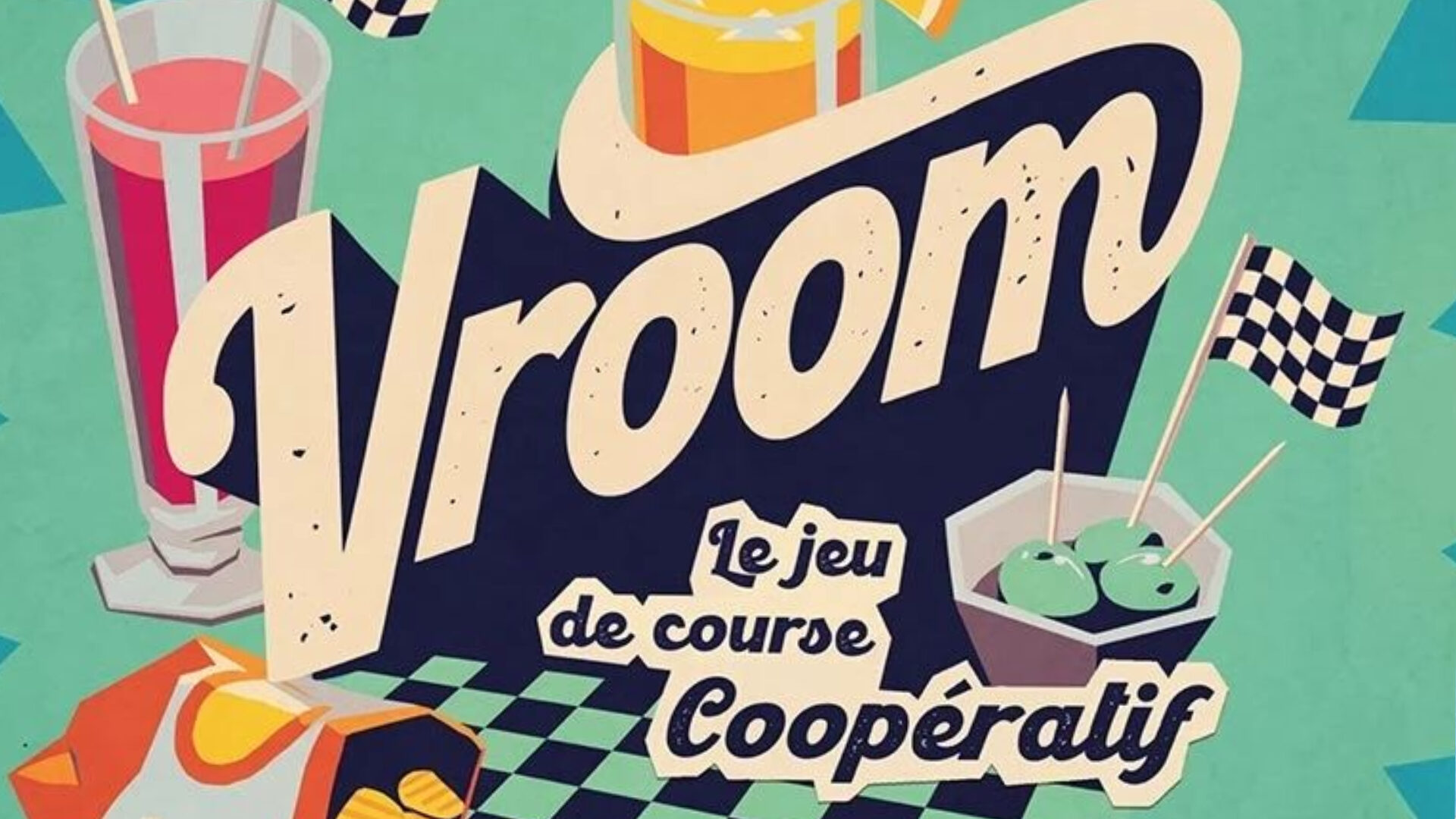
Vroom
The podium is a team effort
Score: 7.5/10
Images and videos
At a glance
We liked
- The cooperative finishing order makes every movement interesting to watch.
- Improvised circuits genuinely use the table and available objects.
- Five modules introduce new constraints and different gestures.
- Wooden cars and stickers give the components personality.
We liked less
- Little control over the result and no choice of drawn cards.
- Enjoyment depends heavily on the group and is less convincing with three.
- Repetition eventually reduces the surprise despite the variants.
- Uneven events and a finish line that can end the game abruptly.
 By Farrel Grimwood · published · 7 min read
Contents
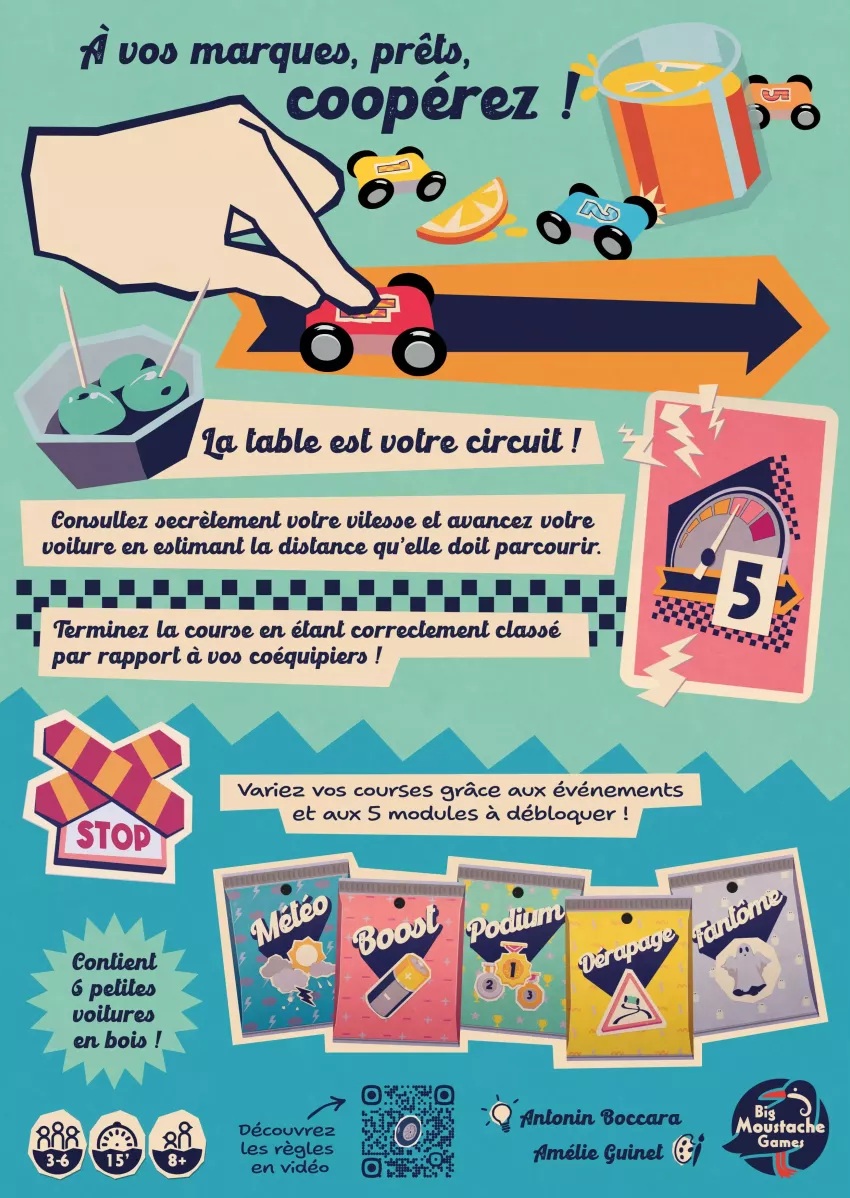
For once, overtaking everyone is not necessarily a good idea. In Vroom, a car that gets too far ahead can make the whole table lose. Drivers play together and must finish in a specific order, holding cards they keep to themselves. No board to count spaces, no die to solve the problem: each player pushes a little wooden car and hopes the others understand what that movement means.
Antonin Boccara returns to his taste for cooperative games with limited communication. Published by Big Moustache Games and illustrated by Amélie Guinet, Vroom accommodates three to six players aged eight and up. The box promises short races and several surprises to discover through victories. The premise is intriguing, especially when the living-room table is enough to make a circuit. But is there a real desire to return once the surprise wears off?
Numbers, but no spaces
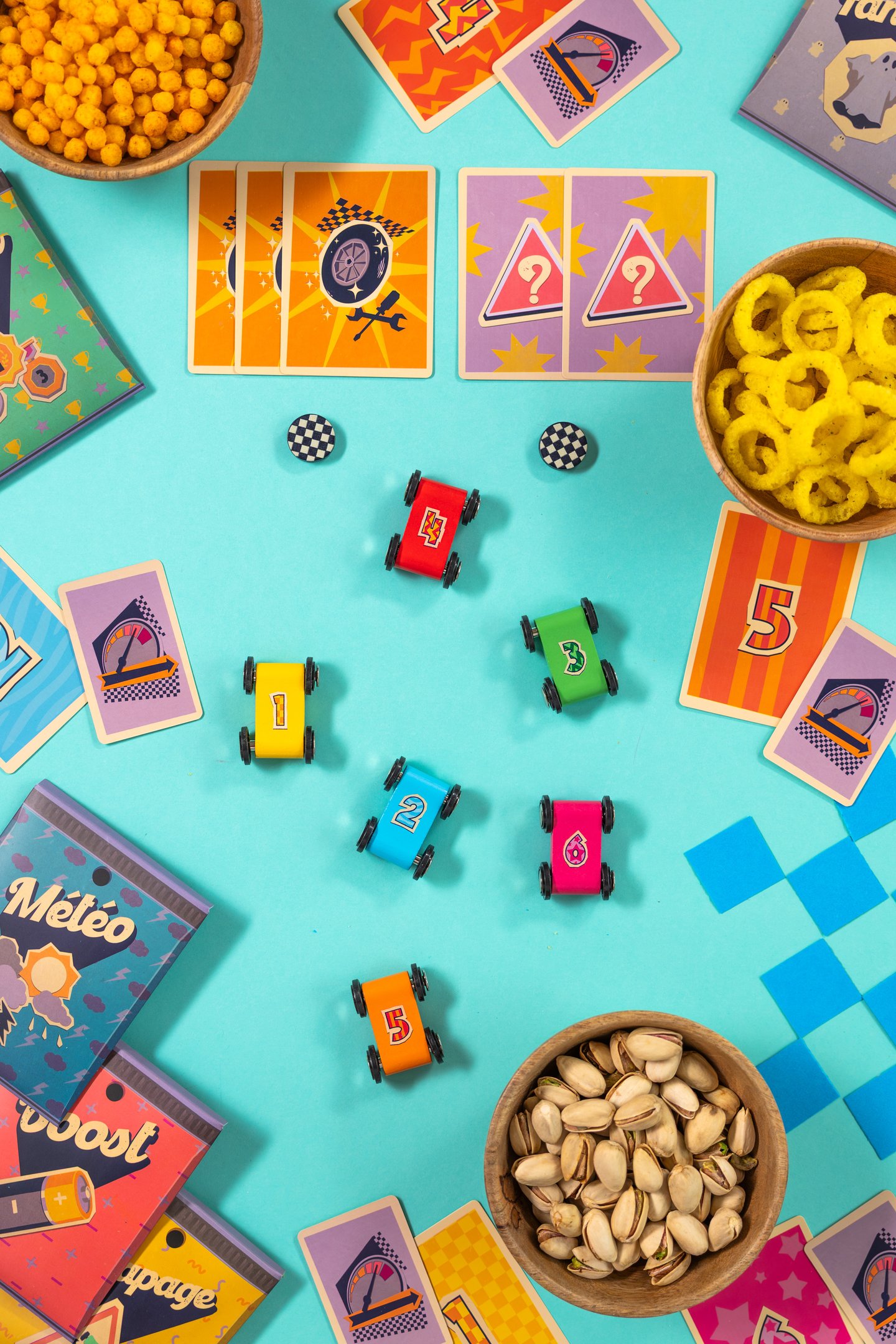
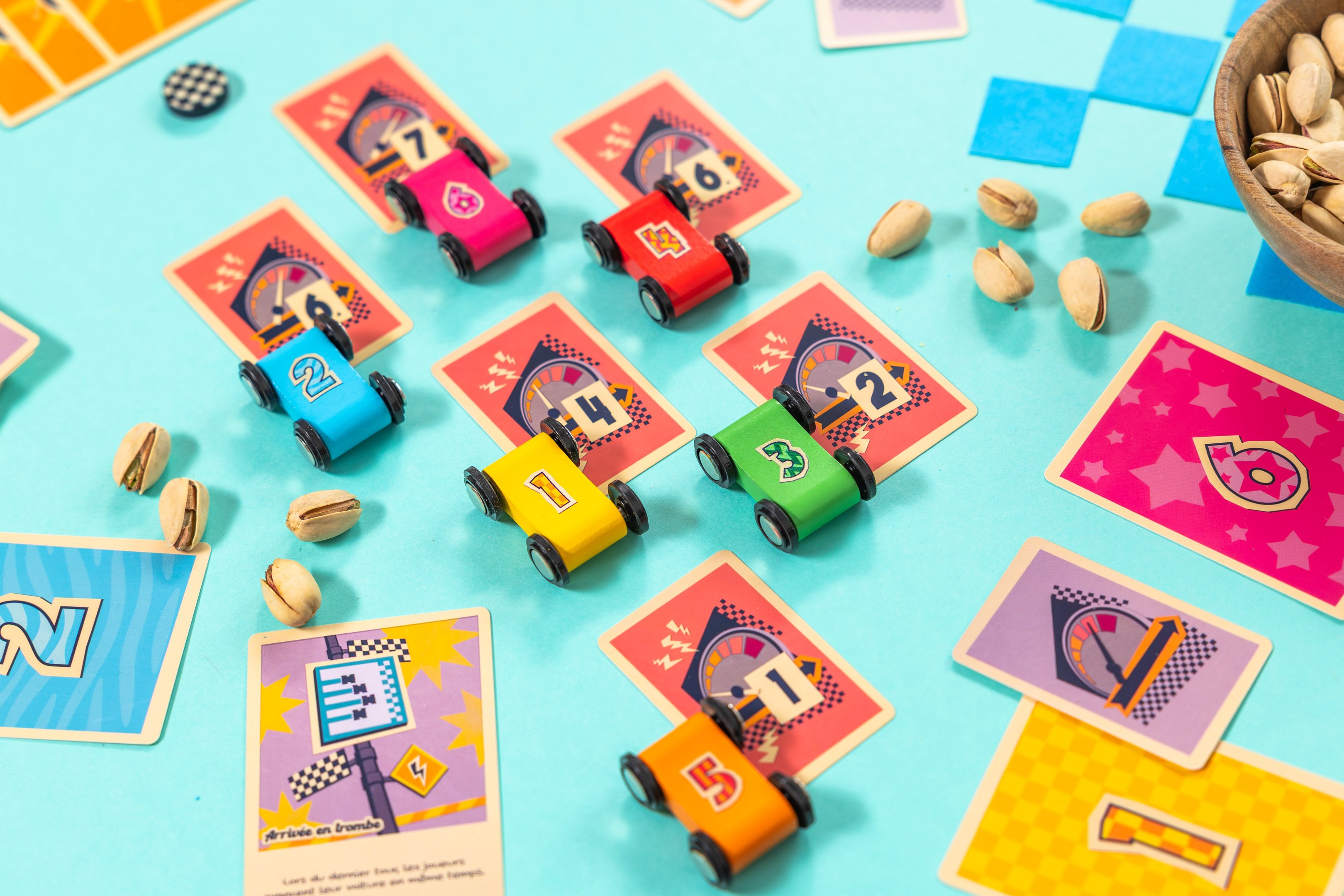
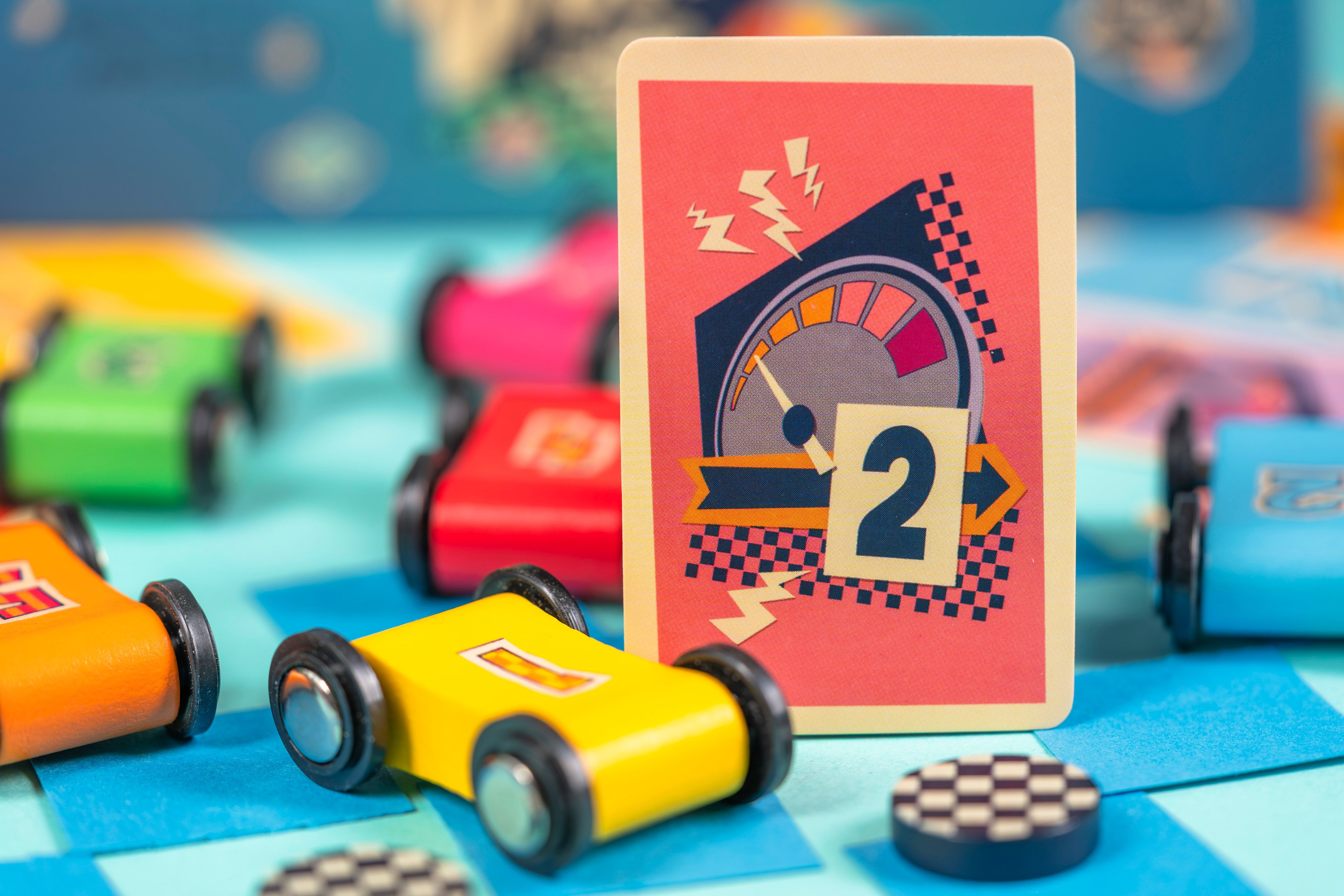
Two markers define the finish line, and the cars line up at the start. Each round, everyone draws a Speed card numbered from 1 to 7, then drivers move their cars in number order. A low value means a short movement, a high value a longer one. What “long” means, however, has to be worked out by watching the others. A 5, for example, does not correspond to any prescribed distance.
After five rounds, everyone adds up their five cards. The car with the highest total must be ahead of the one with the next highest total, and so on. Two equal totals can finish in either order. The aim is therefore not to beat a neighbour, but to understand whether that car should finish ahead or behind. Every overtake becomes suspicious when the numbers accumulated by the other driver are unknown.
The most amusing part is that the urge to overtake sometimes needs resisting. With a low total, staying last can be the best move for the whole table. Watching a neighbour becomes a matter of deciding whether to let them pass, a pleasant change from games mainly about blocking their way. The cars genuinely serve cooperative play rather than merely dressing up a series of additions.
The neighbour drives differently
One player only needs to move generously with an average value and the next to be cautious with a high card for the order to go wrong. Both still think they have done the right thing. That is the whole challenge of Vroom: agreeing on distances without being able to ask a neighbour what they drew. When a small movement seemed to signal a 2 but actually concealed a 5, the final reveal gives plenty to discuss.
The relationship with The Mind, where numbers must be played in order without revealing hands, is clear. Vroom adds something much easier to observe: the movement remains visible on the table. Gaps can be compared and overtakes watched. Earlier cards also need remembering, since they may no longer be checked after use. Doubt about a personal total is enough to make the final movement much less obvious.
Even an experienced player cannot take control for everyone, since other players’ cards remain unknown. That is welcome at a table with different gaming habits. There is still relatively little control over the result: correctly estimating a movement offers no protection against an overly generous partner. Good calculations are not enough, and losing without being able to identify a clearly bad decision has to be accepted.
The finish line is not always forgiving
Making tiny movements to avoid large gaps might seem tempting. The game prevents that with a fairly harsh constraint: no car may cross the finish before the fifth round, but at least one must have crossed after that final movement. Failing either requirement immediately loses the game. Cars therefore have to move properly, without going too early.
Mistakes in the finishing order receive more tolerance. Spare Tyre cards absorb them across a game’s three races. The minimum number of cars needed to restore the correct order is removed from the standings: removing one costs one tyre, removing several costs two. Losing the last tyre is not yet defeat; needing to spend another with none left is. That important detail gives the group one final chance.
Tyres allow mistakes, but only in certain respects. A completely wrong order can be survived, yet a few centimetres too far before the last round can cause instant defeat. The finish-line rule is brutal for such a light game. It forces a necessary risk, but can end a session before its funniest moment: revealing the totals. It is worth stressing before the start.
Build a circuit from whatever is lying around
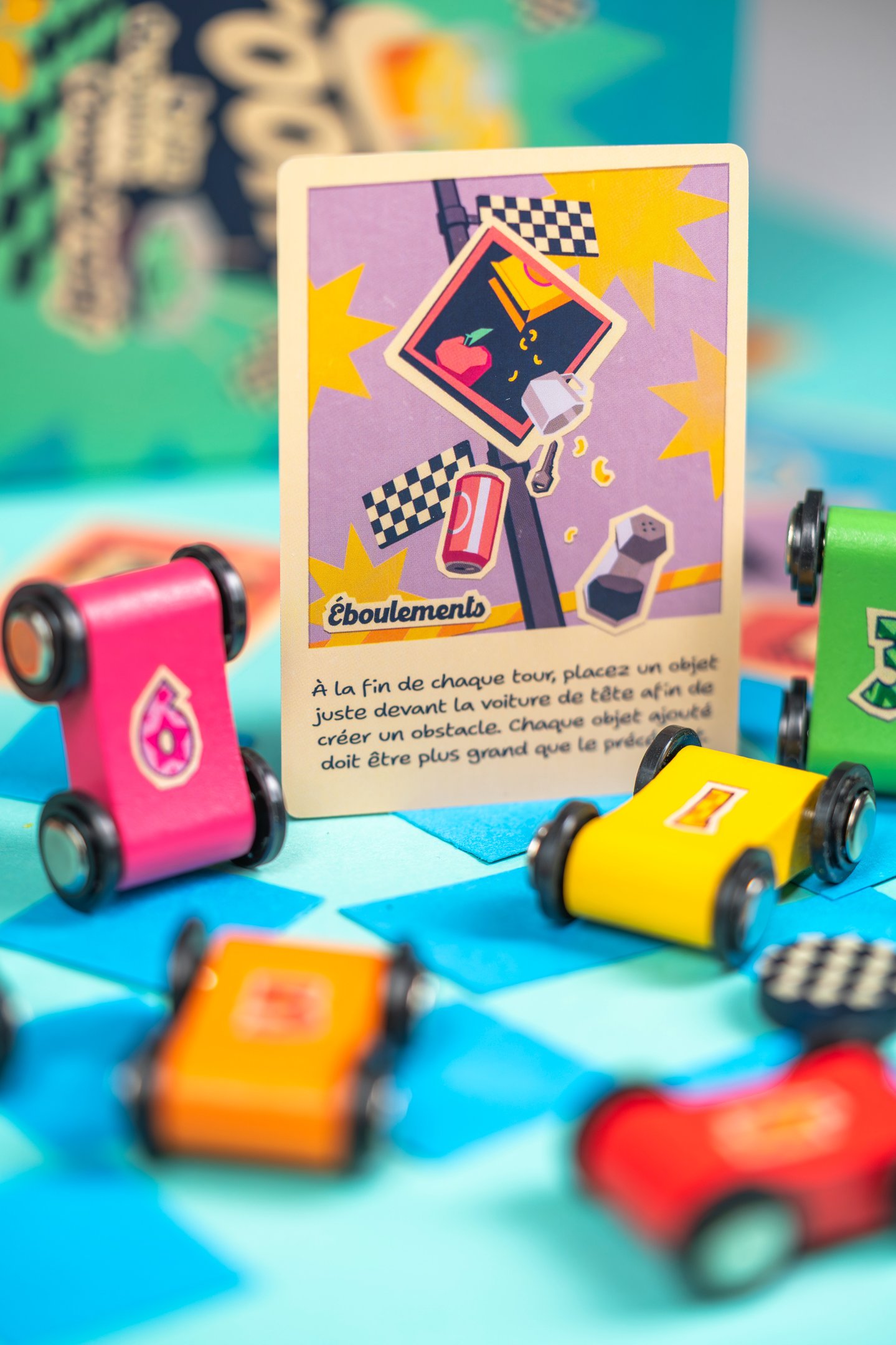
The second race adds one Event card, and the third combines two. The course then becomes more complicated through constraints that directly use the available space. The Out-and-Back event, for instance, requires going around an object before returning towards the start. Another turns the rulebook into a ramp. The simple straight line between two markers soon disappears.
With no printed circuit, a race can genuinely be changed with next to nothing. Going around an object differs from travelling straight, especially when trying to judge whether a neighbour covered a large distance or merely took a wide corner. The reference points from the first race no longer suffice. This improvisation is one of the box’s best ideas: the course genuinely changes, without assembling tiles or enduring a lengthy setup.
Not every event is equally enjoyable, however. A detour can make the standings more interesting to interpret; an extra manipulation can mainly interrupt the pace. Objects also need to stay put and leave enough room for hands. Playing without a board is convenient, but does not mean any cluttered corner of a table will be comfortable.
The box’s five envelopes open progressively after victories. Each contains a module with new rules, and gauges on the back allow a choice between thinking, interaction and more outlandish situations. Curiosity encourages opening the next one, but nothing requires keeping everything afterwards: a favourite variant can be revisited or several combined.
Some go well beyond a simple obstacle. Weather can require flicking, moving blind or blowing. Keeping the right order inevitably becomes a different matter when cars can no longer be pushed at will. These variants embrace the toy-car aspect and its slightly ridiculous gestures. Players need to want to perform them, but they offer better reasons to replay than a change of scenery.
There is a warning for the first print run, identified by number 001 above the barcode. A clarification is missing for the Boost module: its cards must be placed on the circuit at the start of every race. The original booklet also omits the instruction to reshuffle all Speed cards between races. Two avoidable omissions, especially for a box relying so heavily on ease of learning.
Funnier when the whole table joins in
With three players, the other two cars are fairly easy to track and less happens between personal movements. Vroom benefits from four, five or six drivers: gaps multiply, overtakes become harder to interpret and the standings contain more surprises. The game does not offer more actions, but provides many more reasons to watch the others. A first introduction is best with a few people around.
The stated age of eight suits a child able to remember a few numbers and accept losing together. Addition is not the main obstacle; understanding why staying behind someone can be necessary requires more attention. An adult can help with the totals, but cannot make the child’s movements for them. The cars and short rules make entry easier without guaranteeing success.
The whole table still needs to care about what is happening. Drawing, moving absent-mindedly and waiting for the next turn quickly reduces the race to a rather thin sequence of gestures. Modules cannot compensate for a lack of enthusiasm. The three races can also feel long to someone who does not engage on the first attempt, even if the stated fifteen minutes remain a reasonable format.
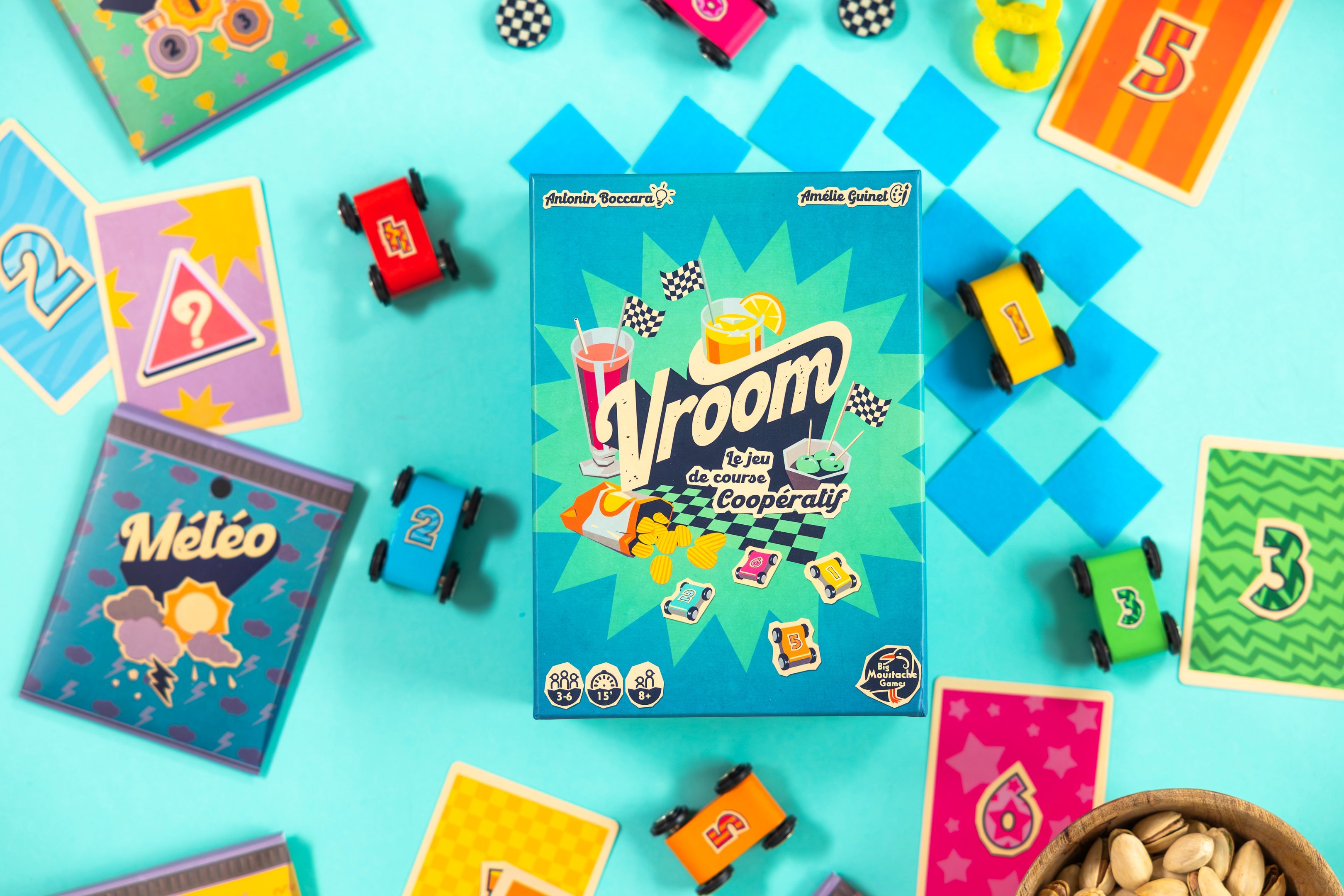
The six wooden cars are a good choice for a game involving constant handling. Two sticker sheets allow customisation, while Amélie Guinet’s colours and illustrations keep everything readable and welcoming. At around twenty euros, the contents are generous: 31 Speed cards, eight Events, car cards, spare tyres and five modules, in addition to the cars and finish markers.
Sticker-based trophy checklists accompany the discovery of modules and early victories. They are a pleasant extra, not a sufficient reason to keep playing repeatedly. Once the envelopes are open, Vroom mainly retains its appeal as a game to introduce to others or bring out occasionally. With the same players every time, surprise diminishes and turns can feel a little thin. The variants delay that point without removing the formula’s simplicity.
Verdict
A race that changes familiar habits
7.5/10
Vroom makes excellent use of little cars and objects lying around the table. The cooperative race requires watching what others do, then events and modules complicate the exercise just as reference points begin to form. With four or more players and partners ready to laugh at a failed finishing order, there is a very good time to be had. The box is generous for its price, and the variants offer more than a surprise on opening.
It still requires enjoying judgement-based play and accepting very simple actions. Some events are less interesting, the first printing’s rules need clarification, and the desire for repeated sessions eventually fades once the modules are familiar. Vroom is therefore a good choice for a break with family or friends, particularly when it can be introduced to new players.
Pros
- The cooperative finishing order makes every movement interesting to watch.
- Improvised circuits genuinely use the table and available objects.
- Five modules introduce new constraints and different gestures.
- Wooden cars and stickers give the components personality.
- A well-stocked box for around twenty euros.
Cons
- Little control over the result and no choice of drawn cards.
- Enjoyment depends heavily on the group and is less convincing with three.
- Repetition eventually reduces the surprise despite the variants.
- Uneven events and a finish line that can end the game abruptly.
- Two important clarifications missing from the first printing’s rules.
More in Tabletop
Full library 7.5/10
To me ! …or not to me ?
Bankiiiz Éditions 8/10
Wapigo
Totem 9/10
Courtisans
Catch Up Games 8.5/10
Cartaventura: Haiku
BLAM! 7.5/10
Jungle Twist
Kiwizou 8/10
Aurealis
La Boîte de Jeu 6.5/10
Trait Cool
 8.5/10
Maladum : Dungeons of Enveron
Battle Systems 8/10
Dungeons & Dragons – Forgotten Realms: Adventures in Faerûn
Wizards of the Coast 9/10