


Aurealis
Victory lies on the back of the cards
Score: 8/10
Images and videos
At a glance
We liked
- Card backs give a real reason to watch the opposing hand and the river.
- Renown tiles sustain tension until the start of the next turn.
- Several concrete routes to victory through digs, animals and temples.
- Short turns once the icons are understood.
We liked less
- Many pieces and tiles to move for a game advertised at thirty minutes.
- The first session takes time to learn symbols and colours.
- Renown tile exchanges can frustrate fans of stable progress.
- A small icon reference aid would have been welcome
 By Farrel Grimwood · published · 4 min read
Contents
Seven tiles are enough to win in Aurealis, provided they are still in front of their owner at the start of the turn. The opponent therefore has one final action to take back part of that lead. This small difference turns a collection race into a duel requiring attention to the other player’s plans right to the end.
Joachim Thôme revisits an idea already used in Les Tribus du Vent: card backs provide information. Here, the two sides lead an expedition into a jungle inhabited by fantastic animals and ancient remains. Alexandre Bonvalot’s illustrations dress a game intended for two people aged ten and up, with sessions of around thirty minutes. The rules sit within a fairly simple framework. The question is whether all those cards, tiles and little pieces genuinely serve the promised tension.
Three ways forward
Each turn offers one action. Playing an Adventurer card can, among other effects, gain gold, move archaeologists, place animals or provide new Jungle cards. Building a dig site requires filling the designated spaces on a Jungle card with archaeologists. The third possibility is discarding three cards from hand to use a base-camp power, such as receiving gold or moving several archaeologists.
These three options give the game a clear direction. Cards advance the expedition, while the dig site turns preparation into a discovery. The camp prevents a complete dead end when a hand cannot produce the desired move, but discarding three cards is a significant expense. Each action spent preparing also gives the opponent a turn to complete their own objectives.
Earned tiles take several forms. Excavating can yield a relic or temple. Filling a Jungle card’s animal spaces can grant access to a legendary animal. Those discoveries stay in front of their owner and bring them closer to the seven tiles needed for victory. Collecting three different temples also grants an immediate win, preventing attention from resting on a single total.
Card backs say a lot
Aurealis’s best idea comes from the Adventurer cards. Their effect depends on colours visible on the backs of cards in the player’s possession, the opponent’s cards and the shared supply. A card is therefore not chosen solely for the power printed on its face. The conditions have to be checked at the moment it is played. Some cards become more interesting when several of their conditions are met.
The system requires looking beyond a personal hand. A card can wait for the right set of colours, then lose some appeal when the other player refreshes theirs. The central river, from which cards are taken to replenish a hand, also changes future possibilities. Taking or playing a card can alter the intended next turn. The information stays visible, but learning to use it quickly is necessary to avoid falling behind.
The adventurers’ roles help explain the mechanism. Blue cards notably move archaeologists, green ones place animals and red ones obtain new Jungle cards. Yellow cards can yield gold. It then becomes possible to prepare a dig while watching the colours needed to play the right card afterwards. The interesting decision lies in that sequence more than in simply adding a piece to a space.
The downside becomes apparent while learning. Icons need recognising, card backs need interpreting and several areas of the table need checking before a choice. The action itself is short, but the reading beforehand requires attention. The stated age of ten is defensible for a child already familiar with effect-based card games; it does not guarantee an independent, flowing first session.
Renown changes sides
Renown tiles provide Aurealis’s best reversal. They reward a lead over the opponent in certain discoveries, but ownership can change. If the other side meets or exceeds the required level, it claims the tile. A player can therefore possess seven tiles at the end of a turn, then fall below that threshold before being entitled to win.
That rule gives a real reason to follow the opposing expedition. Taking a Renown tile increases one total while reducing the rival’s. Even a tie can trigger the transfer: a fairly modest action is sometimes enough to undo an apparently solid advantage.
The race is not entirely subject to these swings. Relics, legendary animals and temples are more stable acquisitions. Focusing only on Renown risks losing tiles; ignoring these moving objectives can let the opponent claim several at once. The duel’s appeal lies in that balance: building a lasting lead while remaining able to reclaim a success at the right moment.
The final round can nevertheless shake up the standings, and that needs accepting. Watching a tile change sides just before the victory check creates tension, but may frustrate anyone who prefers measuring permanently secured progress. Aurealis embraces that approach, rewarding attention to the other player as much as construction of a personal tableau.
Lots of little things on the table
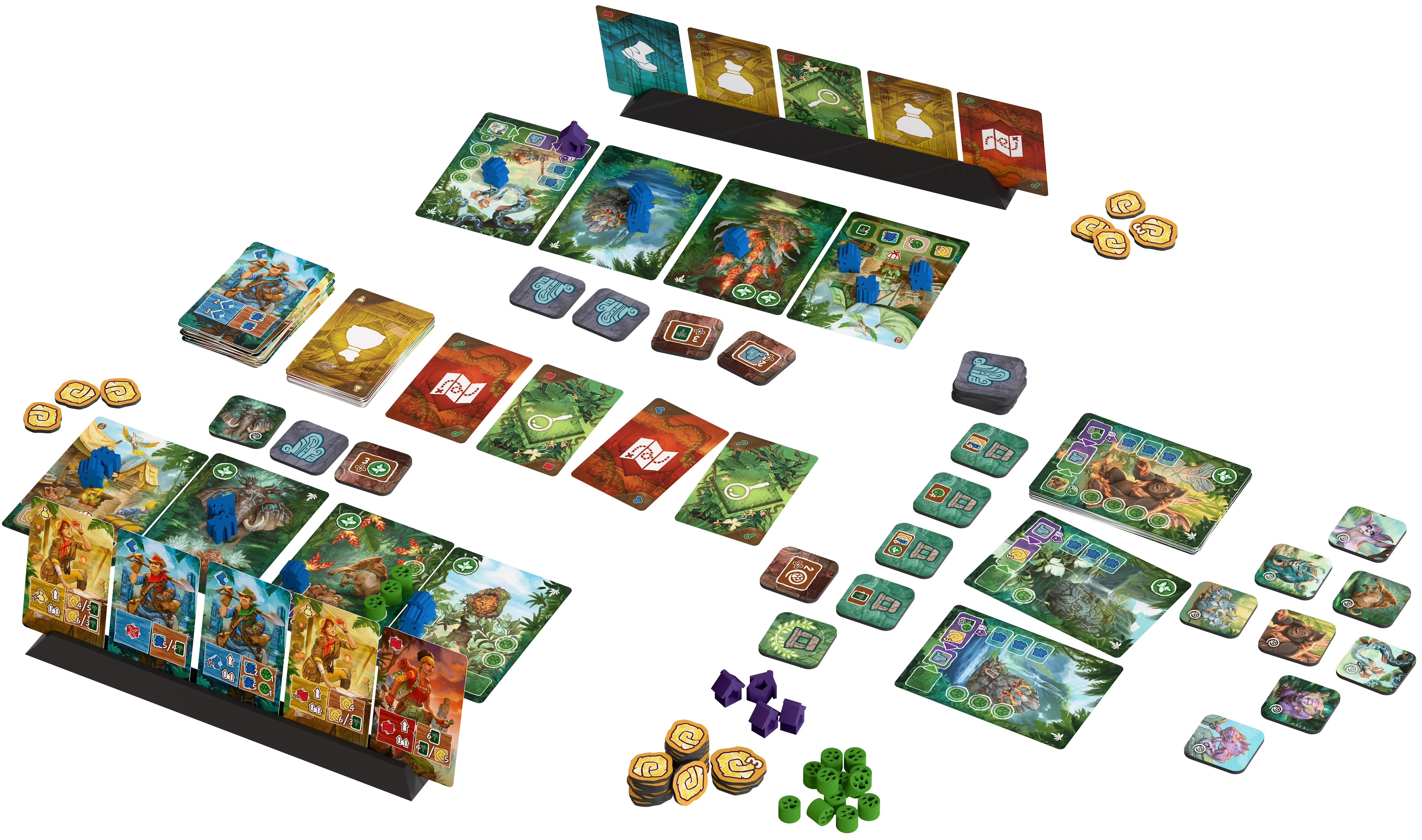
The two card holders make a component peculiarity useful: backs have to remain visible because their colours contribute to effects. Alongside them sit Jungle cards, tiles, gold and several categories of pieces. Alexandre Bonvalot makes the arrangement attractive, even if icons and colours often draw more attention during play than the exploration setting.
The box contains enough to vary the paths to seven tiles, but requires more handling than a small card duel. Archaeologists move, animals fill spaces, dig sites replace a preparation stage and Renown tiles pass between sides. No gesture is complicated. Their accumulation can nevertheless slow a game whose turn, on paper, amounts to a single action.
Verdict
Seven tiles are not always enough
8/10
Aurealis succeeds thanks to its card backs and Renown tiles. The former require reading the whole table before playing; the latter maintain real pressure until the victory check. Excavation and animal observation offer several ways to build a lead, with enough choices to avoid repeating the same expedition every time.
The many components to move and the icons require some patience at first. That density is less suitable for those seeking a minimalist thirty-minute head-to-head game. For two players willing to watch colours, objectives and opposing moves, the result remains a lively race in which no lead is entirely safe.
Pros
- Card backs give a real reason to watch the opposing hand and the river.
- Renown tiles sustain tension until the start of the next turn.
- Several concrete routes to victory through digs, animals and temples.
- Short turns once the icons are understood.
Cons
- Many pieces and tiles to move for a game advertised at thirty minutes.
- The first session takes time to learn symbols and colours.
- Renown tile exchanges can frustrate fans of stable progress.
- A small icon reference aid would have been welcome
More in Tabletop
Full library 7.5/10
To me ! …or not to me ?
Bankiiiz Éditions 8.5/10
Cartaventura: Haiku
BLAM! 7.5/10
Jungle Twist
Kiwizou 7.5/10
Vroom
Big Moustache Games 6.5/10
Trait Cool
 8/10
Wapigo
Totem 9/10
Courtisans
Catch Up Games 8.5/10
Maladum : Dungeons of Enveron
Battle Systems 8/10
Dungeons & Dragons – Forgotten Realms: Adventures in Faerûn
Wizards of the Coast 9/10