
Maladum : Dungeons of Enveron
A living dungeon that demands time and space
Score: 8.5/10
Images and videos


At a glance
We liked
- Three-dimensional scenery that genuinely affects movement, shooting and searching.
- An extraction structure that makes the return as important as the main goal.
- The Dread meter imposes constant pressure without setting an artificial duration.
- Event cards capable of producing unexpected and coherent situations.
We liked less
- Setup that can take from twenty minutes to almost an hour.
- Cases of line of sight and movement which sometimes require an agreement at the table.
- Lots of icons and rules to consult during the first Quests.
- A strong element of chance in appearances and certain fights.
 By Farrel Grimwood · published · 7 min read
Contents
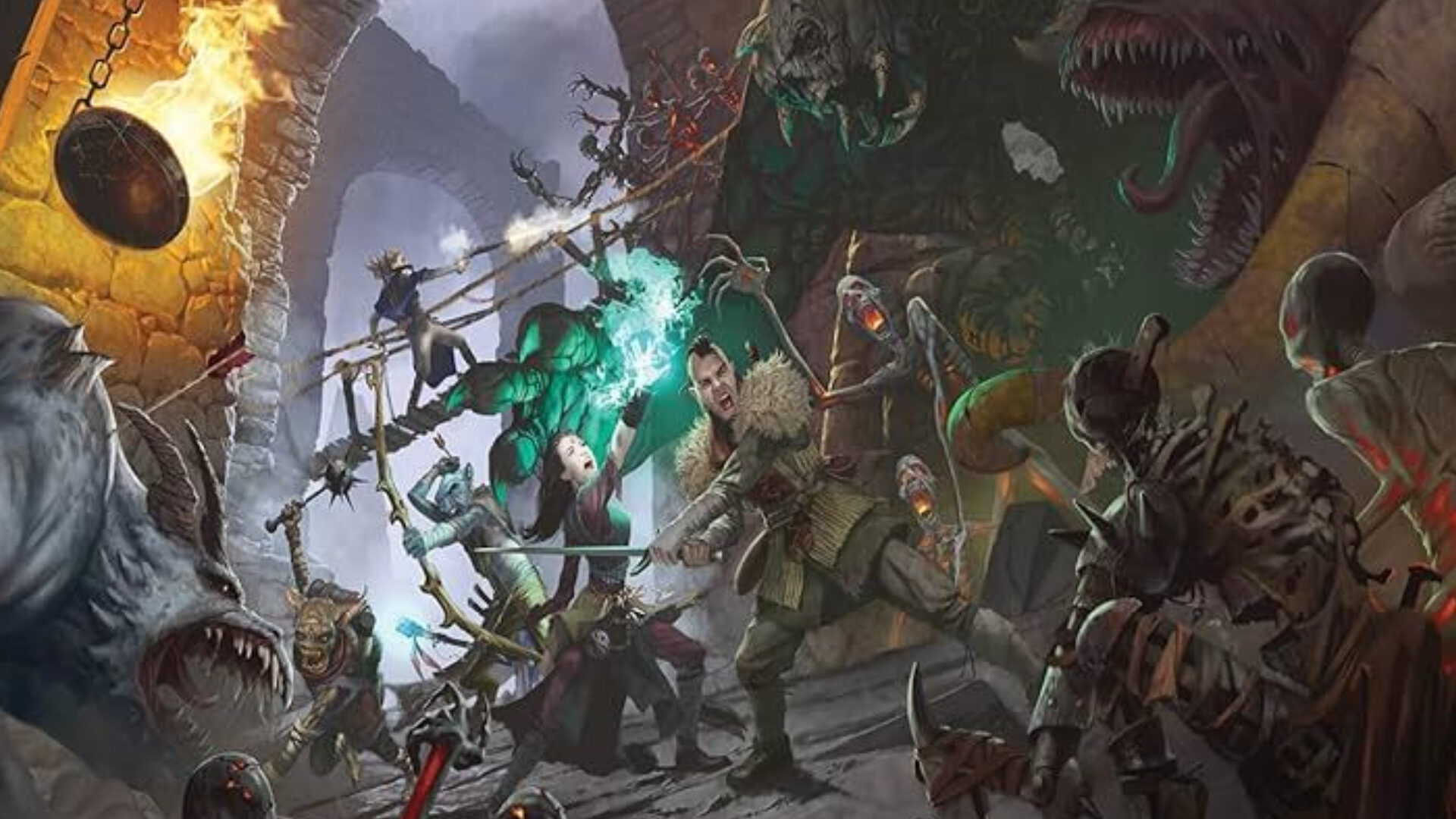
Battle Systems made itself known with Core Space and its printed cardboard sets capable of transforming a table into a space station. Maladum : Dungeons of Enveron uses the same basis for fantasy: a band of adventurers enters crypts, searches what they can, confronts the Revenants and above all must come out before the dungeon closes in on them. The principle evokes HeroQuest, but the game is much closer to a skirmish with extraction than to a series of rooms to clean.
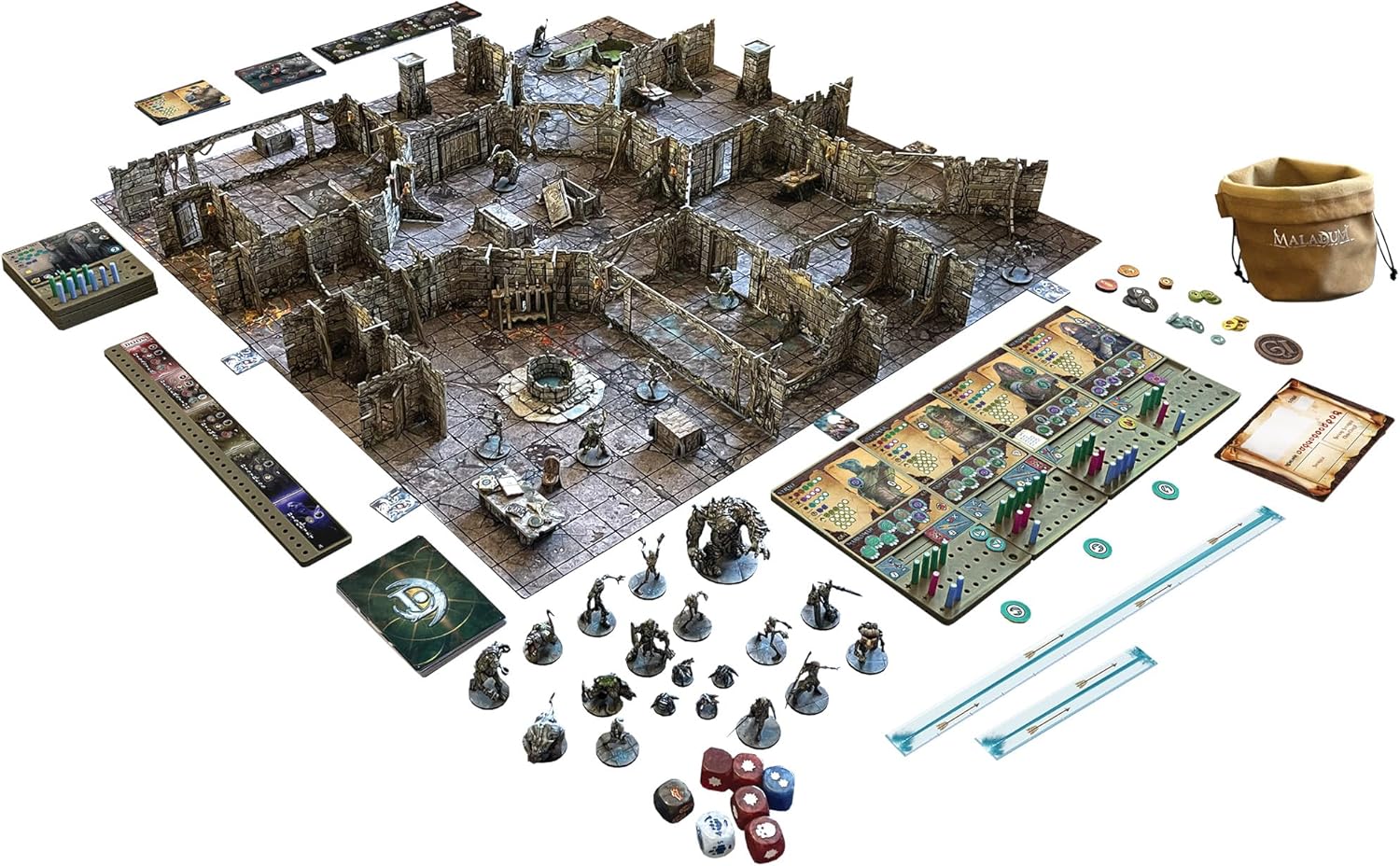
The French box brings together 28 figurines, a 60 x 60 cm carpet, walls, three-dimensional furniture, 169 equipment tokens and a branched campaign of more than twenty Quests. You have to set the scene, read 92 pages of rules and accept that a session advertised as taking two hours begins well before the first round.
Maladum wants to make every piece of furniture, every detour and every wasted minute a decision. Does this heaviness create a truly more lively dungeon, or does it end up stifling the game that it was supposed to make spectacular?
The dungeon actually comes out of the box
The first contact takes work. The Vaults of Enveron include forty walls, forty-four clips, and nearly ninety pieces of furniture or accessories. The dense cardboard is printed on both sides, the main walls snap together and the figures can be played with without painting. However, some small elements, including the chests, hold better with glue. The “no glue” formula therefore does not apply to every piece, at least if you want clean work.
Once the assembly is complete, doors change sightlines, tables cut off a path, a chair becomes an improvised weapon, and a barricade slows a chase. The chests actually hold the tokens found. Searching a grave means opening the item in front of you, with the possibility of discovering a weapon or a trap. Flat tiles rarely achieve this consistency.
The Quest map remains known from the start. The unknown comes from content, events, hidden rooms, and enemy entry points. This choice facilitates tactics, but reduces the gradual discovery of the location. It also requires the furniture to be precisely placed on the grid. An offset wall quickly creates a contentious half-square and requires an initial agreement between the players.
A Quest does not end when its main objective is fulfilled. The adventurers still have to return to the starting point. This rule seems modest, but it changes the whole game. A party can collect the requested artifact, lose a hero in the return corridor, and turn a clean victory into a catastrophic retreat. The path traveled there becomes a problem to be solved in reverse, often with more enemies and fewer resources.
Each hero has two actions, plus quick gestures. Moving, hitting, shooting, searching, pushing, persuading, interacting, getting up, casting a spell or resting cover very different situations without multiplying the mini-games. Two actions remain short enough to force a choice. Opening a chest sometimes means forgoing the move that would have put the group back behind a door.
The fight starts with a blue die, supplemented if necessary by less powerful red dice. Hits that go beyond armor deal damage, while critical hits and incidents activate weapon properties. Cover removes hits and attacks of opportunity punish a poorly prepared start. The core catches on quickly, but the equipment, states and icons add enough exceptions to force you to keep the reference aids close to the mat.
Dread turns every detour into debt
At the start of each turn, a black pawn joins the Dread meter. The first magic token spent by the adventurers during this same turn also fuels it. The counter goes through six levels, hardens Event cards and increases the frequency or power of Revenants. When it reaches its final level, the board flips and enemies improve their values. The game therefore does not wait for the table to decide to speed up.
The Event deck depends on the Quest and the group’s value. It can spawn a beast, move an entrance, open a hidden room, or activate enemies at the worst possible moment. A wandering creature can attack the Revenants, block a useful corridor and then become the main problem during the escape. These collisions produce the most memorable scenes. Dread finally makes loot dangerous. One more chest is never free: it costs an action, a detour and often a complete new turn. The pressure, however, remains linked to the dice.
Two unfortunate spawns can saturate an area much faster than expected, with little means to correct the streak. The system produces excellent tension, but it accepts that a good decision sometimes receives a very brutal response.
Maladum works without a GM. The Revenants search for a visible target, move in a pattern, then strike or shoot when conditions are right. They open doors, attack barricades and bypass obvious dangers. Roaming beasts and inhabitants follow their own priorities. Their interests can intersect with those of the group without automatically falling into one camp.
This autonomy makes soloing solid and avoids sacrificing a player to control the dungeon. It also creates a story that does not depend solely on the campaign text. A Revenant who breaks down a door, a stranger who grabs an object or an animal who blocks a corridor compose a situation that the scenario book had not written in advance.
The diagram doesn’t answer everything. Two targets at equal distance, a half-open door or a piece of furniture between two squares require a human decision. The rules invite you to choose the consistent option, generally the most unfavorable for adventurers. This freedom suits those accustomed to miniature games, less so for those who expect one definitive answer. In solo, four heroes and all enemies also make busy turns heavier.
Loot takes up space, literally
The 169 equipment tokens form one of the best ideas in the box. Weapons, armor, potions, food and precious items are drawn from a bag, then placed directly on the hero’s board. Their size represents their bulk. A large weapon takes up more space than a vial, and filling each slot becomes a small organizational problem. The weight of the loot therefore exists without adding a column of numbers.
Health, skill and magic tokens complete this physical tracking. A weapon can break, equipment can be repaired, sold or replaced, and rarities change the contents of the bag during the campaign. Searching remains interesting because the object is not an abstract bonus: it must enter the board, be used during the escape and survive until the camp.
Profusion produces its own friction. The shapes sometimes allow you to guess what you are touching, certain effects require you to find a precise reference in the bag and the icons often require the booklet. After a few good finds, a well-equipped group also looks at ordinary objects with less interest. Progression therefore gradually reduces the value of the excavation.
In Enveron, Maladum is ancient technology turned magic. At the table, casting a spell consumes blue tokens and requires a specific roll capable of canceling the effect, returning part of the reserve or causing an incident. Physical armor increases the cost, the target can spend its own energy to resist, and the first magical expenditure of the turn accelerates the Dread. A powerful spell therefore rarely solves one problem without opening another.
This instability sticks very well to the world and prevents the mage from repeating the same attack. It can also make a bow more reassuring than a costly spell, especially at the start of the campaign. Magic is most valuable when it saves a retreat, displaces a threat, or creates an otherwise impossible opening. Used as an ordinary attack, it sometimes seems too expensive compared to a more reliable physical solution.
The campaign continues after the failure
The box contains more than twenty Quests linked by several branches. Secondary objectives, choices and certain outcomes open up different routes. The written story remains light: a few paragraphs set up a mission, but Maladum does not seek to compete with a large narrative game based on hours of reading. Its story comes mainly from what happens on the mat and the consequences preserved between two descents.
After escaping come advancement, trading and rest. Survivors gain experience, rank up, learn skills, sell loot, repair items, and pay party upkeep. The hostel costs money, while a free bivouac exposes you to bad encounters. Gold never becomes a simple counter.
An abandoned hero can trigger a rescue mission on the same dungeon, with the Dread and the situation left in place. The group can also entrust him to a destiny table: return injured, loss of equipment, ransom or permanent death. Failure therefore does not erase the evening. It creates a debt, modifies the team and sometimes leads to immediately replaying a map already set up. This continuity constitutes the best argument for not reducing Maladum to a standalone session.
The fifteen Revenants cover several ranks, from the Lamentor to heavier creatures, with Myria and the Malagaunt to frame the threat. The six wandering beasts and inhabitants keep encounters from becoming entirely predictable. Despite these differences, the campaign often returns to the same dead silhouettes and the same families of behavior. The counter makes opponents more dangerous, but it does not transform their nature.
Expansions add new beasts, factions, campaigns, and more unique monsters. They directly correct this limit, but their price is added to a base already sold for almost 120 euros. The term “Starter Set” takes on its full meaning here: the box is sufficient for a long campaign, while quickly showing the locations planned to expand the range.
Verdict
The dungeon deserves its own table
8.5/10
Maladum : Dungeons of Enveron understands very well what makes a dungeon crawl interesting. The objective counts less than the return, the loot takes a physical place, the magic accelerates the threat and the events bring together Revenants, inhabitants and beasts without a rigid scenario. The campaign prolongs injuries, losses and finds instead of resetting the group. The decor impresses, but it convinces above all because it constantly intervenes in decisions.
The setup is long, the AI sometimes requires you to decide, the icons slow down the beginnings and the Revenants end up lacking variety. With a dedicated table and a group ready to follow the campaign, Maladum becomes one of the liveliest dungeon crawlers of the moment. For an occasional session, it risks remaining in pieces in its box.
Pros
- Three-dimensional scenery that genuinely affects movement, shooting and searching.
- An extraction structure that makes the return as important as the main goal.
- The Dread meter imposes constant pressure without setting an artificial duration.
- Event cards capable of producing unexpected and coherent situations.
- Physical loot and a limited inventory that give weight to each find.
- A branched campaign where failure, rescue and loss continue to exist.
- A complete single player mode thanks to clear AI and the absence of a game master.
Cons
- Setup that can take from twenty minutes to almost an hour.
- Cases of line of sight and movement which sometimes require an agreement at the table.
- Lots of icons and rules to consult during the first Quests.
- A strong element of chance in appearances and certain fights.
- Heavy solo rounds when one person manages four heroes and all enemies.
- A variety of Revenants that is too weak over the duration of the base box.
More in Tabletop
Full library 8.5/10
Cartaventura: Haiku
BLAM! 7.5/10
Jungle Twist
Kiwizou 7.5/10
Vroom
Big Moustache Games 8/10
Aurealis
La Boîte de Jeu 7.5/10
To me ! …or not to me ?
Bankiiiz Éditions 6.5/10
Trait Cool
 8/10
Wapigo
Totem 9/10
Courtisans
Catch Up Games 8/10
Dungeons & Dragons – Forgotten Realms: Adventures in Faerûn
Wizards of the Coast 9/10