
Trait Cool
Draw in the lines and guess without a word
Score: 6.5/10
Images and videos

At a glance
We liked
- An immediately understandable and truly inventive design constraint.
- Two phases which give interest to the rough sketches.
- Double-sided slates and two levels of words to renew the challenge.
- Generous content for a game playable up to eight.
We liked less
- The ban on discussion weakens collective deduction.
- Two words on the same slate make two- or three-player games less fluid.
- The necessary stopwatch is not provided.
- A structure that varies little once the surprise of the first drawing has passed.
 By Farrel Grimwood · published · 6 min read
Contents
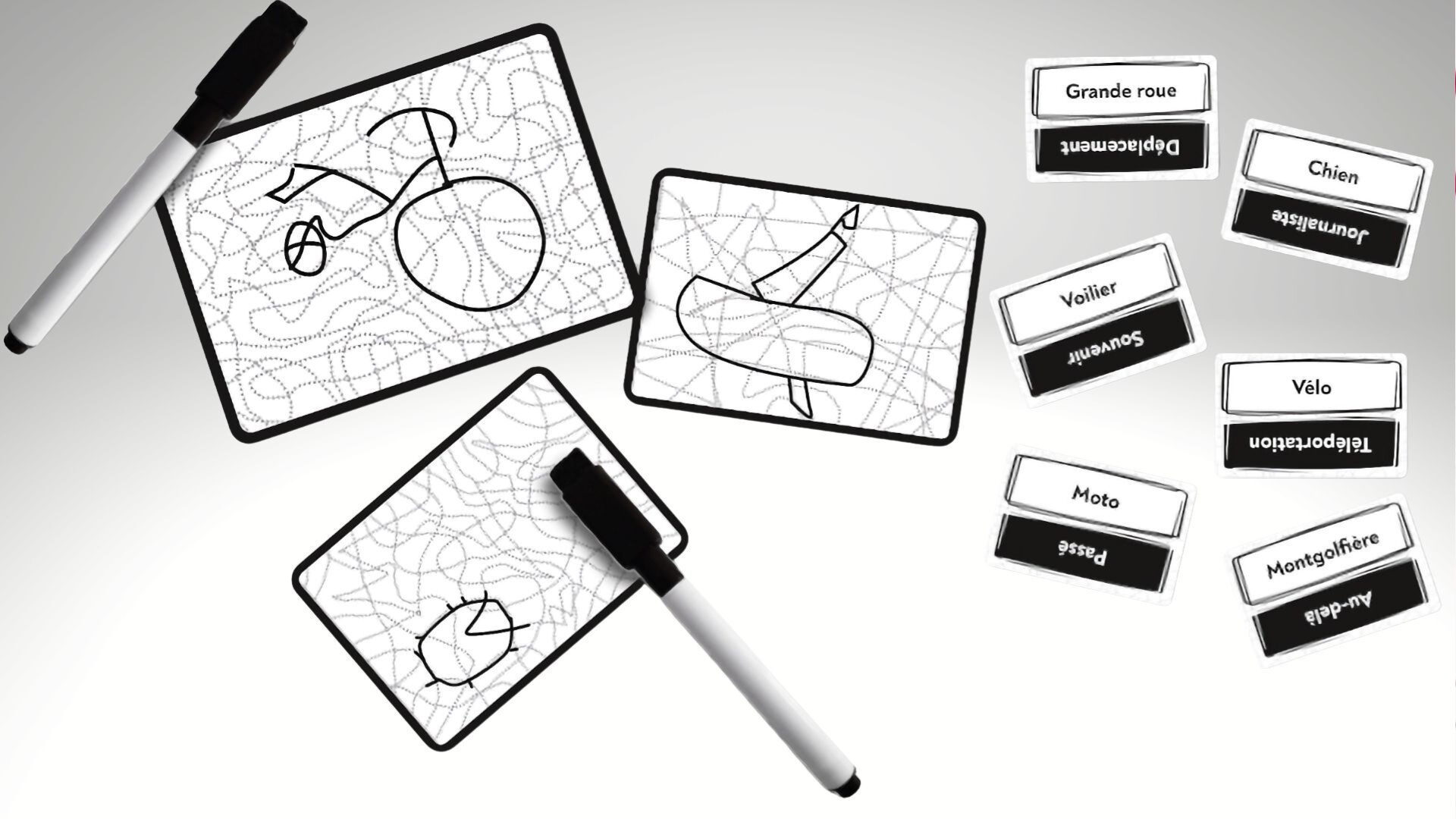
Drawing a bike becomes a funny business when the wheels, frame and handlebars all have to follow already printed curves. This is the principle of Trait Cool: everyone receives a secret word and tries to have it recognized on a slate covered with dotted lines. Two minutes later, the sketches are displayed and the group tries to find the right words among cards added to fool them.
The game arrives in France from Bankiiiz Éditions after a first German publication under the title Krakel Orakel. This original version was among the three nominated for the Spiel des Jahres 2025, without winning the prize. The distinction catches the eye, but it does not say how a game stands when the printed lines stubbornly refuse to form what we have in mind.
The constraint is simple enough to make you want to try and strong enough to produce unexpected sketches. It remains to be seen whether the search for a usable line and the elimination of false words is enough to last four rounds, or if the idea is especially amusing at the moment of discovery.
Two minutes to find a shape
Each card presents two suggestions: a word on a white background, more accessible, and another on a black background, more difficult. The group chooses a level before starting. Everyone then looks at their card in secret and draws at the same time. The marker should follow the dotted lines of the slate. It is allowed to stop in the middle of a line, lift the marker to create separate elements, erase and start again. However, letters and numbers are prohibited.
Once the time is up, each slate is oriented so that the others can read the drawing. We collect the used cards, add as many cards from the draw pile and mix everything before turning them over. In turn, each person eliminates a word that they believe is missing from the slates. No one can comment on the drawings or give any clues, even when their own word seems threatened. After a round of the table, the cards remaining visible are compared to the words actually drawn.
A retained intruder card counts as a penalty. The group wins if it reaches the end of four rounds; it loses immediately as soon as the number of penalties exceeds that of the players. The rules take just a few minutes and clearly separates the two tasks. First produce an understandable sign, then check what others thought they saw. The score structures the game, but the main thing is played out in the gap between an intention and the sketch that emerges from it.
Pre-existing lines change the way you approach a drawing game. He who draws well cannot calmly draw the outline he imagines. The person who draws poorly is no longer solely responsible for an approximate result. Everyone must look for a detail in the dotted network capable of making the word recognizable: two curves for wheels, a point for a beak, an angle for a roof. The slate forces you to choose the most telling clue instead of multiplying the details.
This choice makes the drawing phase more interesting than a simple reproduction exercise. The slates are double-sided and do not all have the same layout. You can change sides, turn the support and decide which end of the line is worth following. The game also allows you to detach several shapes from each other. This margin is enough to create different solutions based on a very strict rule. The imposed line is annoying, but it sometimes provides precisely the form that one would not have thought of alone.
Deduction has good ideas, but plays alone
Mixing the cards prevents the drawings from being judged in isolation. When faced with a poorly shaped bike, the presence of “motorcycle” among the possible words can sow useful doubt. It is no longer enough to vaguely recognize an object: you have to compare several sketches and decide which word is really missing. This inversion makes approximations interesting. A drawing can be mediocre and yet provide just enough clues to save your card.
The order of eliminations also matters. Discarding an obvious decoy leaves others with riskier choices; removing a word close to one’s own drawing early can avoid collective confusion. But this small part of calculation comes up against the ban on discussion. Everyone observes, decides and waits. Silence prevents an author from unintentionally revealing his or her words, which is perfectly understandable. It also takes away from the group the possibility of confronting its hypotheses, which is one of the expected pleasures of a cooperative game.
The most animated moment therefore often comes after the reveal, when players can finally explain what they had wanted to represent. It’s fun, sometimes downright funny, but the phase where the common decision is made remains less collective than the label on the box suggests. Those who like to debate to solve a problem together risk finding this deduction too silent and its stakes quite light.
The box advertises two to eight players, but the number changes the nature of the challenge. From four, each draws a word and eliminates an intruder card. The slates are multiplying, as are the interpretations. The game then benefits more from its party-game appeal: everyone produces something and the revelations concern an entire table.
In pairs or threes, each person receives two words to represent on the same slate. The deck supplies four decoy cards with two players and six with three, and each must eliminate two words during the deduction. This adaptation retains a real quantity of information to sort. It also calls for two graphic ideas in two minutes on a common medium, without signs to clearly separate the words. The setup works on paper, but it’s busier and less spontaneous than the standard group setup.
The age recommendation of 10 and up for the French edition seems consistent with this double requirement: find a symbol then resist false comparisons. Words on white backgrounds allow you to start without unnecessarily complicating the game. Words on black backgrounds then offer real difficulty, not just another pack of cards. They can also increase frustration when the slate and the stopwatch gang up on an idea that is already difficult to illustrate.
A generous box… except for one detail
Eight double-sided slates, eight markers and 240 cards: the box provides enough variety for words and to accommodate a large table. With two proposals per card, the reservoir is large. The slates also change hands between rounds, which avoids working on the same lines four times. For a price around €22.50 to €25 in stores, the quantity of material and the playing capacity remain convincing.
However, a timer is missing. The rule requires one to be provided for every two minutes of drawing, for example on a telephone. This is not a serious obstacle, but it slightly breaks the autonomy of a box which already contains eight pens and eight supports. Erasable markers also involve the usual maintenance of this type of game: correctly erasing the slates and replacing the markers when they stop drawing properly. Nothing prohibitive, simply material constraints that the number of cards does not make disappear.
The variety of words and lines protects Trait Cool from immediate repetition. Coming back to the same term with another slate can completely change the solution found. The two levels allow you to adjust the difficulty without adding a layer of rules. There is enough to chain several games together and let players master the search for visual clues.
The structure never moves: two minutes of drawing, elimination in turn, a revelation, then we start again. Four rounds give the game a reasonable length, but interest depends a lot on the enthusiasm of the group in front of the shaky drawings. The penalty system alone does not create a marked rise in tension. Trait Cool is better defended as a game to bring out for a receptive group than as a cooperative challenge to which one would return to perfect a strategy.
Verdict
The right line but not always the right exchange
6.5/10
Trait Cool has a solid initial idea and exploits it without complicating the rules. Looking for a drawing in already printed lines levels the playing field between confident and less confident artists, and the confrontation with the intruder words gives a second life to the most questionable sketches. The material and the two levels of words support this finding over time.
The cooperative heart, however, lacks exchanges at the decisive moment. The silence is justified by the secret words, but it reduces the interest of the deduction. With two or three people, drawing two subjects on a single slate also makes the game more laborious. In a group that likes to look for, show and then comment on their drawings, the game easily finds its place. It is less convincing as soon as we expect a real collective discussion or a more marked progression between rounds.
Pros
- An immediately understandable and truly inventive design constraint.
- Two phases which give interest to the rough sketches.
- Double-sided slates and two levels of words to renew the challenge.
- Generous content for a game playable up to eight.
Cons
- The ban on discussion weakens collective deduction.
- Two words on the same slate make two- or three-player games less fluid.
- The necessary stopwatch is not provided.
- A structure that varies little once the surprise of the first drawing has passed.
More in Tabletop
Full library 8.5/10
Cartaventura: Haiku
BLAM! 7.5/10
Jungle Twist
Kiwizou 7.5/10
Vroom
Big Moustache Games 8/10
Aurealis
La Boîte de Jeu 7.5/10
To me ! …or not to me ?
Bankiiiz Éditions 8/10
Wapigo
Totem 9/10
Courtisans
Catch Up Games 8.5/10
Maladum : Dungeons of Enveron
Battle Systems 8/10
Dungeons & Dragons – Forgotten Realms: Adventures in Faerûn
Wizards of the Coast 9/10