

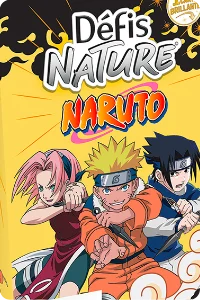
Défis Nature Naruto
The ninjas go into battle
Score: 7/10
Images and videos


At a glance
We liked
- Very simple rules to explain
- Quick and easy games to start
- The instantly appealing Naruto franchise
- Readable and practical cards to handle
We liked less
- Very repetitive mechanics
- Little real strategy
- The Naruto universe remains used on the surface
- No character effects
 By Farrel Grimwood · published · 6 min read
With Défis Nature Naruto, Bioviva moves its usual formula into rather unexpected territory. The collection, which we mainly associate with animals, dinosaurs, monuments or large thematic families, here welcomes the ninjas of Masashi Kishimoto in a quick, accessible little comparison-based card game, designed to be understood in a few minutes. The box contains a rulebook, 35 illustrated cards and a shiny Nine-Tails card, with games expected to last approximately 20 minutes.
The principle is simple: each player reveals a card, chooses a characteristic, then tries to win with the best value. Strength, Seals, Speed, Intelligence: Naruto here becomes a matter of numbers, bets and direct comparison. The one with the highest value wins the cards, until they gain the advantage on the table. Nothing complicated, then. We are in a modernised game of War, with a small layer of choice to prevent everything from relying solely on chance.
The idea is quite logical. Naruto works very well with this approach. Characters have techniques, specialties, power gaps, profiles that are easy to transform into statistics. The game can therefore immediately speak to children who already know the universe, while remaining simple enough for those who do not need to recognize each ninja to follow the game. The franchise draws players in rather than adding real gameplay depth.
The game does not seek to "retell" Naruto, nor to recreate its confrontations, nor to truly translate the combat strategy of the manga; it takes the characters, arranges them on cards, gives them values, then applies the Défis Nature mechanic. It’s effective, readable, easy to play, but obviously quite light. We’re not looking for a rich adaptation, but a quick, family-friendly card duel with well-known faces.
It remains to be seen whether this passage of Défis Nature in the Naruto universe brings enough pleasure to go beyond the simple licensed product, or if the ninjas of Konoha are content here to replace the animals without really evolving the formula.
Values to decide between ninjas
Défis Nature Naruto does not seek to adapt the combat strategy of the manga, it uses the well-known formula of the Bioviva collection: a card, several characteristics, a choice to make, then a comparison of values. Whoever has the best number wins the round, takes the others’ cards, and the game continues until one player collects the entire deck. It’s simple, immediate, and perfectly adapted to the announced age.
The game is therefore based on four criteria: Strength, Seals, Speed and Intelligence. Each turn, the active player looks at their card, chooses what they think is their character’s best strength, then forces others to measure themselves on that same characteristic. The little subtlety comes from the ninja rank, capable of turning certain situations around. This prevents the game from being just an automatic game of War where you turn over cards without ever thinking.
Naruto lends itself quite well to this format. The characters are already built around very readable power relationships: some shine through speed, others through intelligence, others through techniques or raw power. Transforming Kakashi, Hinata, Naruto or Nine-Tails into numerical profiles is therefore something natural. The game does not tell their clashes, but it uses this idea of permanent comparison between ninjas quite well.
But the limit comes from there too. Défis Nature Naruto remains a game of War with an extra layer, not a real tactical duel game. We choose a value, but we do not build a hand, we do not prepare a combo, we do not manage a resource or a strategy over several turns. The decision exists, but it remains short, almost instinctive. You have to identify the best statistic on your card, estimate whether it might be enough, then accept that the chance of the deck does the rest.
This works great with kids or in a quick game. The rules are explained in a minute, the rounds follow one another, and the franchise immediately makes you want to look at the cards, compare the characters, check who has the best value. The game never blocks the table. We deal, we play, we go again. In this family setting, simplicity is a real quality.
Between adults, or even with players accustomed to more structured card games, Défis Nature Naruto quickly shows its limits. Choices are repeated, reversals remain rare, and the game can give the impression of following the deck more than the decisions of the players. The pleasure comes mainly from the franchise and the immediate format, much less from the mechanical depth.
The content remains in this compact logic. Thirty-five illustrated cards, a shiny Kyûbi card, a rulebookr, a small easy-to-carry box. It’s a game you bring out quickly, with little setup required. This lightness corresponds perfectly to the Défis Nature collection, but it also prevents Naruto from gaining much momentum. We could have imagined effects specific to the characters, special techniques, teams, something that gives more flavor to the universe. Here, everything mainly comes down to statistics.
Défis Nature Naruto is therefore effective because it does not betray its promise. It turns ninjas into dueling cards, makes the comparison fun, and gives younger children a simple object to play with the Naruto universe without having to learn a real complex card game. Speed becomes a number, techniques become values, and fights are resolved in seconds. It’s practical, accessible, sometimes pleasant without being surprising.
Konoha in a small box
Visually, Défis Nature Naruto first does what is expected of it: put the franchise at the center. The cards make you want to be looked at, recognized, compared. For a young audience already attached to manga or anime, this is probably the main thing. The fun begins even before the round, in the simple fact of coming across Naruto, Kakashi, Sakura, Hinata, Sasuke or Kyûbi, then checking their values as if you were holding a small ninja card in your hands.
The box follows the usual logic of Défis Nature. It’s compact, easy to transport, immediately identifiable, with a format that doesn’t seek to impress with the quantity of material. Thirty-five cards, a rulebook, a shiny Kyûbi card: the game remains modest, but it assumes this ready-to-play aspect. We don’t set up an entire table, we open, we deal, we play. This is precisely what this type of product should allow.
The illustrations do the job, even if the object remains very limited by its format. The characters must be readable, the statistics visible, the colors clear enough for a child to quickly understand what they have in hand. The game is not looking for a new artistic direction around Naruto, it takes the imagery of the franchise to integrate it into the Défis Nature grid. It’s clean and clear.
The ergonomics are quite correct. The four characteristics are easy to read, the values stand out well, and the grade adds a little extra information without cluttering the card. This is important, because the game relies on quick comparison. If you have to search for a value for too long, the game loses all its rhythm. Here, the layout remains straightforward enough so that the turns follow one another without friction.
This clarity, however, has its downside: the cards are very similar in their construction. The symbols, techniques or teams could have given more depth to the whole.
However, the format remains effective. Bioviva applies its recipe, Naruto brings its faces, and the object naturally finds its audience. The shiny Nine-Tails card adds a little collecting pleasure, especially for children. We are in a clean, readable product, pleasant to handle, not in a card game that seeks to impress with its material.
Défis Nature Naruto therefore succeeds in its packaging because it understands its function. It must be clear, portable, recognizable and strong enough to pass from hand to hand. On this point, it keeps its promise. Konoha fits well in the box, but in a too small version which would have deserved more generosity.
Verdict
Ninjas who play small
7/10
Défis Nature Naruto works because it knows exactly who it's for. The rules are simple, the games are quick, the cards are readable, and the franchise immediately makes you want to compare the characters. For a young audience, or for a family game without lengthy setup, the game does its job correctly. It turns Naruto into an accessible stat duel, with just enough choices to not be a purely automatic game of War.
Pros
- Very simple rules to explain
- Quick and easy games to start
- The instantly appealing Naruto franchise
- Readable and practical cards to handle
- A family format suitable for young people
Cons
- Very repetitive mechanics
- Little real strategy
- The Naruto universe remains used on the surface
- No character effects
- Limited interest for more demanding players
More in Tabletop
Full library 8/10
Wapigo
Totem 8.5/10
Cartaventura: Haiku
BLAM! 7.5/10
Jungle Twist
Kiwizou 7.5/10
Vroom
Big Moustache Games 8/10
Aurealis
La Boîte de Jeu 7.5/10
To me ! …or not to me ?
Bankiiiz Éditions 6.5/10
Trait Cool
 9/10
Courtisans
Catch Up Games 8.5/10
Maladum : Dungeons of Enveron
Battle Systems 8/10