
Dans l’ombre de Frankenstein
Shadow without light
Score: 5.5/10
Contents
Designed as an immersive investigation experience, Dans l’ombre de Frankenstein stands out as one of the most ambitious narrative boxes in the Larousse Jeux collection. Scheduled for October 13, 2025, it revisits the myth of Mary Shelley through a series of enigmas where logic confronts monstrosity. This investigation game, designed to be played without a game master, combines the spirit of deduction, gothic atmosphere and psychological tension in a format accessible to all fans of mystery and storytelling.
The box set includes everything needed to recreate the tragedy of the creature and its creator: character cards, secret identities, fragmented clues and intersecting stories. Each game becomes an exploration of the limits of scientific morality and the power of knowledge.
Between investigation, theater and introspection, Dans l’ombre de Frankenstein invites players to redefine the boundary between human and monster. Because in this laboratory where everything seems driven by ambition and fear, only one question persists: how far can we create without becoming the creature ourselves?
The masks of reason and fear
Dans l’ombre de Frankenstein presents itself as a cooperative and narrative investigation game built around a simple principle: discover the truth by playing a role. The box set contains everything you need to play legendary protagonists. Six character cards allow you to choose your identity and adopt your specific skills. Four verification cards ensure that games run smoothly without a game master, while six Occult Soul cards introduce a dimension of secrecy and suspicion.
Each player participates in one of the four adventures included in the box set. The Horror Laboratory, The Vestiges of Madness, The Creature from the Castle and The Monster on the Trail make up a complete journey. These scenarios follow one another like the chapters of a multiple-choice story, where each clue discovered and each decision modifies the reading of the events.
The whole thing is based on forty puzzle cards. Some require deducing, others observing or connecting narrative elements. The “revelation” cards provide additional clues, while the Vengeance board reinforces the tension between players by inflicting penalties when a choice leads to failure. The experience is therefore not based solely on logical resolution, but on the ability to understand the hidden intentions behind each action.
The rulebook accompanies these mechanics with an introduction, set-up tips, solutions and a conclusion which brings together the threads of each plot. The objective remains the same: to solve the mysteries linked to Doctor Frankenstein and his creature while exploring the limits of scientific reason. Dans l’ombre de Frankenstein features curiosity, fear and fascination, in a clear game structure, entirely based on storytelling and cooperation.
The mechanics of shadow and logic
The operation of Dans l’ombre de Frankenstein is based on methodical construction. The game combines the spirit of investigation and the tension of a theatrical clue hunt. Each player embodies a role with specific skills, and these skills guide collective progression. Success depends on the group’s ability to cross-reference information and interpret the cards accurately.
The game system is based on a balance between collaboration and intuition. The forty puzzle cards introduce varied situations, ranging from logical deduction to the reconstruction of events. No two games play out the same way. Verification and revelation cards allow the group’s choices to be verified without resorting to a game master. This principle makes the narration fluid and maintains a constant tension between discovery and uncertainty.
The four adventures included in the box set form a progressive structure. Each scenario explores a different facet of the universe: the secret of experiments, traces of the past, the confrontation with the creature and the final escape. This division gives the game a real narrative rhythm. Immersion sets in naturally, supported by writing work that favors coherence and precision.
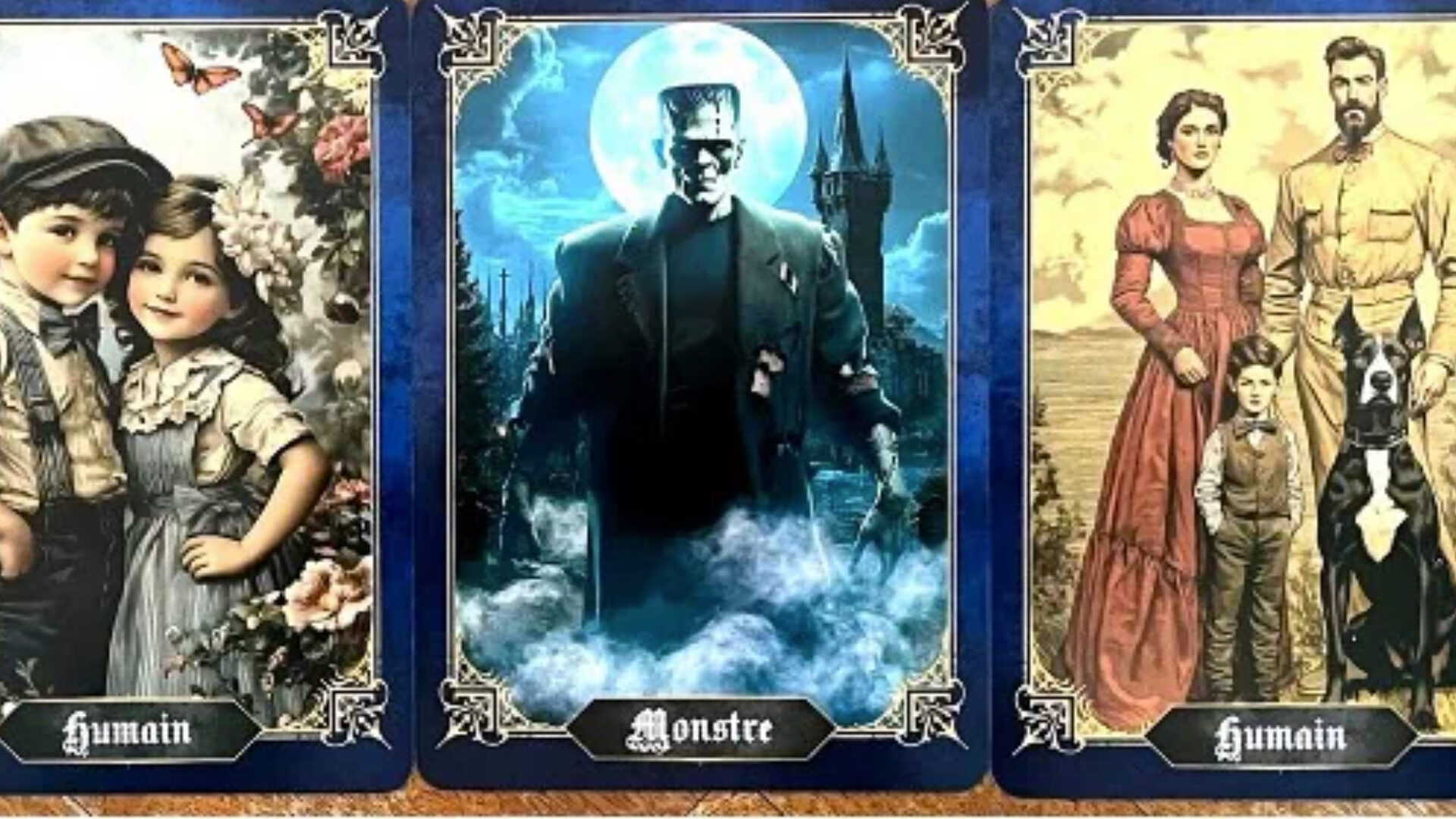
The mechanics of the Occult Soul cards add a psychological dimension to the whole thing. Each player receives a hidden identity, human or monstrous, influencing their decisions and their relationship with others. This tension between distrust and cooperation nourishes the group dynamic and renews the replayability of the box set.
The Vengeance board, which punishes collective errors, reinforces the dramatic stakes. Failure is never an end, but a revelation. It changes the perception of clues and encourages replaying to reach the complete truth. In its structure, Dans l’ombre de Frankenstein favors rigor over complexity. The pleasure comes from the clarity of the rules, the accuracy of the situations and the satisfaction of controlled logic.
The aesthetics of fear and the clarity of mystery
Visually, Dans l’ombre de Frankenstein displays attractive ambitions, but the result remains uneven. The box takes on the codes of Victorian Gothic with its golden frames, dark textures and its old laboratory atmosphere. The intention is clear: to immerse the player in the world of forbidden science, between elegance and anxiety. However, the execution betrays a certain heterogeneity.
The illustrations of the cards seem to come from several sources, sometimes from image banks or visual generators. Some succeed in evoking the spirit of the 19th century, while others suffer from perceptible imperfections: uncertain proportions, inconsistent details, faces with frozen expressions. This disparity prevents the whole from giving off a truly coherent identity, even if the general style remains readable.
The booklet, more sober, brings a welcome touch of clarity. The layout, structured and airy, makes it easier to read the rules and organize the puzzles. The iconography is reduced to the essentials, which reinforces readability and refocuses attention on the text. In this context, sobriety becomes a strength: the game manages to maintain its atmosphere without ever hindering understanding.
Verdict
Shadow without light
5.5/10
Dans l’ombre de Frankenstein displays good intentions, but struggles to give them real substance. The box set offers a narrative framework inspired by the classic myth, but the writing and characters lack life. The situations are interchangeable and the rare attempts at emotion are lost in a mechanical writing which sometimes recalls automatic production.
The puzzles, correct in their construction, lack cohesion and impact. Each scenario gives the impression of an exercise without any real dramatic progression. Intellectual pleasure exists, but without tension, without breath.
The game remains interesting, but the setting, the characters and the narration seem to come from an assembly more than from a vision. Dans l’ombre de Frankenstein had everything to become a tribute to creative genius; it settles for a succession of puzzles without flesh.
More in Tabletop
Full library 8.5/10
Cartaventura: Haiku
BLAM! 7.5/10
Jungle Twist
Kiwizou 7.5/10
Vroom
Big Moustache Games 8/10
Aurealis
La Boîte de Jeu 7.5/10
To me ! …or not to me ?
Bankiiiz Éditions 6.5/10
Trait Cool
 8/10
Wapigo
Totem 9/10
Courtisans
Catch Up Games 8.5/10
Maladum : Dungeons of Enveron
Battle Systems 8/10