


Causal Loop
Double yourself, lose your bearings
Score: 7/10
Images and videos



At a glance
We liked
- A truly central temporal echo mechanic
- Very satisfying puzzles when everything lines up
- A progression which densifies the concept well
- Strong visuals and technical presentation
We liked less
- Writing less refined than its gameplay
- Platform passages that sometimes break the rhythm
- Some overly procedural puzzles
- A pretty universe, but not always memorable
 By Farrel Grimwood · published · 4 min read
Contents
Causal Loop belongs to this family of games which are first and foremost based on an original idea, a mechanic which really forces you to think differently. Bale, an exo-archaeologist sent to Tor Ulsat with his colleague Jen, activates the Chronolith, loses control of the mission, and finds himself stuck in a reality that no longer knows very well in what order it should exist.
Mirebound Interactive’s game does not try to hide its influences. We quickly think of Portal, of The Talos Principle, of those science fiction puzzle games where space is above all a sentence to be reordered. If Causal Loop does not have the writing genius of the biggest names it sometimes evokes despite itself, it does have a proposition clear enough to exist alongside them: record your own actions, replay them, then cooperate with echoes of yourself to cross rooms thought of as small problems of causality.
It’s a game of patience, rhythm and anticipation. A game where you learn less to find the way out than to organize several versions of yourself so that they finally stop getting in each other’s way. When everything lines up, Causal Loop produces some pretty intense satisfaction. When it is content to multiply the buttons or force the precision of a jump, it becomes more banal, sometimes even annoying. The whole game lies in this gap.
An idea that really works
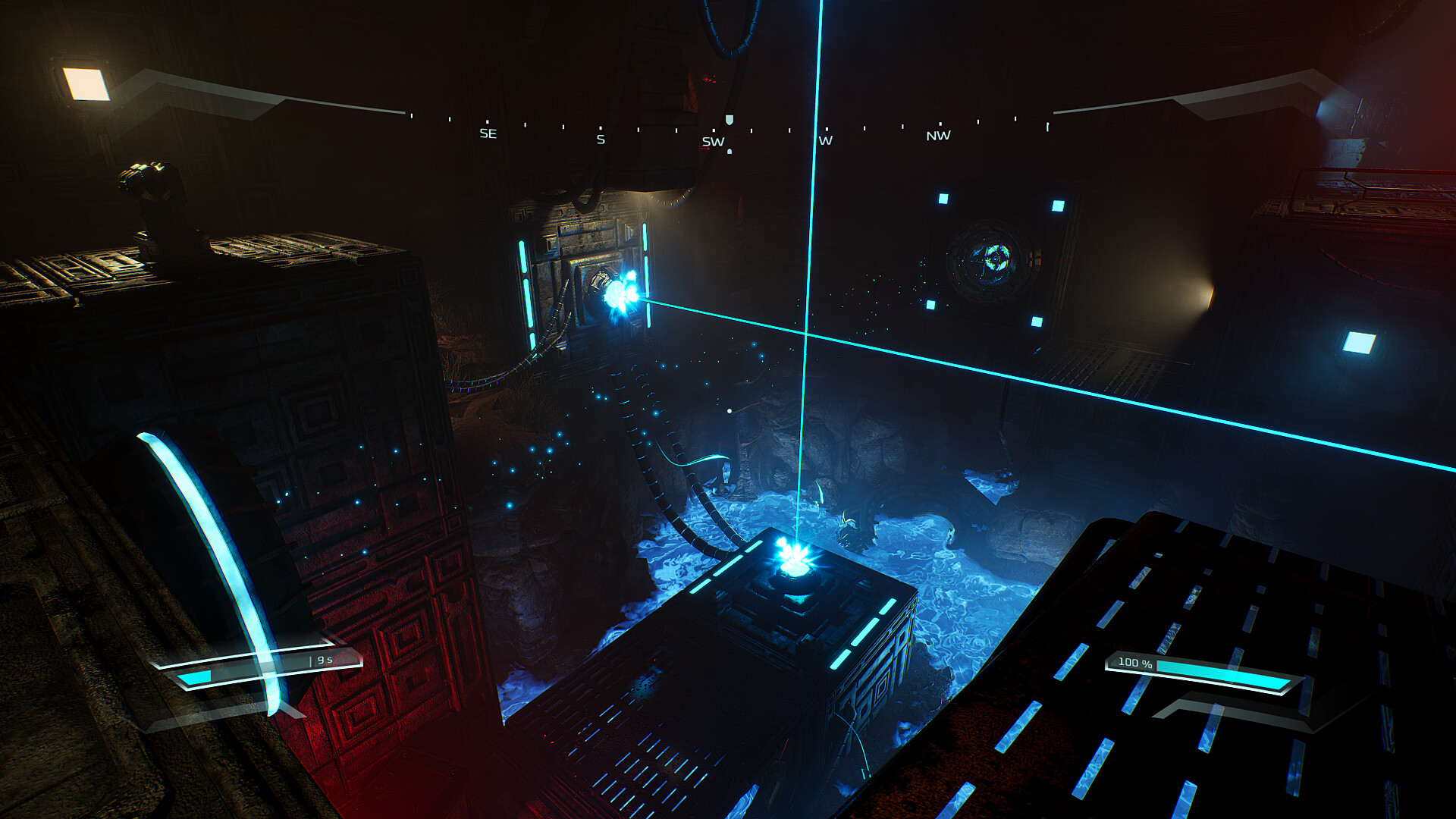
Echo Branching is what Causal Loop is all about. Recording a sequence, letting it replay, then acting alongside it immediately changes the way you look at a puzzle. A switch is no longer just a switch, it’s a date with a past version of Bale. A door is no longer just an obstacle. This is a consequence that must be prepared for a few seconds before crossing it.
The mechanic is quick to learn, simple to understand and flexible enough to grow more complex. The game gradually introduces multiple echoes, timed keys, teleportations, barriers, platforms, trajectories that must be set at the right time. The best riddles give that rare pleasure of a solution that resembles choreography. A double maintains the passage, another presses a button which opens a door, the player crosses exactly at the expected time. Nothing explodes. Nothing screams. But everything falls into place with rare timing.
This strength gives the game its foundation. Causal Loop is not a spectacular game in the classic sense. Its reward is more discreet: the feeling of having understood a logic which at first seemed impossible. It rewards planning rather than reflexes. It’s less immediate, more cerebral, and often much more satisfying.
A readable planet
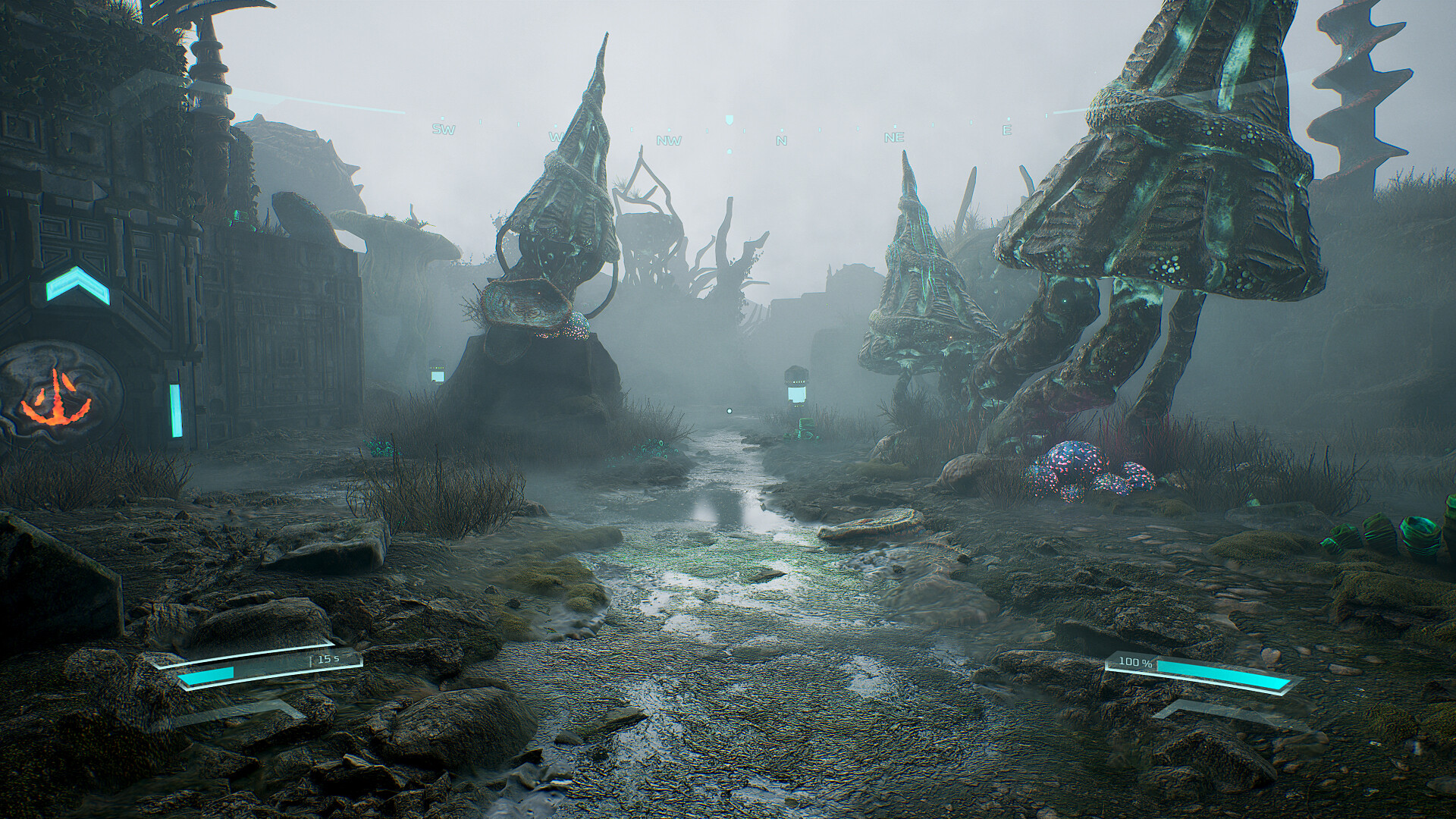
Tor Ulsat works well as a playground. Its ruins, ancient systems, glowing corridors and alien architecture give the title its own identity. The planet is not only pretty, it organizes the puzzles, cuts up the spaces, gives a visual reason to these machines which are still waiting to be awakened.
The technology supports this clarity. Causal Loop displays a crisp, clean image without unnecessary clutter. This is not a detail for a game built around observation. Fluidity allows you to stay thinking instead of fighting against the machine.
However, the universe does not always mark as much as its mechanics. It has a beautiful outfit, a melancholy science fiction atmosphere, clean lights, pleasant settings to explore; but it lacks the image that remains, the more frank oddity, the visual or narrative shock which would make Tor Ulsat something other than a beautiful setting for good puzzles. This is clearly what could have made the difference between a good game and a memorable title capable of lasting through the years.
Soulless dialogues
The story accompanies the adventure correctly. Bale searches for Jen, tries to understand the Tor civilization, dialogues with Walter and goes through chapters where science fiction is used to talk about time, consequences and disappearance. The game is entirely carried by English and German voices, and this dubbing gives more presence to an adventure which could have remained very cold.
But writing doesn’t have the same confidence as puzzles. Bale’s sarcastic tone and certain exchanges are too reminiscent of models of the genre. When the humor is right, it alleviates the loneliness of the ruins. When he forces it, he gives the hero that voice of a protagonist who comments too much, jokes too much, transforms worry too quickly into a contrived reply in order to hope to score.
And when the characters push the line, they reveal a weak story, archetypes that are too visible, a way of writing that wants to be lively but ends up grating. The truth of the game is probably there: Causal Loop knows very well how to make space speak. It is less consistent when its characters speak.
When logic becomes procedure
The big limit of Causal Loop is not its concept but what it adds around to extend the formula. Some rooms don’t get smarter because they add steps, just longer ones. Looking for the right button, throwing a key, reloading it, jumping again, starting again because the timing slipped: these moments don’t always elevate thinking. They sometimes add friction.
Platform passages are divisive for the same reason. The game doesn’t require absurd reflexes, but it does require enough precision for missed jumps to break the mental thread. In a puzzle game, the mistake should ideally teach something. Here it sometimes only teaches you that Bale’s body didn’t do exactly what we wanted.
The difficulty therefore follows a strange curve. Several puzzles increase in complexity very well and make you want to go further. Others remain surprisingly simple, or just pile on actions without producing any real additional insight. Causal Loop is brilliant when it pushes you to think in multiple versions of yourself. It is less so when it replaces that thinking with temporal manipulation.
Verdict
A loop worth the detour
7/10
Causal Loop succeeds because it keeps its main promise: Echo Branching is not a gadget, but a real puzzle mechanic, capable of turning a room into a musical score and the player into his own partner. The game is clean, readable, often very pleasant to watch, and its fifteen chapter format provides enough material without stretching it to the point of exhaustion.
It remains less strong in the writing or its universe than in its system, and certain enigmas confuse complexity and length. But the whole thing has a real personality. Causal Loop is not an instant classic. It's a very good science fiction puzzle game, imperfect, but sincerely clever, which knows exactly why it exists.
Pros
- A truly central temporal echo mechanic
- Very satisfying puzzles when everything lines up
- A progression which densifies the concept well
- Strong visuals and technical presentation
- Welcome accessibility options
Cons
- Writing less refined than its gameplay
- Platform passages that sometimes break the rhythm
- Some overly procedural puzzles
- A pretty universe, but not always memorable
More in Video games
Full library 8/10
Woodo
SWITCH 7.5/10
Néro & Sci ∫ Integral Edition
SWITCH 9/10
Puzzle Bobble Everybubble!
PC 6/10
Lost Twins 2
SWITCH 9/10
Dragon’s Dogma 2: Dark Arisen
XBOX 7/10
Brigandine Abyss
XBOX 6/10
The Walking Dead: Streets of Survival
XBOX 8/10
Onimusha: Way of the Sword
XBOX 7/10
HOT WHEELS Infinite Rush
XBOX 8.5/10