Lost Twins 2
The house is in the puzzle
Score: 6/10
Images and videos


At a glance
We liked
- Simple and effective mechanics
- Really pleasant local cooperation
- Soft and careful artistic direction
- Riddles accessible without being hollow
We liked less
- An adventure too short
- A charming but sparsely inhabited world
- A challenge sometimes too tame for those accustomed to the genre
- Limited replayability
 By Farrel Grimwood · published · 6 min read
Contents
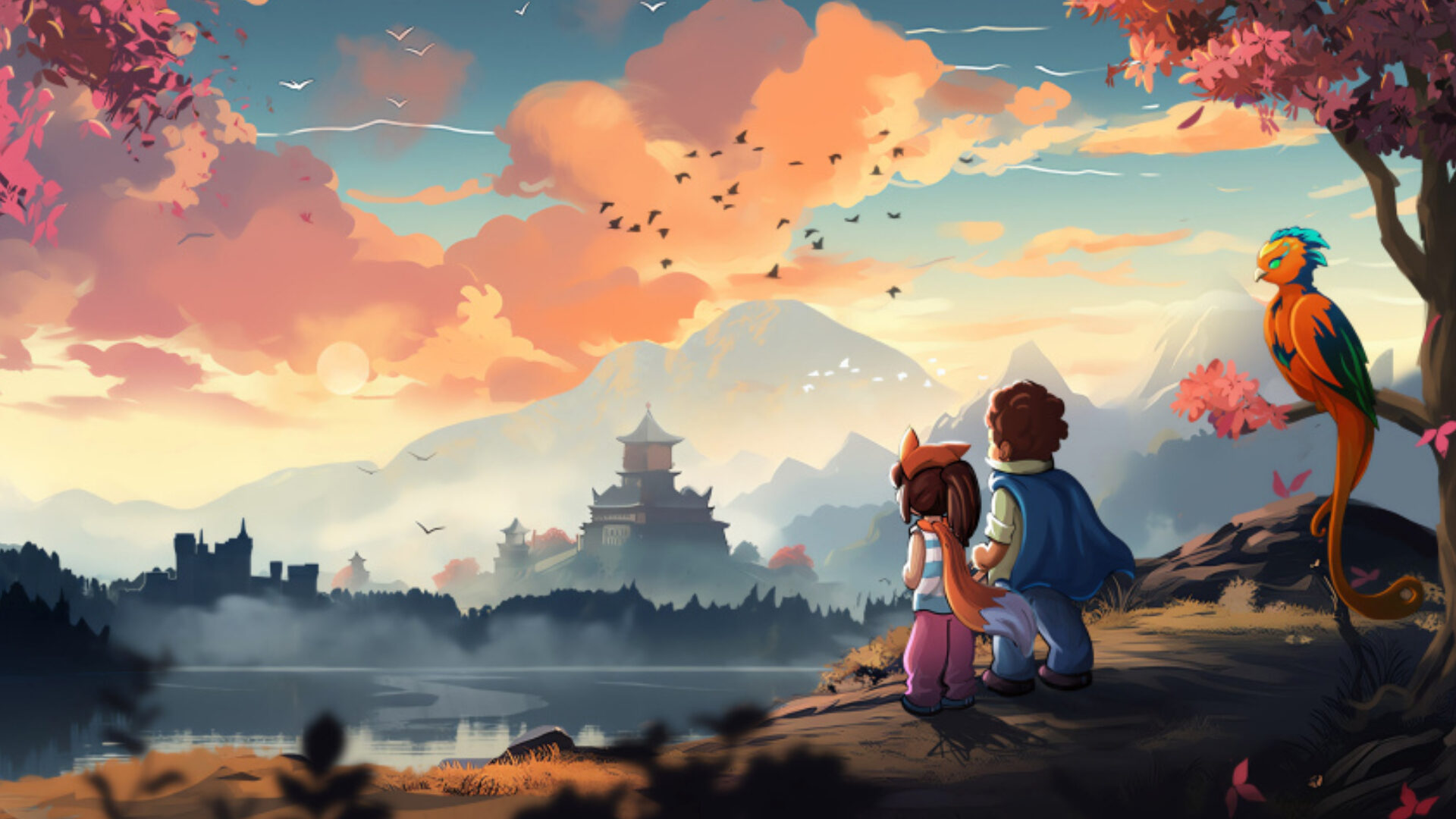
Abi and Ben are playing in their room when a portal swallows up their daily life. Here they are thrown into worlds which have retained the sweetness of a picture book, but no longer really their logic. A Fenghuang, this phoenix bird which serves here as a landmark and a promise of return, awaits them at the end of each level. To return, the two children must join together. To come together, we have to move the world.
Lost Twins 2 is based on this idea: slide the pieces of the decor like you would restore order in a room after a restless dream. The game has grace when it embraces this simplicity. It loses strength as soon as its story fades, as soon as Abi and Ben become pretty mute figures again instead of real children to take home.
On Nintendo Switch, the proposal is good. Short levels, local cooperation, immediate handling, a peaceful tone: all this exudes the console that you place on a table to share a puzzle with two people. But a game adapted to a machine does not automatically become a notable game. Lost Twins 2 is a success in its mechanics. It’s also an adventure that’s far too thin once you look behind its shimmering colors.
Two children, a portal, a story that fades
Lost Twins 2 tells the story of Abi and Ben, leaving their room to travel through three large sets of environments: enchanted forest, frozen castle, toy world. The decor changes, the objects too, and the phoenix bird gives the route a clear image. The children are separated, the world is broken, we have to put the pieces back together to reunite them.
This idea was enough to give the game a real tenderness. The separation of two children, the house to find, the passage from a domestic imagination to fantastic worlds: everything called for a simple, light tale, carried by a few gestures and a few strong images. Unfortunately, Playdew chooses a much drier route. After the introduction, the story disappears. Abi and Ben move through the levels with too little presence, as if the game is afraid to give weight to its own journey.
This is the first real criticism: Lost Twins 2 confuses restraint with emptiness. A puzzle game can tell little. It can even tell a story without words. Here, the images carry the charm, but not enough meaning. We move from painting to painting, we admire, we solve, then we leave again. The trip remains pleasant. A trace is missing. A worry. An attachment. Something that would make Abi and Ben more than two adorable pawns in a very beautiful mechanism.
The world slides, and that’s where the game exists
Each level is divided into blocks that you move like a sliding puzzle. A wall blocks the passage, a chasm cuts the road, a platform remains useless because it is in the wrong place. We change the order of the pieces, and the problem takes another form. The path is made as much as it is traveled.
The strength of Lost Twins 2 comes from this obviousness. The player understands quickly, but the game keeps enough resources not to run out after three rooms. Switches, blocks to push, batteries, fans, flying insects, domes to break, colored portals, objects to move from one fragment to another: each new element adds a pleasant little rule that enriches the gameplay.
The best puzzles require you to think in full path: when to move, where to leave Abi, how to get Ben across, how to preserve a return route, how to drop an object in the correct square before putting it back elsewhere. When the solution is put in place, the game gives a very clear pleasure, that little silly smile that comes when the brain finally puts the room in order.
Lost Twins 2 still keeps a fairly low ceiling. The grid remains limited, the logic too readable, and accessibility often takes over. Players who are very accustomed to puzzle games will see certain answers come too soon. The game compensates with phoenix feathers to collect and side challenges that are smarter than they seem, but its main path rarely remains difficult. It’s a choice… but one that won’t be unanimous.
Cooperation gives its true warmth
Solo, Lost Twins 2 holds up well. We move from one child to another, we prepare an action, we come back, we move the setting, we start again. Reading remains clear and the Switch lends itself well to these small sessions where you complete two or three levels before closing the console.
With two people, the game gains something. The rhythm remains calm, almost complicit. Each player controls a child. The two look at different portions of the level, propose, test, sometimes fail, correct together. Lost Twins 2 then becomes a real couch game, one of those which leaves room for the person who plays little without forcing them to follow.
This is its finest quality. The game remains welcoming without becoming stupid. It can accompany a child, a beginning player, or simply someone looking for a quiet evening of reflection. Cooperation is not just about checking a box. It changes the temperature of the experience.
Charming, then a little hollow
Visually, Lost Twins 2 is tasteful. The settings have the roundness of an illustrated story, with soft colors, painted backgrounds, simple and expressive characters. The image remains truly readable. Each little theater lets the eye understand the puzzle before getting lost in the decoration.
The music follows the same line. It accompanies without invading, with gentle themes that allow reflection to breathe. The game knows how to create a bubble. It also knows how to use it. By remaining in a constant gentleness, the worlds crossed end up lacking relief. The forest, the castle, the toys: everything is pretty, everything is clean, but few things really seem to belong to a story.
This lack of thickness weighs more than the duration. Lost Twins 2 ends quickly, around four to five hours for the most part, but a short format could have sufficed with a more embodied universe. The real problem comes from this window dressing feeling. We see the care. We feel the talent. We look for life behind the scenes, and it almost never comes.
Right place, wrong language
The Switch version makes sense. The short format, local co-op, and overall smoothness are a natural fit for the console. The game lends itself to short sessions, sharing, handheld mode or playing on the living room screen. Its structure benefits more from this flexibility than from a spectacular machine.
However, the game is only in English. On a title which is clearly aimed at family audiences, this is a mistake as stupid as it is incomprehensible. The amount of text remains limited, the adventure can be understood without great mastery of the language, but the absence of French contradicts the accessibility that Lost Twins 2 defends everywhere else. A game this simple to pick up shouldn’t stumble upon such an avoidable barrier.
The bonuses partially revive the whole thing. Feathers and secrets add reason to delve further. The side challenges give a real extra to players who like to twist the levels. But once the logic is understood, the surprise diminishes. Lost Twins 2 remains a nice interlude, more than a puzzle game to which we return for a long time.
Verdict
A beautiful mechanism in a world that is too thin
6/10
Lost Twins 2 succeeds in its most important challenge: turning the scenery into a puzzle. Its levels can be read, moved, recomposed with a clarity that often makes you want to go to the end. In local cooperation, the game gains real warmth and finds a natural place on Switch.
However, it fails to give its journey enough identity. Abi and Ben remain too silent, the story disappears quickly, the worlds crossed lack connections and the absence of French spoils family discourse. Lost Twins 2 is charming, clever, pleasant. It simply lacks a more tenacious soul to become something other than a very pretty puzzle that we close a little too quickly.
Pros
- Simple and effective mechanics
- Really pleasant local cooperation
- Soft and careful artistic direction
- Riddles accessible without being hollow
- A perfect atmosphere to play without pressure
Cons
- An adventure too short
- A charming but sparsely inhabited world
- A challenge sometimes too tame for those accustomed to the genre
- Limited replayability
- Some slowdowns and minor physics quirks
- The absence of French