
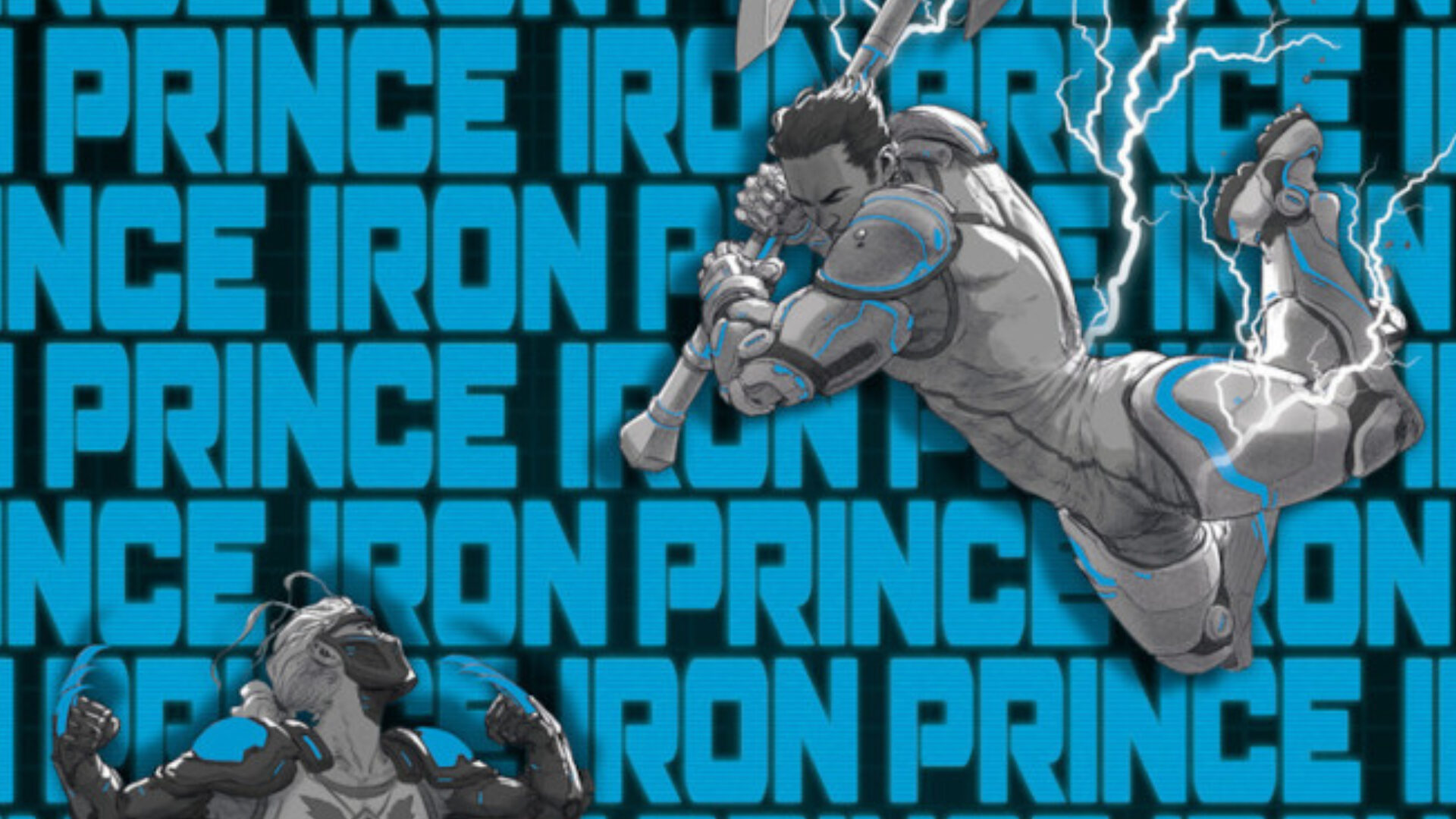
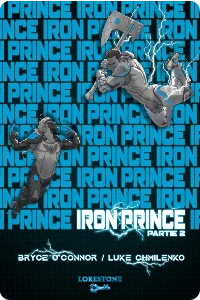
Iron Prince – Part 2
The tournament changes size
Score: 8/10
Images and videos
At a glance
We liked
- Reidon gains in presence and depth, without losing the logic of progression which was the strength of the first volume.
- Group relationships take up more space and give more depth to Galens' dynamics.
- The progression system remains precise, clear and satisfying.
- The fights and the stakes of Sectionals toughen everything up in a credible way.
We liked less
- The novel remains very confined within the framework of the academy.
- The great war continues to exist above all as a distant horizon.
- Some scenes drag out a little too much in the dialogues and transitions.
- The volume sometimes gives the impression of being a step rather than a turning point.
More on Iron Prince
 By Farrel Grimwood · published · 5 min read
Contents
Iron Prince – Part 2 does not seek to repeat the feat of the first volume. Where Part 1 still established itself, presented its rules and tested the solidity of its hero, this sequel enters into the novel’s real substance: the balance of power, the clearer rivalries, the pressure of the result and the sensation that Galens is finally becoming an arena. Reidon is no longer the kid who has to prove he belongs; he becomes a name that we begin to monitor, which immediately changes the weight of the story.
The novel, however, retains its usual anchor point. The universe remains very focused on the Galens Institute, the Sectionals and the logic of ascension by ranks, with a galactic background which continues to exist mainly as a diffuse threat rather than as an open front. This is both the strength and the limit of this second volume: it refines the formula, densifies it, but does not really move it outside its great training theater.
The hero becomes a target
The big change in this volume is that Reidon Ward is no longer just the one who started at the bottom. He becomes someone that the system observes, that others study, that adversaries want to measure, and this shift is essential because it removes from the novel part of its initial comfort. In the first volume, the progression still had something almost linear: a handicap, a potential, an increase. Here, the story must deal with visibility, with judgment, with expectations.
That’s a good thing, because Reidon holds up better when he’s not just defined by his underdog status. The character gains substance as soon as he has to manage something other than his own limits: responsibility, team dynamics, the reactions of those who finally look at him differently. We find what was already the strength of the first volume, but with an additional layer of social tension. The hero no longer advances in a vacuum.
This move also highlights what sets him apart from more mechanical progression fantasy protagonists. Reidon remains a character who works, who accepts, who corrects, who sometimes doubts, but the text leaves him more room as a moral presence in the story. It is no longer just a body to be optimized. He becomes a figure around whom others gravitate, which gives his victories more depth, but also his limitations more interesting.
The team is gaining ground
Where volume 1 mainly laid out the pieces, volume 2 begins to really bring the group into existence. Viv, Aria, Catcher and the others no longer only serve to surround Reidon or illustrate the Galens ecosystem. They become vectors of contrast, friction and occasional breathing room, which prevents the novel from completely closing itself on its logic of classification.
This rise in relationships is probably one of the clearest advances in the volume. Bonds are not treated as simple narrative rewards unlocked after a certain number of battles. They participate in reading the clashes, in the tactical choices, in the way in which Reidon situates himself in the collective. Without it, Iron Prince could easily fall into the trap of being the hero alone against his stat sheet. Volume 2 avoids this more than the first, by showing that progression only makes sense if it also modifies the way of being with others.
Despite everything, there remains a certain heaviness in the way in which the novel organizes its relationships. Some scenes stretch their exchanges a little too much, as if the sequel sometimes needed to insist on getting across what it wants to establish. But this insistence is not always wrong. It also corresponds to a universe that treats camaraderie, rivalry and hierarchy as structuring mechanisms, not as accessories for a break between two fights.
The system is getting tougher
Progression fantasy is only of interest if the system does not simply repeat its initial charm. On this point, volume 2 holds its own. It continues to explore how CADs work, performance gaps, build adjustments, growth thresholds, and how each evolution has a concrete cost in physical effort, recovery, or tactics. The novel does not suddenly become simpler because it moves forward; on the contrary, it becomes more demanding as it starts delivering on its promises.
What is changing above all is that the system is no longer just presented as a promise of progression. It becomes a permanent pressure. The opponents are tougher, the margins finer, the level distinctions heavier to bear. Volume 2 keeps the almost playful logic of the first, but it leads it towards something more tense, more loaded with consequences. We no longer just watch a character rise. We see him chasing a future that begins to demand results.
This is precisely where the novel finds its best pages. When it comes to explaining an evolution, making a difference in rank felt, showing how a weakness transforms into a combat choice, the whole thing has a real hold. When, on the contrary, it comes to bringing the system into existence as a total structure of the world, the text still remains a little prisoner of its academic terrain. It knows how to count very well and how to fight even better. It is less adept at leaving Galens without losing momentum.
The war still waits
Volume 1 already suggested that the war against the Archons weighed on everything else. Volume 2 continues to keep this threat in the background, but without really letting it invade the center of the story. It is a coherent narrative choice, because it allows us to push the logic of training, examination and confrontation further. But this is also the limit of this sequel: it confirms that the real dramatic material of the cycle is still to come.
This restraint is not an absolute fault. It gives the novel time to consolidate its foundations and avoid dispersion. The problem is that by staying in Galens’ orbit, Iron Prince sometimes ends up feeling like one long season filler before the real shift. We feel the rise. But the landscape behind still only appears in fragments.
That said, this positioning has a virtue: it prevents the novel from wanting to change its nature too quickly. Iron Prince remains a military progression fantasy before being a great space war story. Volume 2 assumes this identity more than the first, because it stops wondering if it should already promise further. It focuses on what it can do, with greater confidence.
Verdict
The prince grows, the frame tightens
8/10
Iron Prince – Part 2 confirms what Part 1 already promised: this cycle knows how to build a rise in power which is not based only on numbers, but on a real shift in the status of the hero, his relationships and his place in the world. Reidon Ward gradually ceases to be the survivor to watch and becomes a force that must now be counted among the serious actors of Galens. It is a logical evolution, well done, and often more interesting than simply repeating the pattern of the first volume.
The volume, however, remains very tied to its academic and competitive setting. It densifies the academy, it strengthens the links, it toughens the fighting, but it still leaves the great war at the doorstep. This is what prevents it from being completely freed from its status as a transitional volume. On the other hand, as a consolidation volume, it is frankly solid. Iron Prince moves forward, with a little more confidence this time.
Pros
- Reidon gains in presence and depth, without losing the logic of progression which was the strength of the first volume.
- Group relationships take up more space and give more depth to Galens' dynamics.
- The progression system remains precise, clear and satisfying.
- The fights and the stakes of Sectionals toughen everything up in a credible way.
Cons
- The novel remains very confined within the framework of the academy.
- The great war continues to exist above all as a distant horizon.
- Some scenes drag out a little too much in the dialogues and transitions.
- The volume sometimes gives the impression of being a step rather than a turning point.
More in Books
Full library 8/10
Iron Prince – Part 1
Lorestone 10/10
Sépia, tome 2 : Le complot de Flobourg
Pocket Jeunesse 8/10
100 Films d’animation japonais
Yniss 8/10
The Witcher: A Little Sacrifice
Bragelonne 7/10
One of Us Is Next
PKJ 9/10
The Star That Fell from the Sky
 8/10
Mégères et vamps face caméra
L’Harmattan 8/10
Strange Maps
Seuil 7.5/10
Quelque part dans la région du Kinki
Seuil 7.5/10