The Witcher: A Little Sacrifice
Geralt has found something trickier than slaying a monster
Score: 8/10
Images and videos


At a glance
We liked
- The parallel between the duke's contract and Essi's story
- Dandelion has a real place in the story
- Spreads that play with scale and point of view
- Sapkowski's text preserved in a large-format illustrated edition
We liked less
- Text contrast suffers on some busy backgrounds
- The complete collection costs less than this edition
- The world beneath the shore is barely glimpsed
 By Farrel Grimwood · published · 4 min read
Contents
In Sapkowski’s short stories, Geralt is happy to take a contract that mainly calls for a sword. The Duke of Bremervoord, though, needs an interpreter. He loves a mermaid and expects the witcher to explain how she will have to change her life to marry him. The job gets off to a poor start. It’s one of the best premises in Sword of Destiny, because it puts Geralt in front of a problem he sees clearly in others and much less clearly in himself.
Bragelonne presents The Witcher: A Little Sacrifice in a 56-page illustrated edition. The text is still Andrzej Sapkowski’s, in Alexandre Dayet’s French translation, with art by Xavier Collette. The coast of Bremervoord gives an illustrator plenty to work with. But the best of the story takes place between Geralt, a young bard called Essi, and Dandelion. What does a book this size bring to a story that works so well in the things two people can’t bring themselves to say?
Agloval thought of everything except asking her
Geralt and Dandelion are short of money when they arrive on the coast. Duke Agloval has already bought an elixir that will give Sh’eenaz legs. Three uncomfortable days, he reckons, and everything will be fine. All Geralt has to do is pass the offer on. The mermaid has a different idea: why doesn’t the duke come and live underwater with her? It’s recognizable as The Little Mermaid, but Sapkowski lets the person with the most at stake discuss the cost of the transformation. That’s enough to turn the duke from the great romantic into a man who has planned a wedding for two all by himself.
After negotiations fail, the witcher finally finds a job befitting his trade. Fishermen haven’t returned, and Agloval wants him to kill whatever is attacking them. At low tide, Geralt and Dandelion discover stairs descending into the water. That detail changes far more than the sight of a creature. This is a place that someone built. The duke sees a coast where his men need to be able to earn a living; Geralt understands they aren’t the only ones with a claim to it. The story doesn’t spend much time on that discovery. It leaves a desire to know more about what lives down there, but Sapkowski has other matters to settle on dry land.
What Geralt can’t give back
Essi Daven enters the story at an engagement celebration where she is to sing with Dandelion. The two bards already know each other, and that comes across in the way they talk. It’s a good thing, because Essi first appears in a relationship that has nothing to do with Geralt. She has a profession, a history with Dandelion, and her own view of what the duke plans to do about the creatures of the coast. Her attraction to the witcher, by contrast, becomes important very quickly. The story asks for belief in an intensity the first encounters do little to prepare.
What saves the story is that Geralt doesn’t have the answer Essi wants. He likes her, doesn’t want to hurt her, and is still thinking of Yennefer. He understands perfectly how absurd Agloval is when he expects Sh’eenaz to make the sacrifice for both of them. He does far less well when his own unwillingness to hurt someone risks giving her hope. Sapkowski doesn’t need to make him a villain to show the problem. It’s enough to let him drag out a situation whose outcome he already knows. Dandelion, who has known Essi longer, sees it more clearly. For once, the person best placed to understand what the story costs isn’t the one the reader usually follows.
Another way to see the shore
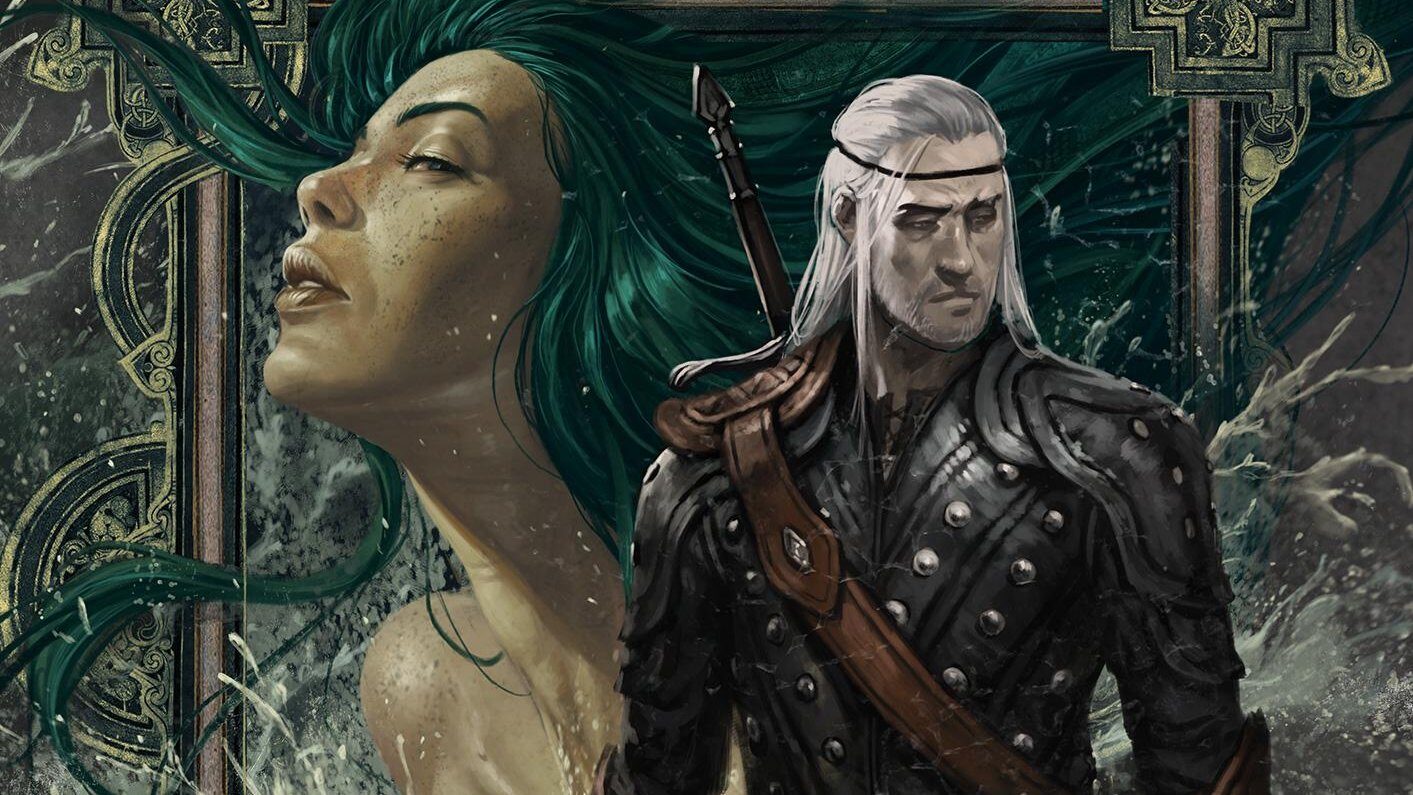
On one spread, Collette gives Sh’eenaz nearly the entire left half. Her green hair spills beyond the ornate frame around her portrait. On the right, the deck of the boat is seen from above and the mermaid is at a distance from the men leaning over to address her. The two images work at different scales, and that’s exactly what makes them interesting. Agloval can give orders aboard his boat. The book has already given Sh’eenaz a place he never allowed her. Elsewhere, the rocks are so large that Geralt looks scarcely more significant than Dandelion, whose purple stands out against a nearly gray shore. The art shifts the point of view and the balance of power with it.
The large format also lets the approach and the fight share a composition. In one spread, the two men are still tiny figures on the slabs to the left, while the creature and Geralt already fill the right. It shows both the route they’ve just taken and what awaits them without needing separate pages. That works better than the placement of text against some backgrounds. Pale lettering stands out against dark stone. On brighter patches, it can take a second pass to regain the thread of a column. That’s the cost of treating a spread as a single image, but reading gains nothing by having to fight the art.
The price of a story already on the shelf
At €35, Bragelonne isn’t offering the simplest way to discover the story. The hardcover Sword of Destiny costs €25 and also includes the other five stories in the collection. The reason to choose this edition is different: to see the shore again, linger over the space Collette gives Sh’eenaz, and see what the illustrations do with a place the prose left to the imagination. From a book that takes up this much room, that’s the least to ask. On its best spreads, it’s more than enough.
Verdict
Read it in the collection, revisit it in large format
8/10
A Little Sacrifice is a very good story because Sapkowski knows when Geralt ought to put his sword away. Essi and Dandelion matter as much as the duke's contract, and Collette finds a way to tell his part of the story by contrasting the scale of Sh'eenaz's portrait with the little room the boat affords her.
The price and the uneven legibility of some columns make this a book to revisit rather than a place to start. The collection remains the right purchase for a first encounter with the Witcher. For returning to this short story and seeing how Collette shifts its point of view, this edition has a real reason to exist.
Pros
- The parallel between the duke's contract and Essi's story
- Dandelion has a real place in the story
- Spreads that play with scale and point of view
- Sapkowski's text preserved in a large-format illustrated edition
Cons
- Text contrast suffers on some busy backgrounds
- The complete collection costs less than this edition
- The world beneath the shore is barely glimpsed