Towa and the Guardians of the Sacred Tree
When light fights against time
Score: 8.5/10
Images and videos


At a glance
We liked
- The duality between Tsurugi and Kagura which structures the entire gameplay
- The village of Shinju which evolves with each cycle
- The artistic direction contrasts between light and corruption
- The orchestral soundtrack enhanced by traditional instruments
We liked less
- The steep difficulty which can discourage novices
- The inevitable repetition of the roguelite genre
 By Farrel Grimwood · published · 8 min read
Contents
Towa and the Guardians of the Sacred Tree is a narrative action roguelite that takes the idea of the cycle to the extreme: each attempt is simultaneously combat, discovery and sacrifice. The game offers a rare duality of gameplay: combining the role of warrior (Tsurugi) with that of support mage (Kagura), in a universe where the progression of the village of Shinju evolves over time, driven by the consequences of your victories and losses.
The challenge is twofold: succeed in creating a captivating game dynamic within an already abundant genre, and add an emotional dimension through time, connections and loss. Towa promises to combine the din of combat and melancholic choices, in an inspired visual and musical setting.
The roots of a world on borrowed time
The universe of Towa and the Guardians of the Sacred Tree unfolds around a founding myth: that of a sacred tree, Shinju, guarantor of the balance between men and divinities. But this balance is shattered when dark forces invade the land, corrupting the spirits and threatening to silence the village. The story then takes the form of a desperate struggle where each cycle of combat becomes an attempt to postpone the inevitable.
The player plays two heroes linked by destiny. Tsurugi, an elite warrior, bears the brunt of head-on combat, the one who throws himself into the heart of darkness to protect his loved ones. His physical strength contrasts with the emotional fragility of Kagura, priestess and mage, whose mission is to support, heal and preserve the memory of each confrontation. Together, they compose a complementary duo, embodying the tension between sacrifice and hope.
The village of Shinju, far from being a simple setting, becomes the real central character. After each attempt, its inhabitants react to failures and victories. Conversations evolve, connections are made, grudges are revealed. This social fabric gives the plot a thickness rare in the genre: we not only play to triumph over enemies, but also to save a threatened way of life, to preserve the memory of those who cling to the light.
Each Guardian encountered embodies a facet of this broken world. Sometimes protectors, sometimes adversaries, they are reflections of human contradictions: loyalty and betrayal, faith and doubt, love and resentment. Their dialogues, often poetic, construct a story that goes beyond simple confrontation. They remind us that the sacred tree is not only a magical resource, but a metaphor for collective survival.
The scenario plays on repetition, transforming the roguelite loop into a narrative element. Each death is not an end but a stage, each beginning a new branch of history. This choice allows us to explore the theme of memory and time: Tsurugi and Kagura are not simple avatars, they become the bearers of a collective history, condemned to repeat in order to better understand and, perhaps, conquer.
This approach gives Towa a melancholy tone. Far from a simple action game, it creates an atmosphere where we feel the weight of destiny and the fragile beauty of human bonds. The player advances, falls, gets up again, and discovers that the essential thing lies not only in the final victory, but in the traces left in each cycle.
The cycle as a battlefield
The gameplay of Towa and the Guardians of the Sacred Tree is anchored in a demanding roguelite formula, but is distinguished by the complementarity of the two protagonists. The player takes turns playing Tsurugi, an offensive warrior, and Kagura, a support mage, in an alternation designed to maintain a constant balance between attack and survival. This duality gives the game a particular rhythm, where each confrontation becomes a ballet of strength and magic, brutality and delicacy.
The fights, fast-paced and methodical, rely on a variety of weapons and evolving skills. Tsurugi deploys heavy strikes, combos and counters that require timing and precision, while Kagura manipulates elemental magic, healing, strengthening and erecting protective barriers. The alternation between these two styles is not limited to variety: it requires constant tactical reflection, because survival depends on the ability to exploit the synergy between raw power and spiritual support.
The level design follows the logic of the cycle. Each attempt leads through areas generated with procedural variations, mixing corrupted forests, forgotten sanctuaries and caverns where guardians slumber. These environments, while familiar in structure, change enough to continue exploration. The paths hide altars, narrative fragments and rare objects, rewarding curiosity and perseverance.
The progression system is designed to give weight to each failure. The resources brought back to the village make it possible to strengthen Tsurugi and Kagura, but also to improve Shinju’s infrastructure. The inhabitants see their lives change depending on the player’s choices: a blacksmith expands his arsenal, a healer offers new rituals, a child finds the courage to become an apprentice. These micro-evolutions give emotional depth to the roguelite loop, transforming each cycle into steps towards collective reconstruction.
The bosses, true pillars of the gameplay, embody the strength and cruelty of corrupted entities. Each of them imposes a different reading of the combat: one relies on unstoppable zone attacks, another on lightning speed, a third on the summoning of multiple allies. These confrontations, spectacular and punishing, require learning, failing and coming back stronger. Frustration, inevitable, then transforms into an engine of progress.
The difficulty, sometimes steep, can discourage those who were hoping for a more accessible experience. However, for roguelite enthusiasts, this requirement becomes a virtue: Towa does not give anything easily, but each victory achieved carries the weight of true accomplishment.
By choosing to link gameplay and story through the prism of repetition, Towa takes a rare approach. The player is not only an actor in a fight, he becomes a witness to a world that evolves despite defeats. And it is in this alliance between mechanics and narration that the game asserts its unique identity.
Light versus shadow, in colors and notes
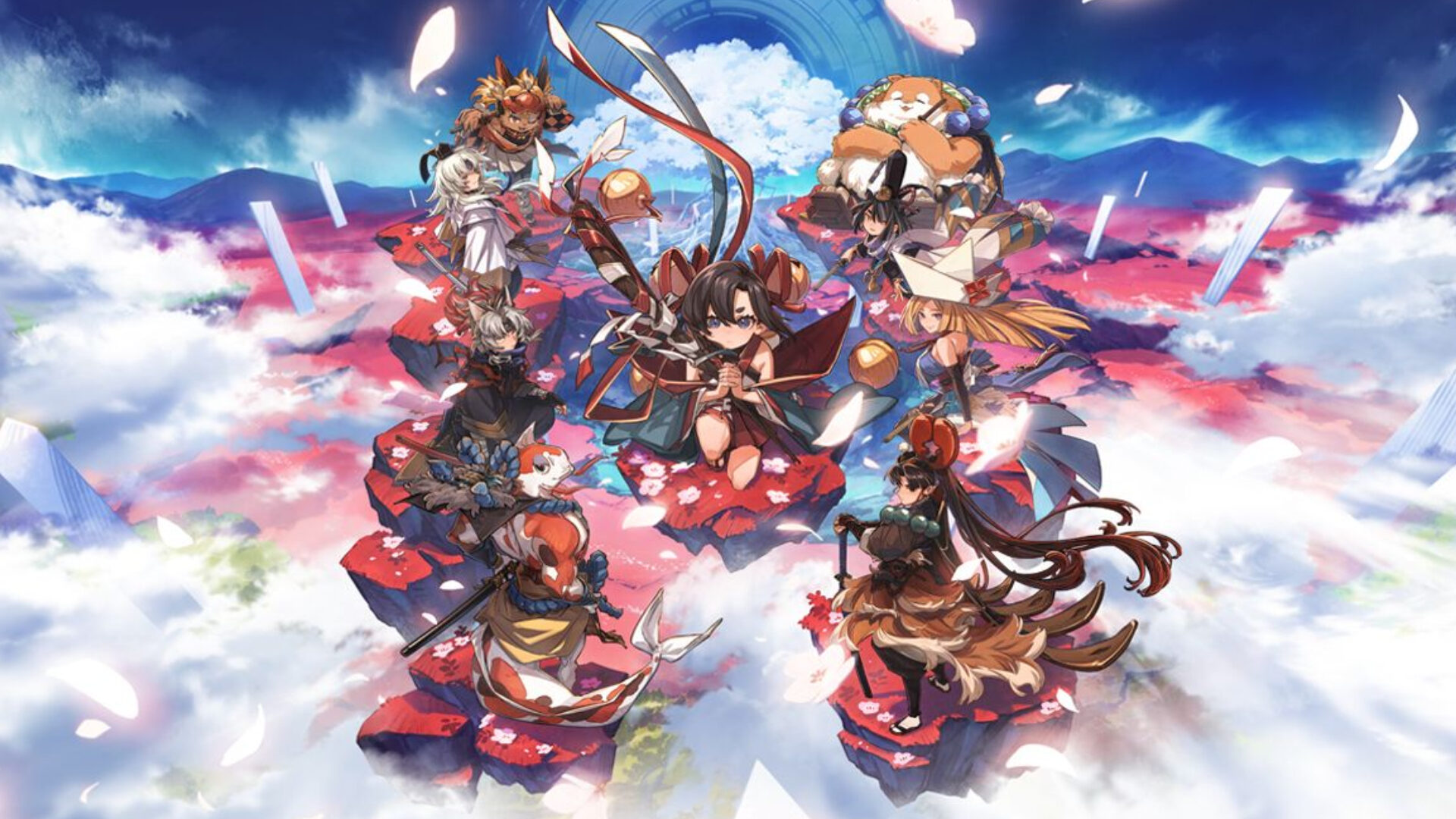
Visually, Towa and the Guardians of the Sacred Tree relies on a poetic artistic direction which combines the aesthetics of a tale with the intensity of a world in danger. The environments oscillate between the serenity of sacred forests and the darkness of corrupted areas, creating a constant contrast that reinforces the opposition between life and decay. Sanctuaries are bathed in soft glow, villages breathe human warmth, while infected lands are adorned with cold, saturated hues, marked with glowing fissures. Each scene becomes a visual metaphor for the threatened balance.
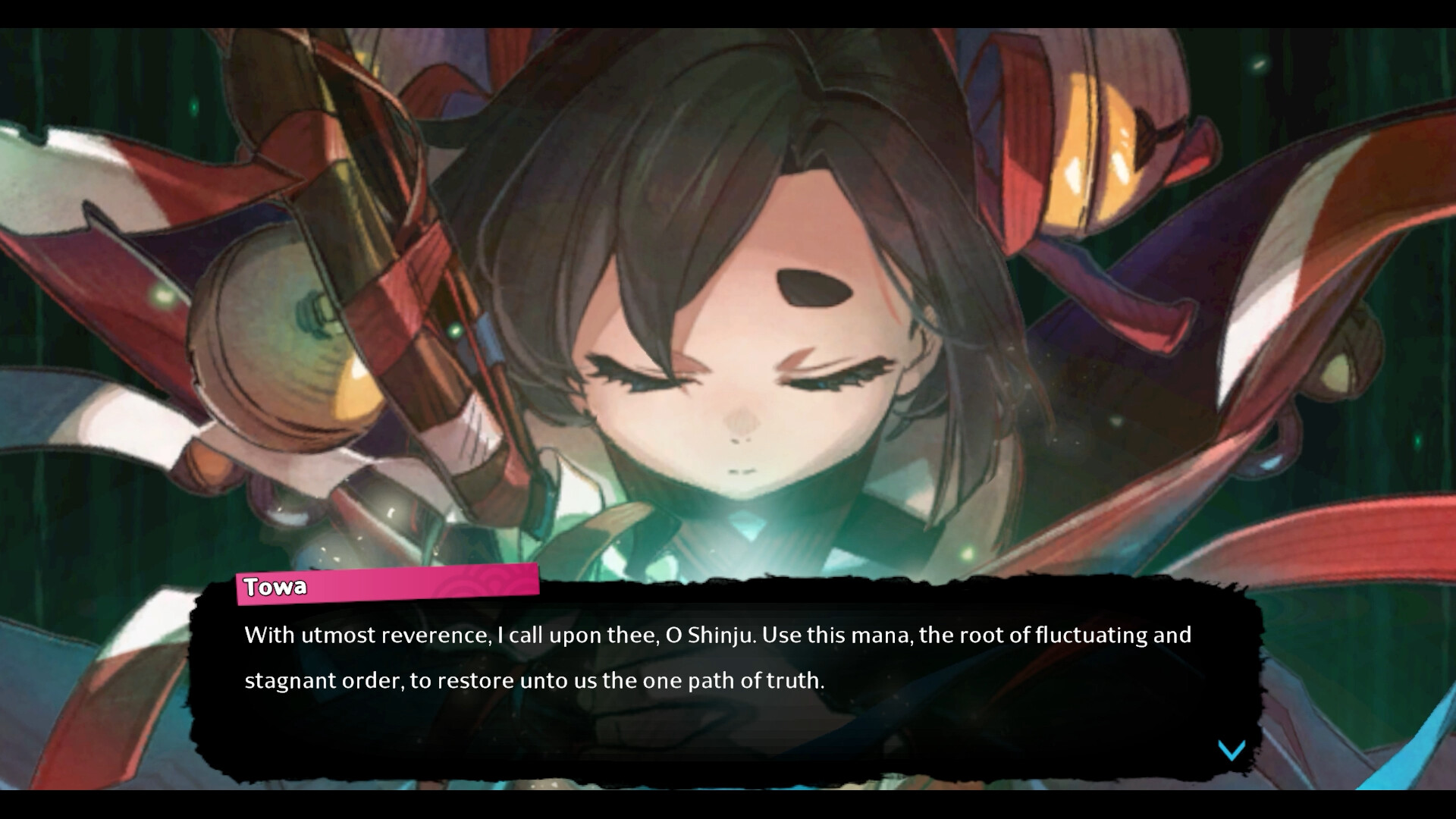
The characters benefit from special care. Tsurugi, robust and massive, is animated with martial gestures which convey his determination. Kagura, more delicate, expresses her fragility through ample and fluid movements. The guardians establish themselves as true mythological entities, between protective deities and nightmarish chimeras, magnified by visual effects which accentuate their aura. If certain secondary environments suffer from repetition in their motifs, the whole retains a strong and immediately recognizable identity.
On Xbox Series, the game maintains good fluidity even during the clashes most loaded with lighting effects. The particles, omnipresent when Kagura uses her powers, sometimes saturate the screen at the risk of confusing the action, but also contribute to the feeling of excess specific to the fights against corrupted forces.
On the soundtrack side, Towa deploys a captivating score. The orchestral themes are accompanied by traditional Japanese instruments which emphasize the sacred nature of the universe. Each place has its musical identity: the village exudes serenity with soothing melodies, the sacred forests vibrate with discreet choirs, and the corrupted areas are draped in heavy percussion and dissonant strings that evoke threat.
The clashes against the guardians are distinguished by intense, almost ceremonial compositions, where the pace accelerates as the fight progresses. These musical variations reinforce the impression of a ritual duel, both physical and spiritual ordeal.
The dubbing, provided in Japanese with French subtitles, brings a welcome authenticity. The voices of the protagonists reflect their complementarity: the measured gravity of Tsurugi, the vibrant sensitivity of Kagura, and the mystical dimension of the guardians.
By combining strong artistic direction and an immersive soundtrack, Towa manages to create a unique atmosphere, where each cycle is not only a mechanical challenge, but also a dive into a rich and memorable sensory universe.
Echoes of a world that is being rebuilt
On a technical level, Towa and the Guardians of the Sacred Tree relies on controlled execution. The game takes advantage of the power of the Xbox Series to maintain stable fluidity in most situations, even when the screen fills with enemies and lighting effects. Some minor slowdowns appear during the busiest sequences, but never to the point of breaking the pace. Loading times remain very short, supporting the logic of rapid and repeated cycles.
Replayability is the heart of the experience. Each failure feeds the next cycle, and the accumulated resources allow the village of Shinju to be improved. Blacksmiths, priestesses, craftsmen: all participate in the player’s gradual rise in power, and each improvement unlocks new gameplay opportunities. This system gives a community dimension to progression, transforming the village into a living mirror of the player’s efforts.
The game also offers various modifiers that adjust the difficulty of the cycles. More accessible modes for novice players, increased challenges for the most seasoned: the balance between accessibility and requirement is well thought out. These options allow everyone to approach the experience at their own pace, without betraying the identity of the roguelite.
The absence of a multiplayer mode may be surprising, as the duality between Tsurugi and Kagura seems to call for cooperation. However, this choice is explained by the desire to maintain an introspective experience, centered on the link between the two protagonists and on the evolution of the village. This bias reinforces narrative coherence, even if it deprives the game of a social dimension that could have broadened its appeal.
Finally, the general technical aspect appears robust: a clear interface and ergonomics designed for the controller. The whole reflects a careful production, which does not seek to shine through showiness but to offer a stable and coherent experience.
Verdict
The fragile beauty of an eternal beginning
8.5/10
Towa and the Guardians of the Sacred Tree stands out as a unique experience, combining the demands of a roguelite with the emotional depth of a mythological story. By placing the player at the heart of a cycle of fights, losses and rebirths, the game succeeds in transforming repetition into a narrative engine. The duality between Tsurugi and Kagura gives a strong identity to the adventure, reinforced by a village that evolves through failures and victories.
The poetic artistic direction, the haunting soundtrack and the community progression make each cycle more than just a challenge: a step towards rebuilding a world in peril. Beyond the difficulty, players will discover a rich, touching and memorable experience.
Pros
- The duality between Tsurugi and Kagura which structures the entire gameplay
- The village of Shinju which evolves with each cycle
- The artistic direction contrasts between light and corruption
- The orchestral soundtrack enhanced by traditional instruments
- Replayability supported by varied cycles and community improvements
Cons
- The steep difficulty which can discourage novices
- The inevitable repetition of the roguelite genre