
Perennial Order
The roots of a nightmare in bloom
Score: 7/10
Images and videos



At a glance
We liked
- The visual aesthetic, dark and organic, which imposes a strong identity
- Memorable bosses, each with their own unique mechanics
- The demanding, precise combat system, where every move counts
- Local and online cooperation, which reinforces tension and shared satisfaction
We liked less
- One-shot death, frustrating for some, sometimes poorly telegraphed
- Lack of notable variety in environments and exploration
- Sometimes laborious back and forth between zones and combats
- An effective soundtrack but not very memorable in terms of themes
 By Farrel Grimwood · published · 5 min read
Contents
With Perennial Order, the independent studio Gardenfiend Games ventures into an area where beauty and horror merge. This 2D boss rush, published by SOEDESCO, transposes to Xbox Series a Dark Age universe invaded by monstrous creatures corrupted by nature itself. Inspired by both gothic aesthetics and forest mythologies, the game invites the player to embody a hybrid figure, half-knight, half-plant, condemned to face colossi rooted in a hostile world.
Here, no classic progression or chatty side quests: the experience is based on raw confrontation, instant death and the need to learn, again and again, until triumph. Perennial Order dares this difficult challenge: to make a punitive mechanism a vector of intoxication. The question is then simple: does the game manage to transform repeated failure into renewed pleasure, or does it get lost in its own brambles?
The whispers of the forgotten woods
Perennial Order does not seek to cover its fights with a talkative narrative. Here, the story is guessed more than it is exposed. The player embodies a hybrid silhouette, a solitary figure emerging from a decomposing nature, half-human, half-plant, doomed to confront colossi rooted in the earth. No explanatory cutscenes, no abundant dialogue: the narration is distilled in the settings, in the fragmented descriptions, in the rare encounters which seem more haunted than alive.
The world we cross is a fresco of ruins and corrupted forests, a territory where each structure seems to be the vestige of an ancient order swallowed up by plants. The secondary, almost ghostly characters appear in brief touches: enigmatic silhouettes, broken voices, fragments of stories left to interpretation. Their role is not to guide, but to maintain an atmosphere of uncertainty, to keep the player in this in-between where understanding is never complete.
The real story is the one that is written in the repetition of battles. Each defeated boss becomes a page turned, each death an interrupted sentence. The identity of the protagonist is forged less by words than by his trials, his defeats, his hard-won victories. In this voluntary silence, Perennial Order constructs an implicit narrative, where the player fills in the blanks, where the imagination becomes complicit in the spreading plant horror.
The brambles of challenge
At the heart of Perennial Order beats uncompromising gameplay. Each confrontation is a duel to the death against a colossal creature, each missed attack can result in the immediate end of the game. The game is based on a simple but merciless mechanic: a single enemy blow is enough to put the player down. This extreme fragility transforms each fight into a ritual of concentration where observation of patterns, learning through failure and precision of gestures become the only weapons of survival.
The handling is based on twin-stick controls: a blade extending from the arm, directed by the right stick, and precise movements dictated by the left stick. This atypical ergonomics requires an adaptation time, but it promotes tension and accuracy of movements. Little by little, the player discovers new skills, which enrich an arsenal that is nevertheless deliberately limited to keep the purity of the challenge intact.
The progression does not follow the classic structure of an action-RPG. Here, no long areas of exploration or side quests: the adventure is built like a succession of arenas where each boss embodies a puzzle to solve. The environments that precede them, made of ruins and haunted glades, serve more as atmospheric interludes than as grounds for prolonged action. This assumed purity gives each confrontation a unique value, a weight which is imprinted in the player’s memory.
The difficulty, steep and uncompromising, risks dividing. For some, it will be synonymous with frustration, with unfair punishment when the readability of the attacks seems imperfect. For others, it will represent the very essence of the game: a school of patience and endurance where each victory, snatched after dozens of attempts, provides a rare exhilaration. The possibility of facing these challenges in pairs, in local or online cooperation, sometimes softens the harshness but does not soften the substance: even in pairs, the danger remains omnipresent, and the monsters strengthen themselves to never give in too easily.
A fresco of roots and shadows
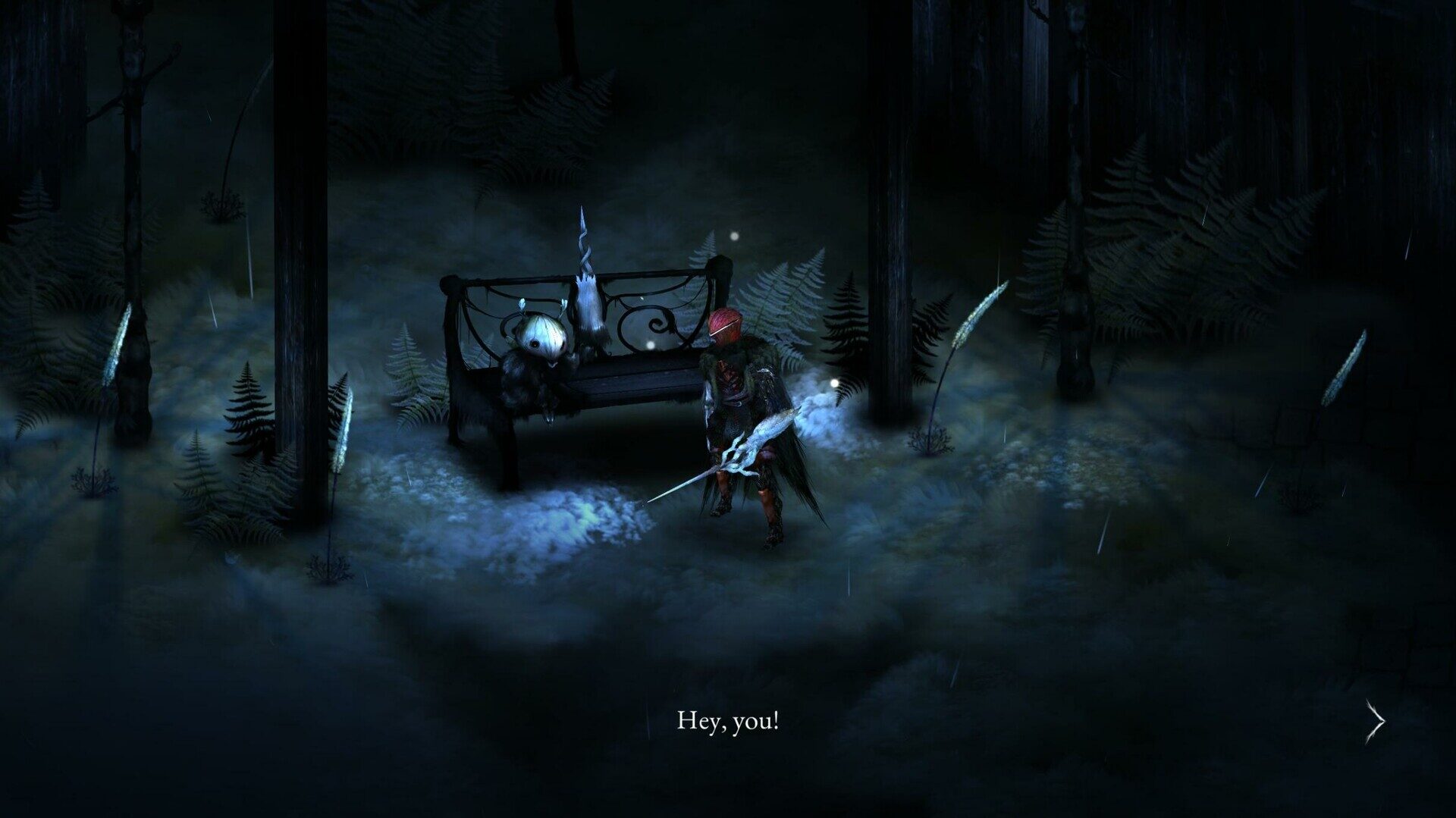
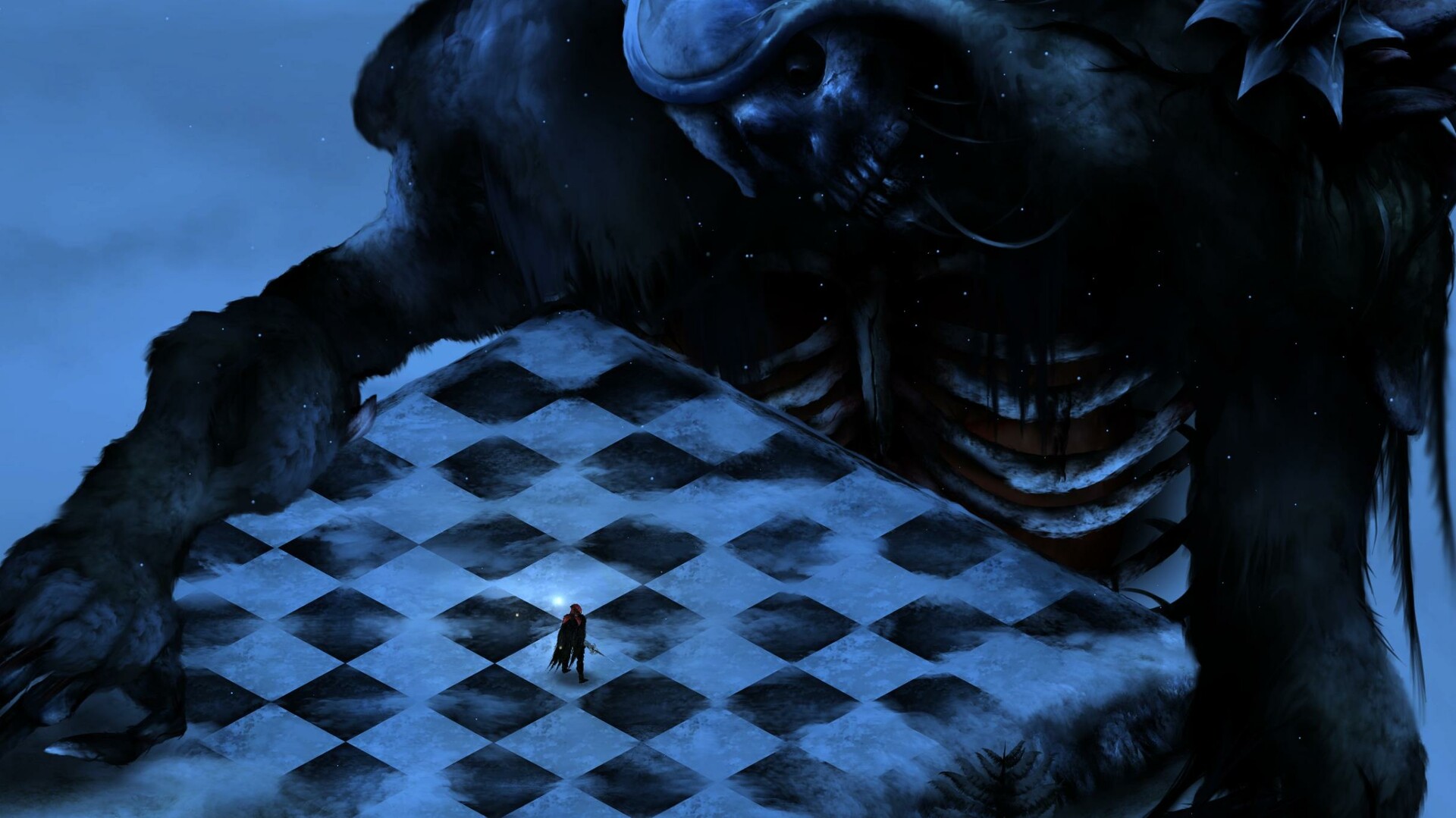
The identity of Perennial Order is affirmed above all by its aesthetics. Each setting, each creature seems torn from a painted canvas, where horror and nature mingle in a permanent contrast. The 2D style, worked as a dark and organic illustration, refers as much to forest myths as to Gothic visions. The bosses, veritable plant nightmares, stand like moving sculptures made of branches, wilted flowers and deformed bodies. Their appearance on the screen imposes a visual shock which marks the retina and nourishes the oppressive atmosphere of the game.
The environments oscillate between invaded ruins, haunted clearings and dark expanses. They do not shine by their variety, but by the coherence with which they support the artistic purpose. Each place seems smothered by vegetation that no longer has anything natural, each color seems desaturated, absorbed in a palette of sick greens and earthy browns. It’s an artistic direction that embraces its monolithic side, even if it means wearing it out.
On the sound side, Perennial Order opts for a discreet but heavy score. The ambient layers, muffled percussions and distant choirs reinforce the feeling of oppression. Silence, often, becomes an instrument: it precedes the arrival of a boss, increases the wait, or makes the explosion of sound of an upcoming fight even more violent. The sound effects are of particular importance: the cracking of a branch, the breath of a creature, the vibration of a blow received are enough to reinforce the immersion. If the music sometimes struggles to convey memorable themes, the whole effectively serves the atmospheric density that the game cultivates.
The thorns of experience
On Xbox Series, Perennial Order benefits from solid optimization that maintains fluidity even during the most intense clashes. The 2D style, less demanding than three-dimensional environments, allows the game to maintain reassuring technical stability. The loading times are short, the animations fluid, and no major slowdown compromises the precision essential to a title where death can occur at the slightest error.
The game also focuses on cooperation, available both locally and online. For two, the experience gains in intensity: the difficulty adjusts, the bosses become more resistant, but the shared dimension transforms the ordeal into a collective rite. However, we will regret some practical limitations: the absence of a fluid “drop-in” system requires organizing the session from the start, and certain saves are not always transferred easily from one player to another.
Replayability relies above all on mastery of combat. Each victory can make you want to come back to perfect your technique, attempt a mistake-free challenge, or explore other approaches as a duo. However, the absence of additional modes or more marked variations limits the long-term prospects. The game is clearly aimed at a specific audience: those who agree to repeat, to fail, and to be reborn again, to enjoy rare but memorable victories.
Verdict
The dizziness of a cruel garden
7/10
Perennial Order is not a game that seeks to please as many people as possible. It stands as a radical experience, a dive into a plant universe where beauty is always accompanied by a silent threat. Every fight is a test, every victory a scar. By refusing the artifices of an explicit narrative and relying on the harshness of an instant death system, Gardenfiend Games delivers a title that divides but which never betrays its intention: to test the player, force them to learn, push them to persevere.
This requirement is its greatest strength and its greatest weakness. It generates a rare satisfaction, that of triumphing after dozens of failures, but it also immediately excludes the curious who would not want to inflict such a rhythm on themselves. The aesthetic, splendid in its darkness, elevates the game to the level of a striking visual experience, but the repetition of the environments ends up attenuating the wonder. Cooperation enriches everything without erasing the harshness of the confrontations, and if the overall content remains limited, it imposes itself with an intensity that few productions know how to maintain.
Pros
- The visual aesthetic, dark and organic, which imposes a strong identity
- Memorable bosses, each with their own unique mechanics
- The demanding, precise combat system, where every move counts
- Local and online cooperation, which reinforces tension and shared satisfaction
- An oppressive sound atmosphere, playing on silence and noisy details
- A coherent artistic direction, which supports the universe from start to finish
Cons
- One-shot death, frustrating for some, sometimes poorly telegraphed
- Lack of notable variety in environments and exploration
- Sometimes laborious back and forth between zones and combats
- An effective soundtrack but not very memorable in terms of themes
- Co-op, well thought out, but lacking fluidity in session management
- A requirement such that it excludes a large part of the potential public
More in Video games
Full library 8.5/10
Train Sim World 6
PS5 8.5/10
Agatha Christie – Death on the Nile
PS5 6.5/10
Brews & Bastards
PS5 9/10
Frostpunk 2 Console Edition
PS5 7/10
Folly Of The Wizards
PS5 8.5/10
Towa and the Guardians of the Sacred Tree
PS5 8.5/10
Dying Light: The Beast
PS5 9.5/10
Borderlands 4
PS5 8/10
Triangle Strategy
PS5 6/10