
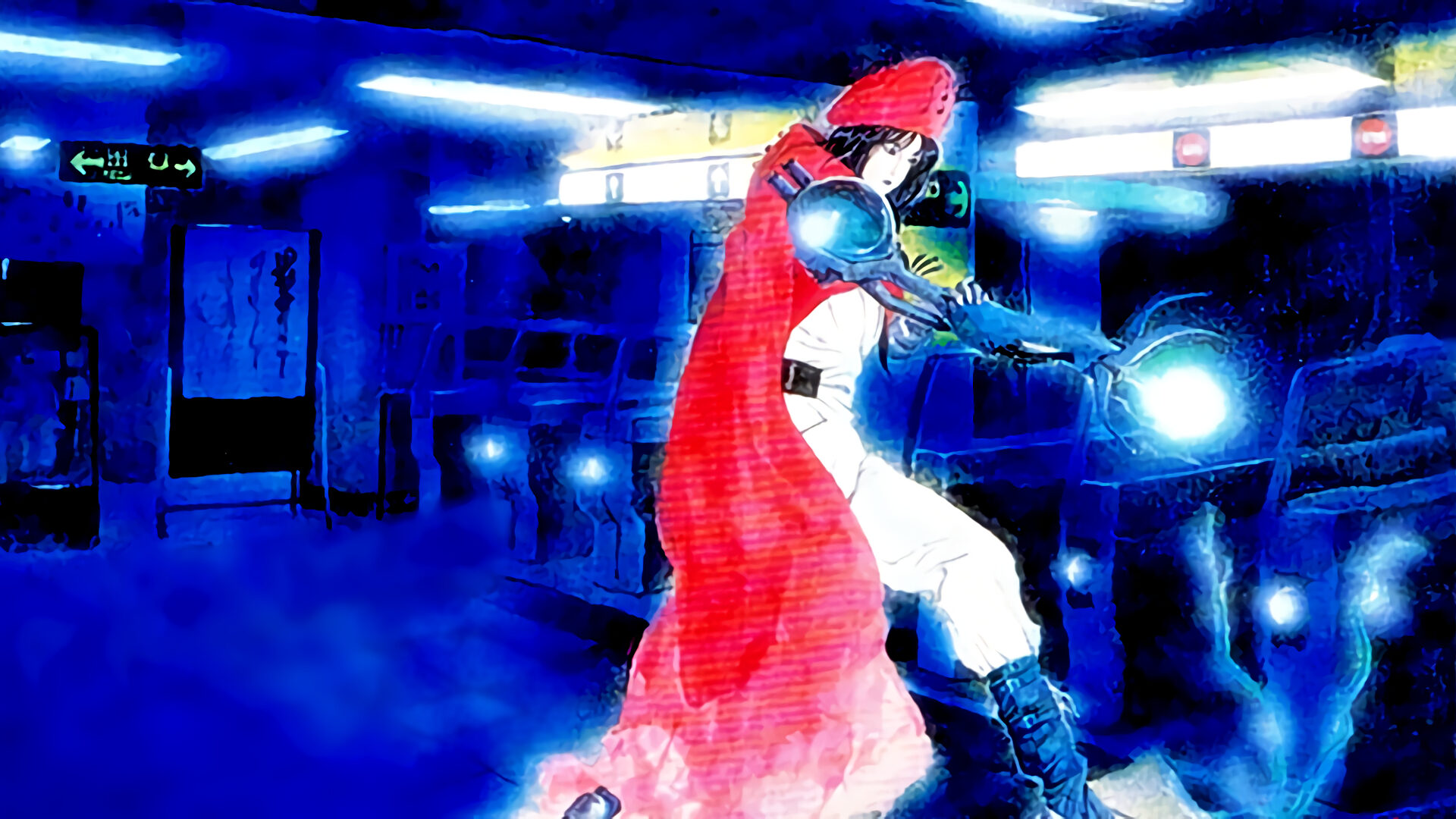

Psycho Dream
The digital nightmare from another age
Score: 6/10
Images and videos




At a glance
We liked
- A truly disturbing atmosphere
- A visual identity that quickly leaves an impression
- A strangeness that gives it a real presence
- Welcome modern quality-of-life options
We liked less
- Very stiff gameplay
- A short, basic structure
- Fights sometimes more rough than intense
- An experience sustained more by its atmosphere than by its precision
 By Farrel Grimwood · published · 7 min read
Contents
Released on September 5, 2025 on consoles, Psycho Dream resurrects a Japanese action platformer from 1992 that remained on the fringes for a long time, first appearing on Super Famicom under the Riot banner, a division of Telenet Japan, before disappearing from Western radars despite plans for an American release that were ultimately canceled.
This reissue by Edia and Ratalaika does not just put an old curiosity back into circulation. It also accompanies it with its usual comfort tools, between rewind, save states, screen filters, gallery and jukebox, as if to make a game more accessible which belongs to an otherwise less conciliatory era.
The starting point retained something singularly catchy. In a world where young people get lost in D Movies, a form of virtual reality from which some never return, two agents of the Diamond Dogs commando, Ryo and Maria, are sent into a nightmare universe to save young Sayaka before it is too late.
All the promise of Psycho Dream is already there, in this tense science fiction, a little dirty, a little strange, where the cyberpunk imagination of the early 90s meets a horror sensibility much more unstable than the average action game of its time.
It is also this status of a slightly offbeat vestige that makes the game interesting. Psycho Dream has neither the aura of a great rediscovered classic, nor the purity of an unjustly forgotten gem. Rather, it arrives with this more murky scent of cult works by accident, of these titles that remain in the memory as much for their strangeness as for their true qualities.
But behind its sick virtual reality universe, its synthetic nightmare aesthetic and its late return to modern consoles, does Psycho Dream really deserve to be rediscovered as a curiosity which still has something to say, or only as a relic whose power of fascination exceeds the real qualities a little too far?
A nightmare better posed than actually inhabited
The world of Psycho Dream rests on a strong foundation. The game imagines a society where part of the youth allows itself to be absorbed by D Movies, virtual reality experiences so invasive that some end up never returning. These victims, the Sinkers, die little by little in the real world while their minds remain trapped in these artificial nightmares.
It is in this context that Ryo and Maria, members of the Diamond Dogs, are sent to save young Sayaka before it is too late. In a few lines, the game thus establishes an idea of dark, almost sickly science fiction, which immediately gives it a real singularity.
This starting point is more than enough to create a real hook. Psycho Dream does not seek a grand fresco, but it establishes a disturbed mental landscape, between flight from reality, synthetic imagination and diffuse horror. There is something very dated about this premise, of course, but also something curiously tenacious. This vision of a youth caught up in virtual worlds to the point of erasure still retains a rather disturbing resonance today. The game already has part of its personality there, in this way of bringing a sick future into existence with very few elements.
On the other hand, Psycho Dream tells its idea better than its characters. Ryo and Maria have distinct profiles, even in their way of fighting, but above all they remain action figures. Their presence serves the rhythm, progression and readability of the game much more than it nourishes real writing. Sayaka herself functions above all as a dramatic starting point, as an emergency to be resolved, more than as a truly embodied character. The setting quickly leaves an impression. The figures leave a much lighter trace.
This is not necessarily a fatal flaw for a game of this format. Psycho Dream never has the ambition of a broad or nuanced story. But this clearly establishes its priorities. Here, writing serves above all to establish an atmosphere and give color to the journey. On this point, the game hits the mark. It doesn’t develop much, but it suggests enough to give rise to a discomfort, a strangeness, a tension which well accompany this descent into a virtual world contaminated by its own monsters.
An old action machine, dry and dented
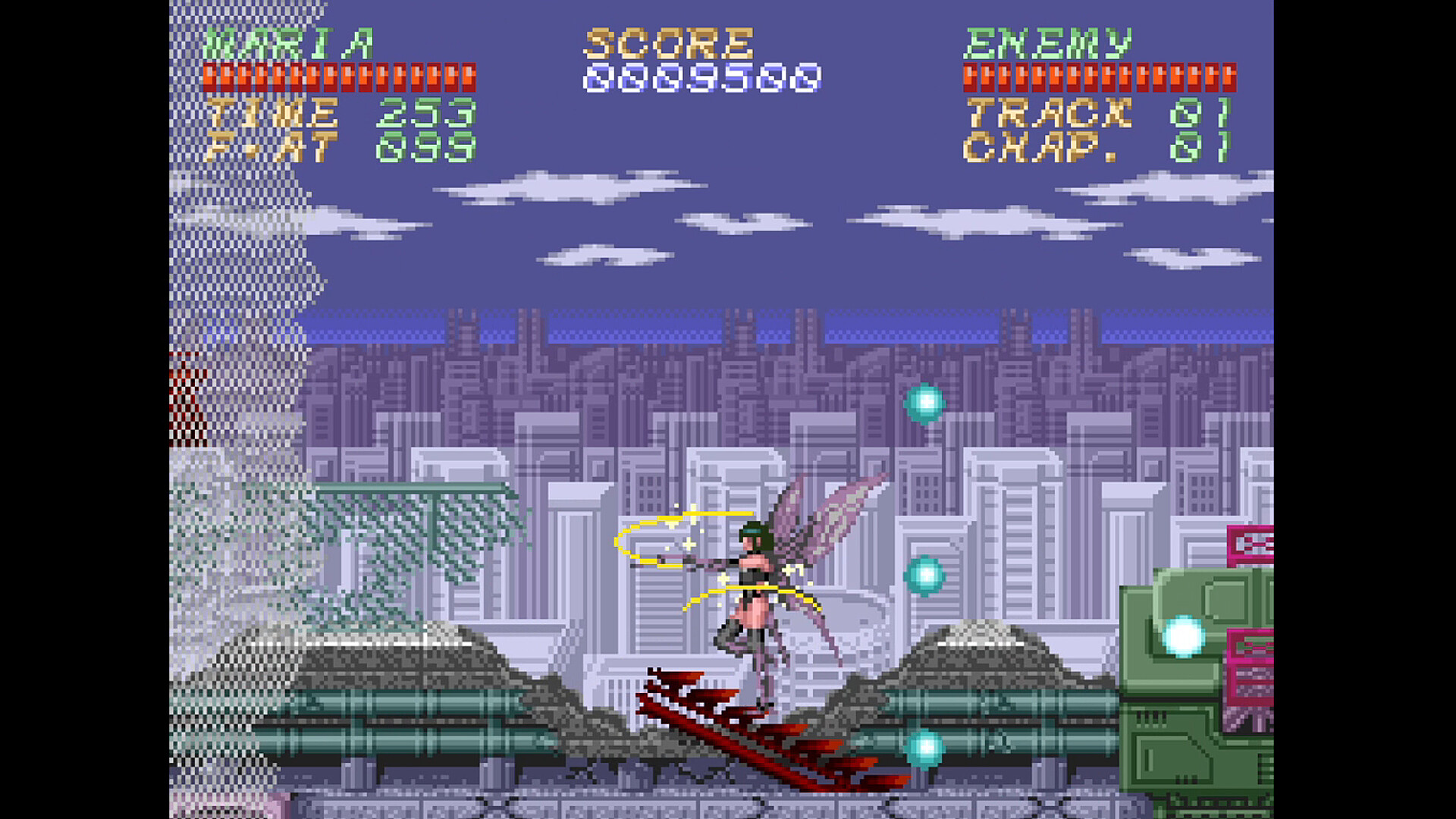
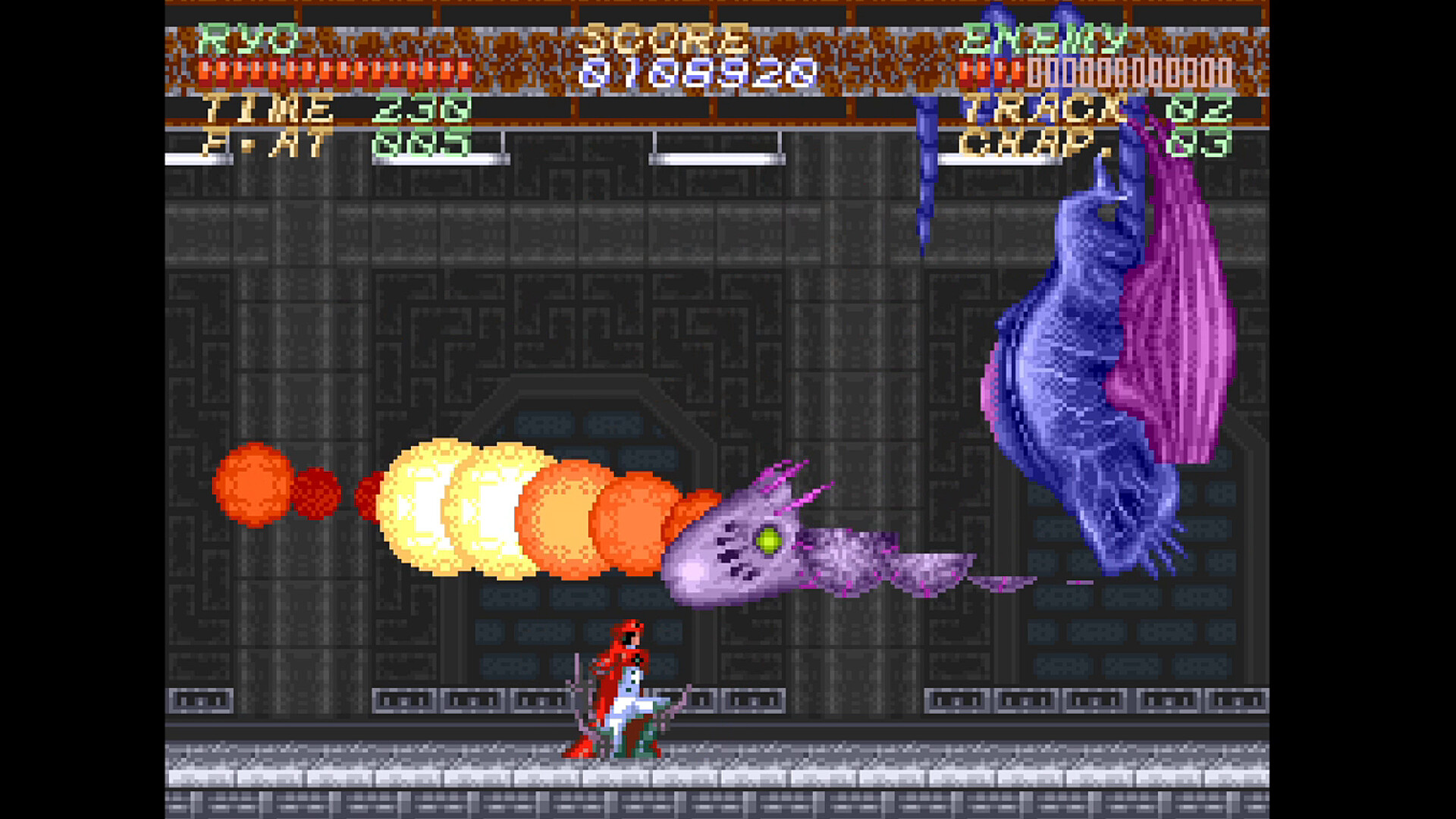
Psycho Dream gets straight to the point. Six stages, two playable characters, some weapon variations via crystals collected along the way, and an extremely direct platformer action structure. Ryo fights with a sword, Maria with a whip, each with a slightly different approach, but the game never seeks to complicate its base. It advances on a simple logic: progress, endure, hit, survive, then start again until the next boss. It’s dry, immediate, almost brutal in the way it is delivered.
Psycho Dream is not trying to be richer than it is. It very quickly imposes its rhythm, its strange bestiary, its transformations linked to certain crystals and this feeling of an old Japanese action game built to put the player under pressure more than to seduce them with the flexibility of its systems. There is a form of primitive efficiency there which fits well with its digital nightmare universe. When everything aligns, the game even finds something quite frantic, almost furious, in the way it makes enemies, projectiles and grotesque bosses appear on the screen.
But this harshness also immediately raises its limits. Movements lack fluidity, attacks do not have the range or clarity that we would like, and certain confrontations give the impression less of a well-maintained challenge than of a game with which you have to agree to deal. Bosses, in particular, tend to drag on, particularly because their windows of vulnerability or the real impact of your hits are not always clear. This is not a brilliant difficulty. It is often a rough, clumsy difficulty, typical of these games whose identity lies as much in their glitches as in their qualities.
The level design follows exactly this logic. Psycho Dream brings together courses which stand out above all for their visual strangeness and the pressure they maintain, much more than for any real sophistication in their construction. We advance in twisted, aggressive spaces, populated by absurd or disturbing creatures, with this constant impression of going through a bad dream on acid. This gives the game a certain presence. On the other hand, this is not enough to renew the pleasure of progression. Certain sequences stretch out, certain passages seem more repetitive than intense, and we quickly feel that the journey owes a lot to its imagination, more than to the finesse of its architecture.
What helps today is obviously the presence of the modern options of this reissue. Rewind, save states, turbo, filters, cheats: all this does not change the heart of the game, but clearly softens the roughest parts of it. And this is undoubtedly the best way to approach Psycho Dream in 2026. Not as a great action game found intact, but as a frantic, battered, sometimes painful, often fascinating curiosity, whose ideas and atmosphere resist time better than the real precision of its gameplay.
A sick aesthetic that stays in your head for a long time
This is undoubtedly where Psycho Dream retains its strength best. Visually, the game is obviously no longer impressive in the strict sense, but it still exudes a real strangeness. Its settings, its creatures, its backgrounds and its entire way of twisting space give the feeling of going through a bad electronic dream, a synthetic world contaminated by something profoundly unstable. Where many old action games today are content with their heritage value, Psycho Dream at least retains this ability to establish an immediately recognizable atmosphere.
This visual identity has less to do with the finesse of its execution than with the violence of its imagination. The enemies have something formless, hostile, sometimes almost absurd. The environments oscillate between degraded science fiction, organic visions and psychedelic nightmare. All this is not very harmonious, far from it, but that is precisely what gives it its personality. Psycho Dream never seeks clean beauty. It prefers dissonance, discomfort, the bizarre. And this is what still allows it to convey something today that many better finished productions never achieve.
This evocative force also partly compensates for the technical limitations of the whole. Yes, the animation shows its age. Yes, some elements seem stiff, basic, even a little unappealing. But the game has enough character to go beyond this simple observation. It does not seduce with its visual flexibility. It grips with its ability to create unease, tension, an impression of a dirty and troubled journey through a digital world that seems to be decomposing before your eyes. On this point, there is real consistency between content and form.
The soundtrack extends this feeling very well. Without showing off, it accompanies the action with a synthetic, tense, often oppressive tone, which fits perfectly with this journey into a mental universe in ruins. Again, it’s not about richness or sophistication. It’s a question of tone. Psycho Dream knows how to make its unease tangible, and its music plays a full part in that. The presence of a jukebox in this reissue is not anecdotal as this soundtrack contributes to the identity of the game.
Verdict
A flawed nightmare, but unmistakably its own
6/10
Psycho Dream is not a great classic suddenly revealed by time. It is an old curiosity, rough, stiff, sometimes frankly clumsy, but carried by an identity that cannot be confused with any other. Its action clearly shows its age, its structure remains basic, and several sequences quickly remind us of the limits of a game born in the early 90s.
But aside from that, there is this sick atmosphere, this visual strangeness, this way of transforming a simple succession of courses into a feverish crossing of a decomposing virtual world. Not everything has aged well, far from it. However, there remains enough personality, enough confusion and enough relief for this reissue to deserve more than a simple nostalgic glance.
Pros
- A truly disturbing atmosphere
- A visual identity that quickly leaves an impression
- A strangeness that gives it a real presence
- Welcome modern quality-of-life options
Cons
- Very stiff gameplay
- A short, basic structure
- Fights sometimes more rough than intense
- An experience sustained more by its atmosphere than by its precision
More in Video games
Full library 8.5/10
Train Sim World 6
PS5 8.5/10
Agatha Christie – Death on the Nile
PS5 6.5/10
Brews & Bastards
PS5 9/10
Frostpunk 2 Console Edition
PS5 7/10
Folly Of The Wizards
PS5 8.5/10
Towa and the Guardians of the Sacred Tree
PS5 8.5/10
Dying Light: The Beast
PS5 9.5/10
Borderlands 4
PS5 8/10
Triangle Strategy
PS5 7/10