
Space Adventure Cobra – The Awakening
The cannon of a memory ready to fire
Score: 8/10
Images and videos



At a glance
We liked
- The Psychogun, original and emblematic, which gives a unique identity to the gameplay.
- Fidelity to the anime: settings, characters and cutscenes respect the work of Buichi Terasawa.
- The assumed retro atmosphere, between run-and-gun and 2D platform.
- The intact charisma of Cobra and Lady Armaroid, which is enough to carry the adventure.
We liked less
- Rigid handling and detection inaccuracies hamper the action.
- Bosses that are too long and frustrating, which break the rhythm.
- Visual repetition and limited variety of environments.
 By Farrel Grimwood · published · 8 min read
Contents
The return of Cobra, pulp icon of 80s manga, today takes the form of a side-scrolling action-adventure game, called Space Adventure Cobra – The Awakening. Developed by the French studio Magic Pockets and published by Microids, this video game project launched on August 26, 2025 on Xbox Series X|S displays a clear ambition: to adapt the first twelve episodes of Buichi Terasawa’s animated series into a game, while capitalizing on the nostalgia of a hero who has become cult for several generations of spectators.
Halfway between run and gun, old-school platforming and Metroidvania hybridizations, this new adventure promises to immerse you in a hallucinatory space universe, made up of cybernetic pirates, interstellar criminal organizations and femmes fatales with multiple secrets. But behind the love of the original material, the question remains: was this revival necessary? And above all, did Cobra deserve better than this first foray on modern consoles?
The myth recycled on steroids
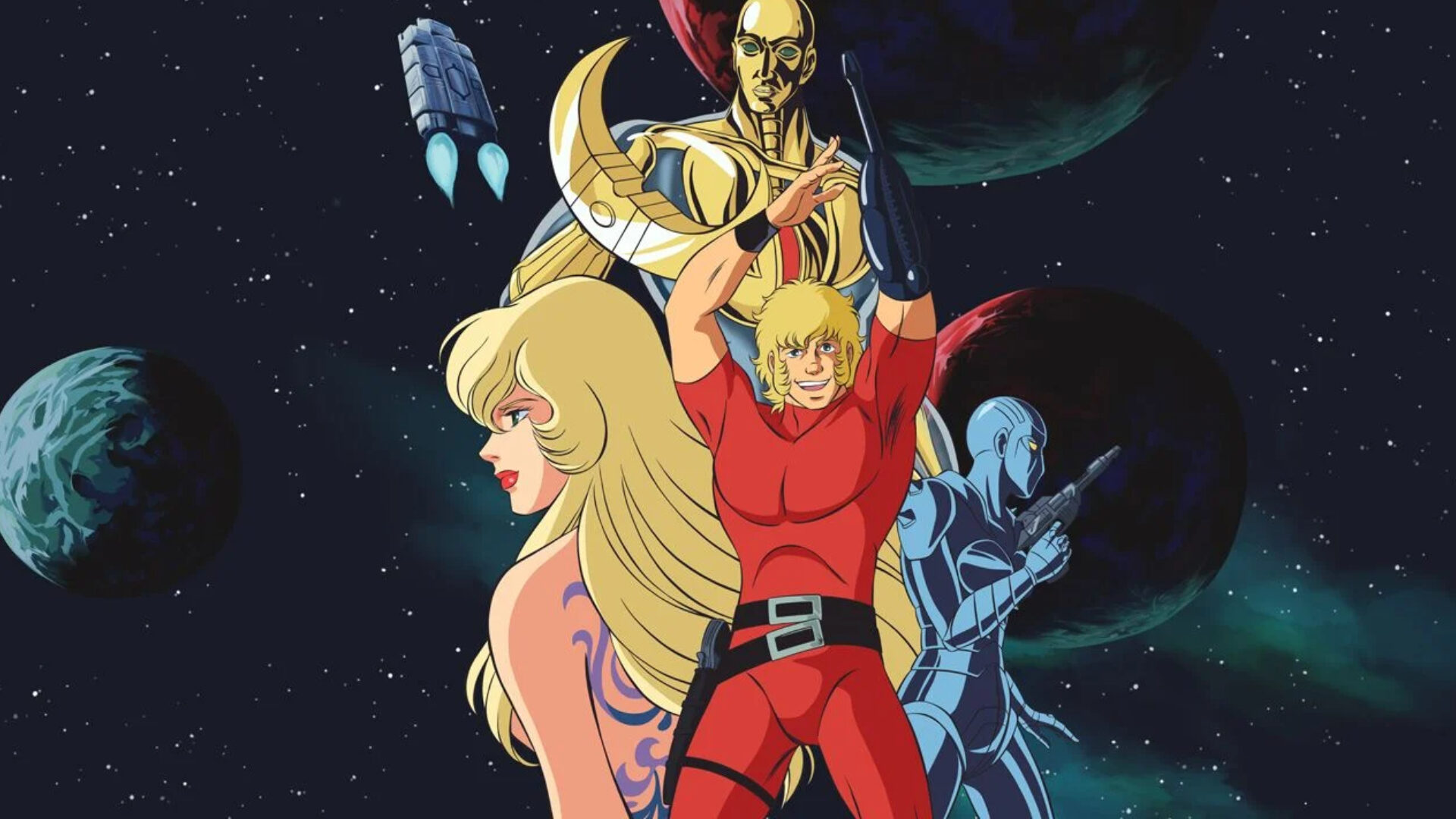
Space Adventure Cobra – The Awakening directly follows the narrative of the first twelve episodes of the original anime broadcast in Japan in 1982, itself adapted from the manga by Buichi Terasawa. You play as Cobra, a former space corsair returned from the dead, equipped with his legendary arm-cannon – the Psychogun – and assisted by the cold and faithful Lady Armaroid. The adventure begins when he crosses paths with Jane, a bounty hunter in search of her two sisters, Catherine and Dominique, all three linked to the mysterious treasure of their father, Captain Nelson. But this personal quest quickly turns into a major conflict against the Pirates Guild organization, led by the enigmatic and formidable Crystal Bowie.
The game offers a narration segmented by chapters, each corresponding to a reinterpreted episode of the anime. This structural choice allows us to remain faithful to the original work while offering a clearly marked linear progression. However, this loyalty is double-edged. If it guarantees respect for the universe and immediate readability for fans, it also restricts any form of reinvention. No new developments, no plot risks taken: the story is content to follow the already known highlights, sometimes at the cost of an excessive simplification of the characterization. The title nevertheless offers four original levels allowing you to play as other heroes.
Cobra, always charismatic in his replies and his casual attitude, suffers here from more than respectful treatment. His motivations, his past, his psychology are certainly barely outlined, but follow a coherent whole in line with the anime. The dialogues fit perfectly into a narration cut between video extracts from the fully redubbed 80s cartoon, confirming the studio’s desire to offer a work that respects its original materials. The only downside to this set clearly comes from the treatment of the levels in question. A simple scene lasting a few seconds is thus transformed into a level lasting around ten minutes, considerably reducing the emotional impact of certain particularly strong scenes.
The staging is in fact limited to a few animated cutscenes, using reworked extracts from the original anime recut for the occasion. If the nostalgic effect works, particularly in the restitution of certain cult moments, the narration loses density. No choice system, no branching enriches the progression. The story is consumed more than it is lived. This gives at certain moments the impression of a story teleported into the gameplay, without any real fusion between narration and action.
The Awakening fully assumes its role of faithful rereading, but at the cost of simplified and diluted writing. The universe of Cobra, although rich in themes (identity, memory, desire for freedom, opposition to technological tyrannies) remains here in the background, summoned without being explored. Newcomers risk seeing a hollow plot, while fans will find a series of frozen icons, as if taken from an interactive museum. What remains is a stylized, coherent universe, but frozen in its own codes.
When the Psychogun loses its precision
The heart of Space Adventure Cobra – The Awakening is based on an alternation between run-and-gun action sequences, 2D platforming, and a hint of progression inspired by Metroidvania. You explore interstellar environments divided into levels, gain new powers, and face waves of enemies until reaching emblematic bosses of the series.
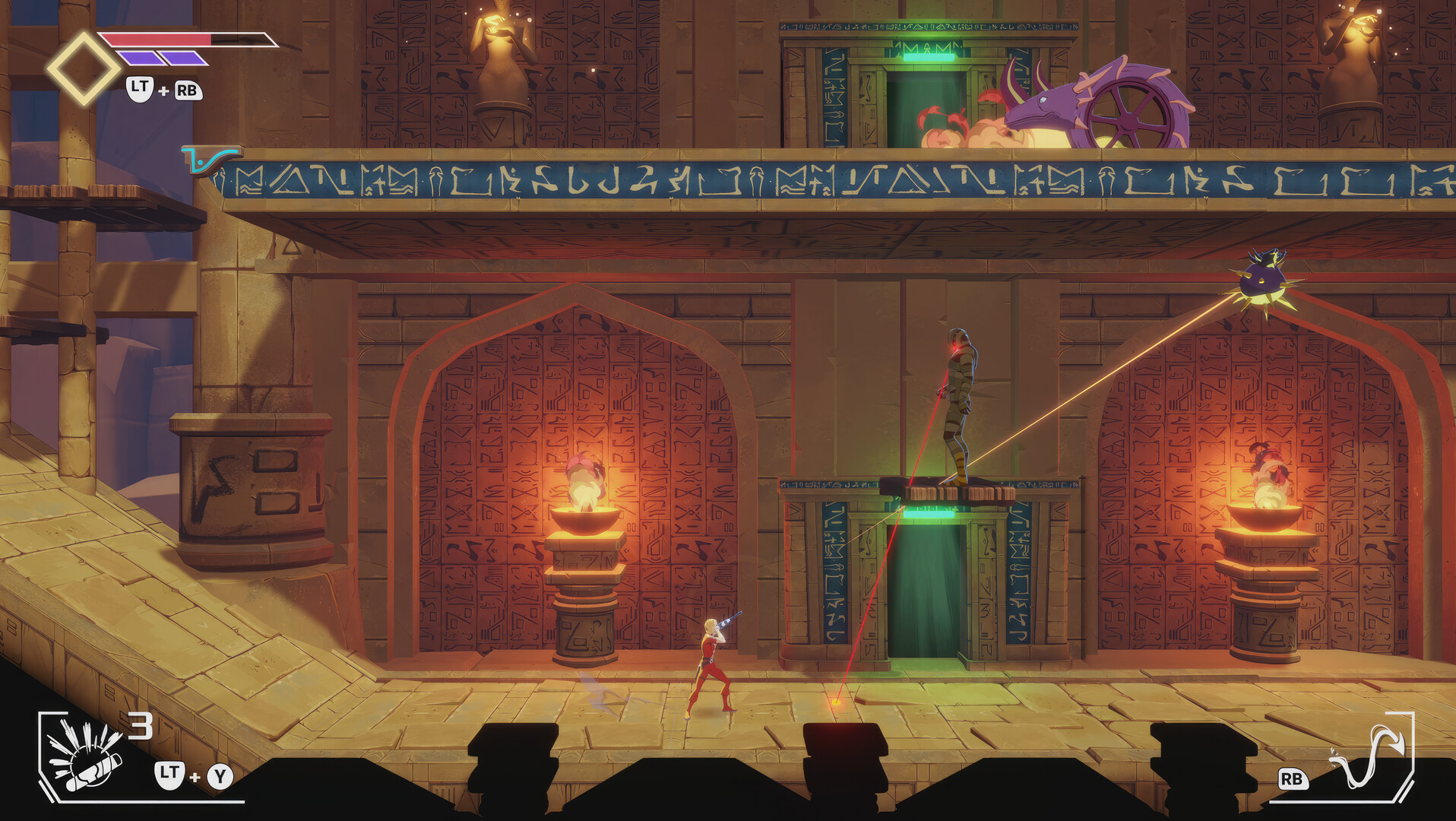
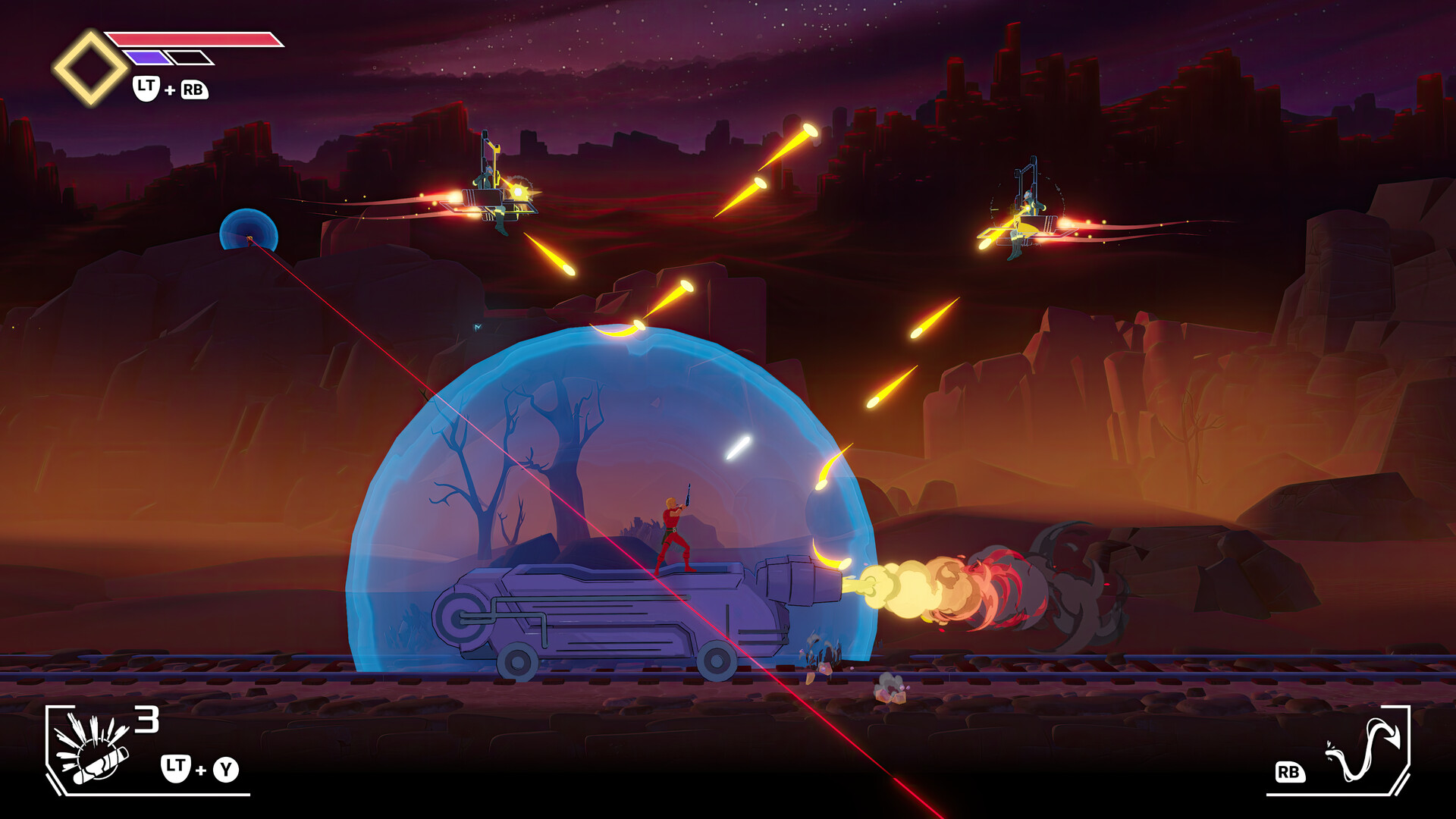
The central element of the gameplay is Cobra’s Psychogun. Fired directly from his left arm, it constitutes the main weapon, equipped with a guided fire mode capable of freezing time to aim at several targets before releasing a devastating salvo. This concept, particularly inventive and pleasant, creates a unique rhythm: between fast-paced action sequences and moments of more tactical planning. However, the technical execution leaves something to be desired. Having to aim with the left directional stick, without ever stopping his movement, makes the gameplay capricious; especially when it is necessary to hit an enemy several times to eliminate them. The result is a strange feeling, especially when Cobra exclaims "I never miss my target" while you do.
On the movement side, the observation is similar. Cobra can run, jump, climb, but his movements lack responsiveness. Adding a crouch button would have made the gameplay much snappier, and its absence makes certain situations unnecessarily laborious. Despite everything, Level Design manages to salvage the experience by fully exploiting Cobra’s capabilities. Some levels are huge and rich in additional sections to explore in order to unlock various improvements or decorations for your ship, others focus on a succession of tricky platforms requiring precision and reflexes.
The boss fights embody the paradox of the game. Thought to be epic confrontations, they frequently turn out to be too long and frustrating. The patterns lack variety, forcing you to repeat tedious sequences rather than exploiting the ingenuity of the Psychogun. The difficulty relies more on endurance than strategy, and even the "medium" difficulty level offers a challenge that can test your nerves.
Paradoxically, the game becomes much more enjoyable in "easy" mode. Here, the majority of classic enemies fall in a single Psychogun hit, which offers a more fluid and brutal progression, reminiscent of the power and precision of the hero. Boss fights also become more manageable and the power gap between your hero and them also becomes more logical and less frustrating.
Finally, the overall structure offers a sequence of chapters-episodes. This choice follows the logic of the anime, but limits the feeling of freedom: we move from one setting to another, without much interconnection, contrary to what the “Metroidvania” label led us to hope. The progression therefore remains more linear than truly exploratory. If at first the title disappoints in this aspect, it quickly takes on meaning. The Awakening is designed as a platform game above all, linear, short, allowing great replayability by adding challenges (collectibles to find, speedruns with recorded times)
The brilliance of anime, the shadow of technical limitations
Visually, Space Adventure Cobra – The Awakening is based on a deliberately retro artistic direction. The environments follow the codes of the original anime: stylized space settings, futuristic bases, exotic jungles and interstellar ships. This aesthetic fidelity is reinforced by the integration of animated sequences taken directly from the 80s series (not from the HD version), used as cutscenes to punctuate the chapters. For Buichi Terasawa fans, the nostalgic effect is undeniable: rediscovering the world of Cobra, its bright colors and its 80s pulp atmosphere, provides immediate pleasure.
However, the technical implementation suffers from visible limits. The sprites and 2D models lack finesse, the animations appear rigid and the general fluidity does not always do justice to the dynamism expected of a modern action game. The settings display limited variety: some levels seem recycled, and visual exploration loses its appeal after a few hours. This impression of repetition weakens a universe which would have deserved more graphic boldness. Conversely, the characters were worked on with rare intensity. The basic enemies always correspond to those present in the anime (with some variations and additions) and, if their animations are the same, this variety and this fidelity once again proves the studio’s respect for its subject.
On the sound side, the game makes a radical choice: rather than modernizing, it offers a deliberately retro soundtrack, inspired by synthetic compositions of the time. The main themes are reminiscent of those of the anime, with a certain effectiveness in the fights and an emphasis on the cutscenes. However, the songs sometimes lack breadth and variation, reinforcing the impression of a repetitive musical loop during prolonged action sequences.
The dubbing, finally, constitutes the greatest success of the title. You have the choice between Japanese and French and, in both cases, the entire cast also redubs the animated sequences in order to provide perfect coherence throughout the work. The actors are in tune with their characters, with a special mention to the voice actor of Cobra, perfectly in tune with Jean-Claude Montalban.
A mixed technical awakening
On a technical level, Space Adventure Cobra – The Awakening turns out to be correct but lackluster. Optimized for the Xbox Series X|S, the game displays decent stability: no major slowdowns, reduced loading times and smooth compatibility with the controller. However, a few rare collision bugs, random enemy placements or even inaccuracies in shot detection disrupt a demanding experience. Nothing game-breaking, but these defects reflect a very slight lack of polish for a 2025 title.
Difficulty is another sensitive point. The game relies on a demanding approach, damage-sponge enemies and tricky passages. Once switched to “easy” difficulty, the title displays all the subtlety of its mechanics and the fluidity of the gameplay. This choice may appeal to purists attached to retro action games, but risks discouraging modern players accustomed to a more controlled difficulty.
In terms of content, The Awakening remains relatively limited. The campaign, segmented into twelve chapters, offers a modest lifespan: around 7 to 8 hours to reach the end, a little more for completionists wishing to unlock all the hidden improvements. In the absence of multiplayer mode or significant additional content, replayability essentially relies on fan nostalgia and the search for optimization in the levels.
Verdict
A flamboyant return despite its flaws
8/10
Space Adventure Cobra – The Awakening achieves the essential: reviving a myth of Japanese pop culture in a respectful and stylized adaptation. Faithful to the first twelve episodes of the anime, it offers fans a nostalgic journey carried by an assumed artistic direction and the intact charisma of Cobra and Lady Armaroid. The Psychogun, the flagship concept of gameplay, breathes a strong identity into the experience, and despite technical rigidity, it provides enough variety to maintain interest and give that very particular taste of coming back.
Certainly, imprecise controls and visual repetition limit the scope of this adaptation. But as a modernized retro capsule, the adventure retains an authenticity and generosity that appeals to fans of the franchise and the curious alike. It's an imperfect title, sometimes frustrating, but which manages to capture the pulp and relaxed spirit of Cobra, which makes it a real success in its register.
Pros
- The Psychogun, original and emblematic, which gives a unique identity to the gameplay.
- Fidelity to the anime: settings, characters and cutscenes respect the work of Buichi Terasawa.
- The assumed retro atmosphere, between run-and-gun and 2D platform.
- The intact charisma of Cobra and Lady Armaroid, which is enough to carry the adventure.
- A synthetic soundtrack that effectively evokes the spirit of the 80s.
- A French dub without the slightest false note.
Cons
- Rigid handling and detection inaccuracies hamper the action.
- Bosses that are too long and frustrating, which break the rhythm.
- Visual repetition and limited variety of environments.
More in Video games
Full library 8.5/10
Train Sim World 6
PS5 8.5/10
Agatha Christie – Death on the Nile
PS5 6.5/10
Brews & Bastards
PS5 9/10
Frostpunk 2 Console Edition
PS5 7/10
Folly Of The Wizards
PS5 8.5/10
Towa and the Guardians of the Sacred Tree
PS5 8.5/10
Dying Light: The Beast
PS5 9.5/10
Borderlands 4
PS5 8/10
Triangle Strategy
PS5 7/10