
Metal Eden
The metallic ballet between an orbital desert and visceral urgency
Score: 8/10
Images and videos


At a glance
We liked
- The brutalist and oppressive aesthetic, consistent from start to finish.
- The combat system is methodical, heavy and rewarding.
- Fragmented narration, which transforms memory into a puzzle.
- Visceral sound design, where every noise becomes a dramatic act.
We liked less
- Visual austerity, which sacrifices variety for coherence.
- Narrative minimalism, sometimes too opaque to arouse immediate emotion.
- Demanding gameplay that risks discouraging less persevering players.
- A deliberately rough progression, which refuses any modern comfort.
 By Farrel Grimwood · published · 6 min read
Contents
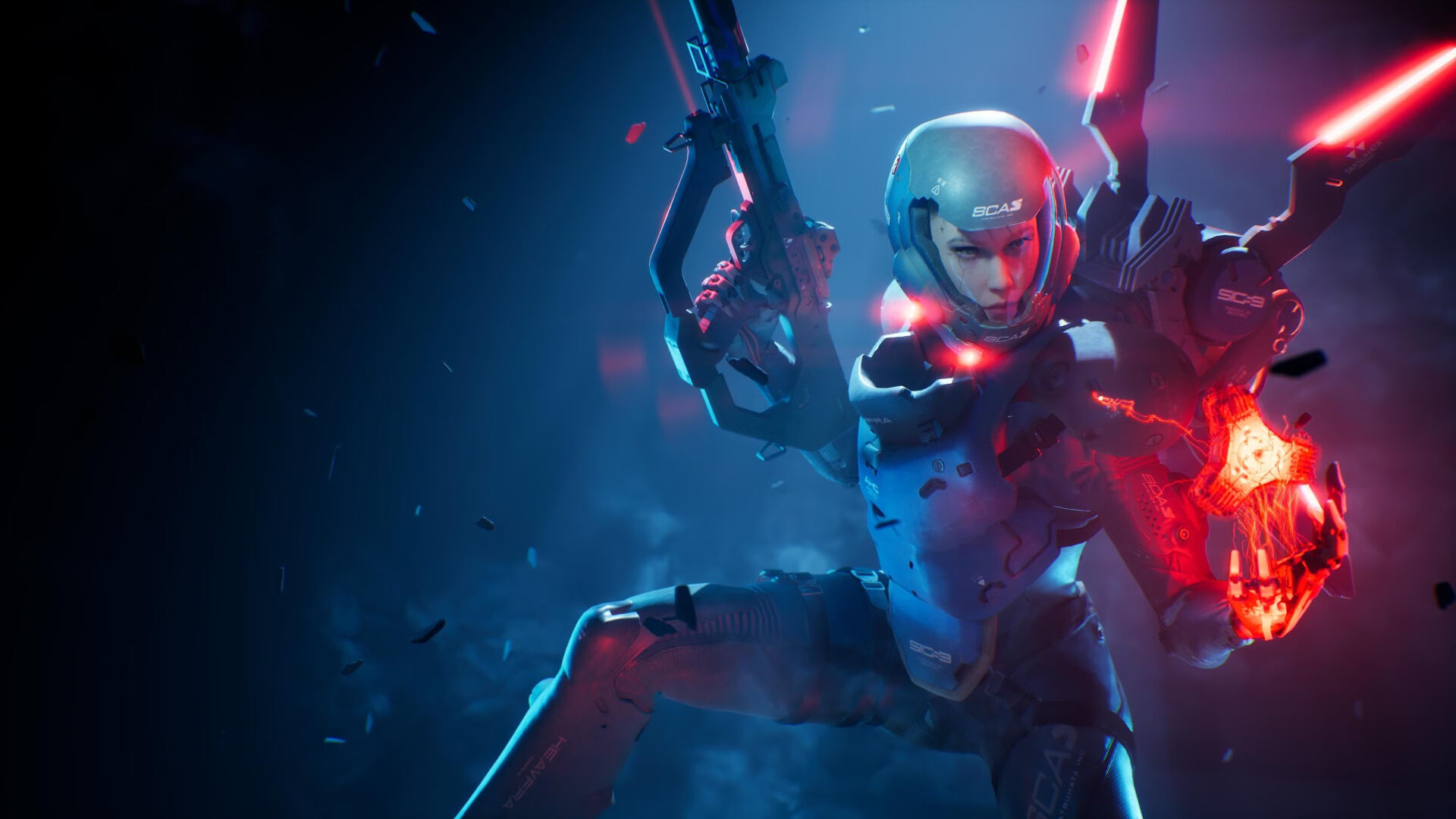
In the tumult of futuristic productions, Metal Eden stands out as an anomaly. Developed by the creators of Ruiner, the game is rooted in a cybernetic aesthetic but refuses the comfort of marked narratives. Here, the action unfolds in a world where iron citadels stand like dead cathedrals, where technology is no longer a promise of progress but a vestige of collapse. It is a work that chooses excess: a universe of burned corridors, mechanical deserts and cyclopean structures where each space tells of a fall more than a victory.
Powered by Unreal Engine 5, Metal Eden seeks less precision of detail than the strength of the impression it creates. The saturated lights lacerate the darkness, the excessive shadows transform the arenas into abyss, and the architecture, oscillating between brutalist and organic, imposes a permanent strangeness. Far from being a simple futuristic shooter, the game claims a hybrid identity: both a murderous dance and a meditation on ruin. An introduction which leaves no escape, and which immediately questions what we call survival in a world which has already ceased to live.
The echoes of Aska, the memory of the Cores
The story of Metal Eden unfolds like an enigma more than a story. Humanity, broken by an unexplained catastrophe, has locked away its consciousnesses in “Cores”: memory fragments, translucent prisons, relics of disembodied survival. Aska, an android sent into this metallic labyrinth, does not embody a classic heroine but a guide for lost souls, a substitute body responsible for snatching these frozen souls from oblivion. This radical narrative choice gives the game an atmosphere that is both mystical and icy: the adventure becomes a funeral quest, a mechanical procession serving dead voices.
The characters never present themselves head-on. They appear in fragments: broken holograms, ghosts of ancient scientists, whispers of survivors lodged in the memories of the Cores. This fragmented narration follows the logic of the world: only pieces, shards, ruins of consciousness remain. As memories are extracted, the player recomposes a tragic fresco where personal history and collective memory merge.
Aska, the central figure, has no human interiority but gains depth through the glances she encounters. Her coldness, her apparent neutrality, contrast with the intensity of the voices she releases. She paradoxically becomes the incarnation of lost humanity: an artificial being who carries the burden of ghosts on her shoulders.
The antagonists are not just corrupt machines or hostile entities. They are the involuntary guardians of a world that refuses to be forgotten. Each drone, each steel titan, seems less driven by the desire to kill than by the desire to preserve ruin in its state. This ambiguity gives the whole thing a metaphysical dimension: the danger is not a clear opposition, but a resistance to change, a deadly inertia.
The story of Metal Eden does not seek the obvious or the spectacular. It advances through allusions, by fragmented visions, by suspended moments where a voice, a face or a reconstituted memory come to crack the opacity of the world. This refusal of a direct explanation can be frustrating, but it contributes to the singular identity of the work: a half-erased fresco, which must be deciphered piece by piece, like reading a burned manuscript.
Iron in motion, the dance of ruins
Metal Eden finds its strength in the alliance of speed and weight, in this paradox where each movement is both grace and burden. The android Aska crosses closed arenas, burned corridors, gutted industrial plains: the level design follows a fractured rhythm, between dizzying verticality and confined spaces saturated with traps. Nothing is arbitrary in these environments: a metal ramp becomes a springboard, an abyss reads as a trap as much as a promise, a light beam guides as much as it blinds. Each zone imposes its own logic, forcing the player to relearn and improvise.
The gameplay relies on a clear duality: the slashing attack of the energy sword and the extreme mobility of cybernetic parkour. The clashes favor precision: a precise dodge, a counter placed at the last moment, a heavy strike which tears the armor of a colossus drone. Here, there is no frantic shooting or continuous massacre: each duel is like a choreography, where mistakes are costly and success provides immediate intoxication. The lock-on system and the readability of the animations accentuate this tension, forcing us to anticipate as much as react.
Progression revolves around collecting Cores. Each memory fragment extracted is not only a narrative reward: it subtly modifies equipment, opens additional skills, strengthens endurance or arsenal. The choice is never simple: should you improve raw power, speed, or the ability to last longer in prolonged fights? The game thus transforms optimization into an extension of the narrative: the memory of the dead fuels the survival of the living.
The design of the enemies supports this logic. The basic units, fast and unpredictable, serve to break the rhythm; the steel titans, slow and massive, require a game of anticipation and placement; the hybrid creatures, half-metallic, half-organic, remind us that the universe is not a simple technological dystopia but a world where metal has colonized flesh. Each of these encounters, placed in environments designed as geometric traps, requires a strategic reading of the places.
This requirement does not exclude experimentation. The game includes phases of pure parkour, where fluidity takes precedence over confrontation: jumps, wall runs, crossing chasms, dizzying climbs. These suspended moments give the player a necessary breath, a poetic contrast with the brutality of the combat. It is in this balance between violence and freedom that Metal Eden asserts its identity.
The gameplay loop, finally, refuses ease. Each return to the hub is a dark breath, where we contemplate the Cores recovered, where we measure progress less in numbers than in ghosts released. Progress is not linear but circular, fractal: each mission opens a new branch, each victory reveals a deeper scar. A demanding design, sometimes rough, but always inhabited by a coherence which makes pain a driving force of play.
A cathedral of metal, a score of ashes
Visually, Metal Eden imposes a universe that is more sculpture than decor. The environments are designed as broken monuments: immense metal arches eaten away by rust, bridges suspended above the void, carcasses of machines frozen in funerary poses. The artistic direction, inherited from Reikon Games’ taste for brutalism, does not seek ornament but excess. Everything is angular, oppressive, saturated with straight lines that crush the horizon. The world does not welcome: it crushes, it swallows, it leaves an impression of empty grandeur.
The color palette accentuates this feeling. Between ash grays, incandescent reds and flashes of electric blue, the image becomes an almost monochrome fresco where the light cuts through every detail. Unreal Engine 5 gives textures clinical precision: shimmering metallic surfaces, incandescent particles, smoke that rises from the ruins like consumed prayers. Each scene is an etching of industrial apocalypse. The effect is hypnotic but also austere: variety gives way to coherence, and this coherence is left like a lasting imprint.
The enemies participate in this aesthetic. The warrior drones, sharp silhouettes, merge with the architecture as if they came from it; the massive titans, covered with luminous symbols, seem cut from the same material as the columns and arches. As for the organometallic hybrids, they introduce an additional note of concern: their half-flesh, half-steel bodies remind us that in this world, even life is devoured by structure.
The soundtrack extends this visual rigor. No recognizable melodies or orchestral themes: only synthetic layers, muffled pulsations, bass rumbles which vibrate like an underlying threat. During the fights, the tempo accelerates, saturated with mechanical percussion and abrasive electronic riffs. Between the clashes, silence reigns, punctuated by industrial sounds: creaking metal, distant echoes, buzzing circuits. The ear finds itself as oppressed as the eye, caught in a spiral of continuous tension.
The sound design, finally, takes care of every detail. The friction of the sword against armor, the metallic breath of an activating drone, the echo of footsteps in an iron cathedral: each noise becomes a dramatic element. Nothing is neutral, nothing is decorative. The sound acts as an invisible guide, like a second skin of the decor.
In this fusion of visual and audio, Metal Eden does not seek seduction but immersion. It is not a world to contemplate, it is a world to endure. And it is precisely this heaviness, this uncompromising intensity, which gives the game its aesthetic singularity.
Verdict
The metal flower, the thorn of challenge
8/10
Metal Eden emerges as a radical work, heir to the cybernetic harshness of Ruiner but transcended by a broader ambition. Everything in its universe exudes rigor: fragmented exploration, heavy and methodical combat, an oppressive aesthetic that transforms each setting into a mausoleum. Where so many futurist productions multiply artifice, it chooses brutal restraint, narrative minimalism, the weight of symbols.
Its limits are clear: a visual austerity that can be boring, a narration that prefers allusion to explanation, gameplay that is unforgiving. But these flaws are not accidents: they are the direct consequence of a deliberate intention. Metal Eden does not open its arms, it extends its claws. It does not seek to appeal to everyone, but to leave a deep impression on those who accept its pact.
In this tension, the game finds its strength. Each victory won, each Core freed, each inhabited silence resonates like an unforgettable reward. Metal Eden is not light entertainment: it is a harsh journey, a meditation on ruin, an experience that leaves scars.
Pros
- The brutalist and oppressive aesthetic, consistent from start to finish.
- The combat system is methodical, heavy and rewarding.
- Fragmented narration, which transforms memory into a puzzle.
- Visceral sound design, where every noise becomes a dramatic act.
- Total coherence between universe, gameplay and artistic direction.
Cons
- Visual austerity, which sacrifices variety for coherence.
- Narrative minimalism, sometimes too opaque to arouse immediate emotion.
- Demanding gameplay that risks discouraging less persevering players.
- A deliberately rough progression, which refuses any modern comfort.
More in Video games
Full library 8.5/10
Train Sim World 6
PS5 8.5/10
Agatha Christie – Death on the Nile
PS5 6.5/10
Brews & Bastards
PS5 9/10
Frostpunk 2 Console Edition
PS5 7/10
Folly Of The Wizards
PS5 8.5/10
Towa and the Guardians of the Sacred Tree
PS5 8.5/10
Dying Light: The Beast
PS5 9.5/10
Borderlands 4
PS5 8/10
Triangle Strategy
PS5 7/10