
Kirby and the Forgotten Land – Nintendo Switch 2 Edition + Star-Crossed World
Star-Crossed World
Score: 9/10
At a glance
We liked
- The fluidity and visual clarity offered by the Switch 2.
- The organic integration of Star-Crossed World, which enriches the basic adventure.
- The creativity of new transformations.
- The rearranged soundtrack, between reminiscences and new compositions.
We liked less
- The reuse of certain already known environments.
- A sometimes irregular rhythm in the revisited levels.
 By Farrel Grimwood · published · 6 min read
Contents
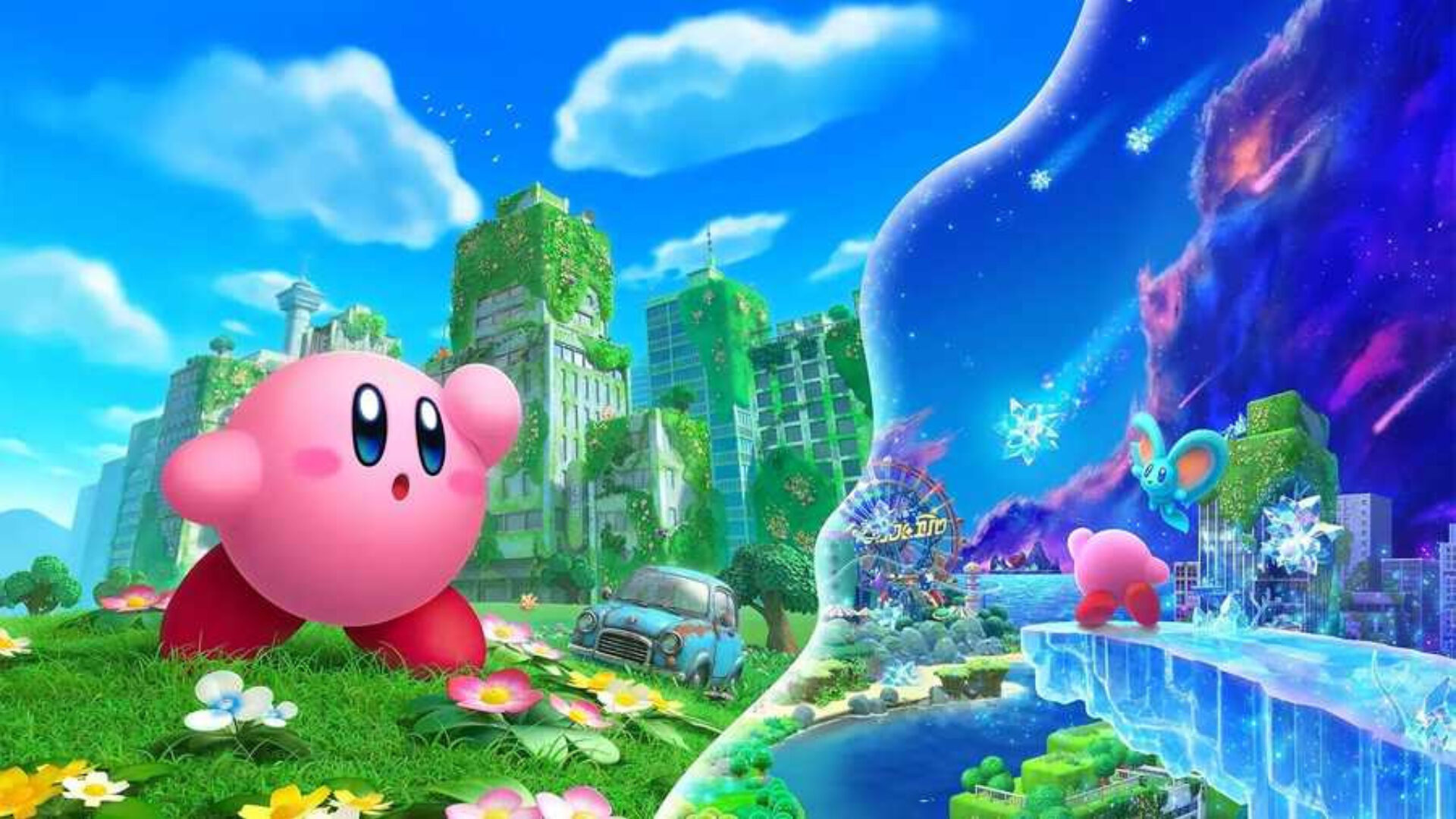
Three years after shaking up the formula with Kirby and the Forgotten Land, Nintendo chose to extend the experience on Switch 2 by offering it a second flowering. More than a simple port, this edition marks a technical and artistic reinvention: increased fluidity, redesigned textures, new lighting effects. But the real promise is embodied in Star-Crossed World, a new expansion which adds a dreamlike dimension to the initial adventure.
Here, the post-apocalyptic ruins of the first opus mingle with a new mythology: fragments of stars falling from the sky, mysterious shards capable of awakening a forgotten power. Each level revisited, each additional challenge becomes a quest to rekindle an extinct constellation.
Shards of light
The story of Kirby and the Forgotten Land – Star-Crossed World is not told through long dialogues but through images and silences. The New World, already marked by abandonment and ruin, is transfigured by the fall of a meteor which scatters fragments of stars across its plains. These shards, vestiges of a forgotten constellation, become the common thread of a quest which is never fully explained but always suggested: to restore light in a universe which had sunk into darkness.
Kirby, a timeless figure, remains an enigma of innocence in the face of this devastated setting. He does not need words to exist: his presence, his lightness, his very appetite, are enough to restore to these landscapes a warmth that they had lost. Elfilin, already a central companion in the initial adventure, takes on a more subtle dimension here. His fragility, his hesitations, his glances become the mirror of a world awaiting reconciliation. Their duo functions as a fragile balance between purity and concern, between tenderness and responsibility.
The Beast Pack, always present, is not content to replay its role as a hostile horde. It becomes the first obstacle to collecting the fragments, the incarnation of a chaos that refuses to go out. However, it is not their roars that stand out the most, but the lost silhouettes that we come across at the bend of a level: captive Waddle Dees, crumbling statues, half-erased frescoes. They are the ones who tell, in silence, the memory of a vanished world.
The expansion is not limited to adding enemies or scenery. It introduces a new, almost mystical tone. The celestial fragments, which we collect one by one, are not just a gameplay objective: they embody a collective memory, an erased past that we rekindle like a star in the night. As the constellations are completed, the story becomes denser, not through words but through the feeling of having reassembled something that was bigger than Kirby himself.
Thus, the writing of Star-Crossed World does not seek narrative surprise or the complexity of the arcs. It pursues another objective: to transform a simple quest into a poetic ritual, where each fragment found is a gesture of repair, and where each character, from Kirby to Elfilin through the hostile silhouettes, becomes a witness to a world waiting for light.
Weightlessness as a weapon, ruin as a playground
In Kirby and the Forgotten Land – Star-Crossed World, the gameplay keeps intact the essence that shook up the series in 2022: a controlled transition to 3D, fluid and generous, which retains the simplicity of Copy Abilities while transposing it into an open and malleable space. But this edition on Switch 2 goes beyond simple technical comfort: the increased fluidity, the brilliance of the textures and the sharpness of the animations give each transformation a tangible force, as if the breath of powers had become denser.
The emblematic mechanics impose themselves like a language. The ability to inhale remains the heart, but it unfolds in an expanded space: absorb, transform, extend a combo of blows until it becomes a colorful ballet. Mouthful Mode, already pivotal in the first part, finds new vitality here: dented cars, vending machines, living staircases become so many variations that transform the environment into malleable terrain. The expansion adds its own excesses: giant springs, light panels, animated gears. Each new object swallowed becomes an ephemeral puzzle, a key that redefines the limits of the setting.
The level design is based on a balance between free exploration and tight challenges. Each world retains its structure: a succession of thematic zones, from lush jungle to rusty factories; but is enriched with celestial variations. The star fragments are scattered like shards of constellations: hidden in crevices, offered after a tense platform sequence, won at the end of a duel against a colossal boss. This rhythm creates a constant alternation: running forward, then slowing down to search, then confronting.
The combat retains the smoothness of an accessible game, but the Switch 2 allows you to refine the collisions, to add a new weight to the clashes. Certain new bosses embody this desire: massive figures covered in stellar crystals, which require you to learn their patterns, to juggle between dodge and counterattack. The evolving skills, already present in the initial opus, gain in variety: each Copy Ability can be strengthened in the laboratory, offering surprising variations that stimulate replayability.
Star-Crossed World also enriches the additional activities. Timed challenge courses, where the use of a specific transformation becomes a speed puzzle, are added to the combat arenas. The presence of a redesigned “Ultimate Cup” acts as a rite of passage: endurance, precision and mastery are required in a succession of fights that leave no respite.
The game design, finally, succeeds in preserving accessibility without giving up depth. Everything is designed to welcome the newbie as well as the veteran: collecting Waddle Dees remains simple, but the quest for star fragments requires finer observation, more methodical exploration. In this double reading, Kirby and the Forgotten Land – Star-Crossed World finds its balance: a work welcoming on the surface, but rich in layers for those willing to dig.
Azure crystals, melodies of light
The aesthetic of Kirby and the Forgotten Land – Star-Crossed World has never looked so accomplished. The game finds new clarity on Switch 2. The textures, softened without losing their richness, breathe new life into environments where nature covers the concrete, where fields of flowers pierce the cracked asphalt. Each level becomes a painting: an abandoned amusement park where vegetation has reclaimed its rights, a beach bathed in orange light where sunken buildings can be seen beneath the surface, a stellar mountain studded with incandescent crystals.
Star-Crossed World accentuates this visual poetry. The fall of celestial fragments modifies existing places: in the plains, bursts of light transform the topography; in factories, crystals fit into rusty machines; in the heavens, astral arches appear like bridges to another dimension. This juxtaposition between the ruin and the crystalline miracle gives the settings a new depth, both melancholy and magical.
The artistic direction succeeds in balancing childish accessibility and the seriousness of the subject. Kirby, a pink ball always luminous, contrasts with the austerity of the environments. This contrast is assumed: it underlines that tenderness and lightness can remain even in a world in decay. In the new levels, this contrast becomes even more striking: the ethereal crystal illuminates the dull ruins, like a visual metaphor for hope.
The soundtrack, faithful to the spirit of the series, stands out as a vector of emotion. Old themes return, rearranged with richer, more precise instruments, magnified by the sonic power of the Switch 2. New compositions linked to celestial fragments add a cosmic dimension: aerial layers, crystalline percussion, suspended melodies that seem to float outside of time. The combat music gains in intensity: more pronounced riffs, more complex orchestrations, while retaining the liveliness and fantasy specific to Kirby.
The meticulous sound effects fully contribute to this immersion. The sound of a collected fragment, crystalline and sparkling, is etched like a sonic signature; the rustling of the grass, the running of the water or the cracking of the concrete reinforce the sensation of crossing a living world, in ruins but inhabited.
Between its transfigured visuals and its reinvented soundtrack, Kirby and the Forgotten Land – Star-Crossed World offers a total sensory experience. It’s less a simple update than a re-enchantment: the same world, but illuminated by a new light.
Verdict
The constellation found
9/10
Kirby and the Forgotten Land – Star-Crossed World stands out as much more than a reissue. By harnessing the power of the Switch 2, HAL Laboratory and Nintendo transform a recent classic into a transfigured work, more fluid, more vibrant, more dense. But it is the extension which gives it its new identity: a cosmic fresco where the fragments of stars give the story an almost mystical poetry, and where each revisited level turns into a luminous ritual.
Everything is not free from flaws: certain repetitions betray the structure inherited from the base game, some recycled environments attenuate the effect of novelty, and the narrative simplicity sometimes leaves the feeling of a story unresolved. However, the aesthetic coherence, the wealth of gameplay finds and the balance between accessibility and depth make this edition a resounding success.
It's not just Kirby that we find: it's a promise, that an already known world can be reborn in another light and once again establish itself as an unmissable adventure.
Pros
- The fluidity and visual clarity offered by the Switch 2.
- The organic integration of Star-Crossed World, which enriches the basic adventure.
- The creativity of new transformations.
- The rearranged soundtrack, between reminiscences and new compositions.
- The balance between simplicity of access and richness of exploration.
Cons
- The reuse of certain already known environments.
- A sometimes irregular rhythm in the revisited levels.
More in Video games
Full library 7/10
Ariana and the Elder Codex
SWITCH 6.5/10
Kingdom’s Return: Time-Eating Fruit and the Ancient Monster
SWITCH 3.5/10
Ultra Bonk Survivors
SWITCH 9/10
Inazuma Eleven: Victory Road
SWITCH 8/10
Romancing SaGa -Minstrel Song- Remastered International
SWITCH 6.5/10
Winter Burrow
SWITCH 7/10
Reus 2
SWITCH 6/10
Snoopy & The Great Mystery Club
SWITCH 6.5/10
Lost in Fantaland
SWITCH 7.5/10