
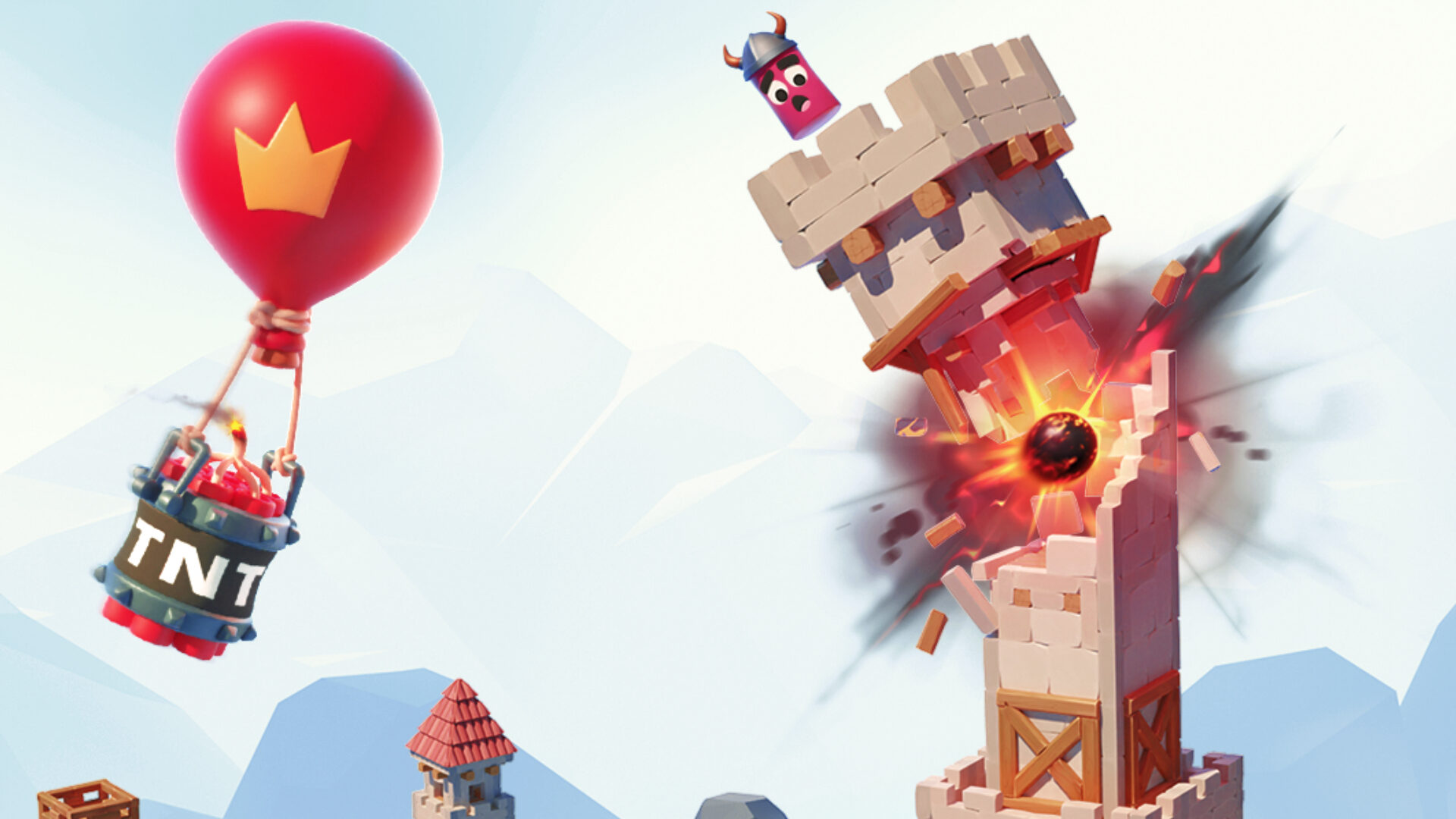
Castle Crumble
The calm before the fall
Score: 7.5/10
Images and videos



At a glance
We liked
- Exemplary physics and engine consistency
- The minimalist but splendid artistic direction
- The Switch port of rare stability
- The meditative atmosphere of destruction
We liked less
- The game loop is too rigid
- A lack of variety in progression
- An austerity that curbs emotion
- A formal perfection that ends up boring
 By Farrel Grimwood · published · 4 min read
Contents
Castle Crumble is one of those games that seems light before revealing its true nature: an engineering experience disguised as leisure. Developed by the Polish studio Orbital Knight, already known for its precise and minimalist mobile experiences, the title transposes a clear concept onto Switch: destroy fortresses, observe the chaos, and find a form of balance in this destruction.
But beneath its apparent simplicity lies a game of mathematical rigor. Every castle is a gravity equation, every projectile a trajectory test, every collapse a predictable consequence. The pleasure comes not from the crash, but from the exact moment when everything falls apart according to plan. Castle Crumble is about control, not chance.
The realms of silence
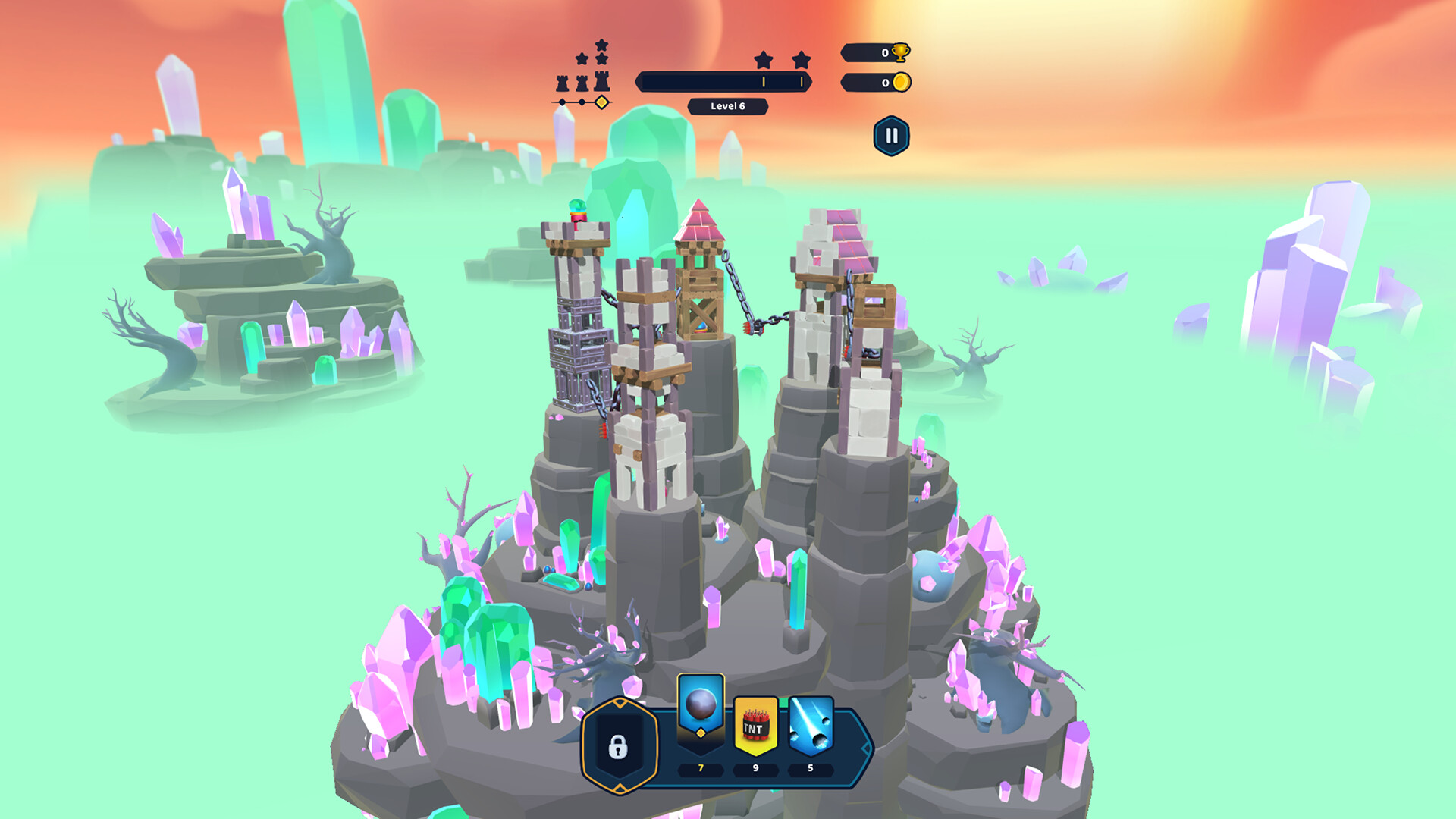
The game doesn’t tell anything and doesn’t need to. A few sentences are enough: a world divided into kingdoms, a countryside to liberate, a forgotten magic, a power to restore. It’s just a narrative thread, but it structures the progression. The medieval, Aztec, Byzantine and infernal realms are not environments, but states of mind. Each setting imposes a new physical logic, a different material to break.
In this miniature theater, everything works by contrast. The first minute, calm and almost meditative, precedes the moment of the shot, the fracture, the breath. The towers collapse, the slabs come loose, the catapults fall silent: a moment of emptiness follows the storm. And this is where Castle Crumble finds its beauty: in this silence after the destruction, in this immediate and almost guilty satisfaction of the successful fall.
The player, reduced to the essential, becomes an observer of his own precision. No dialogue, no characters: just the sharp sound of an impact and the dust rising. The game renounces any narration, but its staging of the void tells in its own way: architecture as vanity, ruin as truth.
The mechanics of pleasure
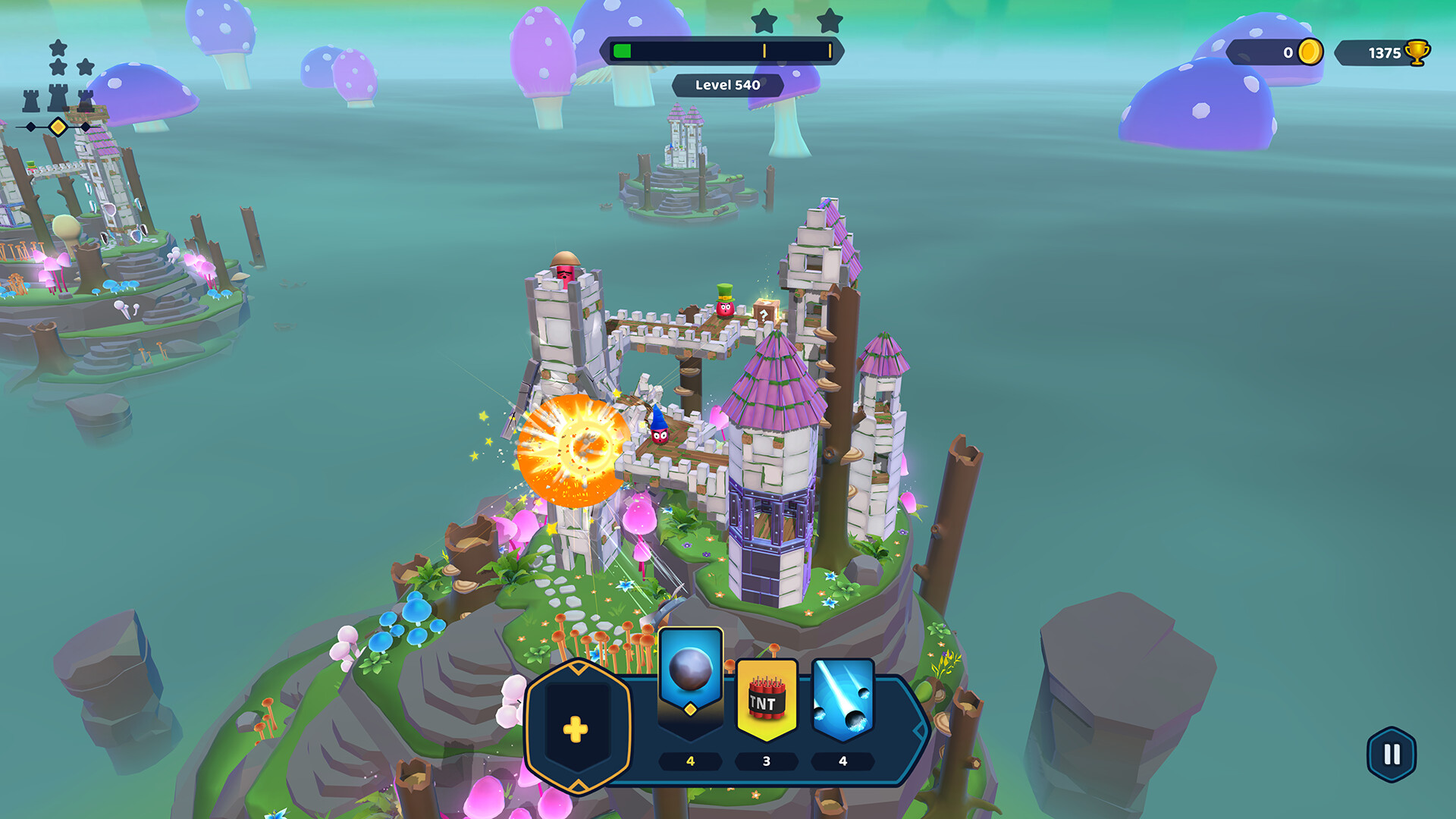
The heart of the game lies in a physics system of rare purity. The materials obey their logic: stone resists, wood bends, metal collapses with inertia. Each level becomes a miniature laboratory where everything depends on reading the space. Launching a projectile, adjusting an angle, understanding the structure: everything depends on perception.
The tools offered to the player (bombs, spells, chain projectiles) do not multiply the possibilities, they specify their nuances. Each weapon has its own texture, tempo, and reaction. Success is not about power but about understanding: where to strike, when, and how to create the perfect chain reaction.
It is this search for perfection that transforms Castle Crumble into an almost sensory experience. The vibration of the shot, the movement of the debris, the cloud of dust that rises: everything contributes to an aesthetic of controlled destruction. The pleasure is immediate but never simplistic. We do not destroy to break everything, we destroy so that everything stands up for a second before collapse.
And that’s where fatigue sets in. Because this mechanical, impeccable beauty is exhausted by perfection. The progression, based on the repetition of the same ritual, ends up closing in on itself. The new zones change the color of the sky, not the nature of the gesture. Rigor becomes routine, mastery becomes automatism. Calculated chaos freezes in the method.
The theater of ruin
Technically, Castle Crumble copes with remarkable ease. On Switch, the engine maintains its fluidity despite the density of particles and the multiplicity of debris. Fortresses collapse without slowing down, collisions resolve smoothly, and each impact retains its own inertia. This stability, almost unreal on a handheld console, demonstrates rare care.
The artistic direction, deliberately spare, evokes wooden toys more than legendary castles. Matte textures, sharp contours, light shadows construct a tangible universe, credible in its simplicity. Each shot gives the impression of handling a model: we feel the hand of the creator, the pleasure of detail.
The work on light and dust is exemplary. The shards of stone, the fleeting reflections on the surfaces, the way the mist rises after a shot compose a silent ballet. Nothing is exaggerated, nothing is left to chance. Castle Crumble proves that a destruction game can be beautiful without being noisy.
The soundtrack embraces this restraint: hushed orchestral layers, muffled percussion, precise tinkling. Each explosion becomes a note in an invisible score. This choice of austerity reinforces the contemplative atmosphere. We play as much to destroy as to listen to the fall.
The dizziness of mastery
What sets Castle Crumble apart is its refusal of the spectacular. Orbital Knight delivers a game that does not seek to entertain, but to discipline. The experience is not one of carnage, but one of control. The player learns to foresee the fall, to anticipate the collapse. It’s a philosophy: destruction as an exact science.
But this rigor, admirable in its consistency, sometimes deprives the game of the madness it evokes. Everything is too well kept, too clean, too contained. We would like something to overflow, for perfection to collapse. By controlling chaos, Castle Crumble ends up taming it.
On Switch, however, it becomes a fascinating object: short, precise, almost meditative. A game to peck at, to pick up, to contemplate, as one would light a fire just to watch the flames. A simple, raw pleasure, but one that evaporates as soon as we try to retain it.
Verdict
Beauty under control
7.5/10
Castle Crumble is neither a brain-teaser nor an outlet for pent-up energy. It is a study in the fall, a game of destruction which speaks of measure and silence. Orbital Knight transforms catastrophe into aesthetics, smash into discipline. On Switch, the precision of the port and the purity of the concept make it a work apart: elegant, demanding, but almost too restrained for its own glory.
Each shot is a prayer to gravity, each ruin a poem about the end of things. Castle Crumble doesn't give you the power to destroy everything, it teaches you the beauty of watching things fall.
Pros
- Exemplary physics and engine consistency
- The minimalist but splendid artistic direction
- The Switch port of rare stability
- The meditative atmosphere of destruction
Cons
- The game loop is too rigid
- A lack of variety in progression
- An austerity that curbs emotion
- A formal perfection that ends up boring
More in Video games
Full library 8/10
Culdcept Begins
SWITCH 9/10
Total War: Warhammer III – Lord of the End Times DLC
PC 7/10
Brigandine Abyss
XBOX 8/10
Drill Core
XBOX 6/10
Crown of Greed
PC 6.5/10
Deathless. The Hero Quest
SERIES 9/10
Final Fantasy Tactics : The Ivalice Chronicles
SERIES 6.5/10
Lost in Fantaland
SWITCH 7/10
Ariana and the Elder Codex
SWITCH 6.5/10