
Romancing SaGa -Minstrel Song- Remastered International
Freedom does not hold your hand
Score: 8/10
Images and videos


At a glance
We liked
- Real freedom of progression
- Eight heroes who change the way you enter adventure
- A combat and evolution system that is always unique
- French finally available
We liked less
- An opacity that can be off-putting
- Sometimes sharp peaks of difficulty
- Some fairly dated dungeons
- Poorly developed secondary characters
 By Farrel Grimwood · published · 12 min read
Contents
With Romancing SaGa Minstrel Song Remastered International, Square Enix is releasing an RPG that never really sought to politely please. The game comes from another era, but above all from another way of thinking about JRPG. Not that of the large narrative corridor, the reassuring quest marker or the hero that we follow to the end of a tidy scenario. Here, Mardias opens up quickly, sometimes too much, and leaves the player to fend for themselves with its cities, its rumors, its quests, its fights and its bad decisions. This International version was released on December 9, 2025 on Nintendo Switch, PlayStation 4 and PlayStation 5, with a new French translation.
The principle is simple, at least on paper. We choose one of eight heroes, each with their starting point, their first encounters and their way of entering the world. Then the game lets go. We recruit, we travel, we listen to the locals, we come across a mission, we miss another, we move forward without always knowing if we are in the right place. Romancing SaGa does not give the impression of unfolding a story in front of the player. Rather, it gives the impression of offering him a world, with all that that implies of freedom, vagueness and small humiliations.
This is precisely what makes it interesting. Minstrel Song remains a strange, abrupt and fascinating RPG, which requires you to accept not understanding everything right away. You have to talk to NPCs, come back elsewhere, test, make mistakes, discover that combat is not always the right answer, then start again with another hero to grasp another side of Mardias. Where many RPGs seek to smooth out the experience, this one maintains an almost provocative form of roughness.
This International version makes the entrance less dry. The French really changes something for a game so dependent on its dialogues, its rumors and its systems. HD graphics, accelerated mode, mini maps, New Game Plus, reinforced bosses and additional characters to recruit also provide welcome comfort. But don’t be mistaken. The remaster improves access, it does not domesticate the beast. Romancing SaGa remains Romancing SaGa. A game that would rather lose the player than lie to them about their own freedom.
Eight paths, no instructions
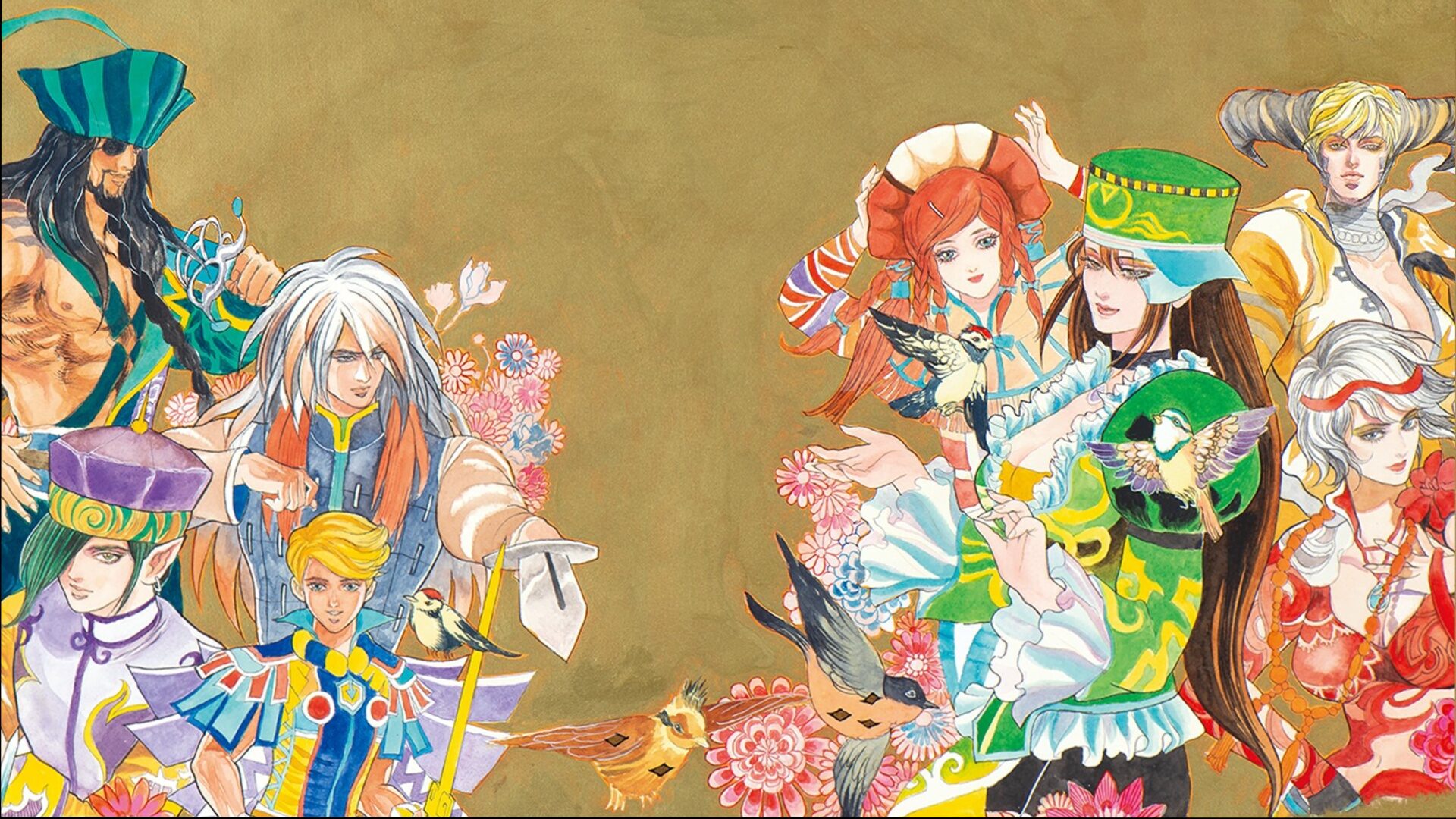
Romancing SaGa Minstrel Song Remastered International doesn’t tell its story like a classic JRPG. It doesn’t take a central hero and lead him through a world in a planned order, with companions arriving at the right time and well-placed revelations. The game has eight characters, eight starting points, eight ways to enter Mardias. Albert, Aisha, Jamil, Claudia, Gray, Hawke, Sif and Barbara do not experience exactly the same openness, do not come from the same background, and do not give the same first color to the adventure.
It’s a strong idea, because it immediately changes the relationship to the story. We don’t discover Mardias from just a single glance. We approach it in fragments. A nobleman on the run, a nomad, a thief, a warrior, a pirate, a dancer: each departure gives an angle, a mood, a way of understanding the world before the game gradually releases the player. The narrative is therefore not so much a line as a set of trajectories which end up intersecting around the same continent.
The heart of the story remains quite simple. Mardias still bears traces of an ancient conflict between gods, men and evil powers. Saruin, a dark figure from this mythology, hovers over the whole thing like a threat that the game does not immediately place at the center of each step. This is one of the particularities of Romancing SaGa: the main plot exists, but it does not try to take up all the space. It waits, deep in the world, while the player takes care of other things.
And that something else is often where Minstrel Song becomes most interesting. Quests are born from a rumor, a dialogue, a village crossed at the right time. Some disappear if you wait too long. Others only open up because we spoke to the right person, recruited the right companion, or simply chose to look elsewhere. The story progresses as a collection of intersecting stories, sometimes very short, sometimes more striking, which give Mardias the impression of a living world without going through long cutscenes.
It can be frustrating. The game doesn’t always emphasize what matters. It does not warn that a quest is closed. It does not dramatise every choice. You can miss a crucial event, miss a character, waste time, or realize too late that a small decision was more important than it seemed. But this dryness is also part of its personality. Romancing SaGa does not tell the player that he is free. It lets the player deal with the consequences of this freedom.
The secondary characters follow this same logic. You can recruit many companions, sometimes surprising, sometimes very discreet, but the game does not treat them as a group united by a great common story. They enter and exit more like road figures, passing allies, compositional possibilities. This gives less attachment than a more traditional RPG, but more flexibility. We don’t just build a narrative team. We put together an adventure troop.
The new playable characters in this Remastered International version further reinforce this idea of a world open to encounters. Their presence does not transform the story, but it expands the possibilities, especially for those who already know Minstrel Song and want to return to Mardias with other combinations. Here again, the interest comes less from a large additional scene than from what the game allows you to do differently.
The French translation changes a lot of things. In an RPG where we advance through discussions, rumors, descriptions and sometimes discreet clues, understanding exactly what the inhabitants are saying is not a secondary comfort. This is almost a necessary condition to enter the game without feeling constantly kept at a distance. This International version does not magically make the writing more modern, nor the progression clearer. But it finally opens Mardias to an audience who until then had to use English or Japanese.
Romancing SaGa Minstrel Song therefore remains a special story. It has a mythology, heroes, a threat, quests, but it often refuses the great continuous staging. It prefers to let the player pick up the pieces, follow his own leads, accept silences and absences. It’s sometimes cold, sometimes confusing, but also quite rare. Mardias does not tell a single adventure. It lets several form, then disappear, at the pace of the one who accepts to get lost in them.
An RPG that lets you do it, then lets you pay
Romancing SaGa Minstrel Song Remastered International is based on an idea that many RPGs promise, but that few assume so frankly: letting the player fend for themselves in complete freedom. We choose a hero, we leave our starting point, then Mardias opens without waiting for everything to be properly explained. Cities appear, quests cross paths, companions are recruited, dungeons are discovered, and we quickly understand that the game is not going to organize the adventure for us.
There is something exhilarating about this freedom. We can go in one direction, come across a rumor, follow a local problem, abandon a lead, recruit a new character, change course, then discover later that a quest has closed or that an event has evolved without expecting us. The game gives the impression of a world that moves forward without asking the player’s permission. It’s brutal, but it’s also what gives it its true personality.
The problem is that this freedom does not seek to be kind. Romancing SaGa explains little, warns little, and assumes a lot. We can easily find ourselves faced with a fight that is too difficult, a poorly understood quest or a system that we use incorrectly for several hours. The game is not opaque because it lacks content, but because it comes from a philosophy where discovering also involves making mistakes. It can be exciting. It can also become downright dry.
The fights are at the heart of this harshness. Combat remains turn-based, but not on a quiet mechanic where you just have to always choose the same attack until you empty the opponent’s gauge. Characters progress through use, learn new techniques while fighting, learn new techniques in the middle of battle, and gain in efficiency depending on their role, their equipment and their actions. The game keeps this very SaGa logic where evolution is not just a line of levels, but a sum of habits, professions, statistics and systems that respond to each other.
When it works, it’s excellent. A technique that is unlocked at the right time, a character that finally finds its role, a team that begins to hold its own against enemies that were until then too violent: Romancing SaGa gives real satisfaction in construction. We don’t just follow an automatic level up. We are gradually shaping a group capable of taking on Mardias. The pleasure comes as much from victory as from the progressive understanding of the machine.
But this machine remains demanding. The fights can be long, the dungeons tiring, and the increase in power does not follow a comfortable curve. The game has this very particular way of punishing a poorly prepared team, without necessarily clearly explaining what is missing. Bad equipment, bad classes, bad choice of route, too many unnecessary confrontations, not enough healing or resistance: the reasons exist, but they are not always obvious. Romancing SaGa doesn’t really cheat. It leaves very little room for naive improvisation.
The Remastered International version still greatly improves comfort. Accelerated mode is truly life-changing in an RPG that is so repetitive in its movement and combat. The mini maps, the revised interface, the New Game Plus and the progress carryover options make the whole thing less stiff than before. The game remains hard to master, but it becomes much less painful to practice. This is important, because Minstrel Song often asks you to redo, to try differently, to come back with another hero or another team.
The new recruitable characters and reinforced bosses also give a little material to the regulars. These are not additions that transform the structure of the game, but they extend this logic of variations. Romancing SaGa is an RPG that is best understood by starting over. Adding new group possibilities or more solid challenges is therefore a step in the right direction. The game does not seek to become anything else. Above all, it seeks to give more reasons to get back on the road.
The level design remains very marked by its age. The towns have charm, the dungeons know how to create an atmosphere, but not everything is as pleasant to navigate. Some locations seem too simple, others too confusing, and exploration depends a lot on the player’s patience. We search because the world can reward curiosity, not because each space is fascinating in itself. Mardias functions better as a network of quests and encounters than as a ground for pure exploration.
This is perhaps where this version best shows its paradox. Romancing SaGa Minstrel Song Remastered International modernizes enough to make the game more accessible, but not enough to obscure its nature. It remains a strange, free, sometimes rough RPG, which gives a lot to those who agree to follow its rules. Others will especially see a title which explains poorly, which balances harshly, which too often leaves the player searching alone for what they would have liked to understand more quickly.
And yet, this roughness is part of its charm. Minstrel Song is not compelling because it is perfectly comfortable. It is strong because it offers a way of playing that we hardly come across anymore. An adventure where the path counts as much as the goal, where failure is part of reading the world, where the team is built through trials, and where freedom is never free. Mardias lets it happen. Then Mardias presents the bill.
An old world in a better light
Romancing SaGa Minstrel Song Remastered International maintains a very particular visual identity. This is not the remaster of an RPG that we bring out only to flatter nostalgia with some cleaner textures. The game retains its almost theatrical style, with its strangely proportioned characters, its marked faces, its very busy costumes and this way of giving Mardias the appearance of an ancient tale that is a little stiff, but immediately recognizable.
Artistic direction remains one of its real strengths. The game doesn’t feel like many other JRPGs even today. There is in its cities, its characters, its monsters and its menus something at once baroque, dated and singular. We may not like these elongated chibi models, these slightly mechanical animations or this aesthetic which never seeks naturalness. But you can’t really accuse it of lacking personality.
The remaster benefits the whole experience. The settings are clearer, the interfaces are cleaner, the characters stand out better, and the image overall appears more pleasant than during the PlayStation 2 era. The game remains old in its construction, but it does not give the impression of having been released without care. We see the limits of the original base, but also the effort to make Mardias more readable, more comfortable, less rough to watch during long sessions.
This is not enough to erase everything. The animations retain a certain stiffness, the environments remain simple, and certain dungeons quickly betray their age. Romancing SaGa Minstrel Song has never been a spectacular game in the modern sense. This version does not transform it into a sumptuous fresco. Above all, it makes what already existed more present: an identity, a color, a world that embraces its oddities.
Combat benefits well from this upgrade. Technique effects, special attacks, monsters and team compositions read correctly, especially with the comfort added by acceleration. The game maintains a rather particular form of energy in its clashes, between very strong poses, names of skills that click and small visual flashes when a technique is triggered at the right time. Again, it’s not modern, but it has character.
The soundtrack probably remains one of the strongest elements of the whole thing. Kenji Ito gives Mardias ample, heroic, sometimes melancholy music, with this ability to make people feel adventure even when the game itself remains dry. The themes carry many scenes, accompany the cities, the fights, the more serious moments, and remind us how Romancing SaGa has always had a real musical backbone.
This version also allows you to enjoy the arrangements and sound design in good conditions. The music has kept its breath, the combat themes still work, and the whole regularly gives more impetus to the adventure than the staging itself. When the game seems a little cold, the music often brings grandeur back to Mardias.
The sound effects remain more functional. The moves, the spells, the menus, the movements: everything fulfills its role without really surprising. This isn’t where the game scores, but it doesn’t hinder the experience either. The real sound subject is music, and it still largely holds up.
Romancing SaGa Minstrel Song Remastered International therefore does not hide its age. It presents it better. The game remains sometimes stiff, sometimes strange, sometimes very influenced by its origins, but its visual style and soundtrack give it a presence that many smoother RPGs don’t have. Mardias is not a modern world. It’s an old decor that has been better lit, without trying to erase all its cracks.
Verdict
A freedom that is earned
8/10
Romancing SaGa Minstrel Song Remastered International remains an unusual RPG. Its open structure, its eight heroes, its quests that can be missed, its system of progression through use and its very dry way of letting the player manage make it still a unique experience. This version makes Mardias more accessible, thanks to French, comfort options, acceleration, mini maps and additions designed for regulars, without betraying what gave the game its personality.
But this personality keeps its angles. The game explains little, punishes quickly, still shows its age in certain dungeons, and requires a patience that not everyone will have. We can find it fascinating for its freedom, or off-putting for its opacity. This is precisely what makes it interesting. Square Enix does not deliver here a comfortable JRPG, but a strange, demanding, sometimes dry old world, which especially rewards those who are willing to get lost before understanding.
Pros
- Real freedom of progression
- Eight heroes who change the way you enter adventure
- A combat and evolution system that is always unique
- French finally available
- Really useful comfort options
- A soundtrack as strong as ever
Cons
- An opacity that can be off-putting
- Sometimes sharp peaks of difficulty
- Some fairly dated dungeons
- Poorly developed secondary characters
- A structure that requires a lot of patience
More in Video games
Full library 5.5/10
Warrior Cats: Clans of the Forest
SWITCH 6.5/10
Demons’ Night Fever
SWITCH 9/10
Dragon’s Dogma 2: Dark Arisen
XBOX 6/10
Qliphah in Providence’s Shadow
SWITCH 8/10
Verho – Curse of Faces
XBOX 7.5/10
Terrinoth: Heroes of Descent
XBOX 7/10
LumenTale: Memories of Trey
SWITCH 6/10
STARBITES
SWITCH 8/10
Monster Crown: Sin Eater
XBOX 7/10