
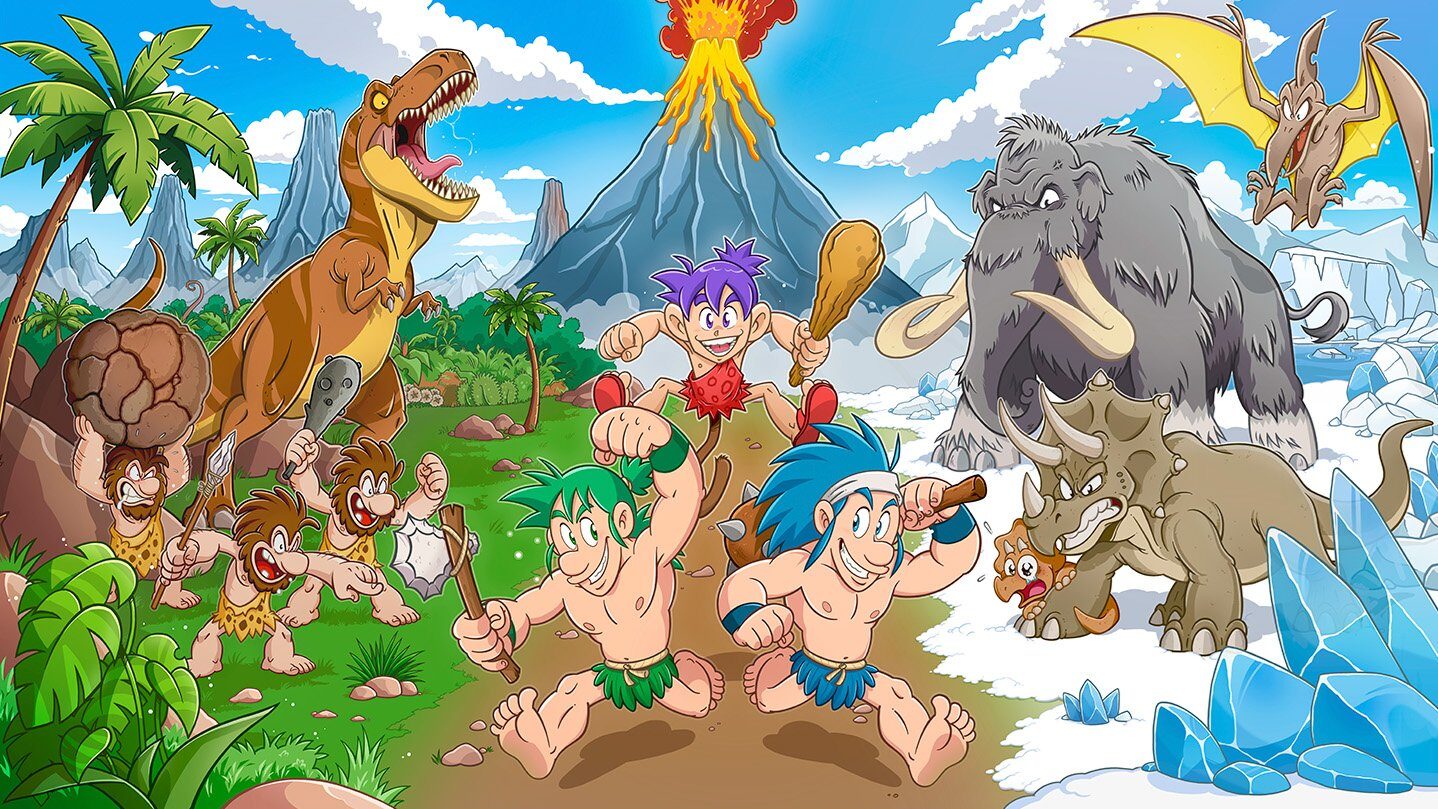

Joe & Mac Retro Collection
Three cartridges, and the first isn’t the best
Score: 7/10
Images and videos


At a glance
We liked
- Three games that show how the formula changed
- Lost in the Tropics still holds up very well with two players
- Rewind and save states
- A Boss Rush that gives a real reason to come back
We liked less
- The arcade version of Caveman Ninja is missing
- The early bosses drag on once their attacks are familiar
- The archive material explains very little about the games
 By Farrel Grimwood · published · 4 min read
Contents
In the first half of the ’90s, Data East found three ways to send a guy in animal skins to fight dinosaurs. There’s the game with one foot still in the arcade, the one that finally takes jumping seriously and the one that lets its heroes go back to the village between outings. Red Art Studios puts all three together in Joe & Mac Retro Collection. These are the Super Nintendo games and their regional editions, not everything the two cavemen have been up to since they started.
Rewind and save states mean a fall doesn’t have to cost what it did in 1992. Boss Rush even gives a good reason to redo the fights without replaying the levels. The question is what those cartridges are worth once the novelty of seeing those enormous dinosaur heads again has worn off. Is it worth coming back for the first Joe & Mac, or for what Data East learned trying to move away from it?
Caveman Ninja still lives for its bosses
In Caveman Ninja, the village women are kidnapped and the heroes set out to find them. The excuse is good enough to get through some short stages and come face to face with a dinosaur that takes up a fair part of the screen. The Super Nintendo adaptation has its own map and routes to find. It still has the pace of the arcade: grab a weapon, move forward, dodge whatever comes at you and wait for the big one. When a tyrannosaur opens a comically large mouth, the art still does exactly what it needs to. It’s immediately clear where to look, and hard not to want to see what’s coming out.
The trouble is what’s left to do when the surprise wears off. Some bosses ask for the same move to be repeated for a long time. Land a shot, wait out the invincibility and do it again. Between fights, the levels may hide the odd detour, but they mainly ask for a steady trip to the right while watching for enemies rushing in from the edge of the screen. With two players, the chaos is part of the fun, and there’s less time to count how many hits are left. Alone, it doesn’t take long to find those monsters more impressive to look at than to fight.
Congo can jump, Joe and Mac learn to go home
Congo’s Caper changes the hero and, more importantly, the priorities. Congo still swings a club, but he can bounce off enemies and change form with the rubies he finds. Once the jump gets bigger, there’s a reason to see what’s above the path instead of rushing toward the next boss. The game also offers a choice of routes after the opening. It feels good to finish a level without necessarily emptying something’s health bar. Then again, a big jump that takes the ground off screen isn’t always a gift, and this one is single-player only. It has better platforming ideas than its predecessor, but it’s the least useful cartridge to pull out with a friend over.
Lost in the Tropics puts Joe and Mac back together. A rival chief steals the crown, and off they go to get it back, with a village to return to for supplies. There’s a choice of routes, money to look for and even a house to furnish. The village is only a short interlude, but it finally gives the levels something to offer besides another boss to cross off. The bosses themselves are better paced. When the triceratops breaks the ice piece by piece, it changes the ground under the fight. It’s no longer a matter of making exactly the same dodge from start to finish.
This is where the return of co-op makes the most sense. The levels leave enough room for each player to find something to do, and friendly fire can be turned on or off. The same setting keeps things simple when introducing someone to the game or makes life harder once everybody already knows how to jump. It isn’t what makes Lost in the Tropics the best of the three, but it does show how much thought this one gave to what happens between swings of the club.
The arcade game is still missing
Red Art Studios does a decent job with the features around the games. It’s possible to stop halfway through a level, go back to just before a bad jump, keep the original aspect ratio or add a CRT filter. Boss Rush is worth more than a spot on the extras menu. It puts the fights people come back for in a row and, without rewind, gives a reason to learn their attacks. The Japanese editions and regional box art are worth a look too, to see how the same games were presented in different countries.
But for a collection that invites comparison, leaving out the original arcade game is the hardest choice to defend. Without it, there’s no way to see exactly what Data East changed in bringing the game home. The manuals, artwork and music are nice to revisit, but they don’t explain much about the move from the straight lines of Caveman Ninja to the village in Lost in the Tropics. Red Art preserves three games. It leaves players to tell the story of what came between them.
Verdict
The village makes the difference
7/10
Joe & Mac Retro Collection is worth it mainly for Congo’s Caper and Lost in the Tropics. The first finally makes jumping more than a way to avoid being hit. The second keeps co-op and finds, in its village and more open levels, good reasons to stick around between bosses. The first Joe & Mac still looks great, but the other two give the controller more to do.
The collection has the modern conveniences it ought to and a Boss Rush worth using. Even so, three Super Nintendo games and their variants tell only part of the story. It’s good to have these cartridges back. It’s harder to believe they’re everything worth preserving about Joe and Mac.
Pros
- Three games that show how the formula changed
- Lost in the Tropics still holds up very well with two players
- Rewind and save states
- A Boss Rush that gives a real reason to come back
Cons
- The arcade version of Caveman Ninja is missing
- The early bosses drag on once their attacks are familiar
- The archive material explains very little about the games
More in Video games
Full library 8.5/10
Village in the Shade
SWITCH 5.5/10
Warrior Cats: Clans of the Forest
SWITCH 6.5/10
Demons’ Night Fever
SWITCH 8/10
Culdcept Begins
SWITCH 5/10
The Witch’s Bakery
SWITCH 6/10
Qliphah in Providence’s Shadow
SWITCH 8/10
Woodo
SWITCH 6/10
Barbarian Saga: The Beastmaster
SWITCH 5/10
Disgaea Mayhem
SWITCH 5/10