
Hell Is Us
Between the memory of the war and the unresolved silence
Score: 8.5/10
Images and videos


At a glance
We liked
- The radical approach: no map, no compass, a raw and organic exploration.
- The austere aesthetic of Hadea, which imprints a heavy and memorable atmosphere.
- The design of the creatures, disturbing and allegorical.
- The methodical, brutal and heavy combat system, which refuses easy fluidity.
We liked less
- Visual austerity which can become boring in the long run due to its uniformity.
- Lack of variety in encounters and bestiary.
- A deliberately opaque narrative that leaves certain arcs too vague.
- The radical nature of the exploration, fascinating but potentially frustrating.
 By Farrel Grimwood · published · 6 min read
Contents
In a video game landscape saturated with landmarks and indications, Hell Is Us chooses erasure. Born from the imagination of Jonathan Jacques-Belletête, already recognized for his work on Deus Ex: Human Revolution, the game immediately imposes a radical approach: explore a fictional country, Hadea, ravaged by a civil war and infested with supernatural creatures, without a map, without a compass, without GPS. Here, no icons to collect or secondary quests dictated by luminous markers: only the terrain, memory and instinct to move forward.
This choice is not just a game design whim: it shapes the experience. Each step is soaked in the silence of the devastated plains, each abandoned building retains the echo of past conflicts. The ruins are not simple settings: they embody a story that is not written through dialogue, but through dust and solitude. In this divide, Hell Is Us establishes its identity: a journey both interior and exterior, where the quest for answers merges with the exploration of a territory which refuses to reveal its secrets too quickly.
Hadea’s scars, the shadows of memory
The universe of Hell Is Us opens on a fictional nation, Hadea, undermined by years of civil war. Far from linear narratives that take you by the hand, the game offers a fragmented, fragmentary narrative that emerges through the remains of a torn country. The conflict is never shown head-on: it is suggested by the ruins, inscribed in the absent faces, told by the geography itself. This economy of words gives the story a particular density: each silence becomes a testimony, each absence a trace.
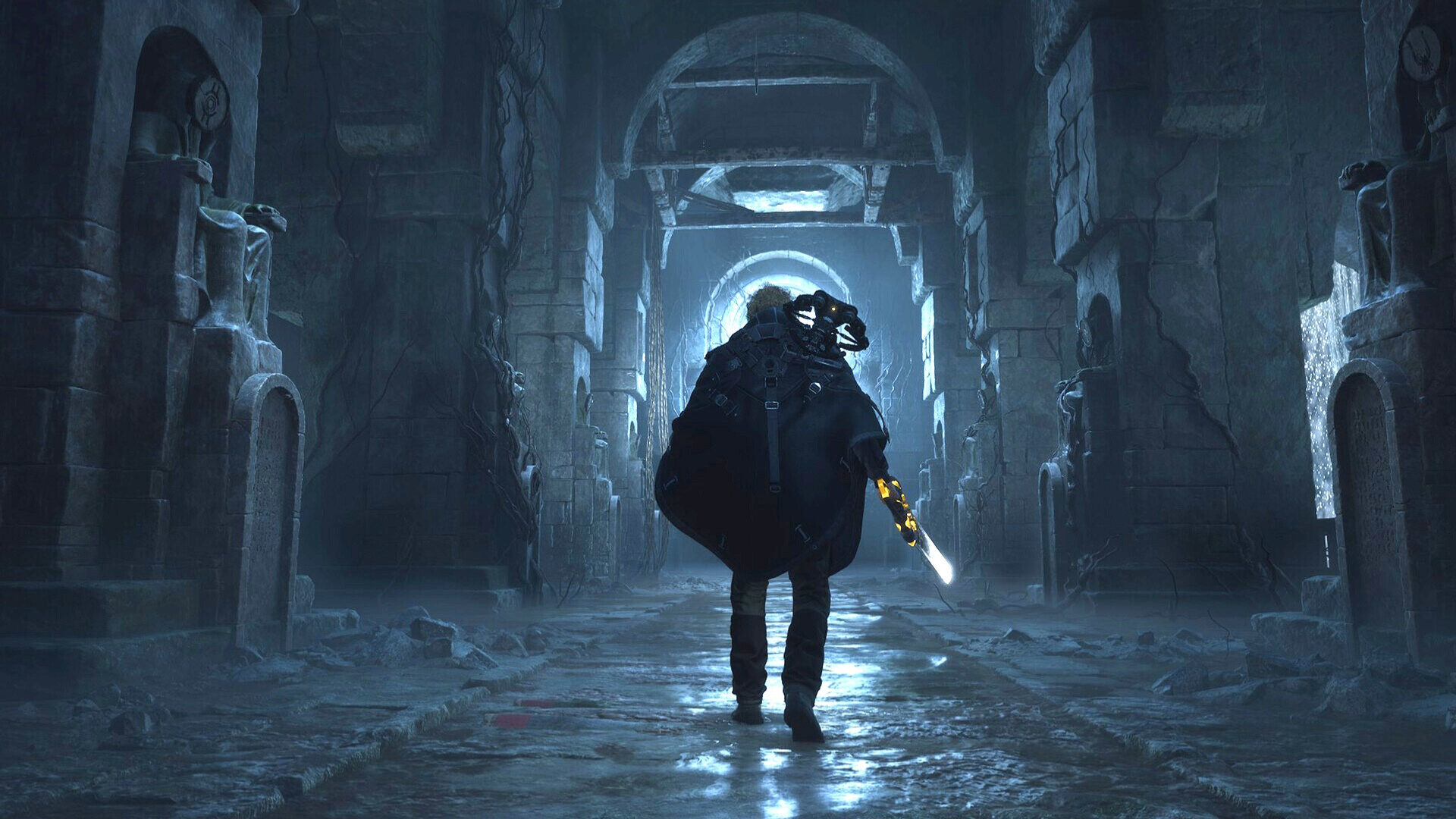
The central protagonist, Rémi, a man who returned to this ravaged native country in search of his parents, is not defined by endless dialogues but by his direct confrontation with the scars of the territory. His identity, deliberately vague, functions like a mirror: he embodies less a classic hero than a witness to disintegration, bearer of personal traumas which resonate with collective ruin. The weapon he brandishes, an ancient and mysterious blade, is less a tool than the symbol of a lost memory, a fragile continuity between past and present.
The creatures, emerging in the heart of this broken earth after a singular "Calamity", reflect the anguish, the persistence of past wars, the materialization of the grudges and hatreds which still gnaw away at the nation. Their existence, never fully explained, gives the narration an allegorical dimension, a form of modern myth where the fantastic amplifies historical reality.
The secondary characters, scattered at the margins, do not deliver great monologues: they embody fragments of history, reflections of suffering or resilience. Here, a survivor trapped in the rubble evokes the fear of yesterday; there, the silhouette of a forgotten soldier marks the persistence of the conflict. It is in these fleeting appearances that narrative depth emerges, far from the classic canons of RPG or action-adventure.
The story of Hell Is Us is not delivered, it is ripped away. It does not unfold like a common thread but like an exploded mosaic, where each piece found composes a fresco of collective memory, a reward for the player who manages to brave the mechanics. A radical, demanding approach, which chooses the unsaid rather than the explicit, and leaves it to the player to fill in the gaps with their own sensitivity.
The territory as a compass, survival as a language
Hell Is Us deconstructs the habits of action-adventure to impose a logic of wandering and exploration. No indicator, no map, no compass marks the space: Hadea is explored on sight, in doubt and instinct. The player advances as if deciphering an unknown territory, following the silhouettes of the hills, orienting himself thanks to ruins visible in the distance, memorizing the forest paths which cross and get lost, discovering secrets, speaking with non-player characters. This voluntary absence of guidance transforms level design into a sensory experience: each detour becomes a decision, each landmark a fragile anchor in a world that refuses to be immediately surrendered.
The heart of the system is based on two inseparable companions: a drone and a sword. The first, floating, illuminates the darkness, signals the presence of creatures and opens an almost organic visual field in the mist. The second, archaic and heavy, imposes a methodical, brutal combat rhythm, far from the rapid choreographies of contemporary action. The clashes do not seek fluidity, but tension: hitting, dodging, waiting, feeling the weight of a hit or miss. Every victory has to be paid for, every defeat weighs heavily.
The bestiary, restricted but striking, acts as an extension of the territory. Creatures often blend in with the rubble and emerge like embodied shards of memory. The design of their confrontations, often placed in cramped spaces or oppressive clearings, forces the player to use the environment as a resource: positioning, retreating, circling around. The arena is an actor in the fight.
Progression is built through discovery and not through collection: no escalation of icons or cascades of secondary objectives. The player learns by traveling, by observing, by confronting. This radicality gives the experience a unique scent, but also a rare requirement: wandering can be disconcerting, minimalism frustrating. However, it is precisely in this austerity that the game finds its singularity.
The overall design is thus part of a tension: offering total freedom but without a net, imposing raw exploration while sculpting each ruin like an enigma. Hell Is Us does not offer an open world in the classic sense: it offers a tight, coherent territory, thought of as a scar to be traversed, a wound that we can only cross by accepting our pain and our silence.
A world of ruins, a score of silences
The visual strength of Hell Is Us lies not in spectacular escalation, but in austerity. Hadea reveals itself as a fractured territory, frozen in the post-war period: deserted villages, gutted roads, rusty military carcasses in the middle of the fields. Unreal Engine 5 gives a raw density to these landscapes, playing on the harsh light of a low sun or the thickness of the mists that swallow the forests. Nothing is there to seduce: everything is there to oppress, to recall the still open scar.
The artistic direction opts for expressive sobriety. The dark interiors, sometimes lit only by the drone beam, accentuate the impression of solitude; the panoramas, often melancholic, appear like paintings frozen in mourning. The deliberate lack of variety – few colors, few contrasts – underlines this bias: the world is not a celebration, but a wound. This radical choice can tire the eye, but it reinforces the identity of the game, its desire to engrave discomfort rather than wonder.
Supernatural creatures participate in this aesthetic of dissonance. Their hybrid design, half-human, half-artifact, contrasts with the realistic coldness of the setting. Their presence introduces an almost surreal strangeness, as if Hadea was not just a destroyed country but a place haunted by ancient, unexplained forces.
On the sound side, the soundtrack refuses emphasis. No grandiloquent orchestral themes: only minimalist layers, muffled percussion, electric stridencies that arise during clashes. Silence, omnipresent, becomes an instrument in its own right. Walking in an abandoned valley, hearing only the blowing of the wind or the creaking of a metal carcass: these moments, far from being empty, are charged with a dramatic tension that never lets up.
The sound effects reinforce this feeling of brutal immersion: the sharp impact of a sword blow, the metallic vibration of a drone, the inhuman cry of the monsters tear the silence and remind us that each encounter is a break in immobility. This sonic minimalism, far from impoverishing the experience, gives it a rare intensity, as if each sound had to carry a narrative weight.
In this alliance between austere visuals and stripped-down sound, Hell Is Us imposes total coherence. The game does not seek to seduce, but to disturb. And it is precisely in this unease that it finds its individuality: a world which speaks as much by what it shows as by what it does not say.
Verdict
The dizziness of a world without reference points
8.5/10
Hell Is Us dares where so many others shy away. By refusing the map, the compass and the luminous markers, it breaks modern habits to impose an experience where each step becomes a choice, each detour an interpretation. It is a game of silences and fractures, a journey into an imaginary country which nevertheless speaks of very real wounds: war, the post-war period, the ghosts that we never really chase away.
Not everything is flawless: the radicality of its approach can be confusing, the visual austerity is sometimes boring, and the narrative minimalism leaves certain gray areas too opaque. But these are the accepted setbacks of a singular ambition. Where others multiply artifice, Hell Is Us prefers naked tension, doubt, discomfort.
The result is an imperfect but unforgettable work: an inner journey, an implicit critique of our habits as players, and a poetic fresco that prefers lack to excess. In the pain of the ruins as in the thrill of the clashes, the game imposes a rare identity.
Pros
- The radical approach: no map, no compass, a raw and organic exploration.
- The austere aesthetic of Hadea, which imprints a heavy and memorable atmosphere.
- The design of the creatures, disturbing and allegorical.
- The methodical, brutal and heavy combat system, which refuses easy fluidity.
- Sound minimalism, where each silence and each sound effect carries a dramatic weight.
Cons
- Visual austerity which can become boring in the long run due to its uniformity.
- Lack of variety in encounters and bestiary.
- A deliberately opaque narrative that leaves certain arcs too vague.
- The radical nature of the exploration, fascinating but potentially frustrating.
More in Video games
Full library 8.5/10
Train Sim World 6
PS5 8.5/10
Agatha Christie – Death on the Nile
PS5 6.5/10
Brews & Bastards
PS5 9/10
Frostpunk 2 Console Edition
PS5 7/10
Folly Of The Wizards
PS5 8.5/10
Towa and the Guardians of the Sacred Tree
PS5 8.5/10
Dying Light: The Beast
PS5 9.5/10
Borderlands 4
PS5 8/10
Triangle Strategy
PS5 7/10