
Ereban: Shadow Legacy
The shadow that goes faster than the light
Score: 8/10
Images and videos
At a glance
We liked
- A really successful shadow-merging mechanic.
- A game that favors movement and reading the lights rather than waiting behind a crate.
- A coherent SF/mystical atmosphere, served by good work on contrasts.
- Several difficulty modes, up to Hardcore, which allow you to precisely calibrate the intensity of the game.
We liked less
- A story that starts well but ends up getting lost in questionable choices and rushed revelations.
- An interface that is too heavy, which discourages the use of the entire arsenal.
- Overly forgiving AI and a limited bestiary.
- Some technical rough edges and a certain lack of variety in the environments.
 By Farrel Grimwood · published · 6 min read
Contents
Ereban: Shadow Legacy has everything of the heir of Aragami that we hoped to see return: a pure stealth game that makes no apologies for being one, a heroine who crosses the levels like a flow of ink and a slightly dirty sci-fi world where the light is more disturbing than the enemies themselves. No automatic rifle, no cinematic finishers against a slow-motion background, just shadows, drones, a few bad humans and the certainty that if we get spotted, it’s because we missed the plan.
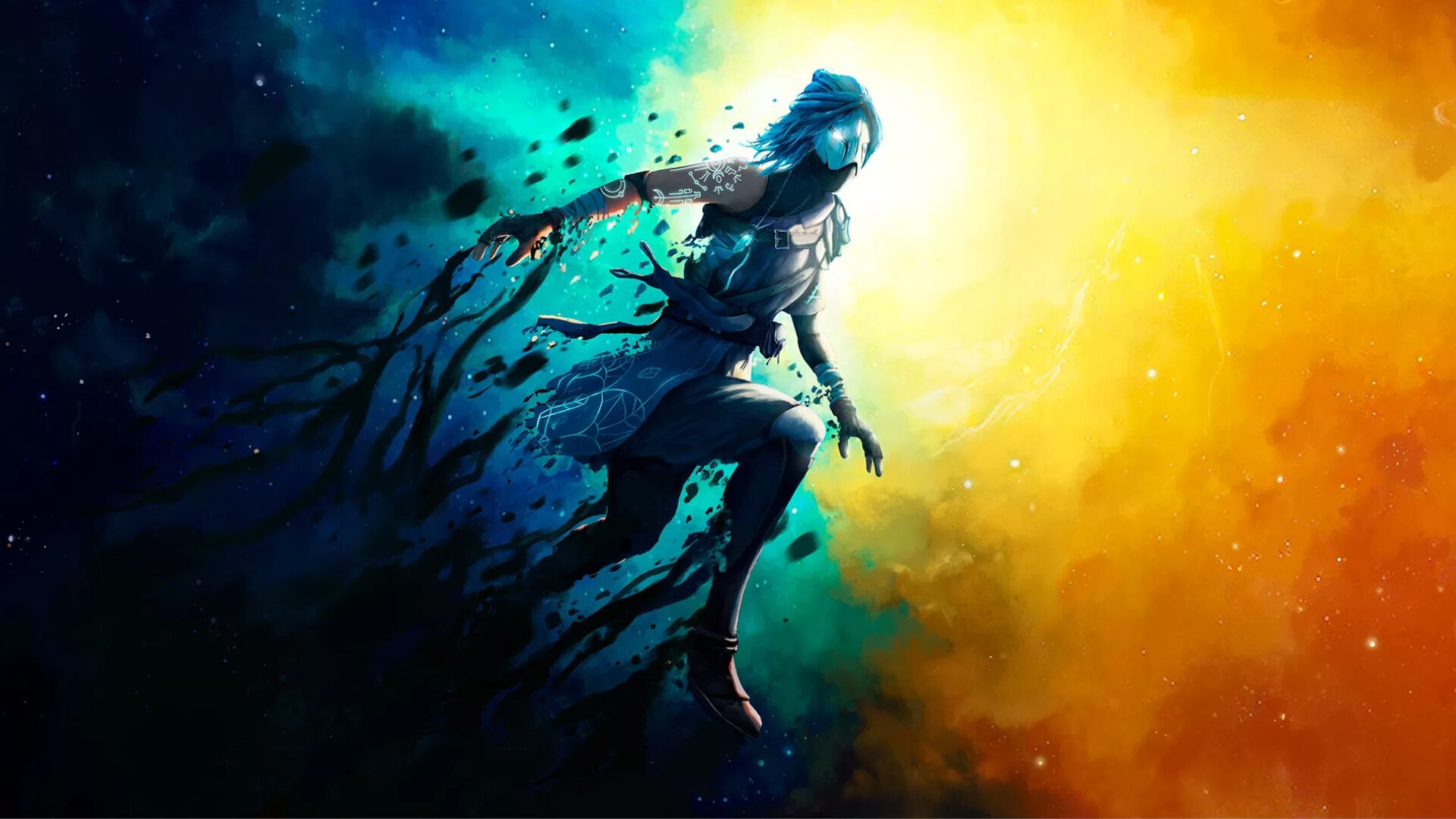
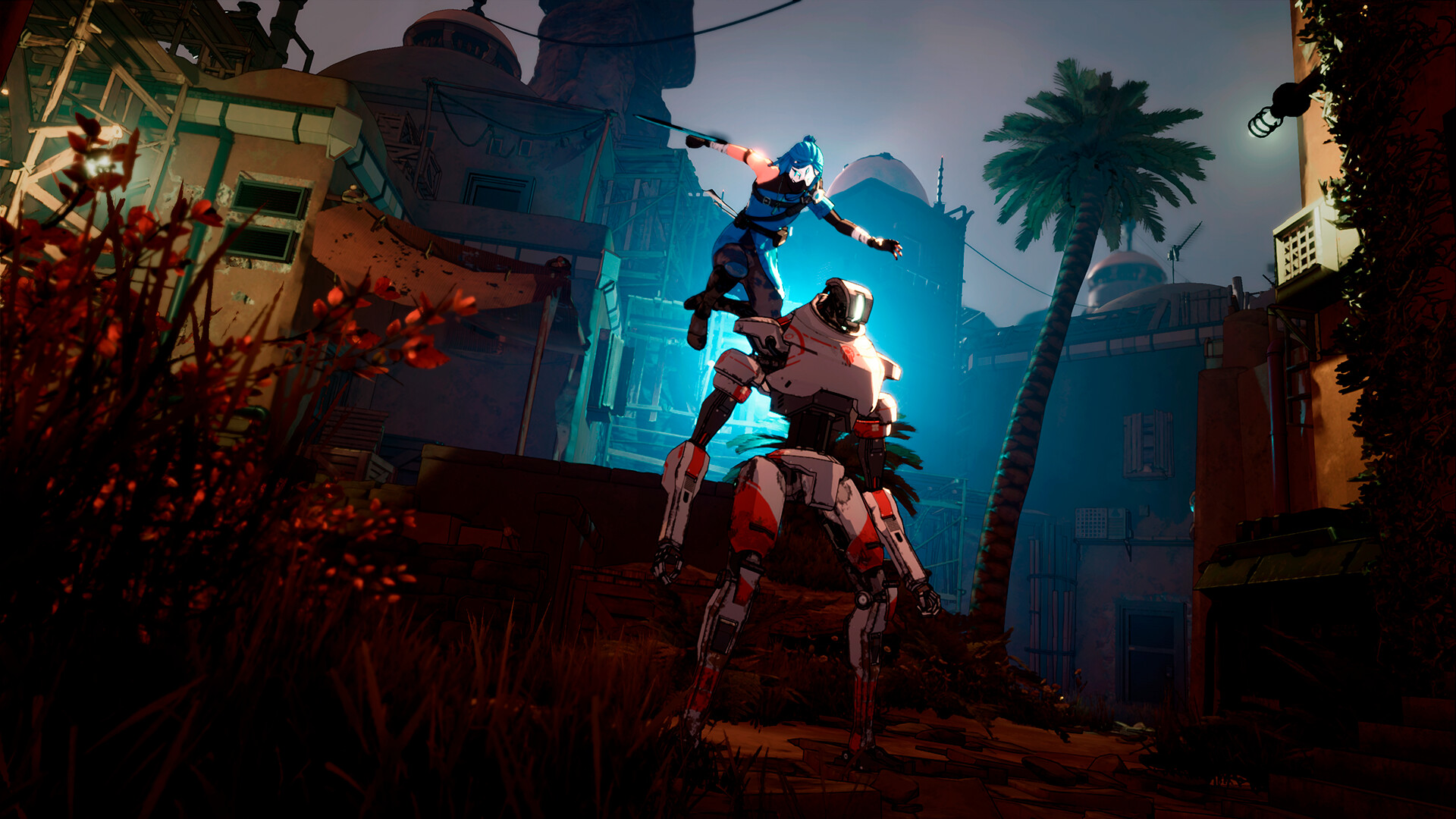
The promise is held in one image: Ayana disappearing into a dark corner, running along a wall to the ceiling, coming back down behind a robot, breaking it in one gesture and falling back into the ground before anyone understood where the problem was coming from. Ereban lives for these moments. The rest (Helios, the rebels, the archives to collect, the lethal/non-lethal choices) revolve around without always reaching the same level.
One last shadow in an already exhausted world
Ayana is the last of the Ereban, a vanished people whose only trace still active is this ability to literally blend into the shadows. Helios, an energy megacorp convinced of having saved the universe from a crisis, has above all taken superb advantage of the chaos and seems very interested in getting its hands back on what remains of this lineage.
The setting mixes industrial stations, sterile complexes and ancient ruins covered in metal, with a resistance (the Forgotten Suns) who tries to pull Ayana out of this trap and make her look beyond the first survival mission. On paper, everything is there for a great quest for identity: erased origins, savior corporation grayer than it wants to say, world collapsing in on itself.
In practice, the narration gets a little lost in its own material. The characters’ decisions have the logic of a late train: Ayana who responds to an invitation from Helios while being convinced that they have massacred her own people, trust given to strangers in two dialogues because the scenario must move forward… The big twists arrive especially in the last act, with a whiplash effect that is more tiring than truly satisfying. The universe is engaging, Ayana’s voice holds up, but the story ends less strongly than it begins.
Dissolve to move on better
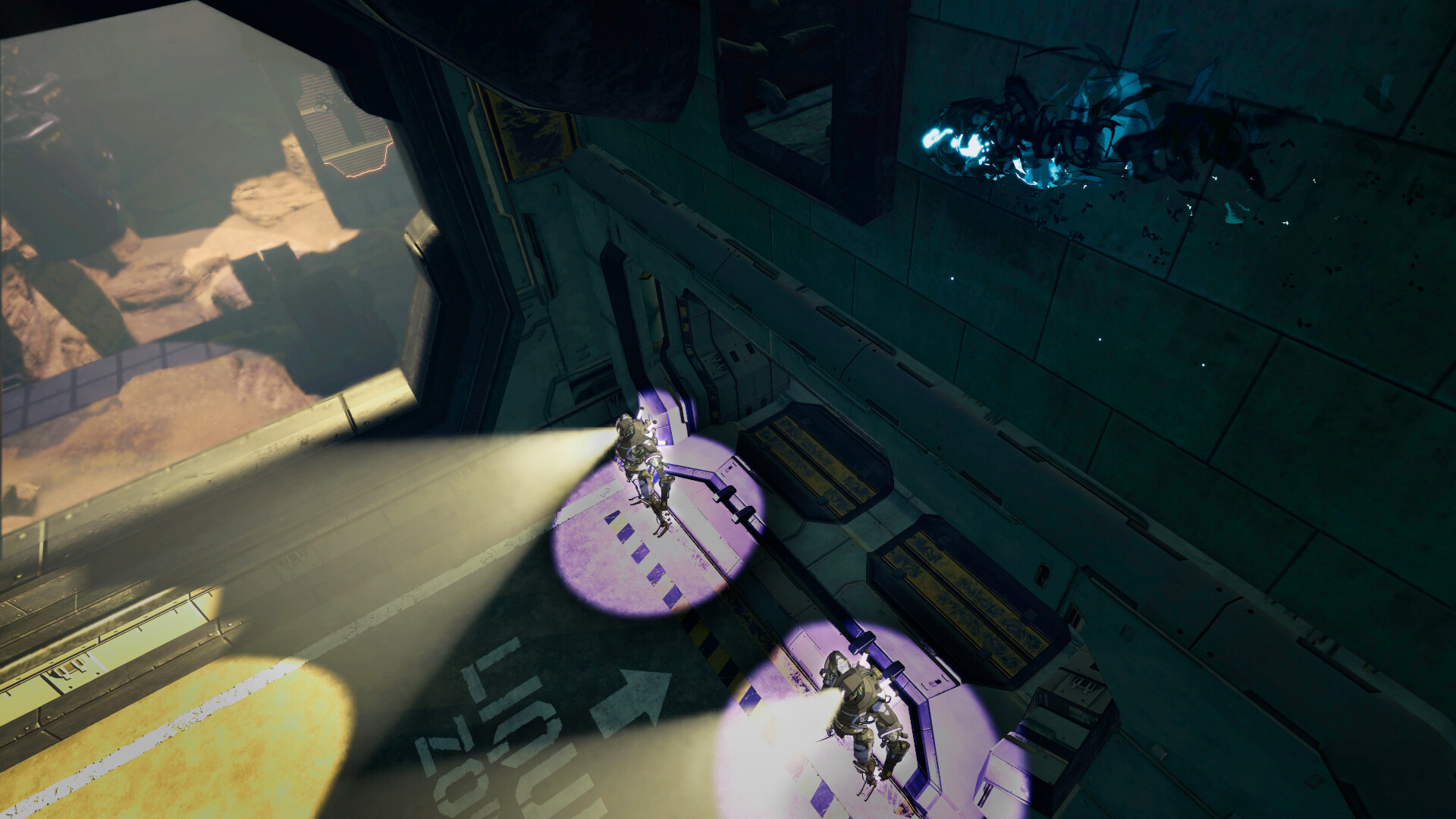
Pad in hand, the real star of the game is neither Helios, nor the Suns, nor even Ayana. It is her ability to literally become a shadow. In any dark area, she can transform into a mass of liquid black that slides across the floor, up walls, through grates, and around cones of light as if geometry were nothing more than a puzzle to be folded.
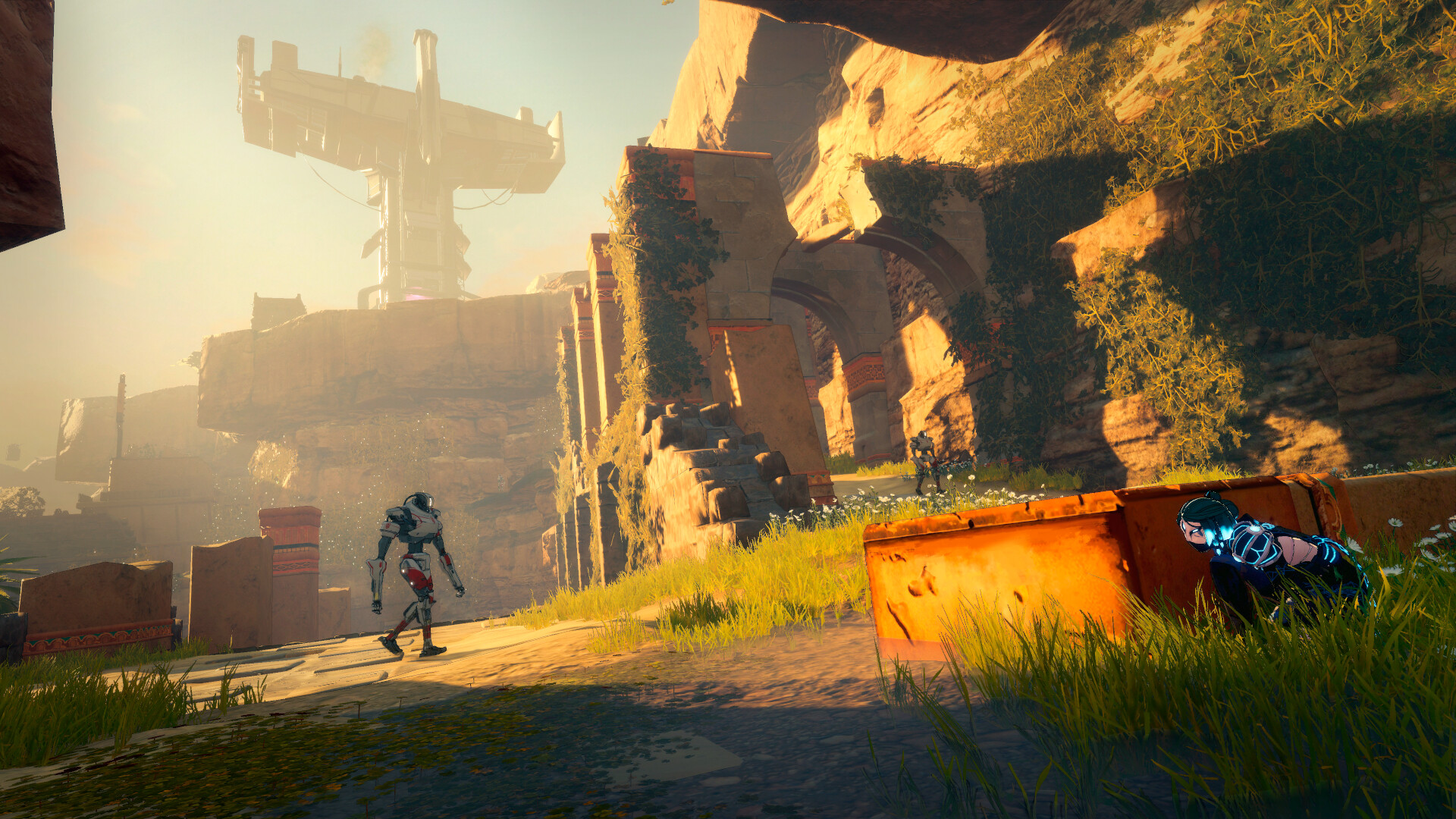
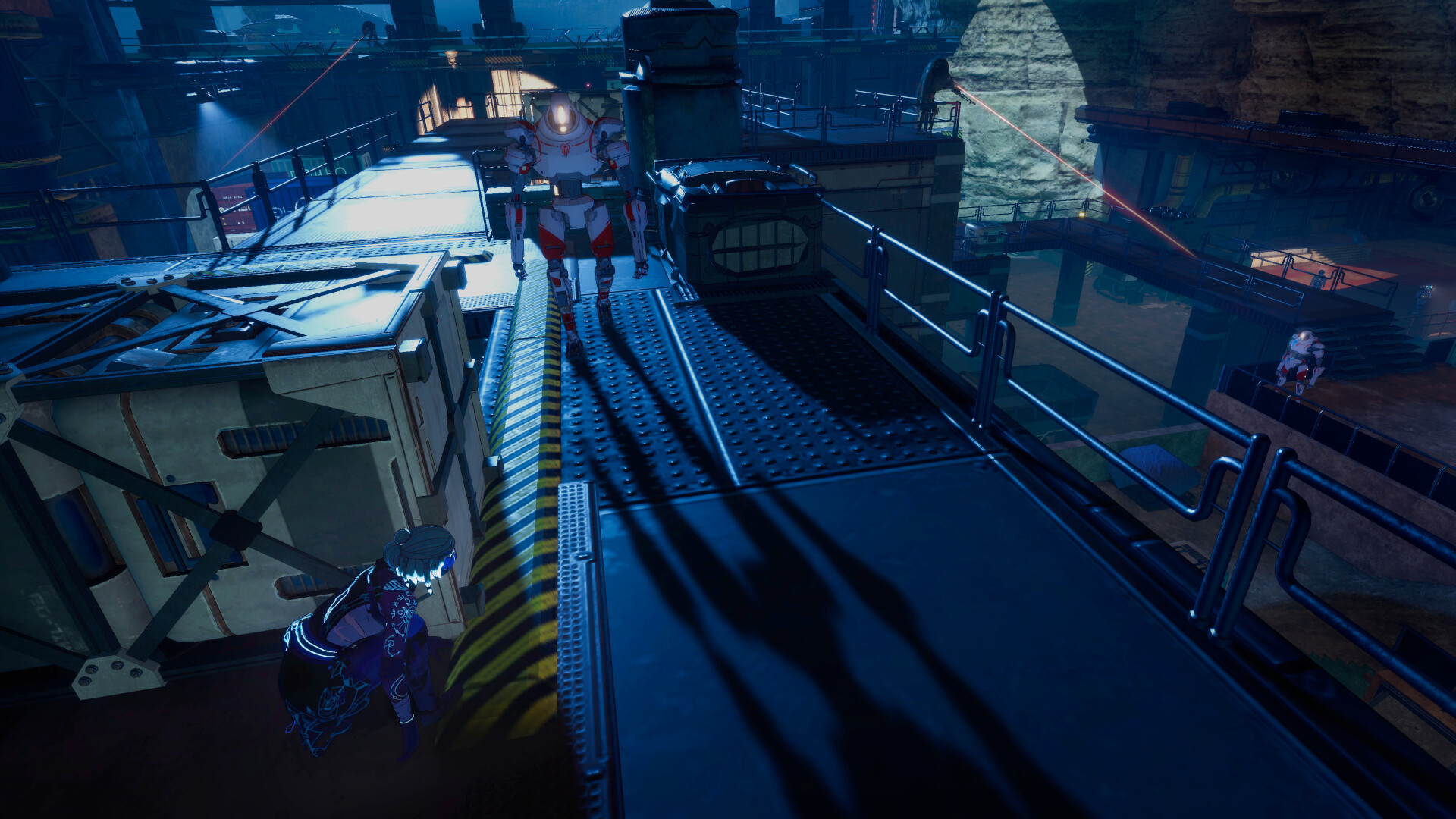
The level design revolves entirely around this transformation. The fans project moving shadows that we must follow like temporary platforms, the footbridges draw trajectories of black on which we hold ourselves, a simple pillar becomes a lifebuoy as soon as it breaks the beam of a projector. It’s this mix of platforming and reading the lights that makes the real difference: we don’t just stay crouched behind a wall, we read the room like a network of dark lines to take at the right moment.
This power doesn’t carry everything, but it gives the game a clear identity. Ereban doesn’t ape Dishonored or Thief, it takes a piece of this vocabulary and pushes it to the limit: the ground is a map of comfort zones and forbidden zones, and we literally play with this contrast.
A system that wants to let everything happen
Beyond this transformation, Ereban stacks tools: sonar which reveals enemies and collectibles, electric mines to paralyze drones, shadow orbs to throw to blind, shadow dash to project behind a target, possibility of dissolving bodies in a shadow realm to avoid leaving traces.
On paper, Ayana can do anything: infiltrate a complex without being seen, set an ambush, turn a corridor into a robot trap, or coldly raze an entire room while remaining intangible. In fact, the system clashes a bit with its own interface. Each power must be selected in a separate menu, with key combinations that are not always intuitive: hold a button to activate one, release the shadow at the right time to possess and then free someone, remember different commands for each gadget.
Unfortunately, Shadow Merge overwhelms the rest. We use it to enter, exit, climb, go around, surprise. To the point that the game sometimes seems to have built its entire system around a single idea, so good that it ends up swallowing up the others and no longer leaving the slightest room for them.
Ghost, butcher, or both
Ereban likes the idea that we can define the legend of Ayana. Syms robots are almost anonymous obstacles, cut into pieces without moral consequences, while humans are supposed to weigh more in the balance. The interface takes your approach into account: ghost mission without any alerts or kills, deadly shadow course which cleans everything that moves, or something in between.
This system should make each run a little different. In practice, the impact remains surprisingly small. The overall status (lethal or non-lethal) mainly depends on humans, while we spend the majority of time getting around robots. The gain from a pacifist route is timid: a few different reactions in the last chapter, humans less quick to trigger alarms, and variations on the ending that can be seen by simply reloading the auto-save just before the final choice.
We won’t talk about a failed moral system – the game has no such pretension – but we keep the impression that this idea of inheritance would have deserved something other than an end menu depending on who we really killed.
Levels that remain in their comfort zone
The missions follow a very classic format: complex infiltration, recovery of objects, sabotage, escape. Up to two thirds of the game, the areas remain rather linear, with an obvious path and a few branches for those who like to search the collectible corners.
When Ereban allows itself to open the map a little, that is to say by allowing the exploration of a semi-open city in the third act, a sort of large hub with several objectives, the game breathes suddenly: we choose our angle of attack, we trace our own route from lampposts to conduits, and we finally feel what Shadow Merge can give in a less linear space. These moments bring out the rest by contrast: the rhythm tends to flatten out in the more interventionist sections, where patrols and platforms are linked together on a discreet rail.
The lifespan remains deliberately contained. Allow six to eight hours to see the credits for the first time, a little more if you are targeting all the collectibles or if you are restarting chapters to improve your rankings. Enough so that the central mechanics do not repeat themselves too much, not enough for us to forget the relative poverty of the bestiary and certain environments.
The Xbox does the job, no miracles
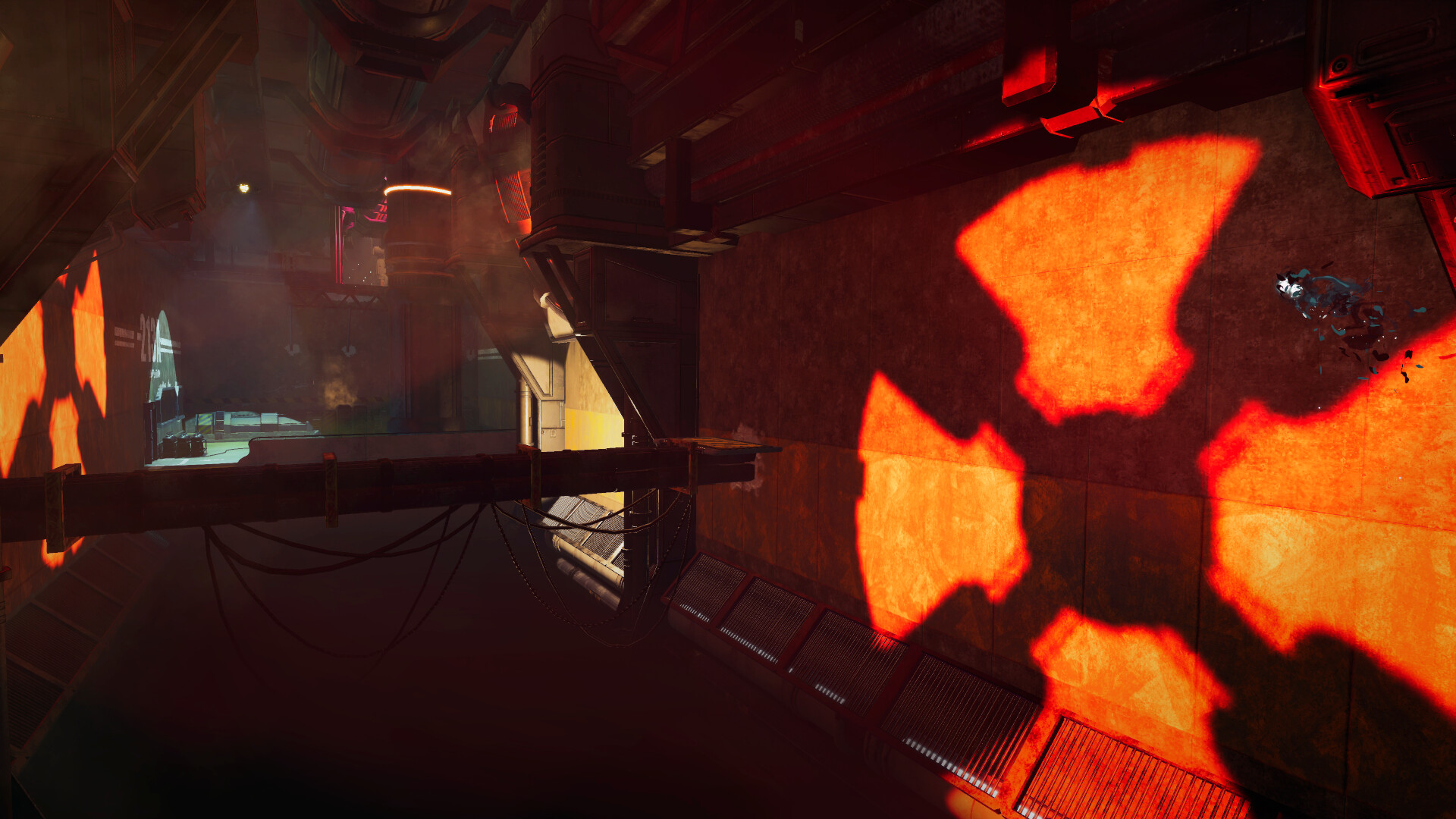
On Xbox Series, Ereban keeps its promise of smooth stealth without breaking the bank: stable framerate, short loading times, clean animations, and everything needed to keep Shadow Merge pleasant to use without micro-jutters at each transition. The visual style mixes discreet cel‑shading, industrial structures and more exotic touches, with work on light which is not just decorative but intimately linked to the gameplay.
It still feels like the first game from a small studio. Some collision inaccuracies, somewhat empty areas, an AI which hesitates between credible and too easily exploitable, and technical performance that is adequate rather than stunning. Nothing prohibitive for those looking for an infiltration game with a reasonable budget, but enough to remind us that we are not looking at a machine that crushes consoles. The good news is that everything that matters (readability, responsive controls, stability) is in the right place and works wonderfully.
Verdict
A good idea for stealth
8/10
Ereban: Shadow Legacy is a bit like the game that reminds us why we loved to sneak into old Splinter Cell games, while refusing to play the same score again. Its shadow mechanics are a real success, its pleasure comes from the way we read the rooms and how we cross them, not from the number of enemies neutralized or the loot recovered. We feel the studio knows exactly what it wants to make people feel, even if everything surrounding this feeling, like the story or the interface, is not yet at the same level.
On Xbox Series, we have a short, tense game, sometimes brilliant in its way of making light a permanent danger, sometimes more timid than it should be. Not a future infiltration classic, but clearly a title to recommend to anyone who still has memories of Aragami.
Pros
- A really successful shadow-merging mechanic.
- A game that favors movement and reading the lights rather than waiting behind a crate.
- A coherent SF/mystical atmosphere, served by good work on contrasts.
- Several difficulty modes, up to Hardcore, which allow you to precisely calibrate the intensity of the game.
Cons
- A story that starts well but ends up getting lost in questionable choices and rushed revelations.
- An interface that is too heavy, which discourages the use of the entire arsenal.
- Overly forgiving AI and a limited bestiary.
- Some technical rough edges and a certain lack of variety in the environments.
More in Video games
Full library 9/10
Dragon’s Dogma 2: Dark Arisen
XBOX 7/10
Brigandine Abyss
XBOX 6/10
The Walking Dead: Streets of Survival
XBOX 8/10
Onimusha: Way of the Sword
XBOX 7/10
HOT WHEELS Infinite Rush
XBOX 8.5/10
S.T.A.L.K.E.R. 2: Cost of Hope
XBOX 7.5/10
The Lord of the Rings: War in the North – Legacy Edition
XBOX 8/10
Verho – Curse of Faces
XBOX 8/10
Halo: Campaign Evolved
XBOX 7/10