

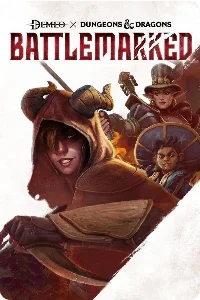
Demeo x Dungeons & Dragons: Battlemarked
Demeo had the table, D&D finally gives it a world
Score: 8.5/10
Images and videos


At a glance
We liked
- Deep tactical combat with only two actions per hero
- Elemental interactions that are easy to understand and very satisfying
- A permanent progression which finally gives continuity to Demeo
- Eight clearly differentiated classes in the current version
We liked less
- A hero creation that is far too limited for a Dungeons & Dragons license
- Narrative choices and dice rolls with modest effects
- Only two complete campaigns to date
- Less precise hand tracking than controllers in combat
 By Farrel Grimwood · published · 12 min read
Contents
Resolution Games didn’t need to start from scratch to adapt Dungeons & Dragons. With Demeo, the studio already had a convincing virtual table, easy-to-handle figurines and a card system capable of transforming a dungeon into a tactical problem. Above all, it lacked a world, ongoing adventures and progression that goes beyond a succession of boards. Demeo x Dungeons & Dragons: Battlemarked takes this base to install it in the Forgotten Realms, around Neverwinter then in the frozen expanses of Icewind Dale.
The current version goes significantly further than the one published in November 2025. The solo has been overhauled, two classes have joined the six initial heroes, new quests have been added and several options now allow you to adjust the difficulty. On Meta Quest 3, the title also benefits from a wireless table, mixed reality and hand tracking. However, it remains a very supervised adaptation: no game master, no improvised action and hero creation reduced to a few choices.
Does this alliance finally give Demeo the campaign it was missing, or does it just dress up its fights with the most famous names in Dungeons & Dragons?
Demeo changes campaign
The principle remains that of a tactical board game observed from above. Each player controls one or more heroes represented by figurines. You must move them onto squares, exploit their deck of cards and eliminate the enemies who occupy the board. The camera can descend to the level of the sets to better read a room or admire a miniature, but the action remains conceived as a game around a table.
The difference lies in the structure. The adventures of Demeo consisted of three levels largely focused on combat, with a loss of progress at the end of the game. Battlemarked connects its maps with a story, world map, dialogue, side objectives, and ongoing hero development. The team returns to a bazaar between missions, chooses their next destination and keeps the upgrades obtained.
Two complete campaigns are offered. Embers of Chaos begins near Neverwinter and leads the group into the nearby forest. Crown of Frost takes the party to Icewind Dale and the Spine of the World. Each one takes about six to eight hours without trying to complete everything. Side quests, three short adventures present from launch and the free additions published since extend the whole.
This continuity changes the rhythm. An opened chest, an unlocked power or a weapon won against a boss no longer disappears after an evening, as was the case in the base game. Cards are therefore no longer just tools to be consumed before the last floor. They participate in the construction of a group that we find several days later. The formula maintains the immediate effectiveness of Demeo, but it finally gives a reason to become attached to your team.
Two actions to turn a fight around
Each hero has two action points per turn. Moving, striking in melee range, or playing most cards consumes one. Some abilities are free, while moving to a square occupied by an enemy allows you to combine movement and attack in a single action. This economy seems simple, but it forces you to choose between moving forward, protecting yourself, preparing an effect or trying to kill a target before responding.
The order of turns adds another constraint. Heroes act first, then game-controlled allies, and finally enemies. It is possible to delay the action of a hero to modify the sequence within the group. The fighter can thus wait for the bard to reinforce the team, or the ranger can let another fighter push a target towards his trap. A decision made too quickly doesn’t just cost a few life points: it can break the entire intended combination.
The cards give each class a readable function. The fighter absorbs and controls the terrain, the rogue strikes hard as soon as he finds the right angle, the ranger attacks from a distance and places devices, the paladin protects his allies, the bard improves their actions and the sorcerer organizes his magical damage. The warlock and the druid, added for free in 2026, further expand the possibilities. The first plays with his occult powers; the second can take the form of a bear occupying four squares, solid but much more difficult to place in a corridor.
Most powers clearly state their cost, range, area, and damage type. Simply enter a card, aim at the desired square and then validate. The cards also come back more regularly than in Demeo. The game therefore invites you to use interesting abilities instead of keeping them for an hour for fear of running out against the next boss.
This generosity takes nothing away from the difficulty. Wrong entry into a room can expose the party to multiple lines of fire. A downed hero can still be raised, but the time lost leaves enemies occupying the best squares. The hardest fights require reading the entire board, counting everyone’s two actions and planning the opponent’s turn. Battlemarked becomes excellent when a prepared four-step plan eliminates a threat that seemed untouchable seconds earlier.
The elements make the real show
The setting does not only serve to separate the combatants. Water extinguishes fire, cleans poison, and reduces some flame damage. A wet target, on the other hand, becomes more sensitive to lightning. The cold can freeze a damp area, while oil, barrels and toxic slicks can trigger chain reactions.
These interactions give weight to the most ordinary cards. An electric attack already deals damage, but it becomes much more profitable if an ally has first spread water under several enemies. A barrel placed near a group can serve as a weapon, a threat, or a way to block a route. Even a push ability gains value when it knocks a creature into a dangerous area.
The best battles are therefore not based on a simple comparison of numbers. They require observing the ground, heights, obstacles and the position of each unit. This logic creates very satisfying solutions without requiring you to memorize an entire manual. The rules are clear enough to be understood while playing, then flexible enough to produce real surprises after several hours.
However, not everything is perfectly readable. An area loaded with effects, imposing figures and objects can make choosing a space tricky. The camera helps, but some small sets leave little perspective. Sometimes you have to turn the table, go down as close as possible and check the destination twice before releasing a figurine. This defect remains occasional with the Quest 3 controllers; it becomes more annoying with hand tracking.
Eight heroes, little freedom to create them
The current selection has eight heroes. The first six cover the rogue, paladin, ranger, bard, fighter, and sorcerer. The warlock Azruss and the druid Gruda Razortusk later joined the group. Each class has a clear identity, a distinct deck of cards, and a natural place on the team. Changing two members is enough to change the way you approach a map.
Progression is divided into three branches linked to class, main power and secondary ability. Levels unlock new cards, strengthen certain characteristics and give access to more specialized variants. Weapons can also be won against major adversaries and then upgraded in some cases. The choices don’t completely change a class, but they allow you to direct a hero towards protection, damage or support.
Creation remains much narrower than the vocabulary of Dungeons & Dragons might lead you to believe. Each hero retains their race, body, voice, and class. The player chooses a name, color, and secondary ability, then expands the intended branches. It is not possible to invent a fighter elf, a dwarf bard, or a rogue half-orc.
This limit serves the readability of the board. A miniature immediately corresponds to a function, and the cards have been balanced around a specific kit. However, it reduces the personal part of the adventure. A game based on D&D naturally creates the desire to build your own adventurer; Battlemarked instead asks to customize already written heroes. The system is effective, but the word creation promises more than it authorizes.
Forgotten Realms are not reduced to a logo on the box. Neverwinter, Icewind Dale, the Spine of the World, known spells, races and the bestiary give a coherent framework to the two campaigns. The cards use familiar abilities, the dice appear in certain controls and the dialogues set up an adventure closer to a module than to a series of isolated fights.
However, the game does not attempt to reproduce the rules of the fifth edition. The attacks use the logic of Demeo, with its cards, its squares and its very reduced number of actions. The twenty-sided die checks mainly occur during a dialogue, a trap or an event. They offer a bit of uncertainty, but failure rarely closes a major path. The person who activates the interaction often makes the roll for the entire group, which also limits the place of individual abilities.
There is no game master or improvisation, which is clearly a missed opportunity. You cannot invent a solution, convince a secondary character with an unexpected argument or use an object outside the intended framework. Dialogue choices sometimes change a reward or the immediate resolution of a scene, but the campaign follows a well-defined route.
This discipline avoids downtime. A team can set up, understand their objective, and begin a fight within minutes. It also explains why the meeting between the two franchises sometimes seems unbalanced. D&D provides the universe, the monsters and some of the vocabulary; Demeo retains control over almost all the rules. Those expecting a faithful adaptation of the role-playing game may find the result too closed-minded. Those who want a clear tactical game, on the other hand, benefit from an immediately recognizable setting without having to follow a human-led campaign.
Two campaigns that finally give direction
Embers of Chaos fulfills its role as a first adventure correctly. Its locations alternate between forest, ruins and inhabited spaces, while its objectives gradually introduce systems. Crown of Frost offers a more pronounced setting, cold threats and more demanding combat. The second campaign better exploits elemental interactions and assumes that the team already controls the cost of its actions.
The narrative doesn’t compete with a large RPG written around hundreds of choices. It relies on functional characters, clear objectives and easy-to-follow twists and turns. The English voices give depth to the exchanges, but they are repeated during combat, notably for certain replies from the bard. The French text allow you to follow the story without difficulty; French dubbing is unfortunately not offered.
Real progress comes from the context given to battles. Defending a location, exploring a secondary area, or confronting a mission-related enemy produces a tension that Demeo‘s standalone dungeons struggled to maintain. The world map also makes the duration visible. We know why the group is moving and what they hope to achieve.
Optional quests are not simple boxes intended to extend the duration. Some unlock a hero, ability, or content that actually changes the team. The quest Bear Hunting, added with the druid, allows for example to integrate Gruda after a mission located in the first campaign. Independent adventures offer games that are easier to launch without repeating a long story.
The quantity of main content nevertheless remains measured. Two six to eight hour campaigns form a solid foundation, especially with the side missions, but they can be completed in a few weeks by a regular group. A third campaign has been announced for 2026 without being yet available. The game finally gives direction to Demeo; it still needs more substantial adventures to transform this success into a real collection.
The solo has been fixed
The launch version required recruited companions whose progression remained limited. This rule made the team less personal and created a gap between the main hero and his allies. The December 2025 update replaced this with a custom team of up to four heroes. Everyone is now gaining experience and maintaining their development.
The player alone can build a coherent composition, assign roles and make each member progress at the same pace. Controlling four heroes requires more attention, but avoids depending on less interesting temporary allies. Combat becomes real tactical problems where every action belongs to the player.
Solo also allows you to take the time to examine the cards and test a combination without waiting for three other people. The duration of battles increases, since the same person must manage each turn, but the pace remains regular. Frequent saves make sessions easier to split and a campaign can be restarted with a different composition.
The settings added in 2026 further improve this flexibility. The difficulty of campaigns can be changed, elite enemies can strengthen encounters and respawning can be activated or not. The game can thus accompany a first discovery or offer more severe opposition to a team which already knows all its cards.
The single-player mode obviously loses the discussions and collective errors that give charm to a board game, but it retains all the depth of the combat. To follow the story at your own pace and develop the eight heroes, it is now fully recommended.
Co-op accommodates up to four people and supports cross-play with other versions. Participants on Quest, PC, PlayStation or Nintendo Switch 2 can therefore join the same team. A game saved by the host can be resumed later with other players, which avoids blocking a campaign when the initial group is not complete.
With four people, everyone can control a hero. The distribution is natural and the debates around an action are reminiscent of an evening of board games. The downside is a longer wait time. A player who does not know his cards well can slow down the entire round, and a placement error immediately commits the group.
Two players each controlling two heroes provides the best balance. The discussions remain present, each person can prepare a complete combination and the rounds move faster. This formula also makes it easier to discover a new class: the other hero serves as a reference point when the first kit still requires a few fights to become familiar.
Communication is not an extra. Elemental damage, pushes, zones and order of actions require warning before playing. A correct attack can ruin a much more profitable combination if launched too early. Battlemarked thus creates a concrete cooperation, based on the rules of the set rather than on a simple vocal presence.
Meta Quest 3 suits it particularly well
The Quest version places the table in the center of a virtual space or in the real room thanks to mixed reality. The Meta Quest 3 makes this second option convincing: the physical decor remains visible in color, the table maintains good stability and it becomes easy to keep an eye on what is around you. The game can also line up the same table for several headsets gathered in the same room.
The controllers allow you to grab a figurine, pull it towards a square, turn the table with both hands and bring your head closer to examine the scenery. It takes little time to get started. The Quest 3’s lenses and screen definition keep text readable, although the most detailed cards sometimes need to be brought closer.
The view from above greatly limits discomfort. No quick movement throws the player into the dungeon, and the table can be manipulated without artificial body movement. It is therefore possible to play seated and adjust your position for a long game. The fatigue comes more from the duration of certain fights than from the camera.
The production remains thought of as an animated model. The figures are detailed, the spells produce clear effects, and each biome has a visible identity. The heroes, however, remain relatively fixed pieces. The spoken scenes and reactions never seek the expressiveness of an RPG observed from a human level. This choice corresponds to the concept, but it limits the strength of certain narrative moments.
Hand tracking allows playing without controllers and reinforces the illusion of touching the table. It still lacks precision when grabbing a small card or placing a figurine on a crowded square. A poorly recognized hand can interrupt a gesture or select the wrong element. The option is suitable for leisurely exploring; controllers remain preferable as soon as a fight requires exact placements.
Verdict
The best table in Demeo, not all Dungeons & Dragons yet
8.5/10
Demeo x Dungeons & Dragons: Battlemarked fixes Demeo's main weakness by giving continuity to its excellent fights. The two actions per turn, the order of heroes, the class cards and the elemental reactions create battles that are readable without being simple. The campaign, the quests and the permanent progression finally give weight to each victory. Dungeons & Dragons remains more of a framework than a complete system. The heroes are largely predefined, the die rolls have little influence on the route and no improvisation replaces the written choices. This restraint will disappoint players who hope to regain the freedom of a table with a game master. On the other hand, it allows Resolution Games to maintain a precise rhythm and an immediately understandable interface.
The updates transformed the single-player, enriched the class selection, and strengthened the difficulty options. On Meta Quest 3, mixed reality, image sharpness and wireless gaming make it a particularly natural version. Two complete campaigns are not yet enough to exhaust the potential of this alliance, but the twelve to sixteen hours offered more than justify the 27.99 euros requested. Battlemarked is not a substitute for a real D&D campaign; it offers one of the best tactical tables available in virtual reality.
Pros
- Deep tactical combat with only two actions per hero
- Elemental interactions that are easy to understand and very satisfying
- A permanent progression which finally gives continuity to Demeo
- Eight clearly differentiated classes in the current version
- A single player now complete with four custom heroes
- Effective cross-coop from one to four players
- Excellent integration of mixed reality on Meta Quest 3
- Fair pricing for the campaigns and free additions
Cons
- A hero creation that is far too limited for a Dungeons & Dragons license
- Narrative choices and dice rolls with modest effects
- Only two complete campaigns to date
- Less precise hand tracking than controllers in combat
- Sometimes repetitive English voices and no French dubbing
More in Video games
Full library 8.5/10
Village in the Shade
SWITCH 10/10
World of Warcraft: Forever
PC 5.5/10
Warrior Cats: Clans of the Forest
SWITCH 6.5/10
Demons’ Night Fever
SWITCH 8/10
Culdcept Begins
SWITCH 5/10
The Witch’s Bakery
SWITCH 8.5/10
Warhammer 40,000: Boltgun 2
PC 7/10
Joe & Mac Retro Collection
SWITCH 9/10
Dragon’s Dogma 2: Dark Arisen
XBOX 9/10