
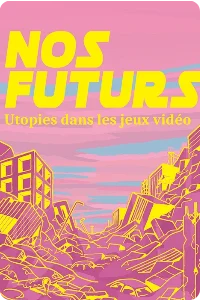
Nos Futurs – Utopies dans les jeux vidéo
Possible worlds caught between the screen and reality
Score: 7/10
At a glance
We liked
- A perceptive angle: utopia seen as a game system rather than futuristic wallpaper.
- A focused selection of Sable, Frostpunk, Scorn and LambdaMOO that avoids becoming a bland catalogue.
- Several voices and styles give the collection movement and prevent a monotonous tone.
- A short but clear format that takes video games seriously without drowning them in jargon.
We liked less
- The collection format limits the depth of each essay, especially with games this rich.
- A lack of bite: the book opens many avenues without always daring to follow them through.
- Some themes, including politics, ecology and online governance, deserved more direct treatment.
 By Farrel Grimwood · published · 5 min read
Contents
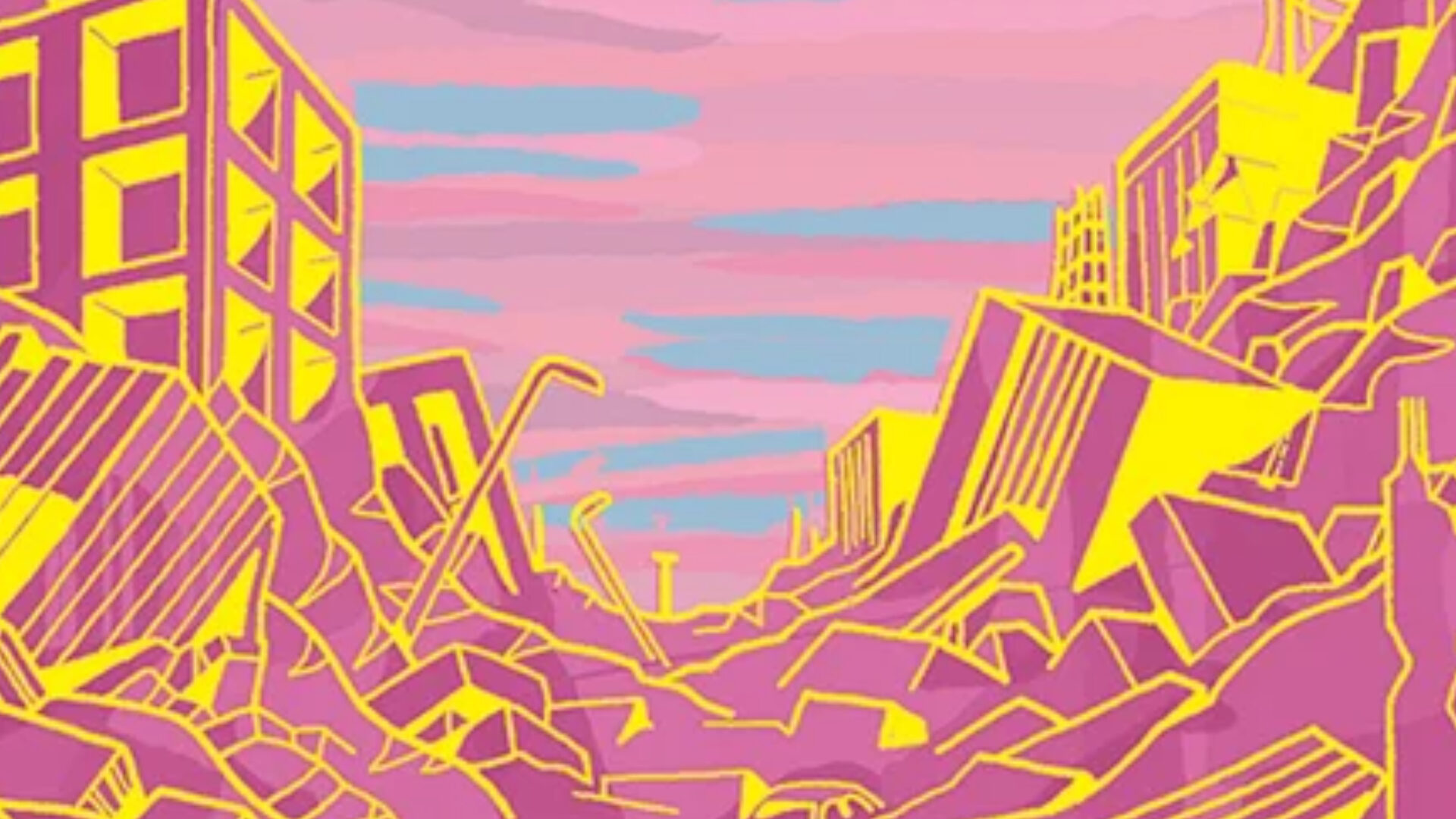
Nos Futurs – Utopies dans les jeux vidéo does not join the pile of books about video games that recycle the same ideas with three poorly digested examples. Its project is more precise: take a few well-chosen games, Sable, Frostpunk, Scorn and LambdaMOO, and use them as a laboratory for discussing utopias, dystopias, the politics of the future, communities and systems. It all fits into a compact book: 127 pocket-sized pages, a cover by Pierre Ferrero, published by Vallées de l’Étrange, which openly embraces its dual role from the outset as a critical tool and a small work of speculative literature.
The result does not pretend to say everything about utopias in video games. This is a collection, not an exhaustive study: several voices, a few games, clear angles and a deliberate choice to dig deeper rather than cover the entire spectrum of pixelated science fiction. The book is short, dense in places and frustrating in others, but has at least one essential quality: it takes video games seriously as machines for making worlds, rather than a convenient source of illustrations.
A clear agenda, a precarious format
The starting point is solid, so we know exactly what we are getting into: Nos Futurs is a collection devoted to science fiction and utopias, comprising various texts, three translated from English, each focusing on a particular game or type of world.
On paper, this format of multiple voices fits the subject perfectly. Utopia is not a single fixed thing, but a tension. It can be desert-bound and contemplative, as in Sable; frozen and punitive, as in Frostpunk; organic and oozing, as in Scorn; social and improvised, as in LambdaMOO. Bringing these perspectives together accepts that video game futures do not all move in the same direction, and that is welcome. The trap, however, is superficial coverage: four weighty worlds, five authors, 127 pages. Every text has to hit its mark quickly, without getting lost in preambles.
The book manages reasonably well, but the constraint is obvious. Its essays establish the stakes well and know what they want to say about their games, yet stop a handful of pages before really exhausting their material. This is neither academic chatter nor a plunge into the deep end. Nos Futurs opts for a miniature laboratory rather than a theoretical manifesto.
Sable, Frostpunk, Scorn: three futures telling different stories
One of the collection’s good decisions is to venture beyond a pristine high-tech future. Sable, Frostpunk and Scorn offer three radically different visions of an imagined world, providing plenty of ways to discuss utopia without confusing it with a postcard. With its welcoming desert lands, Sable approaches the future through gentleness, mobility, movement and the right to seek a role in a world that has already endured disasters but refuses to abandon beauty. Frostpunk heads the other way: coal dictatorships, a frozen city, survival through emergency laws, a community held together by fear of the cold and social systems that tighten the screws until compromise breaks apart.
Scorn strips away the veneer altogether: intestinal industries, a biomechanical nightmare, a world with little left to promise beyond a plunge into a giant digestive system where the human being is merely one piece of matter among others. Discussing utopia from there plainly does not mean searching for an ideal society. It means looking at what these worlds do to the body, to subjectivity and to the very idea of a desirable future. The collection deserves credit for embracing these contradictions rather than smoothing them out: it presents video game futures as a series of scenarios where hope and catastrophe coexist, rather than one uniform whole.
Where things falter a little is the depth of the exploration. Each game could almost warrant a short book of its own, so much does it carry about work, technology, control, ecology and our relationship with landscapes. Nos Futurs opens the right doors and names the right concepts, but sometimes closes them too quickly. That is the problem with a good idea in a tight format: you can see exactly what it could have become with fifty more pages.
LambdaMOO: utopia when only the other players remain
The other important piece of the puzzle is LambdaMOO. Here, the future is no longer a city, a desert or an organic hell, but a community in its purest form: a historic MOO where utopia unfolds in social relations, in code and in the way people inhabit a shared textual space. This is no longer the simulation of a possible world, but the construction of a real miniature world, with its rules, dramas, conflicts, moments of grace and descents into hell.
The collection rightly sees perfect ground here for discussing anarchism in cyberspace, governance, moderation, power shared or seized, and what becomes of utopia when communication tools and scripts replace physical laws. It offers a good counterpoint to tightly structured single-player games: Sable, Frostpunk and Scorn make many decisions for the player; LambdaMOO reminds us that some digital utopias are built collectively, standing or falling according to very tangible power struggles.
Here again, the text makes you want to go further than the format allows. LambdaMOO encompasses a whole history of online cultures, feminist conflicts, debates over symbolic violence and attempts at digital democracy. You sense that the book knows this material, but it has neither the space nor the ambition to offer a definitive account. It opens the window, lets the air in, then closes it.
A book that opens more doors than it closes
Nos Futurs – Utopies dans les jeux vidéo is more like a box of matches than a stove: it starts a fire rather than heating the room for three days. The themes promised on the back cover are all there: the future, utopia, coal dictatorships, intestinal industries, anarchism, hospitality and hostility. The selected games truly structure the discussion. The authors write well, know their subject and do not treat readers like fools.
What is missing is the moment when the book decides to really bite. Nos Futurs is often perceptive, rarely forceful. It favours an invitation over a tightly argued demonstration, a trail to follow over the complete dismantling of a system. That is a defensible editorial choice, especially in 127 pages. But for a collection that directly asks “what will our tomorrows be made of?”, it is a shame that it does not push its criticism further, particularly on the most political subjects: work, extractivism, colonialism and online governance.
Verdict
A good springboard, though not yet the essential reference on video game utopias
7/10
Nos Futurs - Utopies dans les jeux vidéo achieves its most important aim: taking a few video games seriously as makers of futures, without reducing them to their lore, graphics or some vague worldview imposed after the fact. The book is short, well focused and varied in its voices, and makes you want to replay Sable, Frostpunk and Scorn, or return to LambdaMOO, looking much more closely at what their systems really say about our desires and fears.
It is not yet the substantial volume you keep returning to, annotated, underlined and dog-eared. It remains a little too restrained, sometimes too respectful of these games when you wish it would challenge them more directly. But as a starting point, a prompt for thought and an entry into a still underexplored field, it does the job. Provided you accept that, for now, the real critical utopia remains to be written in the margins it opens.
Pros
- A perceptive angle: utopia seen as a game system rather than futuristic wallpaper.
- A focused selection of Sable, Frostpunk, Scorn and LambdaMOO that avoids becoming a bland catalogue.
- Several voices and styles give the collection movement and prevent a monotonous tone.
- A short but clear format that takes video games seriously without drowning them in jargon.
Cons
- The collection format limits the depth of each essay, especially with games this rich.
- A lack of bite: the book opens many avenues without always daring to follow them through.
- Some themes, including politics, ecology and online governance, deserved more direct treatment.
More in Books
Full library 10/10
Sépia, tome 2 : Le complot de Flobourg
Pocket Jeunesse 8/10
100 Films d’animation japonais
Yniss 8/10
The Witcher: A Little Sacrifice
Bragelonne 7/10
One of Us Is Next
PKJ 9/10
The Star That Fell from the Sky
 8/10
Mégères et vamps face caméra
L’Harmattan 8/10
Strange Maps
Seuil 7.5/10
Quelque part dans la région du Kinki
Seuil 7.5/10
L’Élue du Dragon Volume 1: Le Voyage de Mia
Ynnis Éditions 8/10