

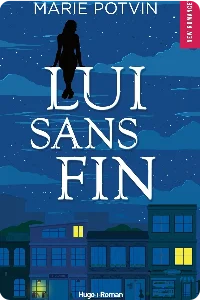
Lui sans fin
The hero leaves the book, the romance skips a few pages
Score: 6.5/10
At a glance
We liked
- The hero modifying his own text offers an immediately catchy concept.
- The dystopian excerpts bring Struan to life before he escapes the book.
- Struan remains touching when he discovers the freedom and rules of the real world.
- Sophie forms a calm, gentle heroine who is sufficiently firm in the face of the fighter.
We liked less
- Rapid physical intimacy strongly contradicts the label of slow burn.
- The dystopia and its oligarchs remain too schematic.
- Struan’s trauma serves his romantic appeal more than his psychological depth.
- Questions about Sophie’s responsibility are raised, then left underexplored.
 By Farrel Grimwood · published · 10 min read
Contents
Sophie lives above her second-hand bookstore, writes in her small apartment and has just achieved the goal that occupied all her nights: publishing her first novel. Marie Potvin, a Quebec author already very present in romance and children’s literature, therefore offers a setting that knows its audience perfectly. Here, the books are not a piece of furniture behind the heroine. They structure her work, her friendships, her imagination and her way of protecting herself from romantic disappointments.
Sophie’s manuscript is a brutal dystopia. Struan, a slave trained for combat, faces colossi in a clandestine arena controlled by oligarchs. Then the printed copies begin to modify what she had written. Struan thinks differently, prepares his escape and ends up feeling the presence of the one who created him. The dialogue passes through the paper before the fighter manages to enter the real world.
Lui sans fin thus has an idea strong enough to be both a romance, a reflection on writing and an offbeat comedy. The novel is, however, presented as a slow burn while the carnal relationship accelerates almost immediately, and its ending clearly opens a second volume without the cover clearly identifying it as volume 1. Between the beautiful idea of the autonomous hero and the very visible reflexes of the New Romance, to what extent does the book really dare to follow its own concept?
An author facing her creature
The opening rests on a very simple shift. Sophie believes she is rereading a finished text, validated and now frozen by printing. However, the text refuses this closure. A thought appears where she had not written any, a decision changes, then Struan gradually ceases to be a body thrown into an arena to become a consciousness capable of looking back at her. The novel finds its most effective image here: the author can no longer correct her hero, she must respond to him.
This shift also works because Struan is not an ideal lover invented in a contemporary romance. Sophie designed him to suffer, endure and kill. His strength, his distrust and his lack of emotional reference points come from a world whose rules she has decided. When he asks for another life, the fantasy of the book boyfriend becomes a moral problem: what does a novelist owe to the being she has condemned to give tension to her story?
Marie Potvin opens this question without exploring its full unsettling implications. Sophie is surprised, doubts what she sees and becomes attached to Struan, but the book quickly chooses emotion rather than a real creative crisis. We could have seen her relationship with writing fracture, guilt take more space or Struan challenge precisely the choices of the one who is at the origin of his pain. The idea remains present, but it mainly serves to bring the two heroes together.
The book within the book
The bits of dystopia prevent Struan from becoming a mere fantasy dropped from the sky. The reader first sees him in the arena, understands the violence that governs his daily life and measures what the possibility of fleeing represents for him. This story within the story also gives a particular rhythm to the beginning: Sophie reads her own novel, spots an anomaly, then discovers that the fiction continues its course without asking her authorization.
The device obviously speaks to readers who have already dreamed of a hero leaving a page. The second-hand bookstore, the first copy received, the best friend active on Bookstagram and discussions around writing create a very recognizable environment. Lui sans fin loves books, the people who recommend them and the sometimes unreasonable bond that an author has with the characters they invent. This tenderness gives the novel an immediate warmth.
It can also make the whole thing a little complacent. The world of books becomes a cocoon where every detail seems designed to provoke recognition: the small bookstore, the book-loving friend, the deeply personal act of creation, then the hero who comes to life. It works as a romantic promise, less as a reflection on publishing or the work of writing. The novel knows very well the images that seduce its readership, but it rarely disturbs them.
When Struan enters the real world, the novel shifts gear. The fighter has only known training, pain, orders and the obligation to survive. He knows nothing of Sophie’s belongings, habits or social boundaries. His discovery of everyday life therefore brings a fairly natural humor. His first instinct remains to read each situation as a threat, while Sophie must make him understand that a world without an arena also has rules.
Struan is loyal, attentive, observant, and determined to protect Sophie; but also worried about a freedom that he never learned to understand. His adjustment gives the book its most touching moments. It is not enough to open a door for him to erase what he has experienced; he still needs to understand what he can want when no one is forcing him to fight.
The character, however, often falls back into the archetype of the bestial colossus. His strength, his protective instinct and his ignorance of modern codes are pushed to the point of giving him almost primitive reactions. There is a logic to this within his original world, but it does not justify everything. By making his body and his contained brutality his main sources of romantic appeal, the novel sometimes reduces the complex man it has just set free.
A slow burn that burns too quickly
Lui sans fin is presented as a slow burn, therefore as a relationship which must take the time to build desire, trust and confession. The dialogue between Sophie and Struan certainly begins before his arrival in the real world. They already know each other through words, and Sophie knows things about him that he has never confided to anyone. This emotional advance avoids treating their meeting as that of two complete strangers.
But the physical intimacy occurs far too quickly for the chosen label. Struan has barely left his world, is still discovering the basic rules of Sophie’s and knows almost nothing about love. However, the relationship quickly moves to sex, then returns to it several times. The problem is not the presence of these scenes. It is their speed that cuts discovery short and makes the promise of slowness difficult to defend.
Tenderness fortunately ends up overtaking this haste. Sophie and Struan listen to each other, seek to preserve each other and learn to distinguish between protection, possession and trust. The last chapters give more weight to their bond than the first impulses. There remains a clear contradiction: emotional romance takes its time, while physical romance skips the steps that could have made the desire much stronger.
The dystopia remains behind the cover
The novel written by Sophie has a brutal basis: fighting slaves, a clandestine arena, oligarchs who dispose of the bodies and a hero trained to never give in. These elements are enough to explain Struan and to give immediate danger to his flight. They also provide a useful contrast to Sophie’s bookstore, apartment, and quieter life.
However, this dystopia remains above all a source of trauma. Its oligarchs have little depth, its political functioning remains schematic and the arena serves above all to create a powerful man, wounded and foreign to love. As soon as Struan leaves the book, the world he leaves loses much of its force. The threat is real, but the universe does not exist enough on its own to compete with the contemporary part.
This imbalance also weakens the psychological side. A man raised in slavery and violence should not only be surprised by modern objects or by Sophie’s gentleness. His freedom, his relationship with the body, his fear of orders and his inability to choose could nourish much harder material. The novel touches on a few pieces of it, then quickly returns to romance. Struan remains endearing, but his trauma sometimes becomes a seductive trait rather than a fully examined wound.
Sophie keeps her feet on the ground
Faced with the impossible, Sophie does not transform into a hysterical or perpetually overwhelmed heroine. She observes, checks, doubts, then looks for a solution. Her calmness makes the first interactions with Struan much more readable. She understands that she is responsible for him without accepting each reaction of the fighter. This firm gentleness gives the couple a more interesting basis than simple physical fascination.
Her life around books also gives her a clear identity. The second-hand bookstore is not just a pretty setting, nor is Sarah, her best friend who is passionate about reading and active on social media. Her father, for his part, brings an emotional presence which reminds us that Sophie did not wait for Struan to be surrounded. These bonds prevent romance from completely shutting out the world around the couple.
The supporting roles nevertheless remain underdeveloped. Sarah brings energy and a sense of complicity, Sophie’s father offers a few touching scenes, but both exist above all to accompany the central secret. Sophie herself sometimes seems too calm in the face of a situation that destroys all the rules she knows. This stability helps the rhythm; it also removes some of the panic, disbelief and conflict that the concept could produce.
The 360 pages move forward with direct writing, lots of dialogue and chapters that are always looking for the next development. The novel moves from the bookstore to the interior text, then from strangeness to comedy and romance without becoming laboured. This fluidity is perfectly suited to an idea that could become confusing if it multiplied the rules on the border between fiction and reality.
The humor relies mainly on Struan’s displacement, but it leaves room for gentler moments. The book thus avoids getting stuck in the darkness of the arena or in a succession of sexual scenes. Marie Potvin knows when to return to Sophie, to her bookstore or to those around her to give the couple a breather. The reading experience therefore maintains real momentum, even when development becomes predictable.
This simplicity, however, limits the scope of the concept. Events follow one another with an ease that sometimes reduces the consequences of the impossible. Sophie’s creation comes to life, crosses the paper and disrupts her daily life, but the story prefers efficiency to disorientation. It reads quickly because it cuts out anything that could slow down the romance. In doing so, it loses some of the strangeness its premise made possible.
A practical border, never really defined
Fantasy is based on a deliberately flexible rule: a printed text can change, a protagonist can feel the person reading it, then fiction can let a very real body emerge. The novel gives just enough steps to make this idea accepted. It seeks no magic formula, no scientific explanation, no great cosmic mechanism. Sophie’s emotion and Struan’s new consciousness serve as proof.
This restraint avoids drowning the romance in a complicated rulebook. It also makes convenient shortcuts possible. The border acts when the plot needs it, without Sophie or Struan being able to really understand what controls it. The material consequences and limits of the phenomenon remain unclear. The book therefore poses a very precise impossibility, but it maintains a space around it large enough to relaunch or shift the tension.
In a fantasy romantic comedy, flexibility allows you to stay close to the two heroes and not turn each chapter into an investigation. It becomes more annoying when the ending uses this border again to impose its cliffhanger. The mystery then seems less constructed than kept in reserve. What follows will still be able to give rules to this phenomenon; this first volume prefers to take advantage of its effect.
The ending clearly seeks shock. It shifts the established certainties, reopens the boundary between the book and reality, then stops on a cliffhanger accompanied by a “to be continued”. The effect makes you want to find Sophie and Struan again, and it proves that Marie Potvin has not exhausted her idea in this first story. The title even takes on a new irony: nothing really had to end here.
The problem is with the presentation. The edition simply bears the title, with no volume number highlighted, and its description sells a complete story around a hero taken from a novel. Discovering in the last pages that the resolution will depend on a sequel creates a frustration that goes beyond the simple pleasure of suspense. The reader does not clearly choose a series; he learns it when he closes the volume.
This choice weighs on the overall assessment. An open ending could have retained the mystery while still completing the main plot. The cliffhanger retains part of the answer and transforms the novel into the first half of a whole that still has no clear date. Curiosity works, but it doesn’t replace a conclusion. For a 360-page book sold for €18, the terms deserved to be made clearer from the outset.
Verdict
A great idea that turns the page too quickly
6.5/10
Lui sans fin has a real hook. The text which is rewritten, the author forced to respond to her creature and the fighter who discovers a life without an arena give the novel an immediate identity. Struan remains touching as he discovers what he wants for himself, Sophie brings calm, and the excerpts from the dystopia give concrete form to the novel within the novel. Marie Potvin writes with fluidity and captures the warmth of a world full of readers.
But the romance rushes through what the premise had patiently set up. Sex cuts short the promised slow burn, the dystopia becomes a simple traumatic origin and the questions about Sophie's responsibility remain less developed than the attraction between the two heroes. The final “to be continued” adds a final reservation by belatedly revealing the serial nature of the project. An original and endearing fantasy romance, that keeps the pages turning but does not yet explore everything it has set in motion.
Pros
- The hero modifying his own text offers an immediately catchy concept.
- The dystopian excerpts bring Struan to life before he escapes the book.
- Struan remains touching when he discovers the freedom and rules of the real world.
- Sophie forms a calm, gentle heroine who is sufficiently firm in the face of the fighter.
- The bookstore, Sarah and the relationship with writing create a warm universe.
- Fluid writing that allows you to move swiftly through the 360 pages.
Cons
- Rapid physical intimacy strongly contradicts the label of slow burn.
- The dystopia and its oligarchs remain too schematic.
- Struan’s trauma serves his romantic appeal more than his psychological depth.
- Questions about Sophie’s responsibility are raised, then left underexplored.
- Sarah and Sophie's father serve mainly to support the central secret.
- The cliffhanger and the “to be continued” reveal too late that the story demands a sequel.
More in Books
Full library 8/10
Kushinada
Hugo Roman 8/10
100 Films d’animation japonais
Yniss 8/10
The Witcher: A Little Sacrifice
Bragelonne 7/10
One of Us Is Next
PKJ 9/10
The Star That Fell from the Sky
 8/10
Mégères et vamps face caméra
L’Harmattan 8/10
Strange Maps
Seuil 7.5/10
Quelque part dans la région du Kinki
Seuil 7.5/10
L’Élue du Dragon Volume 1: Le Voyage de Mia
Ynnis Éditions 8/10