

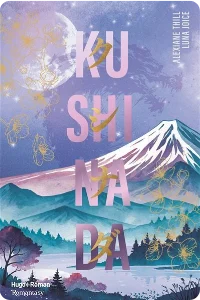
Kushinada
A rich, slow Japanese fantasy that is much more brutal than it looks
Score: 8/10
Images and videos
At a glance
We liked
- A clear and coherent rewrite of the mythos of Susanoo, Kushinada-hime and Yamata-no-Orochi.
- The complementary system of Kushinada and Kusanagi gives a real identity to the fights.
- Saori benefits from a nuanced evolution between family duty and personal choice.
- Lukas offers a natural entry point into Japanese rites, clans and folklore.
We liked less
- The first third stretches and repeats several issues already understood.
- The last part deals too quickly with certain creatures and secondary figures.
- Romance remains far behind despite the romantasy classification.
- The gory details recur often enough to become grueling and sometimes mechanical.
 By Farrel Grimwood · published · 11 min read
Contents
The name Kushinada comes from one of the most famous Kojiki stories. The storm god Susanoo meets a couple whose seven daughters have been devoured, year after year, by Yamata-no-Orochi, an immense serpent with eight heads and eight tails. The eighth, Kushinada-hime, will be next. Susanoo shelters her, gets the creature drunk and then kills it. In one of its tails, he discovers the sword which will take the name Kusanagi. Luna Joice and Alexiane Thill do not copy this legend. They change the outcome to imagine what would happen if Orochi had only been locked in Yomi, the world of the dead.
Centuries later, the door that holds the monster back cracks. Saori Inada, descendant of Kushinada-hime, finally receives the gift her family has been preparing her for since childhood. To fight the creatures released by Orochi, she must bond with a Kusanagi, a warrior responsible for defending her and strengthening her powers. This partner is Lukas Taylor, an Australian who came to Japan after the death of his grandfather. He knew nothing about this heritage and was planning to go on a world tour, not risk his life in sanctuaries.
With its 624 pages, Kushinada therefore promises a complete adventure, an immersion in Japanese folklore and a slow relationship between two heroes who are completely opposed. The novel largely keeps its first two promises, at the cost of a very drawn out beginning and fights that are sometimes difficult to endure. The third is more debatable: love exists, but it remains for a long time behind family, duty and the fight against Orochi. Does this breadth allow the book to go beyond the conventions of romantasy, or does it dilute part of its momentum?
An ancient myth brought to the present
The prologue takes up the figures of Susanoo, Kushinada-hime and Yamata-no-Orochi before introducing the main freedom of the novel: the dragon has not disappeared, its confinement has only postponed the conflict and entrusted the descendants of the first heroes with a hereditary war. This choice determines the organization of the clans, the gifts, the rites and the fear of a new rupture of the Yomi gate.
The most effective discovery consists of transforming the two names of the ancient story into complementary functions. A Kushinada wields magic and faces the forces of Orochi; A Kusanagi protects his partner and fights alongside her. The name of the sword thus becomes that of a line of warriors. The gap with the legend is clear, but it preserves the link between the princess, the fight and the weapon discovered in the body of the monster.
This extension gives the book an immediately readable basis without reducing Japan to a reservoir of exotic creatures. The Inada clan lives at Yaegaki Shrine in Matsue, a place associated with Kushinada-hime and Susanoo. The presence of the pond, the woods, the ritual buildings and the guardian families connect the plot to a real place before fiction installs its own rules there. Even when the novel takes great liberties, we always understand where tradition ends and its world begins.
Saori, heiress under duress
Saori was trained to become Kushinada long before the gift chose her. Her grandmother, matriarch of the Inada clan, made this heritage the center of her upbringing. Training, deprivation, isolation and control of every emotion have shaped a young woman who is polite, upright and almost incapable of saying what she really wants. The book thus shows the human cost of tradition before celebrating its greatness.
Her development does not consist of rejecting her family or mission altogether. Saori believes in her duty and understands the danger that threatens the population. On the other hand, she learns to distinguish respect from obedience, then loyalty from imposed sacrifice. This nuance gives her much more depth than a chosen one who suddenly discovers power. She already knows how to fight; her real struggle is to regain control over her own life.
The novel sometimes places too much emphasis on her self-effacement and the expectations that weigh on her. Several exchanges repeat what her attitude has already made obvious. But Saori remains the emotional heart of the story. Her strength does not erase fear or the after-effects of her upbringing, and her progress remains gradual. When she begins to stand up to the elders, the effect comes less from a brilliant reply than from the long journey necessary for her to finally dare to say it.
Lukas, the foreigner who refuses his role
Lukas serves as an entry point for any reader unfamiliar with Shinto or the Orochi myth. He comes from Australia, loves surfing and was planning a trip with his best friend. The death of his maternal grandfather took him to Japan, then the latter’s inheritance locked him into a position he had never heard of. The explanations he receives are therefore necessary for the story instead of taking the form of a lecture.
His refusal is credible. Lukas does not dream of becoming a chosen one and does not consider that power transmitted by blood immediately creates a debt towards an unknown clan. He wants to protect his loved ones, regain his freedom and leave an institution that decides for him. His humour and insolence offend the matriarchs, but they also prevent the universe from becoming solemn on every page. Faced with Saori, accustomed to accepting everything, this resistance counterbalances the rigidity of the story.
However, the character ends up annoying. He puts his personal project ahead of a danger that he knows is real, and certain reactions unnecessarily prolong an already understood conflict. The book does not hide this selfishness; it makes it the starting point of his evolution. Lukas does not become docile, he gradually chooses to stay for Saori and for the possible victims, which gives more value to his commitment than immediate acceptance.
A duo built on interdependence
A Kushinada and her Kusanagi aren’t just a fighting team. Their gifts need each other, and the bond that unites them forces them to share an intimacy that they did not choose. Tamashii, a soul connection specific to the novel, allows them to perceive each other and come together apart from the rest of the clan. This rule gives a concrete form to trust: if they close themselves off or lie to themselves, their effectiveness suffers.
The device could have easily reduced Lukas to Saori’s bodyguard. On the contrary, combat requires true reciprocity. She carries the power that repels demons; he gives her the protection and support she needs to use it. None can win alone. This functional equality supports their emotional progress and prevents the romance from relying solely on a powerful man responsible for saving a vulnerable heroine.
The forced proximity, however, does not erase their disagreements. Saori accepts the clan’s orders too quickly, Lukas refuses them on principle, and everyone must learn to see what the other is protecting behind their attitude. Their connections and their withdrawals build the bond over time. The novel nevertheless repeats several times that they are essential to each other, even though their training and injuries were already enough to demonstrate this.
Sanctuaries, clans and rites take center stage. The kagura suzu, sets of bells linked to ritual dances, contribute to Saori’s powers. Norito, prayers recited during Shinto ceremonies, are also part of the practice of Kushinada.
The novel also takes the time to show a collective structure. The guardian families, the elders, the training of future chosen ones and the defense of the sanctuaries form a network that goes beyond Saori and Lukas. The danger does not only concern their couple, it threatens a community which has been fighting for centuries and whose rules have hardened under the weight of the dead. This shared history explains the rigidity of the clan without excusing its cruelty.
However, not everything has the same depth. Some creatures are mainly introduced to provide a new challenge, and the large number of Japanese terms can slow down the first few pages. The final glossary actually helps, but it doesn’t replace a definition at the exact moment a word appears. The whole, however, remains coherent: folklore acts on the characters, weapons, gestures and hierarchy. It could not be replaced by another setting without rewriting the novel.
A fantasy before a romance
Hugo Roman classifies Kushinada in its Romantasy imprint and the back cover places love at the center of its final question. We must therefore clarify the real contract: the relationship between Saori and Lukas is built slowly, but it does not direct the majority of events. Training, the Yomi gate, attacks and family abuse take up a lot more space.
This withdrawal benefits the couple. Saori and Lukas don’t exchange a few barbs before confusing attraction with trust. They see themselves as exhausted, hurt, afraid or unfair to each other. Their affection is born from support, decisions made in battle and moments shared in Tamashii. The contrast between Saori’s reserve and Lukas’ energy works, because each truly changes the way the other faces their family and their duty.
On the other hand, readers who came primarily for the romance risk finding it too discreet. It takes a long time, remains gentle and never reaches the physical intensity that the brutality of the fights might lead us to expect. Some emotional stages even seem to arise from the magical bond before being fully gained by their exchanges. The relationship is compelling, but the book would be better presented as a contemporary fantasy with romance than as a couple-centered romance.
A rhythm that requires patience
The 624 pages serve a standalone story and a universe that demands explanations. A certain slowness was therefore inevitable. The beginning sets up the two families, the return of Lukas, the training of Saori, the system of gifts and the first training sessions. This construction allows you to understand the issues without consulting the glossary in each chapter.
The first third, however, exceeds this need. Lukas’ doubts, Saori’s submission and the strength of their bond are rephrased several times. Close training scenes delay the moment when Orochi’s threat comes into its own. The novel remains readable thanks to the alternation of voices, but sometimes you have to wait a long time before information or a relationship really progresses.
The balance reverses in the last part. The attacks become stronger, the revelations follow one another and the final fight finally unfolds the size promised by the eight-headed dragon. This acceleration is gripping, but it leaves less room for creatures, consequences and certain secondary figures than the beginning gave to the preparations. A hundred pages better redistributed would have made the whole more tense without removing its contemplative dimension.
The shimmering cover and emphasis on romance can give a misleading idea of the level of violence. The clashes depict blood, mutilated bodies, torn limbs and very real injuries. Heroes do not emerge clean from an attack, and Orochi creatures are never treated as abstract enemies. This harshness gives weight to the threat.
The action scenes remain easy to follow despite the number of powers and fighters. The duo’s positions are clear, Saori’s ritual gestures are distinguished from Lukas’ physical intervention and each attack tests their coordination. The final fight particularly benefits from this preparation: it seems immense without transforming into a simple accumulation of noise and light.
The repetition of the bloody detail, however, ends up blunting its effect. A well-described injury shocks; the fourth can give the impression that the novel is still trying to prove that it is adult. This violence also contrasts with certain dialogues and archetypes close to young adults. The contrast may please, but it deserves to be known before reading. People sensitive to gore will not find a gentle mythological adventure here.
Two authors, one shared voice
Luna Joice and Alexiane Thill share the two protagonists, with an alternation of points of view which suits the central link. Saori’s voice remains controlled, attentive to the rules and silences; that of Lukas appears more spontaneous, ironic and action-oriented. The difference characterizes the heroes without giving the impression that two novels have been assembled.
The writing favors clear sentences, numerous dialogues and chapters which often end with a concern or a decision. This choice makes accessible a universe loaded with names and rites. The descriptions of the shrines and ceremonies establish a precise atmosphere, while Lukas’ humor prevents Saori’s family gravity from overwhelming the entire text.
The emotional vocabulary, however, sometimes revolves around the same ideas, and certain explanations come back even though the reader has already integrated them. The secondary characters have a clear function, but several remain attached to a dominant trait: the cruel matriarch, the faithful ally or the hostile elder. The coherence of the two voices remains a real asset; a firmer revision would have especially benefited from tightening up their repetitions.
A standalone volume that sees the fight through
In an area where trilogies and suspended endings have become common, the choice of a standalone novel can be surprising. Kushinada sets its rules, develops its duo and leads the conflict with Orochi to a real resolution. The epilogue provides a point of arrival for the characters instead of cutting off just before the expected answers.
This autonomy partly justifies the length. The authors do not need to artificially keep a secret for a second volume, and the reader can become involved in the clans without signing for several years. The conclusion closes the link between the ancient legend and contemporary descendants. It retains real emotion, because the price of victory is not limited to a few wounds erased in the next chapter.
The downside is the concentration at the end. Secondary figures, certain demons and several consequences would have benefited from a little more air. The book has enough material for two volumes, but its decision to remain self-contained also gives it a clearer identity. Better a somewhat quick conclusion than a conflict interrupted for the sole reason of selling the sequel.
The paperback edition sold for €19.95 offers a large format of 14.5 × 22.5 cm, a cover worked with gilding, careful chapter openings and a glossary placed at the end. At 624 pages, the volume weighs almost 700 grams: it is comfortable on a table, less so in one hand during a long journey. The price remains consistent for this format and this pagination.
The glossary is the most useful addition. It allows you to find a rite, a creature or a term of the clan organization without making each dialogue heavier. However, it would have been even more practical with discreet references at the first occurrence of less common words. The object supports the ambition of the novel well: it makes you want to enter this universe and provides a tool to avoid getting lost in it.
Verdict
Duty, blood and choice
8/10
Kushinada draws on a specific myth and transforms it into contemporary fantasy without erasing its origin. The Yaegaki shrine, norito, kagura suzu and Yomi and the Orochi figure all participate in the story. Above all, the couple formed by the protector and her Kusanagi gives a strong rule to the universe. Saori carries the most touching trajectory, while Lukas brings the refusal and humor necessary to challenge a family order that has become cruel. Their trust builds slowly enough to give weight to the common victory.
However, the novel would have benefited from better distribution of its 624 pages. Its first third repeats several conflicts, then its ending accelerates when the creatures and supporting roles become the most interesting. The romance, sweet and credible, also remains too understated to justify the imprint’s chosen label on its own. Finally, graphic violence deserves a clearly visible warning. These reservations cancel neither the richness of the folklore, nor the effectiveness of the combat, nor the pleasure of finding a complete adventure in one volume. A generous, well-researched fantasy, darker and more patient than its golden setting suggests.
Pros
- A clear and coherent rewrite of the mythos of Susanoo, Kushinada-hime and Yamata-no-Orochi.
- The complementary system of Kushinada and Kusanagi gives a real identity to the fights.
- Saori benefits from a nuanced evolution between family duty and personal choice.
- Lukas offers a natural entry point into Japanese rites, clans and folklore.
- The shrines, norito and kagura suzu have a real function in the plot.
- The action scenes are readable, intense and support the progression of the duo.
- The two points of view form a fluid whole despite the co-writing.
- The story is concluded in a single volume and the glossary makes reading easier.
Cons
- The first third stretches and repeats several issues already understood.
- The last part deals too quickly with certain creatures and secondary figures.
- Romance remains far behind despite the romantasy classification.
- The gory details recur often enough to become grueling and sometimes mechanical.
- Several secondary characters remain locked into a dominant trait.
More in Books
Full library 8/10
100 Films d’animation japonais
Yniss 8/10
The Witcher: A Little Sacrifice
Bragelonne 7/10
One of Us Is Next
PKJ 9/10
The Star That Fell from the Sky
 8/10
Mégères et vamps face caméra
L’Harmattan 8/10
Strange Maps
Seuil 7.5/10
Quelque part dans la région du Kinki
Seuil 7.5/10
L’Élue du Dragon Volume 1: Le Voyage de Mia
Ynnis Éditions 8/10
Comme dans une romance de Noël… ou pas !
Hauteville 9/10