

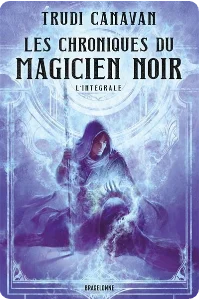
Les Chroniques du Magicien Noir – L’Intégrale
An interesting return, less demanding than the first cycle
Score: 7.5/10
At a glance
We liked
- Sachaka and the Traitors clearly enrich the universe.
- Concrete links between magic, slavery and control of knowledge.
- Continuity with the first cycle and the evolution of the Guild.
- A clear read despite the multiple plots and points of view.
We liked less
- Preparations that take too long and thoughts that repeat themselves.
- Lorkin lacks depth at the start; several returning heroes remain sidelined.
- Resolutions that are too quick and less strong than the stakes announced.
 By Farrel Grimwood · published · 8 min read
Contents
Twenty years have passed since The Black Magician Trilogy. Sonea has become a recognized magician, the Guild has changed its rules and her son Lorkin wants to leave the family protection to do something with his life. Trudi Canavan thus returns to her world with a new generation, but retains a good part of the old heroes. Bragelonne now brings together this second trilogy in a 1,520-page omnibus: The Ambassador’s Mission, The Renegade and The Traitor Queen.
The return is pleasant, especially since the story finally takes a close interest in Sachaka, this neighboring country whose magical power was already worrying the Guild. The relationships between the two nations, the secrets they keep and the changes that have occurred in Imardin provide material to extend the story. Is returning to Sonea and those close to her enough when their new adventure takes so long to get going?
The Guild still has work to do
Sonea had to fight to find her place in an institution reserved for the privileged. The Guild now accepts students from poor neighborhoods, but prejudices have survived this openness. Canavan thus avoids presenting the victories of the first cycle as a definitive solution. The rules have evolved; not all of those who benefited from it changed their minds. A detail about the books sums up this operation well. The Guild maintained the idea that its presses used magic, even though their invention came from a man without powers. This deception protected its monopoly. The arrival of students from different backgrounds contributes to weakening it. The example is interesting because it gives a concrete consequence to the reform: bringing in new people also modifies the circulation of knowledge and economic interests.
Sonea’s situation remains just as contradictory. She is one of the rare magicians authorized to practice black magic, which allows one to accumulate energy drawn from other beings. Her power is useful for the defense of the country, but also justifies close surveillance. A law even prohibits her from leaving Imardin. Seeing her prevented from helping her son despite her position gives a real reason for anger, more convincing than a new threat appearing without connection with the previous novels, but also and above all serves as a conspicuous plot device, keeping her out of the action to give more latitude to her son.
Lorkin must prove himself
Son of Sonea and Akkarin, the former High Lord of the Guild, Lorkin grew up with a difficult name to bear. He becomes Dannyl’s assistant, appointed ambassador to Sachaka, hoping to be useful away from his mother. This departure also allows him to discover a society where black magic is common and where the wealth of the powerful is based on slavery. His education prepared him to cast spells, much less to live with this reality.
An assassination attempt quickly disrupts his mission. Tyvara, the young woman who saves him, belongs to the Traitors, a clandestine organization opposed to Sachakan power. Lorkin finds himself involved in their conflicts, of which he knows almost nothing. His storyline becomes more interesting as he understands that his father’s actions also left debts and resentments. The name that opened doors for him at home could very well get him killed elsewhere.
It’s a good foundation, even if Lorkin initially lacks personality. He wants to do well, asks a lot of questions and discovers what others already know. His position makes explanations easier, but for a long time makes him less endearing than Sonea in the first cycle. He becomes more interesting when he has to decide what he agrees to pass on to the Traitors. His knowledge of healing finally gives him a role that goes beyond that of the son to protect. His attraction to Tyvara accompanies this evolution without being enough, on its own, to make all his decisions convincing.
Rebels far from blameless
Sachaka brings the most interesting part of this sequel. Its master magicians draw their power from the slaves whose energy they absorb. The magic system therefore has a very clear human cost. To maintain their superiority, the dominant must maintain control over those who feed them. The question goes far beyond the power of a spell: it concerns the organization of the country and what its leaders have an interest in prohibiting.
Opposite them, the Traitors live in a hidden community, Sanctuary. One might expect to find an exemplary society there. Canavan makes a more interesting choice: women hold the power and limit men’s access to magic. The rebels fight oppression while imposing their own inequalities. They also have disagreements over Lorkin and opening up to outsiders. Their cause is understandable, their methods remain questionable.
Exchanges of knowledge give these tensions substance. The Traitors have knowledge related to magic stones, while the healing practiced by the Guild would be valuable to them. Everyone wants to obtain what they lack without delivering what ensures their security. The negotiations thus have real content. Teaching a technique can change a balance of power, help sick people or provide a new advantage to an already abusive authority.
This political dimension frankly enriches the novels, even if certain possibilities opened up by these discoveries remain underdeveloped. The potential changes are immense, but the narrative dwells more on the conditions of a deal than on all its consequences. We end with several ideas for which we would have liked to see more applications.
In Imardin, Cery investigates murders that shake up the world of thieves. This former friend of Sonea knows the criminal networks and their habits, but comes up against an adversary capable of using magic. His informants, his precautions and his experience are no longer enough. The plot therefore returns to the working-class neighborhoods of the first cycle, showing what such an imbalance can cause there.
Cery’s aging is well exploited at the start. He has a family, responsibilities and much more to lose than the young man in the first novels. Seeing him having to hide gives another dimension to his resourcefulness. The threat is all the more worrying because it destroys his security in places he thought he knew.
The problem is that this vulnerability ends up reducing his role. The investigation advances through research, waiting and precautions, with too few intermediate results to renew the tension. Sonea has considerable powers, Cery has his contacts, but both struggle for a long time to change the situation. The contrast with Lorkin’s discoveries becomes unfavorable. We find these figures with pleasure, then we wait until they finally have something decisive to do.
Dannyl occupies a less comfortable position than it seems. As ambassador, he must deal with the Sachakan authorities, protect the interests of the Guild and understand a country whose slavery he condemns. His research on the history of magic extends the questions of the first cycle. The past intervenes in present discussions, because the different nations have retained neither the same knowledge nor the same version of events.
His love life also complicates his mission. His relationship with Tayend, who remains linked to his former life in Élyne, and his rapprochement with Achati, his interlocutor at Sachaka, force him to review his certainties. Canavan integrates homosexuality into the ordinary relationships of her characters, while showing that their freedom depends on the country in which they live. These cultural differences give interest to the exchanges beyond the simple love triangle.
The place given to feelings suits this fantasy, which is more attentive to relationships than to confrontations. The writing, however, is sometimes too insistent in its explanations. Doubts are formulated, examined, then taken up again during conversations. We quickly understand what is holding Dannyl back; repeating it becomes less necessary. And despite his central position, he often remains sidelined from the decisions that really advance the Sachakan plot.
An ending that doesn’t make up for everything
The three novels do not have quite the same function. The Ambassador’s Mission sets up the two investigations and Lorkin’s departure. The Renegade delves deeper into the society of the Traitors while opening a new intrigue at the Guild, around two novices, Lilia and Naki, and the clandestine transmission of black magic. The Traitor Queen must then conclude these different conflicts. The whole thing is easy to follow, but the preparation takes up a disproportionate amount of space.
However, reading remains fluid. Canavan sets out the rules of her world with clarity and alternates points of view without making events difficult to follow. Even when the action progresses little, the differences in environment and relationships maintain curiosity. This ease of reading counts at such a length. It allows us to continue despite scenes that would benefit from being tightened.
The last novel accelerates, without giving all the resolutions the expected magnitude. Some confrontations are resolved quickly, while several important decisions are perceived at a distance by the heroes. After so much preparation, this step back weakens the emotion. The problem is less with the absence of big fights than with the feeling that the characters are sometimes witnessing the conclusion of their own story. The first trilogy conveyed their personal stakes more effectively. This sequel offers more leads, but closes them with less force.
Choose the right omnibus
This Bragelonne edition brings together the three novels in the translation by Isabelle Troin, for 25.95 euros. The price is interesting for a complete trilogy, without having to look for the volumes separately. The paperback, however, has 1,520 pages in a format of approximately 12.6 × 19.1 cm: the content is gathered, not reduced. The interest of this edition is primarily due to the grouping and the price.
Pay particular attention to the title. The Black Magician Chronicles is the sequel to The Black Magician Trilogy, and this omnibus therefore does not include Sonea’s debut. The reminders allow us to understand the events, but also reveal major elements of the first cycle. Better to start with The Magicians Guild, The Novice and The High Lord. The reunions, the changes at the Guild and the weight of Akkarin in Lorkin’s life will then have much more meaning.
Verdict
A return which is especially valid for its universe
7.5/10
The Chronicles of the Black Magician usefully extends the universe of Trudi Canavan. The discovery of Sachaka, the contradictions of the Traitors and the issues linked to the transmission of magic give real reasons to continue after the first cycle. The story remains accessible and retains enough endearing characters to support this long read.
The trilogy is less convincing in its rhythm and its outcome. Lorkin takes time to establish himself, the old heroes wait their turn too often and certain conclusions are rushed after hundreds of pages of preparation. This omnibus remains a good purchase to continue the series at a reasonable price, but we must accept a sequel more focused on negotiations and relationships than on tension. Interesting, sometimes gripping, without recapturing the force of the first novels.
Pros
- Sachaka and the Traitors clearly enrich the universe.
- Concrete links between magic, slavery and control of knowledge.
- Continuity with the first cycle and the evolution of the Guild.
- A clear read despite the multiple plots and points of view.
- The three novels combined for 25.95 euros.
Cons
- Preparations that take too long and thoughts that repeat themselves.
- Lorkin lacks depth at the start; several returning heroes remain sidelined.
- Resolutions that are too quick and less strong than the stakes announced.
More in Books
Full library 8/10
The Witcher: A Little Sacrifice
Bragelonne 8.5/10
Diablo IV : Le dernier des Horadrim
Bragelonne 8/10
100 Films d’animation japonais
Yniss 7/10
One of Us Is Next
PKJ 9/10
The Star That Fell from the Sky
 8/10
Mégères et vamps face caméra
L’Harmattan 8/10
Strange Maps
Seuil 7.5/10
Quelque part dans la région du Kinki
Seuil 7.5/10
L’Élue du Dragon Volume 1: Le Voyage de Mia
Ynnis Éditions 8/10