
Lilypad Educational Tablet
The tablet that imitates the screen without really becoming one
Score: 7/10
Images and videos
At a glance
We liked
- A physical format that imitates the tablet without becoming a real touchscreen tablet
- The Lilypad design works well, especially with the animated eyes and moving legs
- Letters, numbers and music activities are accessible to preschool children
- The Toy Story 5 branding brings a real hook thanks to the characters and voices
We liked less
- A fairly limited educational depth beyond the earliest learning stages
- The 3-8 year old age group seems too broad for the content offered
- The mini-games risk becoming repetitive quite quickly
- The branding accounts for a large part of the product’s appeal
 By Farrel Grimwood · published · 5 min read
Contents
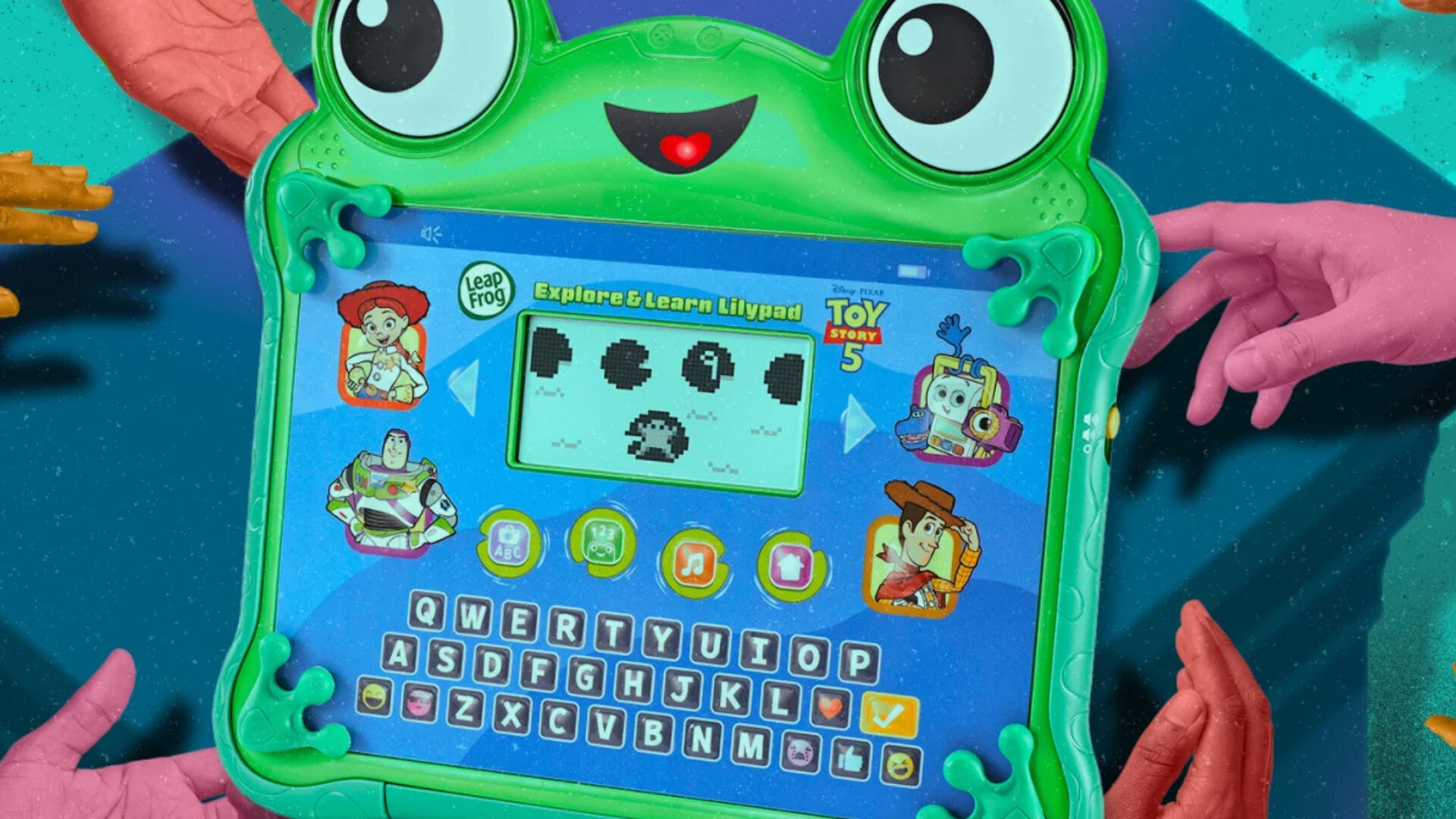
The VTech Lilypad Educational Tablet arrives with an idea that is almost too perfect for a licensed product: transforming the Toy Story 5 tablet into a real children’s toy. In the film, Lilypad represents this new competition between screens and classic toys. On the shelf, it becomes a green, smiling VTech object, covered with buttons, which promises to teach letters, numbers and music from the age of three.
The paradox is obvious, but it is also more interesting than it seems. We could fear a fake tablet that simply pushes the child towards one more screen. In practice, Lilypad remains above all a traditional electronic toy: a small monochrome LCD screen, an alphabetical keyboard, character keys, sounds, limited animations and legs to turn to make the eyes move. It is not a touchscreen tablet, but an imitation tablet with clear limits, a closed system and a very physical design.
The promise is therefore twofold. VTech wants to capitalise on Toy Story 5 without losing its usual ground: preschool learning, solid buttons, familiar voices and repeatable mini-games. It remains to be seen whether this Lilypad really has something to offer beyond the marketing wink, or if it is content to dress up a VTech formula already seen with a very fashionable digital frog.
A fake screen, a real VTech toy
The first good point of Lilypad is that it is fairly honest about what it is. It has the shape of a tablet, takes the idea of a screen, speaks with its characters, but everything goes through physical controls. The child presses letters, numbers, icons, turns the little front paws and watches the eyes move. We remain in the manipulatable toy, not in a touchscreen device that draws the child in effortlessly.
For a child of three or four years old, the gesture counts as much as the result. Press a letter, hear the sound, see an animation, start again, then change keys: the loop is simple, but it has the advantage of being readable. The tablet does not require complex navigation, does not offer deep menus, does not drown the child in a miniaturized adult interface.
The design also works because it fits Lilypad well. The frog shape, animated eyes and movable legs give the object a little presence. It’s not just a green shell around an educational program. We feel the effort to transform the character into a tabletop toy, with enough volume and manipulation so that the child does not remain just a spectator of a screen.
The educational basics, without much surprise
On the learning side, VTech sticks to its usual vocabulary. We find letters, sounds, words, numbers, counting to 100, an alphabet book, a little game involving a frog, a musical workshop and an activity where Buzz must be guided around the house. The learning areas are clear: language, numbers, spatial awareness, a little logic, a little rhythm.
For the youngest, this is enough to create real interaction. The ABC keyboard makes you want to try the letters one by one, the numbers allow you to play with counting without taking out an exercise sheet, and the music activity offers a little breathing room. VTech knows how to make this type of toy: the responses are immediate, the instructions are short, mistakes are not really punishable, and the child can experiment without bringing the activity to a halt.
The limit comes from depth. Lilypad supports initial learning, but it does not renew it much. Letters remain letters, numbers remain numbers, and the mini-games seem mainly designed to repeat an instruction rather than to build a progression. For a child who is still discovering the alphabet, it makes sense. For a child already comfortable with these basics, the effect risks wearing out quite quickly.
Toy Story 5 makes you smile, then takes up a lot of space
The Toy Story franchise is obviously the big driving force behind the product. The character keys, the messages with Woody, Buzz, Jessie and the Tech Trio, the voices and the visual design give Lilypad a stronger identity than a generic educational tablet. For a child who comes out of the film or who is already immersed in the Pixar universe, the object immediately has more value.
This presence transforms the exercises into small moments of play with familiar faces, and it gives an emotional reason to press the keys again. VTech understood that the character had to exist in the experience, not just on the box. The moving eyes, sound reactions and discussion mode go in this direction.
But the branding can also mask the modesty of the content. Once the Toy Story effect has passed, we are left with short, tightly guided activities, sometimes more decorative than educational. The messages and characters are amusing, but they don’t add a real layer of play. Lilypad gains in charm what it doesn’t necessarily gain in ambition.
Four years, yes. Eight years, much less
The most debatable point remains the announced age range. For three-, four- or five-year-olds, the proposition holds up. The object is colorful, easy to handle, loud enough to attract attention, limited enough not to become a real tablet, and the learning still corresponds to what the child discovers.
At eight years old, on the other hand, the promise becomes much more fragile. A child of this age is already well beyond the first letters, simple words and basic counting. He may like Toy Story, laugh at voices or manipulate Lilypad’s legs, but the educational interest risks fading very quickly. We are then talking more about an interactive piece of merchandise than a real learning medium.
This is not dramatic if the purchase is well targeted. The problem mainly comes from marketing elasticity. By aiming to cover 3-8 years, the tablet feels like it will last longer than it probably will in many homes. Its natural audience is clearly preschoolers. The older the child gets, the more Lilypad becomes a fun but limited piece of merchandise.
A good transition toy, not an educational revolution
The indicative price of around 35 euros places Lilypad in a reasonable zone for an electronic toy licensed by Disney Pixar. You inevitably pay partly for the brand, but the object offers enough buttons, animations, sounds and modes not to give the impression of a simple sound figurine disguised as a tablet.
Small practical details also count. The volume adjustment will prevent some tension, the automatic shutdown protects the batteries, and the AA battery power supply remains easy to manage. These are basic elements, but on a toy aimed at young children, parental comfort is part of the experience. A good educational toy is not just one that the child switches on. It’s also one that adults don’t regret after two afternoons.
Still, Lilypad does not escape its formula. It’s a nice toy, well designed to capture attention without opening the door to a real tablet, but its content does not go beyond the classic VTech framework. It supports, occupies and repeats. It does not transform learning. Its best argument is not pure pedagogy, but the balance between hands-on interaction, branding and clear limits.
Verdict
A toy screen that knows its limits
7/10
The VTech Lilypad Educational Tablet succeeds above all because it remains a toy before becoming a fake screen. Its buttons, its movable legs, its animated eyes and its very structured activities make it an accessible object for the youngest, with enough Toy Story 5 to make you want to come back. For a three to five year old, the mix of letters, numbers, music and characters works well.
Just don't ask for more than it can give. Lilypad is not an educational tablet that truly grows with the child, nor a tool that will seriously support a child up to eight years old. It’s a solid licensed VTech product, clever in its form, but limited in its substance. A good little transition toy for playing at using a screen without being drawn into one, not the great educational revolution in the bedroom.
Pros
- A physical format that imitates the tablet without becoming a real touchscreen tablet
- The Lilypad design works well, especially with the animated eyes and moving legs
- Letters, numbers and music activities are accessible to preschool children
- The Toy Story 5 branding brings a real hook thanks to the characters and voices
- Adjustable volume, automatic shut-off and AA batteries make everyday use simple
Cons
- A fairly limited educational depth beyond the earliest learning stages
- The 3-8 year old age group seems too broad for the content offered
- The mini-games risk becoming repetitive quite quickly
- The branding accounts for a large part of the product’s appeal
- More interesting as an interactive toy than as a real learning tablet
More in Kids
Full library 6/10
Carrera Speed Arena Disney Pixar Cars Race in a Case Racing Set
Toy 7.5/10
Chien Bleu et autres belles histoires de l’école des loisirs
TV 7.5/10
La Mélodie de la Pluie
 8/10
Ice Watch Kids 4G Watch
Tech 3/10
Ma Première Serre
Other 6/10
La maison des insectes
Other 8/10
Moustache
Board games 7.5/10
Blanc Manger Coco Junior
Board games 8/10
200 Quiz pour les Super Futés 6 ans
Board games 9/10