
Moustache
Four rounds to break your habits
Score: 8/10
Images and videos


At a glance
We liked
- The cumulative rules really change the way each round is played.
- The teams drawn at random renew the alliances without making the game heavier.
- Scoring through stars forces you to choose the useful tricks rather than collecting everything.
- An easy to explain base with enough decisions to avoid playing itself.
We liked less
- Hidden Cup tokens can unfairly move the final standings.
- Some combinations require checking several effects before resolving a trick.
- A bad hand sometimes leaves few interesting decisions.
 By Farrel Grimwood · published · 7 min read
Contents
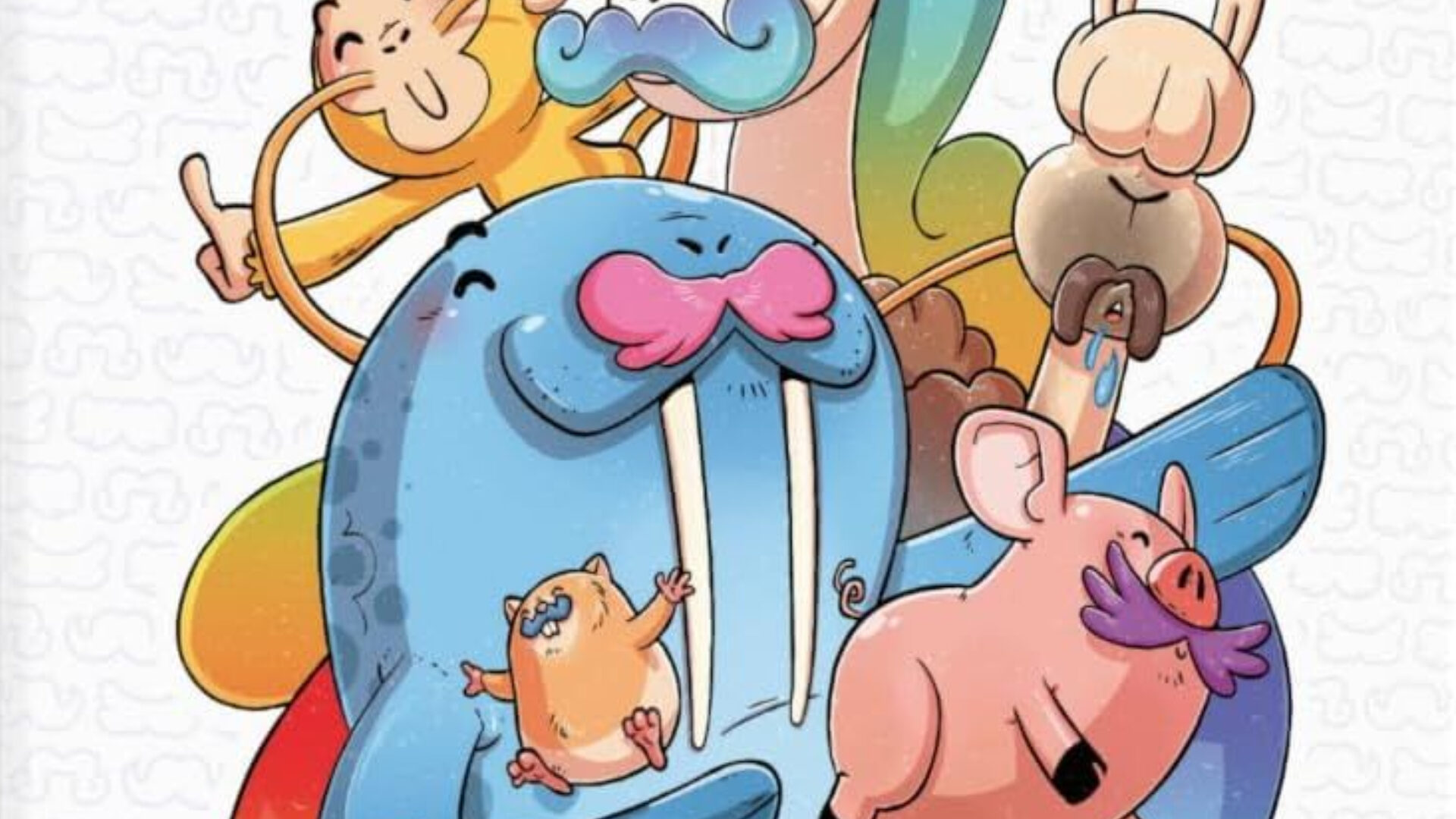
Moustache places four families of animals on the table: green hamsters, pink pigs, orange llamas and blue walruses. The cards range from 0 to 10, the whiskers shine, and the size of the moustache increases with the value. Behind this very simple visual idea hides a team trick-taking game where nothing stays in place for more than one round.
Alexandre Aguilar and Jules Messaud start from a familiar mechanism, then disrupt it in stages. Partners are drawn at random in each round, a new rule is added to the previous one and the winning team collects tokens which will be used to designate an individual winner. Manu Gorobeï gives everything an immediately readable identity, without trying to make people believe that the animals are telling something other than a card battle.
On paper, the mix has everything to become a happy mess: temporary alliances, rules that sometimes contradict each other, unequal hands and a score hidden until the end. It remains to be seen whether Moustache maintains enough control to reward good choices, or whether chance ends up playing the game instead of the table.
Blue beats everything, until further notice
The basics fit into a few lines: a player leads the trick with a card, the others must follow this suit if they can; otherwise, they play whatever they want. When everyone has placed a card, the strongest wins the trick and opens the next one. Nothing complicated for those who already know belote, tarot or any game based on tricks.
The difference comes from the strength of the colors. Green is weaker than pink, pink weaker than orange and blue dominates the whole. Color matters before value. A blue 1 walrus can therefore beat a pink 10 pig as soon as the player is no longer obliged to follow the suit led. Between two cards of the same dominant color, the higher number wins.
This hierarchy requires a little time to adapt because it goes against a very established reflex: first look at the number. The playing aids prevent hesitation, and one round is enough for the order green, pink, orange, blue to become natural. Moustache does not complicate trick-taking for the sake of it. It changes one priority, then builds the whole game around that flaw.
Stars are worth more than tricks
Winning a trick does not automatically earn you something. At the end of the round, each team puts their cards together and counts the stars printed on them. Some values have them, others do not. A big card can therefore ensure a trick without bringing any points, while a less impressive card becomes the real target of the round.
This is where the game leaves the simple contest of strength. You have to identify the stars that have already fallen, choose the trick that deserves a good card and sometimes let the opponent pick up a trick with no points. The hand doesn’t always offer many options, but the decisions exist. Keeping a blue to secure a profitable card or spending it too early really changes the end of the round.
The partner adds additional uncertainty. It is forbidden to announce your hand, so the team must communicate only through the cards placed. A small value could be a call, an abandonment or simply the only card available. This silent cooperation works well because it never turns the game into an endless discussion. We play, we sometimes understand too late, and we move on to the next trick.
Four rounds, four layers
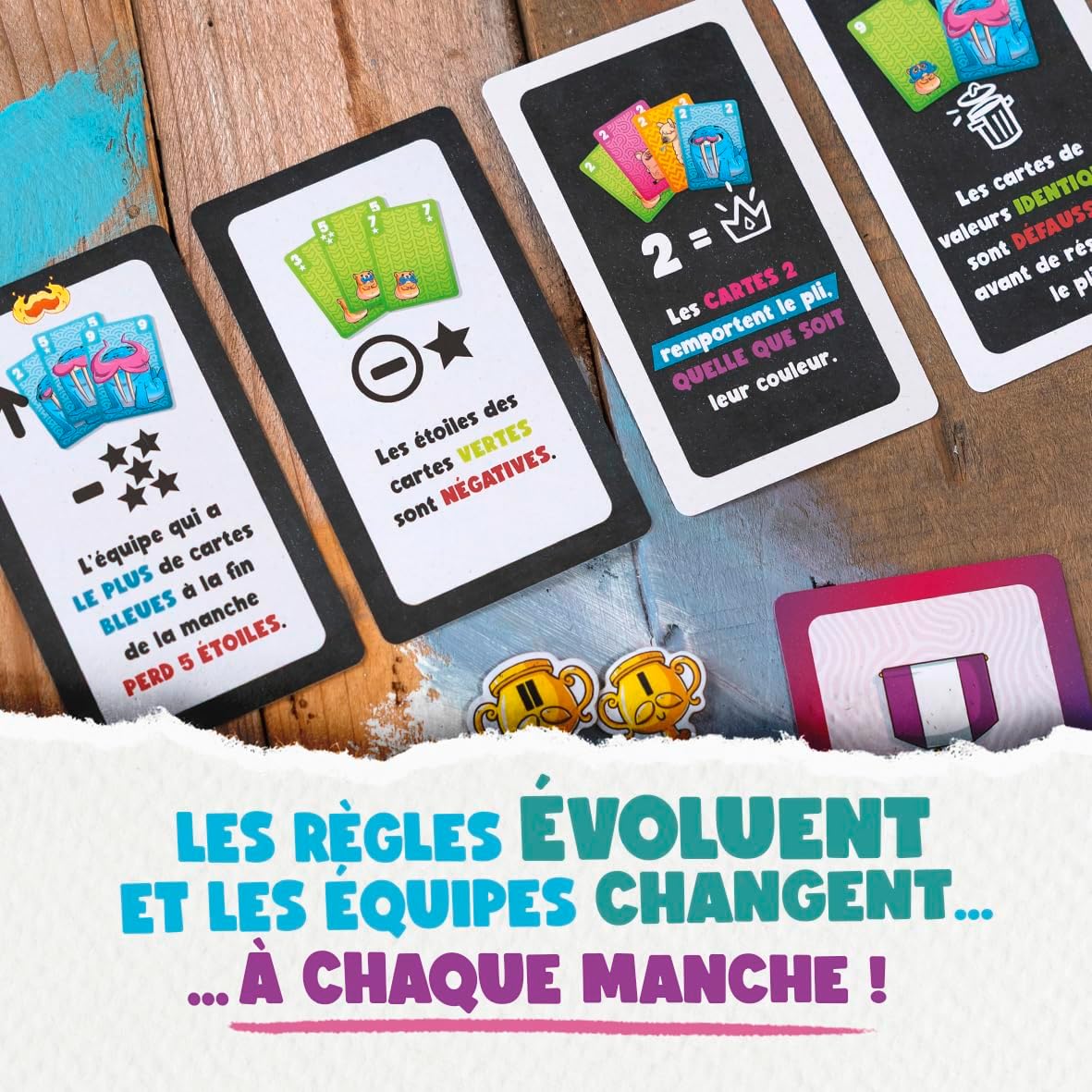
Before the game, four Rule cards are prepared face down: two white then two black, chosen at random from sixteen. The first is revealed at the start of the first round. The second is added at the start of the next round, then the third, then the fourth. One rule never replaces the previous one. The last round is played with all four effects at the same time.
Cards numbered 1 can win every trick, the color hierarchy can be reversed, identical values can be discarded, green cards can remove stars or three cards can go to the neighbor. A strong hand in the normal rule can become mediocre in a second, and a card held for several tricks can lose all its interest.
Each round retains the previous base while forcing you to reread your priorities: white rules modify the terrain without completely reversing it; the black ones add the most annoying effects. The progression avoids throwing four exceptions on the table from the start, but the last round sometimes requires rereading the line before deciding a trick.
Partners for a few minutes
Team cards are redistributed at the start of each round. The player who has just lost five stars can become the new partner, while the previous ally moves to the opposite camp. This change breaks long-term plans and prevents one pair from dominating the entire game thanks to better understanding.
The formula sticks perfectly to all four rounds. An alliance lasts long enough for us to try to understand the other’s game, but not long enough to establish a routine. The table moves without the setup becoming cumbersome: a Team card, a deal, a rule revealed and the round starts again. Moustache thus finds an atmosphere of team play without imposing two fixed camps for twenty minutes.
Not everything is controllable. A team can bring together two poor hands, a partner can never have the useful color and some associations understand each other better than others. But this fragility is part of the rhythm. The round is short, the camps will soon be recomposed and no player can blame the same ally for the same mistake throughout the game.
Cup tokens skew the result a little too much
The team with the most stars wins the round. Each member then draws a Cup token from the three linked to this round and keeps it face down. After four rounds, everyone reveals their tokens, adds up their values and the highest total wins alone. The team is therefore used to obtain a reward, not to share the final victory.
The idea maintains the suspense and avoids knowing the exact ranking before the last second. It also allows two partners to leave the same round with different winnings. This is precisely where the system gets stuck. A player may have contributed to the same victories as his neighbor and recover fewer points only because he drew the wrong token.
This chance does not destroy the game, but it weakens the verdict. Moustache rewards good tricks, reading the rules, and cooperating for four rounds, then lets a hidden draw move the leaderboard. The game remains short enough and light enough to withstand this injustice. We simply have to accept that the final winner is not always the one who played the best.
Moustaches get the job done
Gorobeï gives the game an identity that its mechanics alone would not have. Hamsters, pigs, llamas and walruses each occupy a color, with the same basic design apart from their moustaches. The higher the value goes, the more space it takes up. The metallic shine highlights the gag without hindering reading.
The numbers stand out immediately, the stars are quickly identified and the aids remind you of the order of the colors. White and black Rule cards stand out effortlessly. Even when four effects are active, the table remains understandable because each piece of information has its place.
The box contains 47 Animal cards, 16 Rule cards, 6 Team cards, 6 reference aids and 12 Cup tokens. Everything comes together quickly and everything stores without a struggle. The announced twenty minutes correspond well to a game that is easy to bring out between two longer titles or to restart a table that does not want to listen to an endless explanation.
Short, lively, never entirely fair
Moustache is not looking for the depth of a major competitive trick-taking game. Its sixteen Rule cards renew the priorities, but the distribution, the teams and the Cups retain an important part of the result. You can read the table correctly and end up without the necessary color. You can win the good rounds and draw the wrong tokens.
Success comes from rhythm. Four rounds are enough to develop the game without exhausting the idea. The first round sets up the rule, the second twists it, the third starts producing combinations, and the fourth pushes it just before the mechanics become too cumbersome. The game ends at the right time.
This format makes you want to play again to discover another line of rules, not necessarily to play five games in a row. Moustache works better as a lively family game than as a specialist duel. It induces errors, reversals and some questionable victories, but it retains enough choice so that you never place your cards at random.
Verdict
The tricks still have bite
8/10
Moustache takes a very well-known base and finds two ideas capable of moving it: the teams change every round and the rules stack up until the last round. The result remains easy to explain, quick to implement and tactical enough that the stars, colors and partner require you to think before placing a card. Gorobeï finishes the work with funny, readable and immediately recognizable material.
Hidden Cups give too much weight to the final draw, and games of three or five are less clean despite the Jokers. Certain combinations can also slow down the fourth round. But with four or six, Moustache keeps exactly its promise: a lively family trick-taking game, funny without being shallow, capable of bringing together children and adults without giving some a simplified version. The shiny whiskers catch the eye, but it's the cumulative rules that hold the box together.
Pros
- The cumulative rules really change the way each round is played.
- The teams drawn at random renew the alliances without making the game heavier.
- Scoring through stars forces you to choose the useful tricks rather than collecting everything.
- An easy to explain base with enough decisions to avoid playing itself.
- Gorobeï's work makes the cards readable and immediately recognizable.
- The short format stops before the four rules become tiring.
Cons
- Hidden Cup tokens can unfairly move the final standings.
- Some combinations require checking several effects before resolving a trick.
- A bad hand sometimes leaves few interesting decisions.
More in Kids
Full library 7.5/10
Blanc Manger Coco Junior
Board games 8/10
200 Quiz pour les Super Futés 6 ans
Board games 8.5/10
100 jeux pour Super Futés 5 6 ans
Board games 7.5/10
Chien Bleu et autres belles histoires de l’école des loisirs
TV 7.5/10
La Mélodie de la Pluie
 8/10
Ice Watch Kids 4G Watch
Tech 6/10
Carrera Speed Arena Disney Pixar Cars Race in a Case Racing Set
Toy 3/10
Ma Première Serre
Other 6/10
La maison des insectes
Other 9/10