Ice Watch Kids 4G Watch
A well-framed first phone but dependent on its plan
Score: 8/10
Images and videos


At a glance
We liked
- A real 4G connection independent of the parental phone
- Voice and video calls limited to approved loved ones
- A clear and pleasant AMOLED screen to navigate
- A school mode that blocks distractions without deactivating the emergency call
We liked less
- An imposing case on the thinnest wrists
- Battery life that practically requires daily recharging
- Direct monitoring limited to fifteen minutes and alerts sometimes delayed
- An SOS call directed only to the main parent
 By Farrel Grimwood · published · 11 min read
Contents
- A closed phone on the wrist
- A large case and a quality screen
- Activation guided and locked by an overly expensive plan
- Calls truly reserved for loved ones
- GPS tracking is not permanent
- School mode gets straight to the point
- The app gives almost everything to the parent
- Useful tools, four dispensable games
- Verdict
Ice-Watch has been selling colorful watches since 2006 and has gradually extended its catalog to connected models. Its ICE smart juniors remain Bluetooth accessories dependent on a nearby phone. The ICE kids 4G clearly changes its role: it integrates its own SIM card, a GPS, a speaker, a microphone and a camera. The child can therefore call his family without taking an adult’s phone.
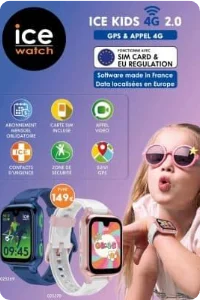
The proposal is aimed at ages 6 to 12. Parents validate contacts, view watch location, create safe zones, and block distractions during school. The child keeps the time, calls, voice exchanges, some tools and four games, but he does not access the Web, social networks, or an application store. The product seeks less to reproduce an adult watch than to delay the purchase of the first smartphone.
This peace of mind has a clear price: 149 euros, to which is added a mandatory plan of 7.99 euros per month, to be taken from ICE on this model. The supplied nano-SIM card cannot be replaced with that of another operator, at least for now. A SIMLESS model is planned for September for those wishing to choose their operator.
Between an AMOLED screen unusual in this market, complete parental controls and several less visible restrictions, is the ICE kids 4G really a good step towards autonomy, or just another gadget?
A closed phone on the wrist
The difference with a Bluetooth watch should be understood immediately. The ICE kids 4G does not pick up calls from the parental phone located ten meters away. It connects directly to the mobile network and therefore retains its communication functions during a trip to school, a sporting activity or an outing to see a loved one. The included card provides 1 GB of data per month and works in more than forty European countries.
The environment remains deliberately closed. No browser allows you to browse the Internet and no third-party applications can be installed. Calls and exchanges only go through loved ones validated in the parental application, installed on a phone. The child does not have a free keyboard to dial a stranger’s number, nor a number allowing him to receive one. This limitation greatly reduces unwanted calls and avoids transforming the watch into a gateway to social networks.
Control necessarily takes away some of the freedom offered by a classic telephone, but that is precisely the point of the product. A child can announce that he has arrived, ask to be picked up or quickly show where he is, without receiving the prompts of a full smartphone. The watch serves an identifiable function here instead of piling adult notifications into a miniature interface.
A large case and a quality screen
The case measures 56.8mm high, 40.9mm wide and 12.7mm thick. It weighs around 50 grams with its silicone strap. These values remain reasonable for a small 4G phone, but they take on another dimension on the wrist of a six-year-old child. The screen and camera take up a lot of space, while the thickness prevents the watch from disappearing under a tight sleeve.
The weight remains low enough for a full day and the bracelet closes with a classic buckle. The silicone is easy to clean and the pin buckle holds better than a simple snap fastener. The two side buttons also offer a safer solution than touch when the child needs to quickly make an emergency call.
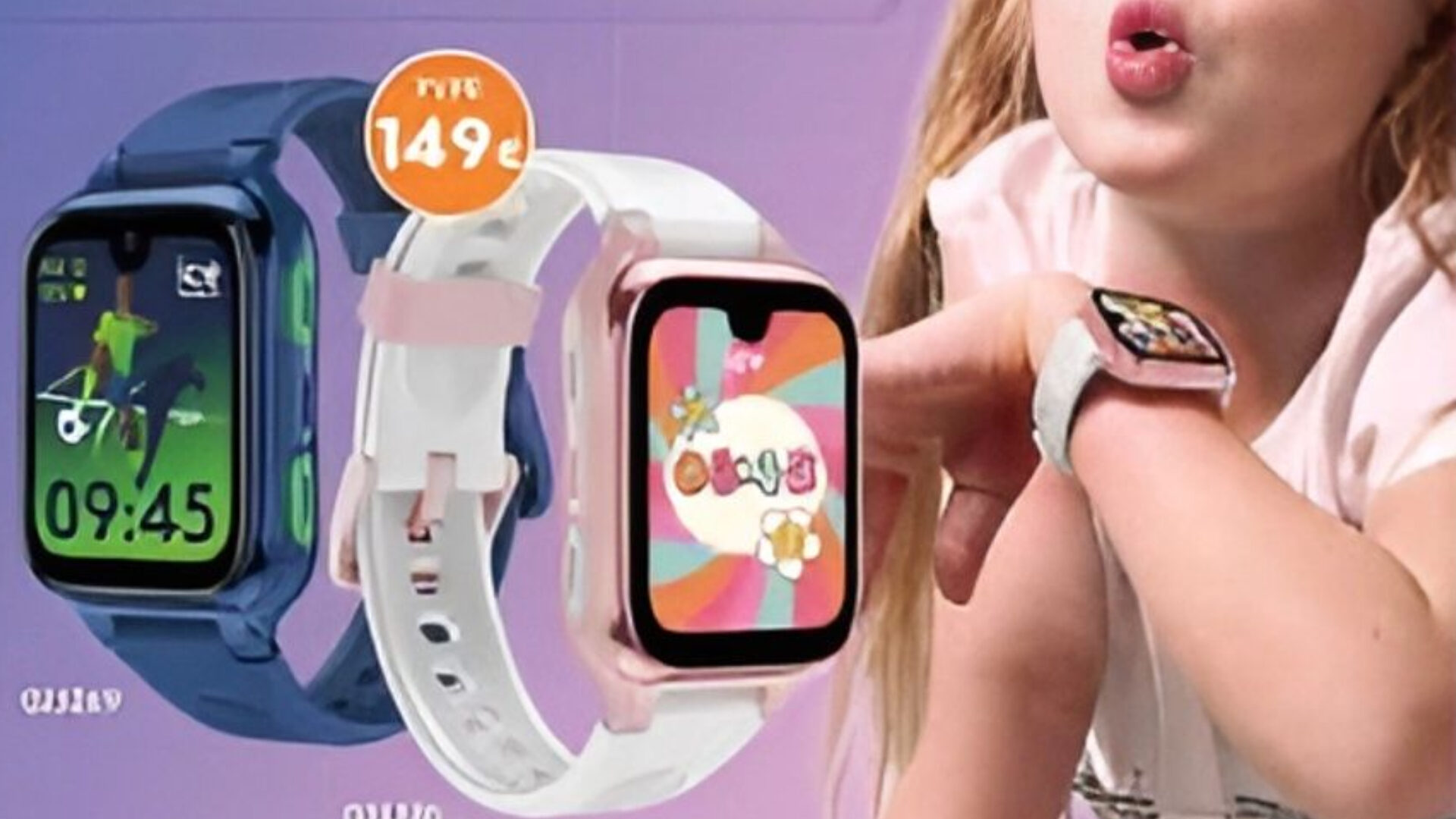
The product is available in blue or in a pink and white combination. The polycarbonate construction corresponds to the target audience: it supports small shocks better than a heavy metal case and avoids unnecessary coldness against the skin. However, the watch remains very visible.
The 1.78-inch panel displays 368 × 448 pixels. AMOLED technology turns off black pixels individually and produces sharper contrast than the small LCD screens still common on children’s watches. The numbers, icons and photos benefit from sufficient definition so as not to give the impression of looking at an old toy screen.
The touchscreen responds correctly and the interface is based on large, colorful icons. A lateral swipe opens the different functions without requiring you to read long titles. Several dials can be chosen directly by the child, which gives them at least some customization without opening up access to sensitive settings.
The screen also serves as a torch by displaying a bright white surface. The function helps in a dark room, but it obviously does not replace a real lamp. More annoying, no automatic brightness adaptation is integrated. A high setting improves reading outside, then speeds up an already rapid discharge. The child must therefore be taught not to keep the screen on unnecessarily.
Activation guided and locked by an overly expensive plan
Getting started starts with a full charge, installing the ICE KIDS 4G app, and creating the primary parent’s account. An email validates this account. The watch then displays a QR code, then an eight-digit code must be entered into the app. Activation of the SIM card and purchase of the plan are done in the same process. Note that it is impossible to start the watch without this subscription, as the latter does not have any third-party applications or WIFI connectivity.
The procedure eliminates the hassle of choosing a card, configuring a mobile access point or searching for a compatible carrier. After payment, a restart registers the watch on the network. Activation requires three to five minutes, no technical knowledge and is very simple. For a parent who just wants to offer a first watch, this is a significant advantage.
But this simplicity is based on a commercial barrier. The watch works exclusively with the nano-SIM inserted by Ice-Watch and the connected functions require the associated offer. It also comes at a high price: 7.99 euros. For this price, ICE provides 1 GB/month + calls/SMS + roaming in more than 40 countries, the equivalent of a €1.99 plan from any modern French provider. This is perhaps explained by the Belgian origin of the brand, where “entry-level” plans are negotiated more around 5/6 euros; but remains difficult to justify on the French market.
ICE specifies that a SIMLESS version, allowing any SIM to be inserted, will be available by September 2026. If you wish to use another operator, you may have to wait. Note, however, that at the price of 7.99 euros, the user pays above all for peace of mind: no tedious research, no long card creation/reception process, no technical handling of the product, connectivity and configuration guaranteed from the moment it is switched on, and above all no commitment. It is in fact possible to cancel very easily via the application, by going to your account and deregistering the watch. The operation is immediate, with no hidden fees, and can be reactivated later if necessary.
Calls truly reserved for loved ones
The primary parent adds other authorized adults from the app. Their email address must match the one used when creating their account. The child then finds these people in a reduced directory and can launch a voice or video call without entering a number. Filtering works both ways: a number that has not been accepted cannot freely reach the watch.
The speaker reaches a sufficient volume for a conversation in a quiet place and the microphone reproduces the voice correctly. In noisy outdoors, the watch format quickly shows its limits: the child cannot bring both the microphone closer to his mouth and the speaker to his ear. The discussion also becomes public, since no headphone jack is present.
The 5 megapixel front camera is enough to see the child and his environment. A stable 4G connection maintains a good image, but compression becomes visible when the network drops. The video call also consumes much more energy than a voice exchange. It can be reassuring occasionally; it should not become the means of contact used on each outing.
The text remains less natural on such a small screen. Parent-defined quick responses, voice notes and photos are much more suitable for young fingers than a full keyboard. The child can respond quickly without turning his wrist into a miniature typing exercise.
Pressing the lower button for five seconds launches an audio call called SOS to the main parent. The duration limits involuntary triggering and the action remains simple enough to be memorized. School mode keeps this command active even when other functions are blocked.
The name SOS, however, deserves a very clear explanation to the child. The watch does not contact the police or several relatives in succession. It calls a single administrator account through the application. If this phone no longer has network, if its notifications are cut off or if the parent does not respond, no outside help is automatically notified. This command is therefore used to quickly contact the appropriate adult, not to replace an emergency telephone. It remains useful for a delay, a misunderstood journey or a sudden worry.
GPS tracking is not permanent
The application combines GPS, A-GPS, neighboring Wi-Fi networks and location by mobile antennas. In clear outdoors, GPS offers the most precise position. In a building, Wi-Fi and cellular network take over with a wider margin. High buildings, weak coverage or a deep interior can therefore move the displayed point.
Location updates are sent every 15, 30, 45 or 60 minutes depending on the setting chosen. The parent can force a refresh or start direct monitoring, but the latter stops after fifteen minutes. This limit avoids draining the battery and prevents the continuous mode from being transformed into a permanent setting.
The security zones use the same principle. A circle can be placed around the home, school or club, then the application warns when entering or leaving. The alert, however, depends on the location frequency. With a position sent every hour, it may arrive late. Presenting these areas as an immediate notification without reminding this delay gives an overly flattering idea of the function.
GPS responds well to the need to check a route or find the watch for a few minutes. It never guarantees that a child is exactly on the displayed point at the exact second.
School mode gets straight to the point
Parents program the times during which the watch must remain discreet. Once School Mode is active, the screen shows the time and blocks regular calls, chats, camera, games and other distractions. The emergency button remains available. The child cannot therefore freely deactivate the blocking in the middle of a lesson.
This operation is more consistent than a simple silent mode. A silent watch would continue to offer its games under the table; here the interface itself closes. Scheduling also avoids repeating the operation every morning and allows class times to be separated from Wednesday or weekend times.
There remains the question of the establishment’s regulations. A watch capable of photographing, calling and transmitting location may be prohibited even when school mode is activated. Parental controls do not replace school permission. This needs to be addressed before relying on the product for the entire day.
The app gives almost everything to the parent
The main screen combines the map, battery level and time of last position. Shortcuts allow you to call, communicate with the child, update the location or launch direct monitoring. The parent also manages contacts, alarms, school mode, quick responses and the daily step goal.
This centralization makes the watch very simple for the child. Important decisions remain on the adult phone and the wrist icons only open actions that have already been framed. Another relative can be added, but they must install the same application and create their own account with the address declared by the main parent.
Useful tools, four dispensable games
The watch includes a camera, gallery, pedometer, weather, alarms, stopwatch, calculator and a fake torch produced by the white screen. The parent can set a step goal and view daily, weekly or monthly results. This is a motivational indication, not a precise sports measurement: the three-axis motion sensor counts wrist gestures as much as it attempts to recognize walking.
The four games remain very simple. They occupy a child for a few minutes, but slightly contradict the idea of a device reduced to the essentials. School mode blocks them at the right times, which limits the problem. Their presence adds no value to communication, GPS or alarms.
The 8 GB of memory provides enough space for photos, music and integrated functions. However, the camera should not be treated as a vacation camera. Its frontal placement favors videoconferencing and self-portraits, while holding the wrist steady to frame a scene quickly becomes awkward.
The sales sheet presents the watch as IP68 waterproof. This certification normally refers to strong protection against dust and immersion defined by the manufacturer. However, Ice-Watch assistance gives much more restrictive instructions for all its connected watches, including the ICE kids 4G: only perspiration is accepted. Hand washing, rain, showering and swimming are not recommended.
The contradiction is impossible to minimize on a children’s product. Asking a student to remove their watch before each tap or at the first drop undoes much of the promised peace and quiet. The manual adds that the warranty does not cover the battery, bracelet, cable and certain damage related to water or use deemed incorrect.
A short-term test endured splashes and a downpour, but this is no substitute for a clear guarantee or advertised immersion depth. The prudent approach consists of following the most restrictive instructions. Ice-Watch must choose between claiming true IP68 with precise conditions or removing the word waterproof from its presentation.
The 700 mAh battery officially lasts one day in normal operation and two to three days in standby. A more intensive period, with several video calls and frequent positions, can bring the autonomy below twenty-two hours. With two voice calls, school mode and less frequent GPS, it can go beyond the day without comfortably reaching two full days.
Daily charging must therefore become part of the family routine. An empty watch at the bottom of the satchel cannot call or be located. The app thankfully displays the battery level remotely, allowing the parent to remind the child to charge it before an outing.
The magnetic USB cable attaches to two contacts on the back and takes about two and a half hours to fill the battery. The system is simple, but proprietary. Losing this cable cannot be solved with the USB-C charger already present in the home. The two-year warranty also excludes the cable and the battery, two elements on which the lifespan of the product directly depends.
Verdict
A good first watch whose premium buys convenience
8/10
The ICE kids 4G correctly understands what a first communication device should be. The child only calls approved loved ones, can send their location, initiate a quick call and maintain a few simple functions without accessing the web or social networks. The AMOLED screen is sharp, the school mode really blocks distractions, and the parent app brings together important settings in one cohesive place.
The biggest reservation concerns water. A children's watch sold as IP68 should not be accompanied by instructions advising against rain and hand washing. Despite this contradiction, closed calls, parental controls and the absence of free Internet form a solid solution for families who want to delay the smartphone. You should simply see the device as a restricted phone worn on the wrist, never as an infallible security system.
Pros
- A real 4G connection independent of the parental phone
- Voice and video calls limited to approved loved ones
- A clear and pleasant AMOLED screen to navigate
- A school mode that blocks distractions without deactivating the emergency call
- GPS supplemented by safety zones and direct tracking
- No free access to the web, social networks or third-party applications
- A parental application that centralizes contacts, schedules and location
- A very simple plan requiring no technical knowledge
Cons
- An imposing case on the thinnest wrists
- Battery life that practically requires daily recharging
- Direct monitoring limited to fifteen minutes and alerts sometimes delayed
- An SOS call directed only to the main parent
- A proprietary SIM card and a mandatory plan of 7.99 euros per month
- IP68 certification contradicted by instructions that advise against rain and hand washing