Carrera Speed Arena Disney Pixar Cars Race in a Case Racing Set
An excellent idea penalized by too variable reliability
Score: 6/10
Images and videos


At a glance
We liked
- A track fixed in the case and ready in moments.
- Quick storage that avoids dismantling and sorting the rails.
- Two simple controllers, well sized for small hands.
- Two clips that actually reduce the maximum speed.
We liked less
- Very variable reliability.
- Power interruptions linked to the track pickup contacts or strips.
- Two cars that are too different in speed and power.
- Exits from the track possible even with the beginner limiter.
 By Farrel Grimwood · published · 10 min read
Contents
- A track already assembled in the case
- Compact does not mean tiny
- Two equal tracks on a very tight track
- Simple controllers with a real limiter
- Lightning McQueen and Cruz don’t always run on equal terms
- Pickup contacts require more care than expected
- Off-track excursions that are sometimes difficult to understand
- Three years old, but not without an adult
- Verdict
A slot-car track quickly takes up a room, takes time to assemble and often ends up dismantled in a box where the rails get mixed up. Carrera starts from this very concrete problem for its Speed Arena range. The track remains fixed in a rigid case: you have to open it, plug in two controllers and provide power to start the race. Tidying up therefore ceases to be the chore that puts an end to the toy after a few outings.
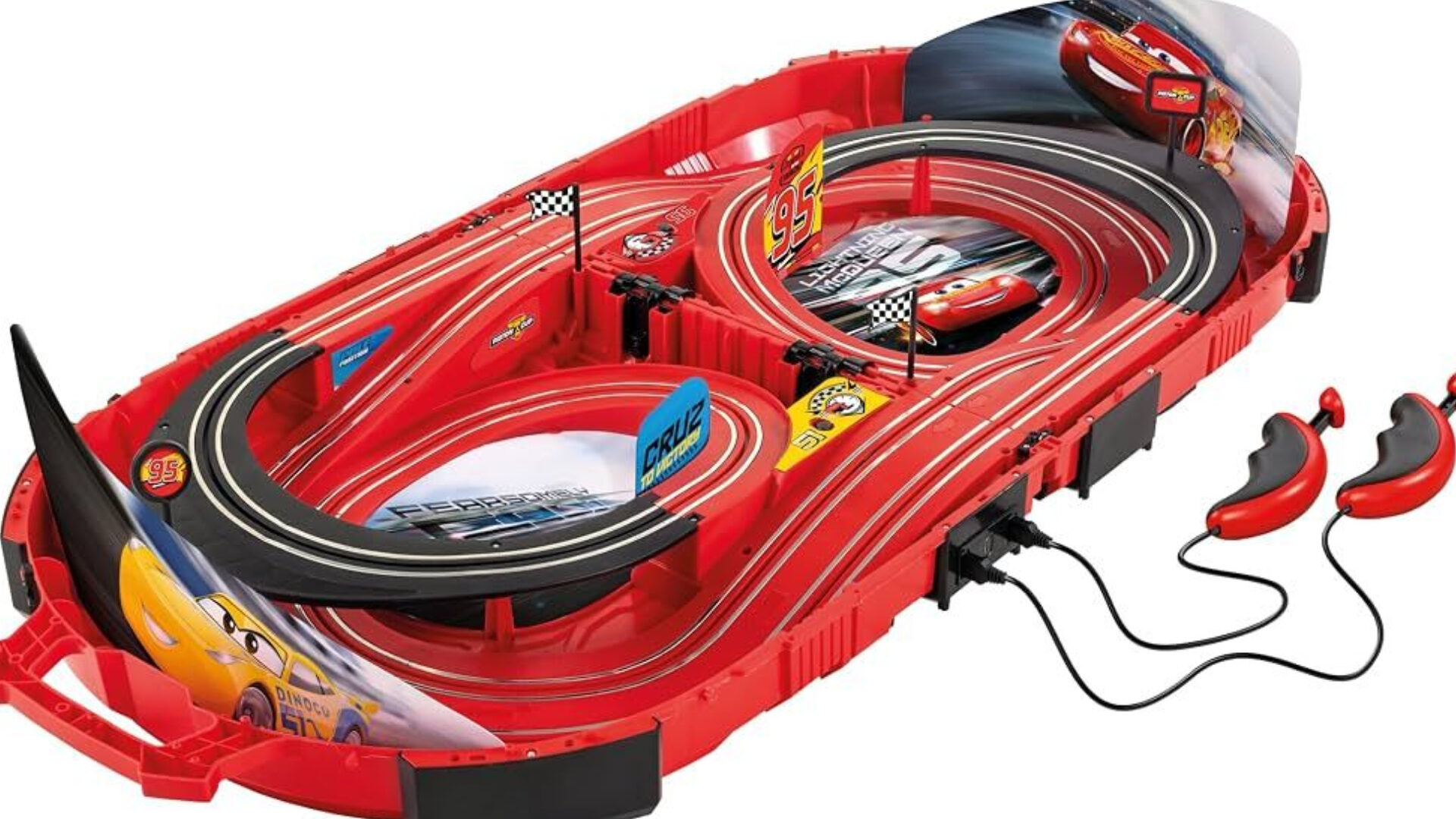
This Disney Pixar Cars edition uses the same mechanism with Lightning McQueen and Cruz Ramirez. The two cars run on separate tracks, a total of 2.77 m long, with two mechanical counters and limiters. The case accepts four AA batteries or USB-C power, allowing you to play away from an outlet or conserve batteries at home.
At around fifty euros and from 3 years old, the proposal is aimed exactly at families who want a real duel without building a large circuit for each game. The case delivers on that promise, but power interruptions, uneven cars and very tight turns can turn a race into a series of interruptions. Is storage comfort enough when the track itself sometimes lacks consistency?
A track already assembled in the case
The heart of the product is not a set of snap-together rails. The two halves of the track are fixed in the shell and remain connected once the box is opened. Four rotating clips keep the case closed. Simply release them, unfold the assembly, plug in the controllers, then place each car in its groove. For a slot-car track, the time saving is real.
The first opening still requires an adult. The latches are very rigid; stickers must be placed on edges, counters and small signs. The battery compartment is protected by a screw, in accordance with the rules imposed on toys for young children. A screwdriver is therefore necessary before the first run if no USB-C power supply is available. The USB-C socket has no cover.
Decorative panels play no role in operation. They complete the theme, but hold less well than the rest and can come off easily when the box is handled. Leaving them aside doesn’t take anything away from the race. The real quality of the case is found in the track attached to the case, not in these parts to be put back in place.
Storage retains a small constraint: the transparent module provided must remain in place to block the cars and controllers during transport. Without it, loose elements move around in the case and can hit the track. Moreover, it is not possible to close the box without dismantling all the removable elements. Once this reflex is acquired, closing takes less than a minute and no rail ends up at the bottom of a cupboard.
Compact does not mean tiny
Opened, the circuit occupies approximately 100 x 45 cm. It fits on a fairly long table and remains accessible from the same side, since the two controller connections are grouped together. On the ground, a child can reach almost the entire track without getting up. This quick access becomes useful as soon as a car leaves its groove.
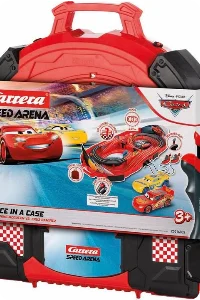
Closed, the case measures approximately 51 x 46 x 12.5 cm. It is carried with its handle and stored vertically, but it does not disappear in a drawer. The benefit therefore does not come from minimal space requirements, but from the regular shape and the absence of parts to sort.
The weight is around two kilos. A child can move the box a short distance, but the dimensions invite holding the handle with both hands on a staircase. The four fasteners must also be checked before transport. This case is practical between the bedroom, living room and car; it remains too broad to spontaneously accompany each outing.
Two equal tracks on a very tight track
Fitting 2.77 m of track into a 100 x 45 cm rectangle requires dense geometry. Each track goes around the case, loops in one half and crosses the other track via a bridge. The player placed outside in one part of the layout goes inside in the other. The two corridors thus cover the same distance, which avoids giving a permanent advantage to one color.
The track is not flat. The rails go up near the hinges, pass over the bridges then go back down into the two halves of the case. The radius of the shortest bend is approximately 10.5 cm and this bend itself is on a slope. A car must therefore maintain enough current to climb, without entering too quickly to keep its guide in the groove.
This combination creates the little driving interest of the box. Holding the trigger at maximum does not guarantee a clean lap. You have to relax before the tightest curves, resume on the climb and find a rhythm. The layout teaches you to modulate the speed well, whereas a perfectly flat oval would quickly boil down to pressing without thinking.
The same geometry, however, amplifies the slightest defect. A tire that grips poorly, a poorly positioned pickup contact or a car that is a little less powerful is immediately noticeable on the slope. Conversely, a more lively engine easily sends the vehicle out of its lane. The circuit therefore requires precision that its 3-year-old target has not yet always mastered.
Simple controllers with a real limiter
Each player holds a wired controller suitable for small hands. The pressure exerted on the control adjusts the speed progressively. The cable limits freedom of movement, but avoids extra batteries, pairing and misplaced controls. The two sockets use a distinct shape and connection requires no configuration.
Carrera adds a small clip on each controller. This part blocks part of the trigger travel and reduces the maximum speed. Beginner mode does not replace driving, but it prevents a 3 or 4 year old child from immediately sending Lightning McQueen over the edge every time they accelerate. The clip remains attached to a short wrist strap, a useful detail for such an easy-to-lose piece. The lack of indication is, however, penalizing. Despite the mention "For experienced drivers, remove the clip", an inattentive parent can easily confuse it with a safety part to be removed automatically and thrown away.
Once the clip is removed, the control becomes sharper and the circuit requires more restraint. This development makes the set interesting after the first games: the child starts with a reduced trigger range, then regains full control when he knows how to slow down before the curve. The progression is simple, visible and does not depend on any menu.
The limiter doesn’t fix everything. A car receiving poor electrical contact may stop even at low speeds, while a faster example may still come out with the clip. The part reduces pilot error; it does not compensate for a defective contact. This is a good help, not a guarantee of continued running.
Lightning McQueen and Cruz don’t always run on equal terms
The box set chooses Lightning McQueen and Cruz Ramirez, two characters directly linked to the competition in Cars 3. This choice avoids transforming the duel into an arbitrary encounter. Children immediately identify their car and can swap roles between two rounds without learning any additional rules.
The shape of the vehicles remains adapted to the circuit: their width leaves enough clearance between the two tracks and their lower guide follows the central groove. The rear wheels receive the movement of the small motor, while two metal pickup contacts placed under the front take power from the strips of the track. As long as these four elements work correctly, the cars run quickly and the race is understood in a few seconds.
The problem comes from variation between individual units. One car can be significantly slower than the other, lose strength on climbs or stop at a place where its rival continues. Swapping lanes allows the origin to be identified: if the same vehicle remains weak on both lanes, the imbalance comes from the car; if both slow down at the same place, the track or its conductive strips are at fault.
A duel quickly loses its interest when the difference comes from equipment. The player associated with the slowest car has no decision capable of catching up with a less regular engine. Alternating vehicles limits frustration for a short game, but a set sold for two should offer two close performances right out of the box.
Pickup contacts require more care than expected
The two metal tabs under each car provide the electrical connection with the track. They must be clean, slightly apart and placed flat on the conductive strips. If they fold, overlap or remain too high, the motor receives less current. The car hesitates, slows down, then stops on an uphill slope or in front of the lap counter.
The instructions devote an entire section to their position and refer to a tutorial. This is not a maintenance detail reserved for several years of play. They need to be positioned correctly from the very first races. An adult can do it with their fingers, without opening the car, but this intervention breaks the idea of a completely autonomous toy from 3 years old.
These pickup contacts are consumables. Carrera sells the set of eight for a few euros. Their replacement is simple and helps extend the life of vehicles. The availability of this small part is a good point, especially on circuits where a worn slat dooms the entire car.
The rate of wear, however, remains worrying. Cars lose contact after a few games. A buildup of dust may account for a gradual decline, but not almost immediate erratic operation. When it is necessary to straighten the pickup contacts each time, maintenance becomes a manufacturing defect and not a normal activity. Particularly frustrating for a child who cannot enjoy their run without regular intervention from the parent.
Off-track excursions that are sometimes difficult to understand
At full speed, exits in tight curves are logical. The lower guide cannot hold a car launched too quickly, especially when the rail goes up towards a bridge. The child immediately sees the consequence of his acceleration, replaces his vehicle and tries to release a little earlier on the next lap.
The box becomes less convincing when the car leaves its lane despite the beginner limiter or at moderate speed. A poorly placed wiper can lift the front slightly. An improperly adjusted rear tire can reduce grip. Finally, an irregularity in the rail can unbalance the vehicle just before the turn. The cause is then no longer readable to a young child.
The barriers catch some off-track cars, but they do not line every inch of track with the same height. The small footprint fortunately allows a car to be returned without having to bypass a large installation. With two players, this reset still cuts the round and gives an advantage to the player who has not left his lane.
The right balance is between a track that is too slow, where the control is useless, and a track that punishes every small variation. Speed Arena seeks this point with its clips, but the precision of the cars is not consistent enough to achieve it on all sets.
Each track has a mechanical counter graduated from 0 to 9. The vehicle pushes a small mechanism each turn and the number advances in front of the player. No screens, no separate batteries, and no apps are needed. For a child starting to count, seeing their progress provides a clearer goal than spinning around until someone gets bored.
The two cars do not start exactly side by side. They must be placed in front of their respective counter and their positions remain staggered on the route. Since the lanes are the same length, the number of laps remains fair, but it becomes more difficult to know who is actually in the lead in the middle of a round.
Resetting also lacks elegance. You have to press several times until you return to 0 instead of pulling a single lever. The graduation stops at 9, which is enough for short races and requires you to start again for a longer series. At this age, ten well-maintained laps are anyway better than endless endurance.
Three years old, but not without an adult
The age of 3 corresponds well to the size of the controllers, the simplicity of the controls and the presence of limiters. A child quickly understands that the trigger makes his car move forward. He can also follow an objective for a few laps, recognize his character and learn to release before a curve.
Complete autonomy is another question. Opening the four fasteners, screwing the compartment, connecting the sockets, precise placement of the pickup contacts and putting them back on the rail regularly require help. The small decorative parts and clips also mean that the box should not be left near a younger child.
At 3 years old, beginner mode works best during a short game with an adult sitting nearby. Around 4 or 5 years old, the relationship between pressure, speed and going off the track becomes easier to understand. An older child may remove the clips and look for a fast lap, but may also find the fixed path limited sooner.
The circuit therefore targets a fairly narrow period. It is more interesting than a toy where the car turns alone, but less scalable than a range of modular rails. Its immediacy is suitable for little ones; its lack of extension reduces interest when driving is mastered.
Verdict
A shiny case, contacts too fragile
6/10
Carrera has found a convincing answer to the main fault of circuits for young children. The track remains assembled, the controllers and the cars fit into the case, then the whole thing closes without sorting around fifteen rails. The two limiters make the first races less brutal, the counters give a clear end and the USB-C avoids continually draining AA batteries.
The Carrera Speed Arena Disney Pixar Cars Race in a Case Racing Set, however, loses half of its strength on the most important element: the continuity of the race. The pickup contacts require early attention, some cars lack power, others still leave their lane with the clip and the conductive strips can interrupt power. A clear difference between Lightning McQueen and Cruz is also enough to make the duel useless.
Pros
- A track fixed in the case and ready in moments.
- Quick storage that avoids dismantling and sorting the rails.
- Two simple controllers, well sized for small hands.
- Two clips that actually reduce the maximum speed.
- Tracks of the same length despite a compact layout.
- Two mechanical counters that give a clear objective.
- The choice between four AA batteries and USB-C power delivery.
- Replaceable pickup contacts sold separately.
- Lightning McQueen and Cruz Ramirez, adapted for a real Cars duel.
Cons
- Very variable reliability.
- Power interruptions linked to the track pickup contacts or strips.
- Two cars that are too different in speed and power.
- Exits from the track possible even with the beginner limiter.
- Pickup contacts that require almost immediate maintenance.
- No USB-C cable or adapter provided.
- Batteries must be removed before USB-C connection.
- A practical case, but bulkier than it looks.
- Complete cars that are difficult to replace separately.