La maison des insectes
A solid but poorly secured observation box
Score: 6/10
Images and videos
At a glance
We liked
- Strong materials that withstand ordinary outings and handling.
- An effective insect catcher that avoids catching insects directly.
- A really practical compact format with the shoulder strap when the bin is empty.
- Thirty photographic cards to guide identification.
We liked less
- The name house can make you believe in a sustainable habitat.
- An assembly too complex for a child alone, with cutting pliers and deburring tool.
- A lid that opens too easily and can let insects escape after a slight shock.
- No net for flying or difficult-to-approach insects.
More on Clementoni
 By Farrel Grimwood · published · 11 min read
Contents
Observing a ladybug or cricket for a few minutes can do more for a child’s curiosity than a long index card full of names. You still need to be able to approach the animal without crushing it, look at it without losing it in the grass and release it before the experience turns into improvised captivity. Clementoni builds its entire kit around this short encounter, with the firm intention of establishing itself as a scientific authority for very young children.
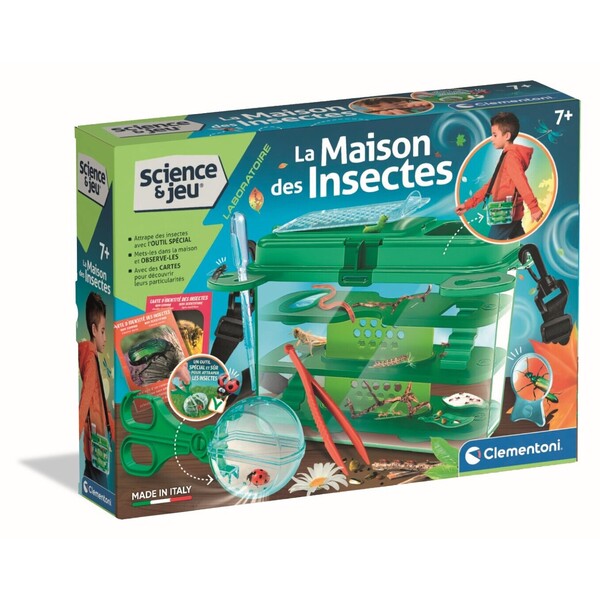
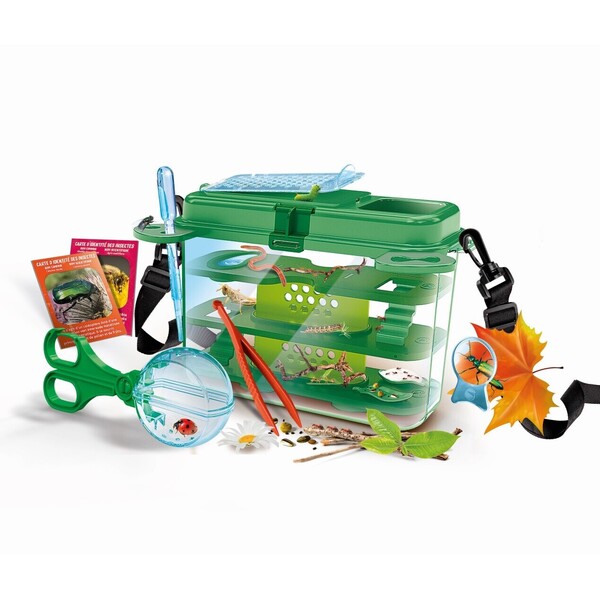
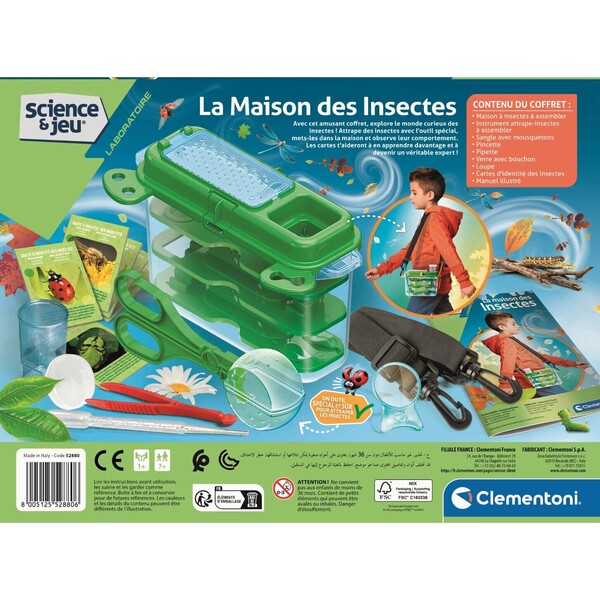
Released in 2025, La maison des insectes brings together a transparent multi-level box, a capture tool, a magnifying glass, a small container, a pipette, a tweezer, a shoulder strap, thirty identification cards and an illustrated booklet. Of course, no animals are provided. The child must go out into a garden or park, find a subject himself, observe it for a few hours maximum, then release it.
The principle seems simple, but it affects living beings whose needs and means of defense vary enormously. At 21.50 euros and from 7 years old, does this box give the right tools to discover insects, or does its attractive equipment get ahead of the precautions necessary to handle them?
A house that is not one
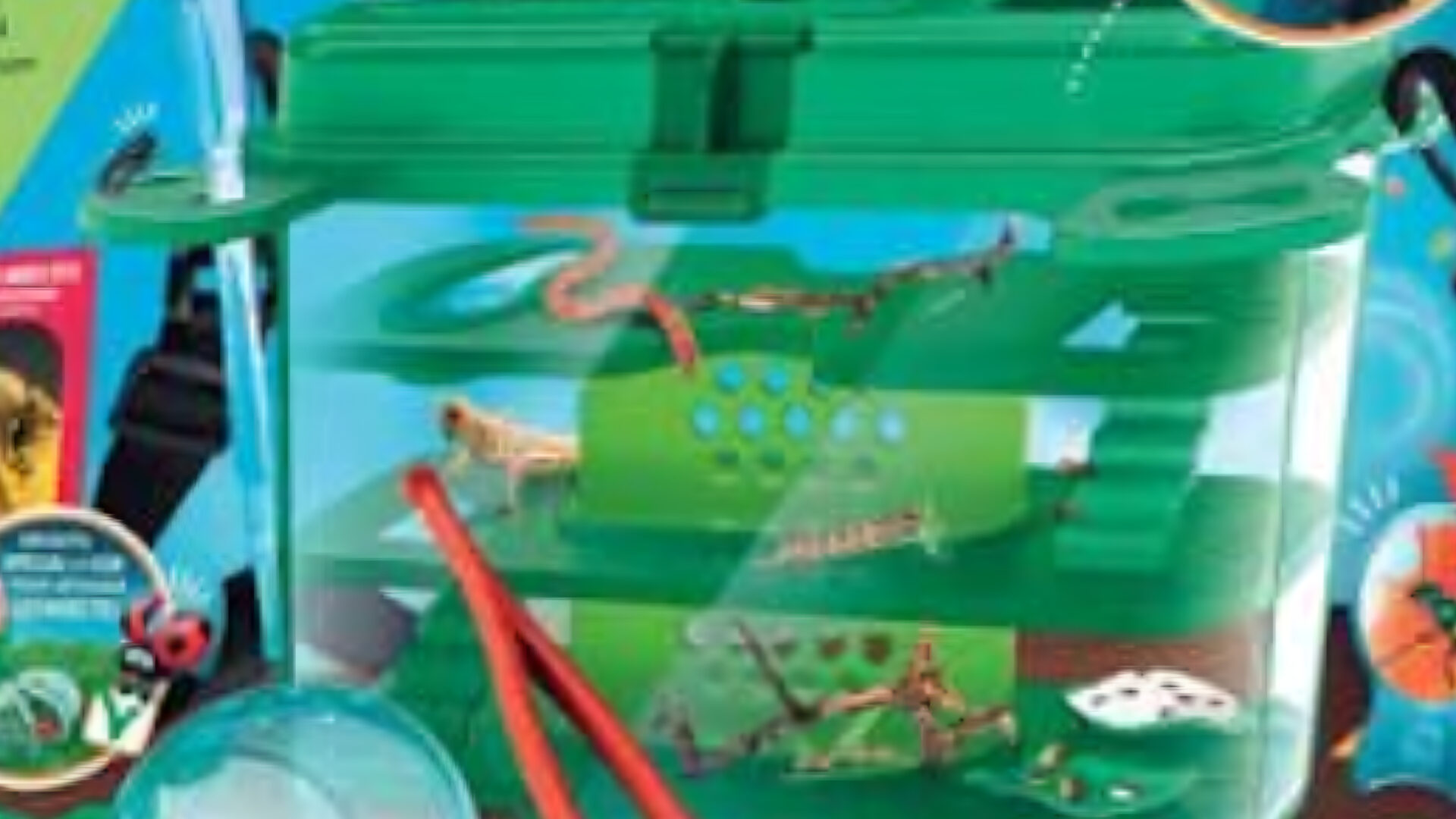
The transparent tray constitutes the center of the box. Its format remains small, but a green decoration on three levels correctly occupies the interior with stairs, leaves, perforated crosspieces and a small bowl. The lid has a transparent hatch and several ventilation openings. Insects can walk, climb and make themselves visible at different heights instead of staying at the bottom of a simple pot.
The word house, however, is confusing. This structure contains no soil, no vegetation, no suitable cover, no temperature or humidity control. The three floors decorate and facilitate observation; they simulate but do not recreate a natural environment. A cricket, a ladybug, an ant and a caterpillar do not live in the same conditions and do not eat the same thing.
The instructions fortunately end up setting the correct limit. They ask that the animal be kept for only a few hours, out of direct sunlight, before release. The product must therefore be understood as a transportable observation chamber, never as a breeding facility or as a hotel to be left outside for several days. A clearer formula on the front would have avoided this ambiguity.
Assembly begins with an adult
The box is not ready upon opening. The interior decor elements remain attached to their plastic frames. Detaching them properly requires cutting pliers, then sometimes a deburrer or a fine cutter to remove the sharp remains. An ordinary pair of scissors struggles to produce a clean result and can mark the parts.
The assembly assembles three superimposed bases, two stairs, perforated crosspieces, small leaves and the bowl. The decor is then placed in the tray, while the tabs, the hatch and the domes join the cover. No glue or screws are necessary, but the number of parts, their direction and the force required for certain connections clearly exceed what a 7 year old child can manage alone.
The presence of an adult is therefore not a simple recommendation placed out of caution in the instructions. It directly conditions the quality of the result. Cutting too far from the workpiece leaves a peak; cutting too close digs into the plastic; a crosspiece installed in the wrong direction requires force to go back. The child can sort the elements and follow the steps, but the tools and connections remain with the adult.
The materials compensate for this difficulty. The tray, tiers and accessories give a solid impression once assembled. The parts do not appear ready to twist the first time they are detached and the structure supports ordinary handling. Clementoni provides durable material, but pays for it with much more complex preparation than the indicated age suggests.
Once the structure is completed, the instruments have housings on the cover. The pipette, tweezers and small glass therefore do not lie at the bottom of the box after the first outing. This organization counts on a box intended to come back often in the garden. It’s a shame, however, that these are only installed, and not clipped. No retention system can prevent accidental loss, especially when the product is carried over the shoulder by a child impatient to discover the microscopic world.
Catch without grabbing
The most interesting tool looks like a pair of scissors ending in two transparent half-domes. By bringing the handles together, the child closes the two parts around the insect. The mechanism works well, is easy to handle and allows you to check the position of the animal before lifting the whole thing. Then simply open the hatch and let it fall gently into the bin.
The principle avoids tight fingers around a fragile body. It works mainly on an immobile insect, placed on a fairly flat and clear surface. In tall grass, under a leaf, on a branch or facing a grasshopper already ready to pounce, the two domes become less easy to place. The box does not contain any net, which clearly limits the capture of flying species.
For subjects that are too small, the booklet suggests a simpler method: turn the small glass over the animal, slide a sheet of paper underneath and quickly transfer everything into the box. This technique is worth having an adult demonstrate on the first outing, as it often offers more control than the large pincer.
The red tweezers raise more questions. It appears in the inventory, but the instructions do not clearly explain when or how to use it. Directly grabbing a leg, wing or abdomen with this tool would be a bad idea. It can move a leaf, a small piece of debris or a support, but Clementoni should have written it down instead of leaving its function open to interpretation, especially at an age where experimentation is the key word.
A lid too easy to open
The transparent walls offer a much more pleasant side view than an opaque jar. The different levels encourage the animal to move and allow you to follow its locomotion, its balance or its way of overcoming an obstacle. The upper hatch also avoids having to remove the entire cover for each transfer.
This good idea is weakened by the general closure. The lid opens too easily and the slightest shock can create enough play to let an insect escape. A box intended to be carried outside, placed in the grass and handled by a child should provide a much clearer lock. Here, you have to check the fasteners after each trip.
The flaw makes the shoulder strap almost contradictory. The box is small enough to be easily transported, but the swing against the hip precisely multiplies the shocks capable of moving the lid. The strap remains practical for reaching the garden when the bin is empty. After capture, the house must be kept flat and constantly monitored. The release is well explained. Just open the hatch and wait. If the animal does not come out, the cover and the interior decoration can be removed, then the decoration placed in the garden to give it time to leave on its own. This method avoids shaking the box, but it does not correct too weak closure during observation.
A magnifying glass that is too small and poorly suited
The magnifying glass was to complement the transparent walls and help examine details. In practice, it is too small to offer comfortable observation. Its surface reduces the visible field, the fingers quickly occupy part of the lens and the child must constantly seek the right distance between his eye, the magnifying glass and the insect.
The green decor makes exercise even less enjoyable. A small subject placed behind a crosspiece or under a floor easily disappears while the magnifying glass is repositioned. The small glass with cap brings the animal closer, but it does not replace a real magnifying glass box with a large lens attached to the lid.
Its size also poses a safety problem outdoors. A magnifying glass should never be pointed into the sun or left unattended in strong light, as it can concentrate the rays. The booklet warns against the box in direct sunlight, but does not clearly regulate the handling of the lens by a child. For a product from 7 years old, this warning should have appeared immediately, or even placed in a separate bag clearly bearing this warning.
This accessory ultimately looks like an addition intended to complete the inventory rather than a real scientific instrument. A larger lens, integrated into a small, stable container, would have been easier to hold, more precise and less easy to misuse.
Thirty cards to guide identification
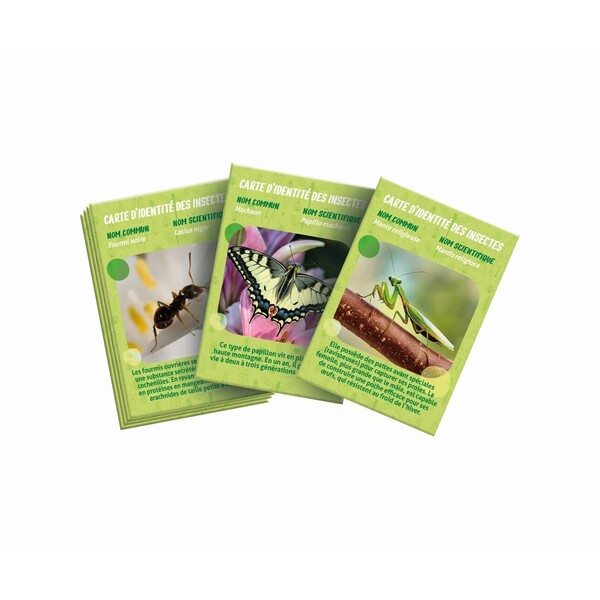
The pack of thirty cards gives the box set an immediate documentary basis. Each card combines a photograph with a description and some particularities. The child can compare what he sees with a real shape rather than with a very simplified drawing. The presentation is clear and the images make you want to search.
The number, however, hides a less varied selection than expected. The silhouettes, environments and behaviors do not cover widely enough everything a child can encounter. The choice is also surprising with the place given to animals like the common fly. It obviously deserves to be known, but it does not represent the subject that many families will want to capture and then keep in a box on the table.
That inclusion makes sense in an identification guide, much less in a selection supposed to accompany the exploration. Species with more contrasting shapes, movements and habitats would have made better use of the layers, the magnifying glass and the pages of notes. The cards are interesting one by one; the package lacks real overall diversity.
Nor do they transform an identification into certainty. Two closely related butterflies, several ladybugs or beetles from the same family can look similar without belonging to the same species. At age 7, a good goal is to first recognize a large group, count legs, spot wings or elytra, and observe behavior. Giving an exact name comes next, with a more comprehensive guide if necessary, which itself is sorely lacking.
Food for everyone
The small bowl receives a few drops of water using the pipette. The booklet also suggests honey or a piece of fruit to nourish the occupants. The gesture gives a function to the decor and can reassure the child who does not want to leave the animal without anything, but the advice brings together too many species under a single recipe.
The needs depend on the insect, its stage and its environment. Some caterpillars only eat the plant they were found on. Predators ignore the fruit. Other animals require specific humidity, vertical support or different ventilation. A drop of honey is therefore not a universal response to a few hours of captivity.
The box also does not require you to separate the species. Introducing a small prey, a predator or several stressed animals together can change their behavior and provoke an attack that the child had not come to observe. One species at a time, ideally a single individual, is a simple rule that is missing from the booklet.
For this product, the best protection remains brevity. The observation can be done without trying to feed the animal if it lasts a short time, then the release must take place exactly where it was found. Clementoni insists on these few hours and the absence of direct sun. These reminders are useful, but they should have more firmly framed the dietary advice.
Dangerous insects are also in the booklet… and in nature
The classification double page shows a bee, a hornet and a mosquito among the examples. However, no clear instructions prohibit a child from capturing an insect capable of stinging or biting. At 7 years old, recognizing a calm wasp, a harmless hoverfly or another striped insect is not easy.
The same lack concerns hair-covered caterpillars, some defensive beetles, spiders and unknown animals. A very simple rule would have sufficed: never catch what you do not know how to recognize, avoid any stinging or biting animal and call an adult before approaching a questionable species. The box explains how to close the pliers, not enough how to choose what can fit inside.
The warnings mainly concern small parts, cutting elements and the risk of leaving the box in the sun. Protected species, places where capture may be prohibited and the need to return the animal to the exact point of collection are not developed. These omissions do not make the box dangerous in themselves, but they require real adult supervision.
This adult presence should not consist only of holding the scissors during assembly. It is used to select the animal, limit the duration, prevent mixing and decide when to stop. With this framework, the box can create an attentive relationship with living things. Without it, the kit risks becoming a container for anything that moves, harming insects or even endangering the child.
Small, sturdy and easy to carry
The dimensions of the tank remain modest. This small size makes it easy to store and allows the child to take it with them without turning each search into an expedition. Two carabiners attach a shoulder strap to the sides, while the pipette, tweezers and small glass find their place on the lid. Everything remains together between two outings.
The structure supports ordinary handling well and the strap frees the hands to search in the grass. It is especially suitable for traveling with an empty bin. As soon as an insect is inside, the weakness of the lid means that the whole thing must be carried flat, without swinging. The house is therefore small and practical, but its transport requires more care than its presentation suggests.
Plastic has another advantage: it requires no batteries, no recharging, no proprietary consumables. Careful rinsing and complete drying allow you to leave for another outing. The instructions would still have benefited from giving a cleaning method, especially after honey, fruit or soil brought from the garden.
Verdict
A good field kit that remains more of a toy
6/10
Clementoni provides sturdy materials, a well-functioning insect catcher, and a small, easy-to-store structure. The shoulder strap is practical for reaching the garden with the empty bin, while the transparent walls and the different levels offer good observation angles. The booklet also recalls the release after a few hours and the ban on direct sunlight. However, assembly is too complex without an adult and requires real cutting tools. The lid opens at the slightest shock, at the risk of letting the insect escape. The magnifying glass is too small, impractical and accompanied by insufficient guidance. The thirty images are interesting, but their variety and certain choices, including the common fly, are also perplexing.
Finally, the scientific framework lacks precision on food, the mixture of species and the animals capable of stinging or biting. Despite these reservations, La maison des insectes remains a decent box set for short, accompanied observation. At around twenty euros, its reusable material can feed several outings, provided you check the lid and quickly return each animal to its environment.
Pros
- Strong materials that withstand ordinary outings and handling.
- An effective insect catcher that avoids catching insects directly.
- A really practical compact format with the shoulder strap when the bin is empty.
- Thirty photographic cards to guide identification.
- Release explained and limited to a few hours.
- No batteries, no consumables and a price close to twenty euros.
Cons
- The name house can make you believe in a sustainable habitat.
- An assembly too complex for a child alone, with cutting pliers and deburring tool.
- A lid that opens too easily and can let insects escape after a slight shock.
- No net for flying or difficult-to-approach insects.
- A magnifying glass that is too small, impractical and accompanied by insufficient guidance for a child.
- Interesting cards, but not very varied and sometimes surprising in their selection.
- Too general dietary advice for very different species.
- No clear ban on bees, wasps, hornets or unknown animals.
- Some errors and shortcuts in the scientific part of the booklet.