

Underling Uprising
The revolution that lacks weight
Score: 6/10
Images and videos
At a glance
We liked
- A very “90s cartoon” artistic direction that is immediately readable.
- A roster of characters who each have a real gaming personality.
- Local co-op for up to four transforms the fun.
- A low price for a complete campaign and a few additional modes.
We liked less
- A combat system that lacks precision and weight.
- Levels that stretch and bring out the repetitiveness in single-player.
- Readability that suffers as soon as the screen is too busy.
- Too little real depth to convince demanding beat’em up fans.
 By Farrel Grimwood · published · 7 min read
Contents
Underling Uprising had everything to be that obvious little brawler that you keep on the console for couch nights. Colors that scream, a Saturday morning cartoon pitch, characters that look like mutants escaped from an overly enthusiastic laboratory and a studio that doesn’t hide its references to the beat’em ups of the 90s. On paper, it’s the reassuring promise of a simple, cooperative release of steam, which doesn’t try to compete with the monsters of the genre but which agrees to place itself a notch below, in the category of "good evening games with friends".
The reality is more nuanced. Underling Uprising knows how to be pleasant, sometimes even downright cool when everything aligns: a team of four, shots that follow each other neatly, a boss who encourages coordination. But the game never has the density or precision that would transform this pleasure into a memorable memory. It often seems to chase the image it wants to project: that of a lively, rebellious brawler, without always finding the system capable of supporting it.
We play the Underlings, enhanced test subjects who rebel against the mad scientist who created them. The world becomes one long excuse to cross the planet, breaking faces, laboratories and a few vehicles along the way. Underling Uprising does not try to philosophize about the monster condition. It prefers to transform this revolt into an aggressive cartoon, a fluorescent comic book where each shot leaves a trail of color on the screen. This is its immediate strength. This is also what makes its gameplay limitations more visible as soon as you scratch the surface a little.
A brawler that smells like Saturday morning
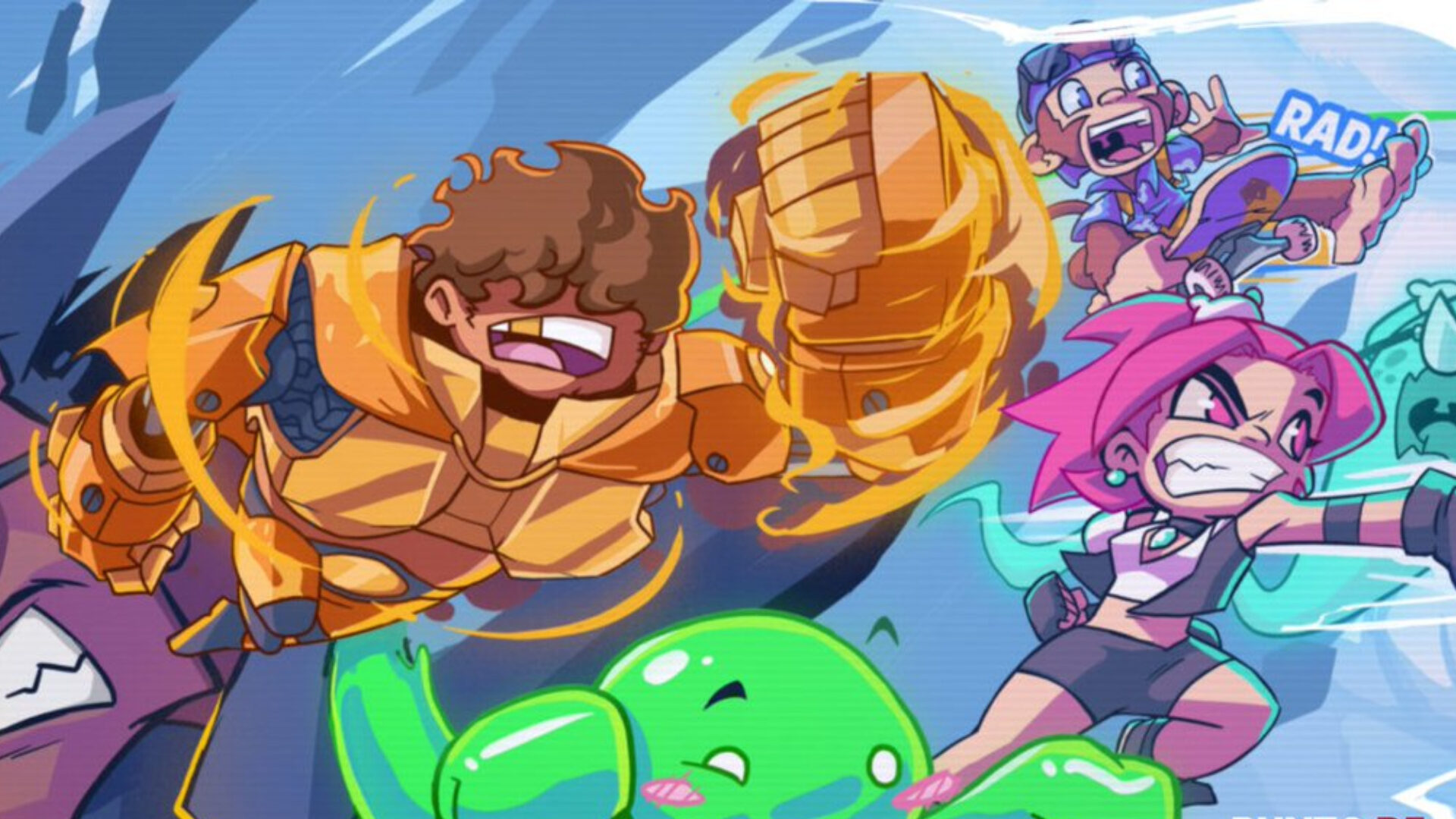
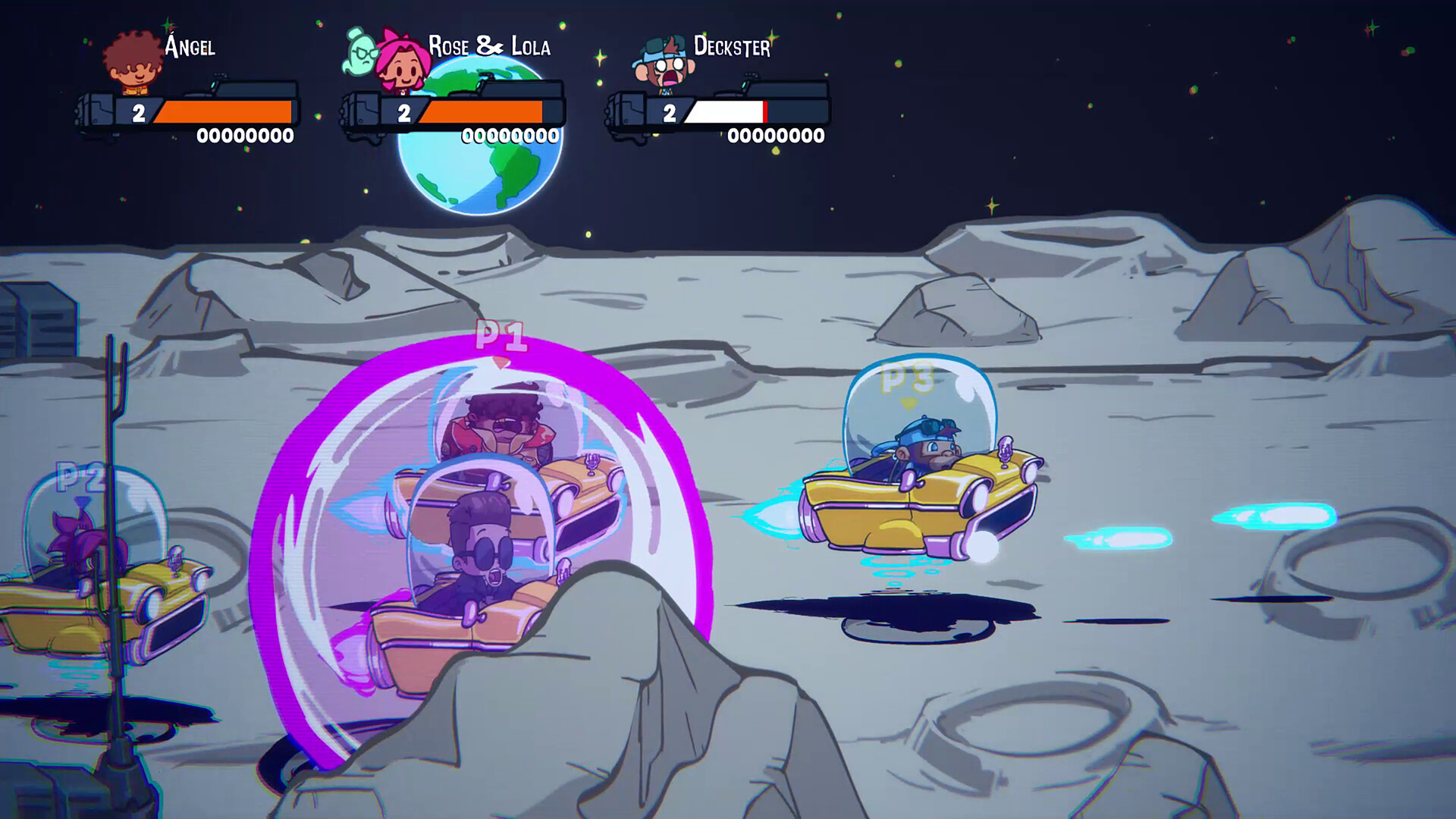
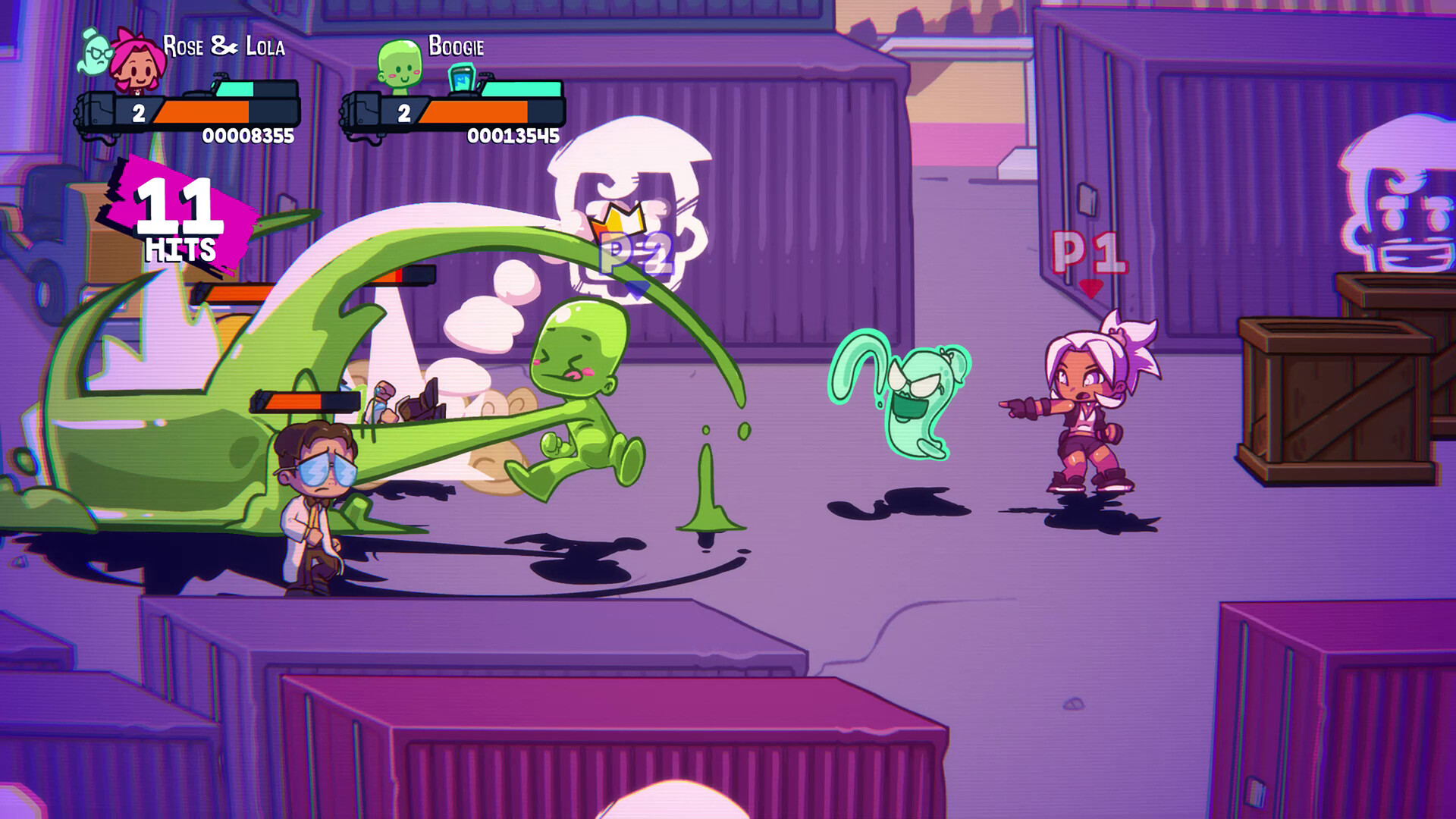
The first thing Underling Uprising gets right is its storefront. The game looks like a lost episode of ’90s cartoon cut too late in the grid: thick silhouettes, saturated colors, exaggerated effects, screaming villains and heroes who pose as much as they punch. The four Underlings, namely Rose, Ángel, Deckster and Boogie, all have a face, a way of occupying the screen. We know in two seconds which one will please the player who likes to fly, who will prefer to stay with their feet anchored in the concrete, dishing out slaps.
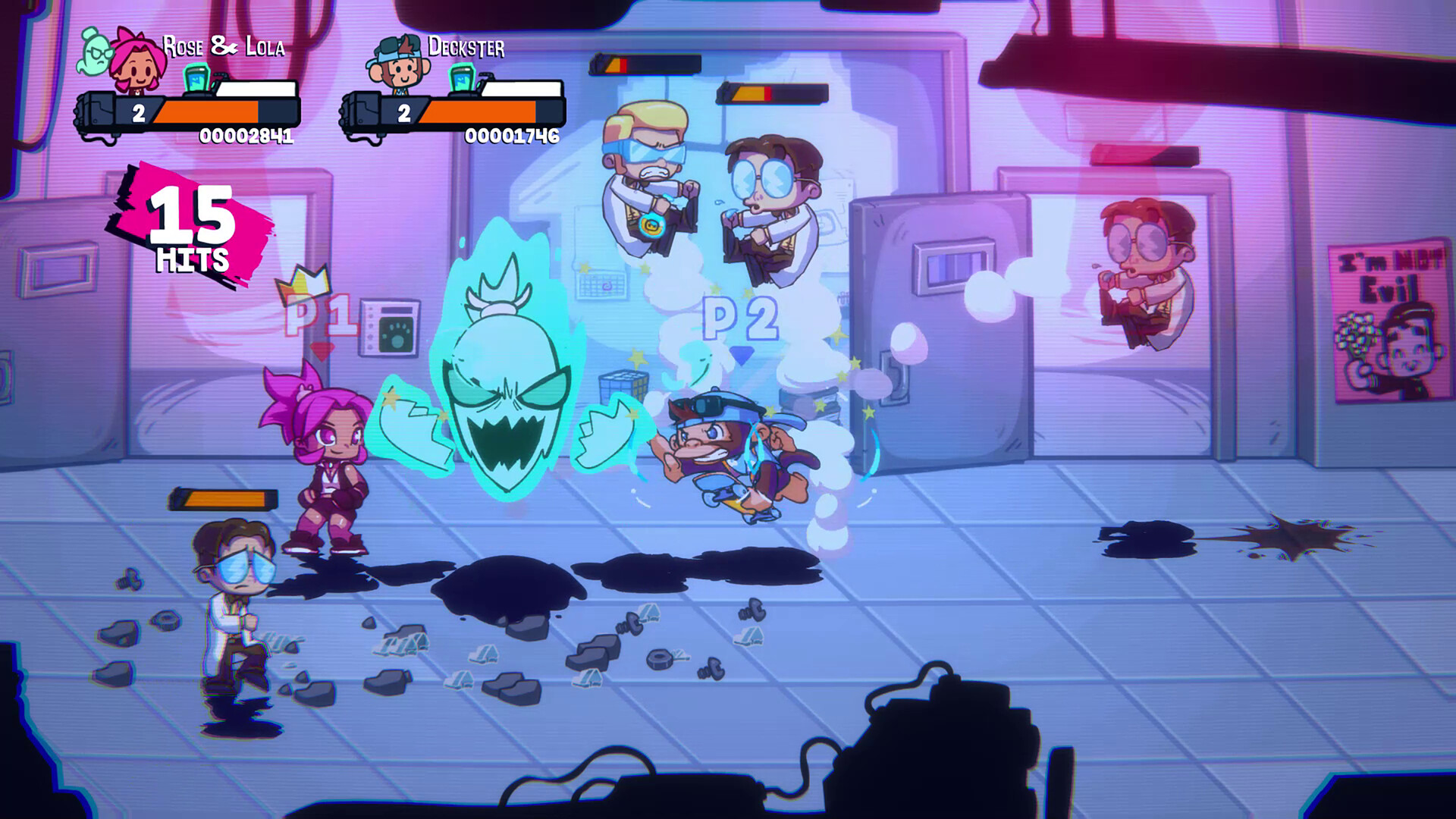
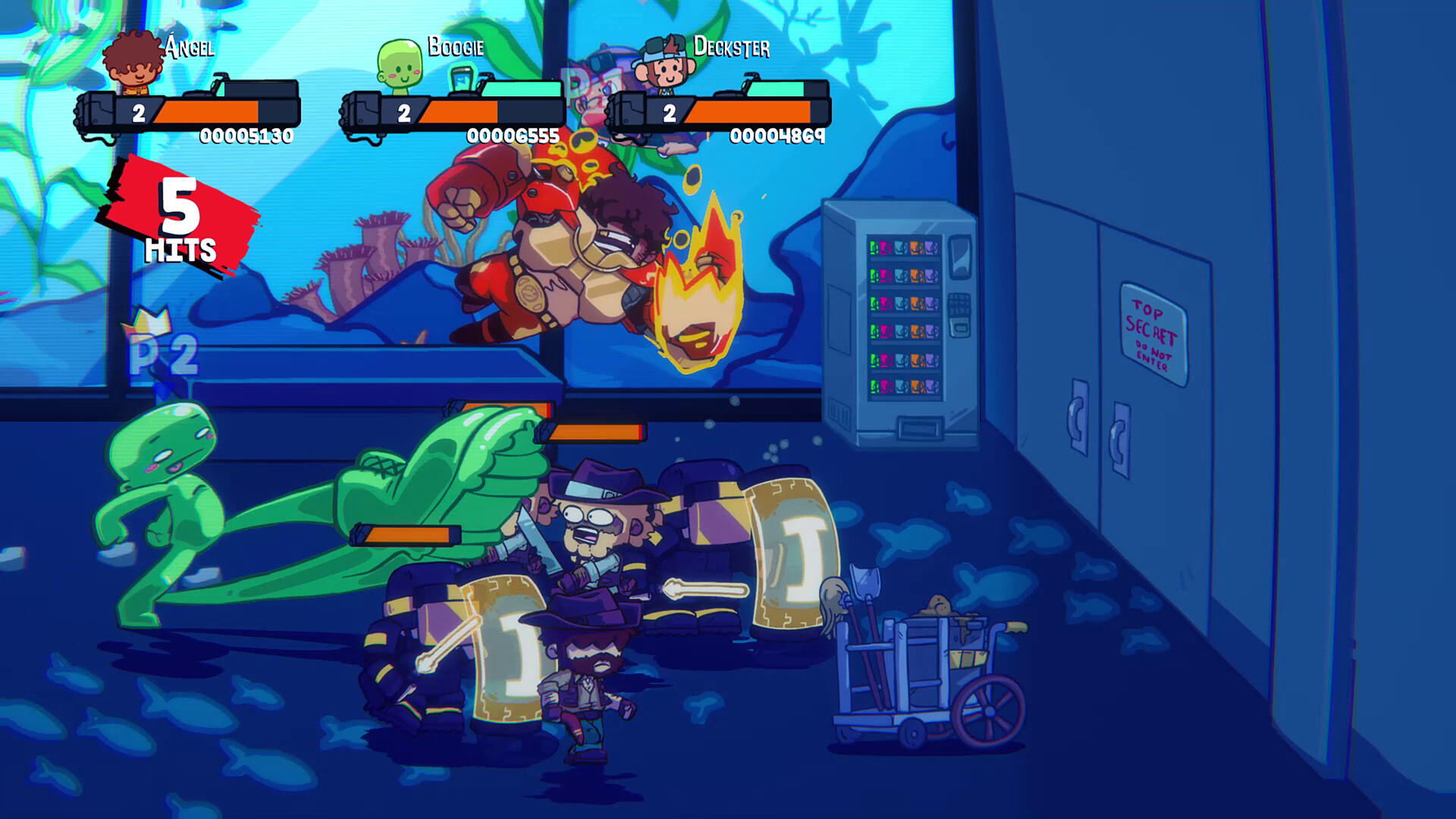
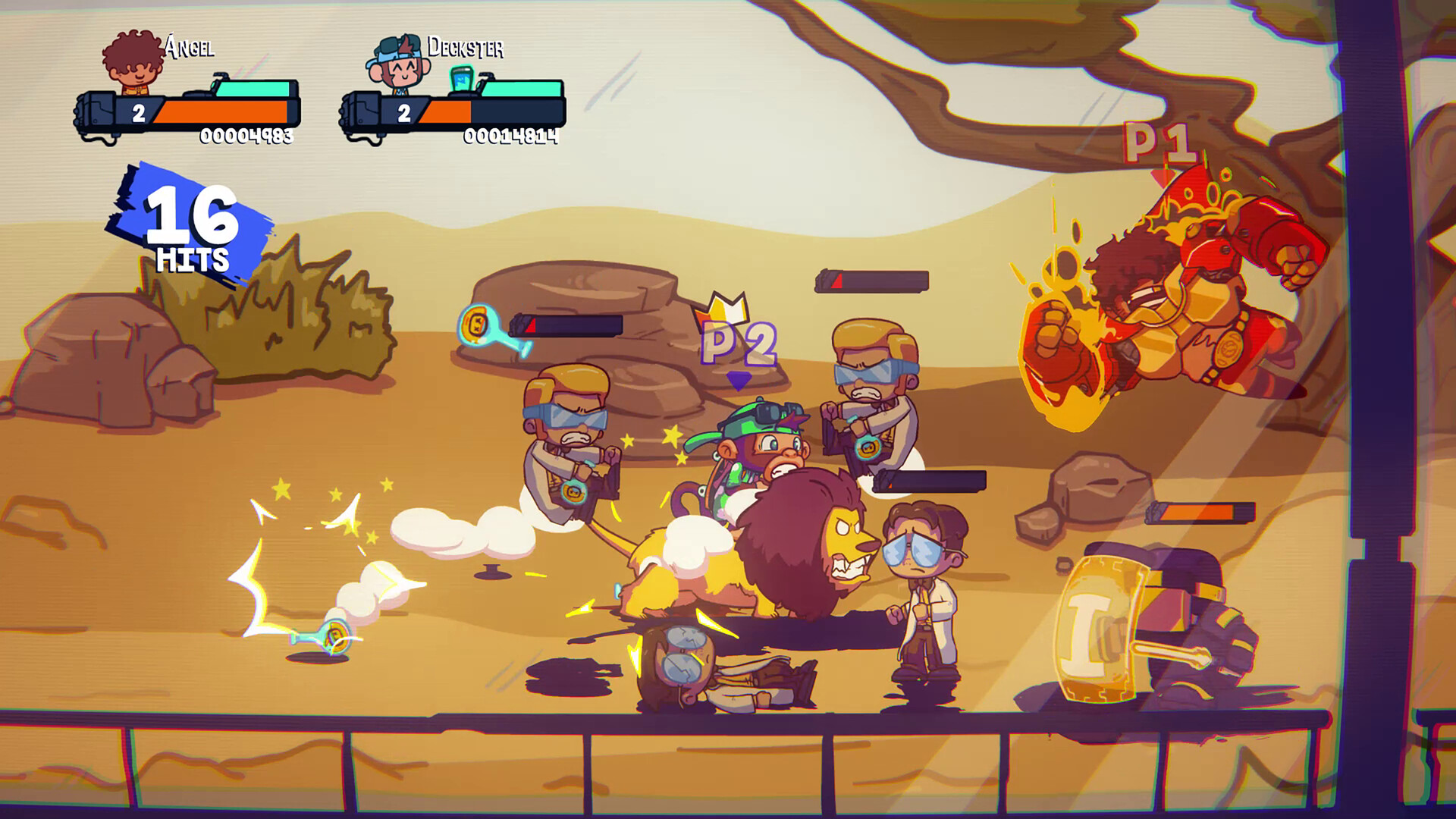
The levels follow this logic. We cross parts of the world that seem designed to be immediately readable: alleys, docks, scientific infrastructures, a few more exotic detours. Nothing that reinvents the beat’em up setting, but enough variation so that the road doesn’t look like a gray corridor. The animation exaggerates the reactions, the impacts, the supers, with this “everything flashes” side which fits the tone. When the screen fills up with players, enemies, weapons and mounts, readability takes a hit, but we can clearly see the game that Underling Uprising is trying to be: a playground fight that forgot to grow up.
This visual identity works all the better as it does not seek realism. The game knows that it is a cartoon, and it accepts it. Where many small brawlers get lost in anonymous pixel art, Underling Uprising finds at least a face. It is easy to recognize. It’s easy to sell. It is rather harder to defend over the long term when you start counting hours rather than colors.
A system that wants to let everything happen
Controller in hand, Underling Uprising is built on a simple principle: let the player improvise. No long lists of commands, no quarter circles, no long combos to memorize. We have a simple base made up of hits, jumps, dashes, throws, weapons picked up and supers; and it’s up to everyone to make their own way. The developers talk about an “open system”, and we understand the intention: to encourage experimentation rather than recitation.
At times, it works. We juggle an enemy, we send his body to another line, a partner recovers behind, a super comes to clean up a wave. The game then finds this particular flow of the beat’em up where we no longer really think, where we let ourselves be carried away by the fight, aligning reactions more than conscious decisions. The energy gauge which fills and explodes in ultimate attacks further accentuates this feeling of a permanent little spectacle.
But Underling Uprising often lacks edge. The blows lack weight, hit reactions are not always clear, the windows of invincibility can give an impression of arbitrariness. We sometimes find ourselves stuck in sequences where the character gets up and immediately gets back on the ground, without the feeling of having had a real margin for error. Where a Streets of Rage 4 or a Fight’N Rage give the impression of a perfectly mastered language, Underling Uprising speaks a more approximate dialect, friendly, but rarely incisive.
The consequence is simple: the game is pleasant when you take it for what it is: an accessible release of steam, but struggles to hook those looking for an additional layer of depth. We feel the desire to do well, to offer subtleties of style for each hero, specific interactions, supers who redefine priorities on screen. We also feel that the combat engine cannot quite support those ambitions.
Seven levels, a lot of fighting, a little filler
The campaign unfolds seven fairly long levels, each with its own setting, its dominant bestiary, its mini-bosses and its final boss. It’s a very classic structure: we move forward, we clean an area, we move forward again, we get locked up for another fight, we pick up what’s lying around, we end up running into the big mouth in the corner. The game tries to break this routine with some simple gimmicks, such as vehicles, mounts, and slightly more scripted situations. None really transform the gameplay, but some sometimes give the impression of leaving the highway for five minutes.
The problem is the pace. Some levels seem to stretch more than necessary, as if the game was afraid of being “too short” and added a layer of waves where a sharper cut would have given more nerve. In solo, this length is felt very quickly: we see the same types of enemies return, the same patterns, the same rooms slightly rearranged. The beat’em up becomes less of an electric trip than a series of rooms to clear.
The bosses are doing better. Each requires a little reading, a space, a way of cutting the life bar. Nothing revolutionary, but some clashes find this tempo where we start by suffering, then where we surprise ourselves by anticipating, by dashing at the right time, by placing the right special in the right window. We would have liked the overall curve to follow this example. Underling Uprising has ideas to punctuate its levels, but it dilutes them a little too much in the rest of the mass.
The sofa, the game’s best ally
As is often the case in this type of production, the real key is in the number of players. Four on a sofa, Underling Uprising changes face. The repetition of waves becomes a pretext for jokes, for organized chaos, for a mistimed super that takes away as many allies as enemies. The readability defects almost turn into quality, because they nourish this feeling of happy mess that the game precisely seeks to provoke.
The story mode playable by several people, the Versus which allows you to settle scores and the Arcade mode for fans of scoring provide enough material to fuel a few evenings. The simplicity of the controls then works in the game’s favor: no one is left behind, even the player who hasn’t touched a beat’em up since the Megadrive days can pick up a controller and do something useful.
In solo, the story is different. The same systems become more monotonous, the technical inaccuracies are more visible, the drawn-out levels weigh more heavily. Underling Uprising is not unplayable alone, far from it, but it loses what makes it most enjoyable: the noise, the screams, the slightly stupid laughter when three Underlings miss the same dodge at the same time.
The Switch does the job, no miracles
On Nintendo Switch, Underling Uprising keeps its promise: it runs, it flashes, it cooperates up to four locally, whether in TV mode, handheld or tabletop with shared Joy-Con. The artistic direction lends itself well to the machine: the flat areas of color and the thick silhouettes cope easily with the handheld resolution, and the game remains readable as long as the screen is not saturated with people.
Technically, the game does not suffer from the major problems specific to the console. No major crashes reported, no permanent framerate catastrophe, rather a general sluggishness in the sensation which has more to do with the design of the combat than the hardware.
The price remains in the low range of the market. Underling Uprising costs around fifteen euros at launch, which also determines how we judge it. For this price, you get a complete campaign, several modes, a roster of distinct characters and local co-op for up to four. It is no giveaway, but it is not a rip-off either. It’s a game that accepts being mediocre on many points but which defends itself better as soon as we forget to compare it to heavier productions.
Verdict
A modest revolt, but not useless
6/10
Underling Uprising is neither the disaster that you uninstall after one stage, nor the new totem of independent beat'em up. It's an honest, colorful, sometimes endearing, often clumsy brawler, who knows exactly who it was designed for: players who still like to start a fight with several people, without having to sort out frame data, cancels and tier lists.
Its biggest flaw is almost paradoxical: it wants to offer a freedom of fighting which is not perfectly supported by its system. The blows lack sharpness, the rhythm slips, some levels drag on rather than build tension. But as long as we accept these limits, what it announces remains: a little revolt of mutants against a cartoon background, to come out from time to time when there are four of us around a screen and we want to hear each other scream.
Pros
- A very “90s cartoon” artistic direction that is immediately readable.
- A roster of characters who each have a real gaming personality.
- Local co-op for up to four transforms the fun.
- A low price for a complete campaign and a few additional modes.
Cons
- A combat system that lacks precision and weight.
- Levels that stretch and bring out the repetitiveness in single-player.
- Readability that suffers as soon as the screen is too busy.
- Too little real depth to convince demanding beat’em up fans.
More in Video games
Full library 6/10
The Walking Dead: Streets of Survival
XBOX 7/10
MARVEL Cosmic Invasion – Cyclops and the Thing
XBOX 8/10
MARVEL Cosmic Invasion
XBOX 5.5/10
Heroes of Mount Dragon
XBOX 7/10
Castlebound
SWITCH 8.5/10
Village in the Shade
SWITCH 5.5/10
Warrior Cats: Clans of the Forest
SWITCH 6.5/10
Demons’ Night Fever
SWITCH 8/10
Culdcept Begins
SWITCH 5/10