
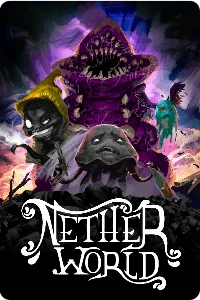
NetherWorld
The jellyfish drowns his divorce
Score: 5.5/10
Images and videos


At a glance
We liked
- A real visual and narrative identity
- Medoo, pathetic but striking hero
- A dirty and very recognizable pixel art
- Some frankly absurd situations
We liked less
- No French
- Too repetitive a provocation
- Imprecise fights
- A very irregular rhythm
 By Farrel Grimwood · published · 10 min read
Contents
NetherWorld is a game that doesn’t try to be kind. Medoo, a pathetic jellyfish abandoned by his wife, begins his journey the way many bad decisions begin: in a bar, with too much alcohol, not enough dignity, and a world already ready to show him that he can fall lower. The Hungry Pixel game, published by Selecta Play, was released on Nintendo Switch with a fairly clear promise: a narrative adventure in pixel art, dirty, absurd, violent, sexual, vulgar, and above all very determined to never fall into line.
The tone is set very quickly. NetherWorld is about breakups, loneliness and decay, but it does so by covering it all with vodka, drugs, questionable mini games, grotesque characters and crude jokes. We come across street magicians, pimps, perverts, mafiosi, sociopathic children and a whole gallery that seems to have come out of an old feverish dream after three drinks too many. The game wants to shock, dirty, make you laugh, then start again before the player really has time to know if he finds it clever or just exhausting.
This is where NetherWorld becomes fragile. Its bad taste is no accident. It is part of the setting, of the subject, of this way of transforming a marital crisis into a descent into a world where everyone seems broken, lustful or already lost. When this absurdity hits the right note, the game finds real singularity. It has attitude, anger, a desire to scratch where many independent games are content to be gently weird.
But excess is not enough. By wanting to be dirty, violent and transgressive, NetherWorld gives the impression of confusing unease and depth. The pixel art has character, the universe has a real identity, but the writing turns to repeated provocation, and the action sequences do not have the precision necessary to support this madness. Combat, throwing objects, bosses and certain mini games have a rigidity that can quickly break the momentum.
It should also be noted that there is a real limitation for the European Switch version: the game is not available in French. For an adventure so talkative, so dependent on its dark humor, its dialogues and its absurd situations, this is far from being a detail. We can understand the action, follow the general direction, grasp the filth of the world. But part of the flavour necessarily comes through the words, and the absence of a French translation leaves a fairly clear barrier for the public.
Medoo hits rock bottom, then digs deeper
NetherWorld first tells of a breakup. Not an elegant breakup, not a beautiful melancholy at the end of love, but something dirtier, more pitiful, more humiliating. Medoo is left by his wife, and the game immediately throws him into a spiral of bars, shady encounters, alcohol, drugs, sex, violence and absurd decisions. This is not the story of a character who seeks to rebuild himself with dignity. It is that of a jellyfish which collapses in an already rotten world.
The starting point could almost be sad. An abandoned character, alone, incapable of handling what happens to him. But NetherWorld constantly refuses gentleness. It prefers to transform pain into a dark joke, into a crude joke, into a creepy encounter, into a situation that always pushes bad taste a little further. The game wants the descent to be grotesque. Medoo isn’t just going through heartbreak. He’s going through an existential hangover.
This approach gives the game a real identity. We don’t often come across an adventure that so frankly assumes dirty absurdity, vulgarity, discomfort and sexual nonsense as its main subject. NetherWorld isn’t trying to make Medoo heroic. It makes him weak, often ridiculous, sometimes even difficult to love. It’s an interesting choice, because it gives the story something harsher than a simple black comedy.
The problem is that this excess sometimes ends up eating into what it is trying to say. The game has ideas, situations, a gallery of frankly twisted characters, but it returns so often to provocation that we end up seeing the mechanics. A pervert here, a drug there, another sex joke, one more grotesque character. When everything wants to shock, nothing really shocks anymore. What remains above all is fatigue.
The secondary characters contribute to this impression. Some have a real face, an immediate presence, a way of making the world stranger and more hostile. Others seem to exist above all to push the cursor a little further into the sordid. The game wins when it lets its absurd figures reveal something about the world or about Medoo. It loses when they only serve to add a layer of dirt.
The absence of French weighs heavily here. NetherWorld relies heavily on its dialogue, its tone, its insults, its comic breaks and its way of playing with discomfort. The English and Spanish available allow you to follow the adventure if you are comfortable with one of the two languages, but the Switch version clearly leaves part of the French audience out. In a game where writing is almost the heart of the experience, this is a real limitation.
Despite everything, there remains something sincere behind the dirt. NetherWorld speaks badly, thinks wrongly, often laughs too loudly, but it starts from a real void: that of an abandoned character who is looking for anything to not be left alone with his pain. When the game returns to that, when it lets Medoo’s misery appear behind the provocation, it becomes more interesting. Not sweeter. Fairer.
It is a deliberately excessive story, often funny, sometimes heavy, rarely lukewarm. NetherWorld has an obvious personality, but it still too often confuses intensity with accumulation. Its initial breakup could have made for a more biting black comedy. Above all, it gives a sticky descent, full of flashes and fat. The game hits rock bottom with conviction. It does not always know what to do once it gets there.
Mini games in an endless binge
NetherWorld doesn’t play like a classic adventure. The title advances by scenes, by encounters, by small absurd sequences which often change form. We discuss, we explore, we throw objects, we participate in mini games, we face bosses, we go through situations that sometimes look more like a bad interactive joke than a traditional progression. This variety gives the game a rather special energy. You never really know what dirt is going to come out next.
NetherWorld has a taste for drifting, and its gameplay follows this logic. A scene might start as a simple discussion in a bar, then end up as a bizarre duel, a stupid challenge, or a more chaotic action sequence. The game does not seek comfort. It wants to surprise, move, make people laugh. This unpredictability fits very well with Medoo’s state, always between two lame decisions.
The playable core, however, remains quite simple. Movements, interactions and throwing objects serve as the basis for many situations. Medoo picks up, aims, swings, dodges, repeats. It’s not very fine, but it’s enough to give the player a presence in this shaky world. We don’t just read a succession of dialogues. We participate in the tumble, sometimes with pleasure, sometimes with the sensation of handling something deliberately rough.
Bosses and action sequences are more questionable. The idea of a dirty narrative game that regularly shifts into combat has potential, especially with such a grotesque universe. But the confrontations often lack precision. The hitboxes, movements, rhythm of attacks or the readability of certain phases do not give the impression of a perfectly mastered system. When the game requires skill, it does not provide the tools clean enough to make failure seem fair.
The mini games stick more to the tone. Some are stupid, quick, almost gratuitous, but they contribute to this impression of a sick world where every normal activity has been replaced by a dubious ordeal. Not all are memorable, and some rely mainly on the element of surprise. But they at least allow us to break the straight line and remind ourselves that NetherWorld prefers accidents to routine.
The rhythm remains very irregular. This is both a quality and a problem. The game can go from a funny moment to a heavy sequence, from a funny idea to a passage that stretches too long, from a biting dialogue to a less well-held action. This instability is part of its identity, but it also ends up tiring. We accept chaos when it gives something. We tolerate it less when it resembles a mechanism that only seeks to be unpredictable.
The exploration remains fairly focused. NetherWorld is not a large open world to explore, but a series of places crossed, characters to meet and objectives to accomplish. The environments are mainly used to set an atmosphere, to place an oddity, to lead Medoo towards the next bad idea. This suits the format, even if we would sometimes have liked denser, more interactive places, capable of prolonging the discomfort other than through dialogue.
The Switch version lends itself well to the handheld format in idea. Short sequences, mini games and scene progression can work in quick sessions. But the sometimes floating precision of the action is quickly noticed as soon as the game asks a little more than moving forward and talking. NetherWorld is more solid in the writing of its situations than in their pure execution.
That’s the limit of this part. The game wants to be a filthy interactive story, an alcoholic trip, a series of tone breaks and mini accidents. When it stays on that ground, it can really have a personality. When it requires real playing precision, it becomes more fragile. Medoo can stagger, that’s the point. The mechanics would have benefited from standing up a little better.
Pixel art that smells like a closed bar
NetherWorld has a real face. Its pixel art does not seek cleanliness, nor the pretty independent postcard that could be placed neatly in a window. The game prefers creepy bars, sweaty rooms, dirty alleys, bizarre creatures and colors that sometimes look like they were chosen after too long a night. It is consistent with its subject. Medoo does not fall into an elegant world. He falls into a place that sticks to your fingers.
This artistic direction does a lot for the identity of the game. The characters have silhouettes that are immediately strange, sometimes grotesque, often repulsive. The world seems full of people who all failed at something and then decided to keep going anyway. This is where NetherWorld is most visually convincing: when it gives the impression that each setting has already experienced too many bad evenings before the player’s arrival.
Pixel art also allows for some real strong images. A bar that is too dark, a scene that is too absurd, a creature that emerges with an impossible head, a setting that turns into something more nightmarish: the game knows how to create visions that stay in your head. It has the taste of a bad dream, and this way of mixing the ridiculous, the sexual, the sordid and the fantastic gives it a rather rare color.
But this visual personality is not enough to compensate for the lack of finesse. Some places seem more raw than really worked, some animations lack fluidity, and some scenes give the impression that the idea was stronger than its execution. NetherWorld has style, yes, but a style that is sometimes more frontal than controlled. It shocks, it amuses, it disgusts a little. It does not always compose with the same precision.
The animations of Medoo and the secondary characters keep this same logic. They are often funny because of their stiff, dirty, slightly broken side. This fits the general tone, but it becomes more annoying as soon as the game requires action or precision. In a dialogue or an absurd scene, this stiffness can make you smile. In a fight or a more demanding mini game, it especially reminds us of the limits of execution.
The sound part follows the same vein. The music creates a sticky, nocturnal atmosphere, sometimes almost sick cabaret, with just the right amount of weirdness to accompany Medoo’s descent. They don’t try to be pretty. They try to stick to the discomfort. When it works, they give the game a real texture, as if you could still hear the room after closing.
The sound effects are more uneven. Some comebacks work well, especially in the more absurd scenes or simple interactions. Others lack weight, especially in moments of action. The throws, the impacts, the clashes would have benefited from being drier, cleaner, more satisfying. For a game so focused on shock and grime, it sometimes lacks real sonic brutality.
The absence of French also weighs on the general atmosphere. NetherWorld talks a lot, insults, provokes. If we do not fully understand its text, its dark humour and shifts in tone lose their force. Pixel art can dirty the screen, it does not replace a joke or a line that hits the mark.
NetherWorld has a strong artistic identity, perhaps even its best argument. The game is ugly in a good way, deliberately sticky, full of strange images and characters who never try to please. But it remains irregular, sometimes too crude, sometimes less precise than its own bad taste would require. It has the smell, the neon lights and the hangover. Sometimes it lacks that final punch to make it all truly memorable.
Verdict
A hangover with ideas
5.5/10
NetherWorld has something that a lot of cleaner games don't: real personality. Medoo, his breakup, his alcohol, his grotesque encounters, his questionable mini games and his sticky pixel art give Hungry Pixel’s game an immediately recognizable identity. The game assumes its bad taste, its black humor and its vulgarity with a rather rare conviction, and certain passages really find this strange zone between uneasiness, dirty laughter and glass-bottom sadness.
But excess is not enough. The writing confuses provocation and depth, the action sequences lack precision, the rhythm goes in all directions, and the absence of French weighs heavily in such a talkative adventure. NetherWorld therefore remains a strong curiosity, often dirty, sometimes funny, sometimes heavy, but never lukewarm. An independent trip that looks good, but staggers too much to make it all the way down.
Pros
- A real visual and narrative identity
- Medoo, pathetic but striking hero
- A dirty and very recognizable pixel art
- Some frankly absurd situations
- A black comedy that dares to go far
Cons
- No French
- Too repetitive a provocation
- Imprecise fights
- A very irregular rhythm
- Uneven mini-games
More in Video games
Full library 8/10
Onimusha: Way of the Sword
XBOX 7.5/10
The Lord of the Rings: War in the North – Legacy Edition
XBOX 5/10
Disgaea Mayhem
SWITCH 9.5/10
Assassin’s Creed Black Flag Resynced
XBOX 5.5/10
Tale of Dark Lands
SWITCH 9/10
007 First Light
XBOX 8/10
Realm of Ink
SWITCH 7/10
Ariana and the Elder Codex
SWITCH 6.5/10
Kingdom’s Return: Time-Eating Fruit and the Ancient Monster
SWITCH 9/10