
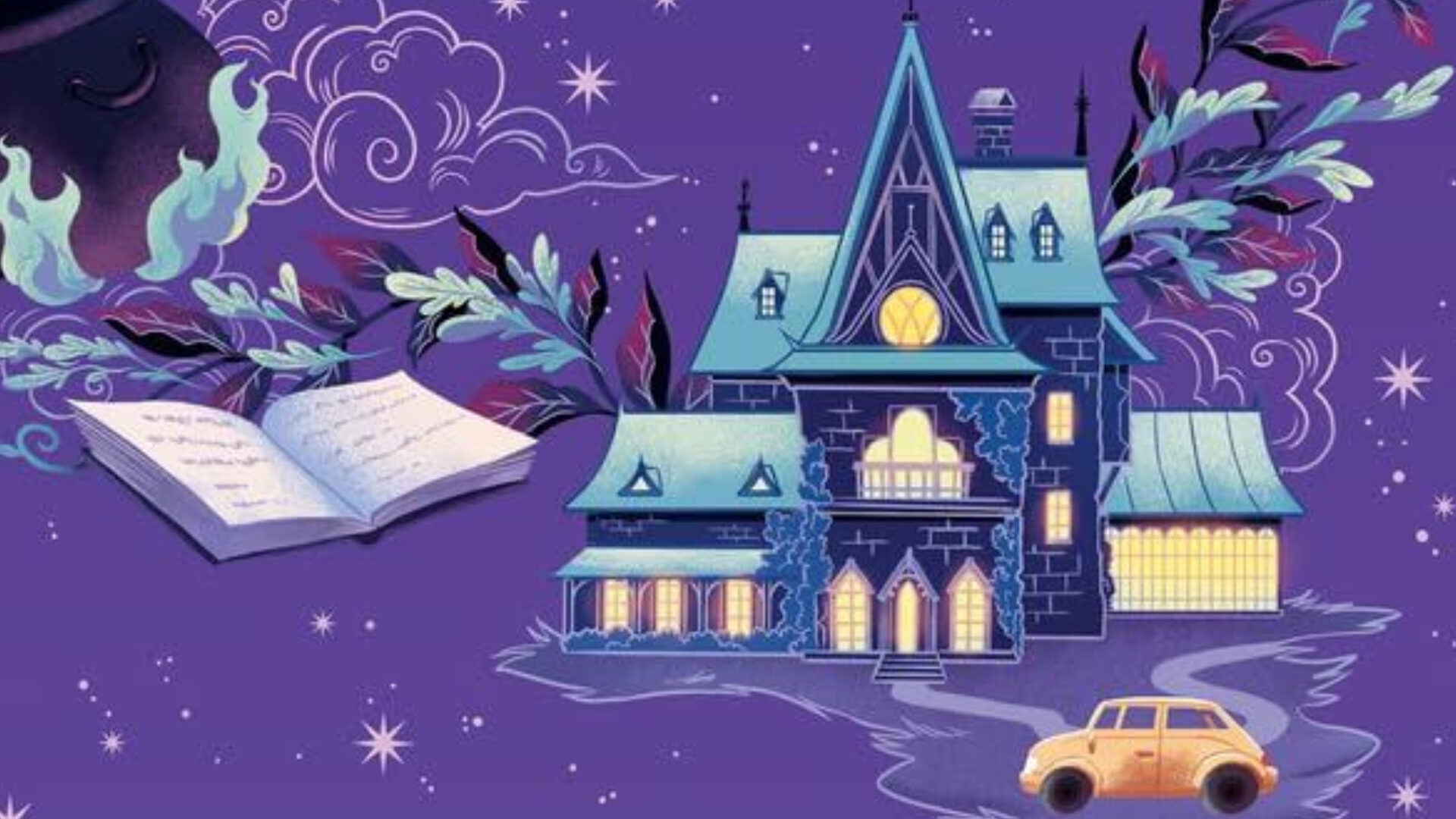

La Société très secrète des sorcières extraordinaires
A chosen family more compelling than the romance
Score: 7.5/10
Images and videos
At a glance
We liked
- Mika has a credible solitude behind a luminous personality.
- Nowhere House becomes a home through its habits and common decisions.
- Rosetta, Terracotta and Altamira each react differently to Mika's arrival.
- The simple, playful and very concrete magic perfectly supports the domestic tone.
We liked less
- Jamie exists less outside of his role as protector and love interest.
- The romance sometimes follows its expected stages without delving deep enough into the couple.
- The changes in point of view remove some uncertainty from the silences.
- The explicit sexual scene fits poorly with the tone and ignores a major rule of the world.
 By Mishakal Yveldir · published · 10 min read
Contents
Sangu Mandanna began writing this novel during the pandemic, at a time when isolation made the need for warmth particularly concrete. She wanted to write the opposite of this period: a gentle, romantic fantasy full of people who end up finding each other. Mika Moon, her heroine, was directly born from this desire, but also from the author’s experience as a neurodivergent woman of color looking for a place where she would no longer have to reduce a part of herself.
Published in English in 2022, then by Lumen in 2023, La Société très secrète des sorcières extraordinaires returns to paperback format on September 3, 2026. Mika is a British witch of Indian origin, aged thirty-one. She regularly changes residence, avoids lasting relationships and posts videos on the internet where she pretends to play the role of a witch. Ian Kubo-Hawthorn realizes that she is not playing and offers her an impossible job: teaching magic to three children gathered on a property in Norfolk.
Nowhere House brings together everything that Mika learned to escape: several witches in the same place, humans who know of their existence and a family welcoming enough to become dangerous. The novel promises a heartwarming read, a romance between a sunny witch and a reserved librarian, then a reflection on the connections we choose. Does its gentleness give weight to these subjects, or does it protect them to the point of refusing their consequences?
A society built to separate
Witches exist in the middle of the ordinary world, but their organization is less like a community and more like a security protocol. Primrose heads the small British circle and imposes simple rules: never reveal magic, never create any links between two witches and limit meetings to a few annual meetings in different places. If a human discovers the truth, their memories may be erased.
This caution has a real basis. Magic appears as golden dust that only witches can see. It is attracted to those who can wield it and becomes more unstable when there are many of them in the same place. Three children without control are enough to trigger flames, levitations or animated objects. Added to this is the ancient fear of humans, which Primrose always considers capable of returning as soon as the secret is jeopardized.
The world adds a more intimate cruelty: when a witch is born, her mother dies shortly after. Each magical child therefore becomes an orphan by nature. The rule explains why Primrose monitors births and places girls with adults who can hide their gifts. It also gives all witches a common wound, without the novel really seeking the origin of this fatality or the possibility of breaking it.
Primrose thus protects her fellow witches by reproducing exactly what weakens them. She avoids visible disasters, but creates women who grow up alone, don’t know how to ask for help and can never show their full identity to anyone close to them. The title then becomes deliberately ironic. Society exists, yet it prohibits its members from forming a society in the most basic sense of the term.
Mika leaves before being left
Primrose took Mika in after the death of her parents, then entrusted her education to a succession of nannies and teachers. As soon as an adult understood what the child could do, they disappeared from her life and had their memories erased. Mika therefore learned that affection was short-lived and that her power quickly made her a problem or a tool. A former romantic relationship, in which her gifts were exploited, reinforced this certainty.
As an adult, she travels with her dog Circe and changes homes before the neighborhood asks too many questions. Her little car nevertheless contains cauldrons, books, an entire greenhouse and even a koi pond, stored away thanks to magic. This detail sums up the character well. Mika carries the possibility of a complete home everywhere, but refuses to put it down long enough for it to become real.
Her online videos constitute her only violation of the rules. She shows herself there with accessories, talks about potions and performs real tricks, counting on the idea that no one will believe a woman who openly presents herself as a witch. Her fourteen thousand subscribers give her an audience, never a concrete presence. Mika appears joyful, colorful and spontaneous, but this energy masks a permanent discipline: to please without letting anyone near.
Nowhere House knows how to welcome people
Nowhere House is owned by Lillian, an often-absent archaeologist who has adopted Rosetta, Terracotta and Altamira. On a daily basis, the girls live with Ian, a former actor who is as talkative as he is affectionate, his husband Ken who maintains the estate, Lucie who runs the house and Jamie, a librarian who arrived here at sixteen. None of these adults are related to the children by blood, but all participated in their upbringing.
The place convinces thanks to its habits more than its eccentricity. Meals are discussed, the garden requires work, the library belongs as much to the girls as to Jamie and the bedroom under the roof lets Mika look out at the sea. When she falls after a magical shock, the inhabitants take turns near her bed. When a decision concerns Rosetta, everyone gives their opinion and Ian reminds us that Mika will soon also have a voice. For a woman who is always tolerated as long as she remains useful, being counted in a vote becomes immense.
This warmth, however, has a flaw. Ian recruits Mika to teach, but the residents also hope that she can solve a problem related to Lillian and the upcoming arrival of her solicitor, Edward. They delay the truth until Mika has already become attached to the girls. The chosen family is therefore built on sincere gestures and on a collective lie. This contradiction gives the final third its strongest conflict, as it specifically touches on the fear of being loved only for what she can provide.
Three students who refuse the same mold
Rosetta, the eldest, loves books and observes the outside world with cautious curiosity. A trip to the bookstore takes on the value of a first freedom for her. Terracotta, in the middle, greets Mika with threats and protects the house by testing each new person. Altamira, the youngest, acts before thinking; her magic sets fire to a ladder, then leaves her floating and unable to get down. Their first names, chosen by Lillian, refer to writing, a protective army and the art of the Altamira caves.
Mika adapts her lessons instead of asking them to become three smaller versions of herself. She explains that magic is like an enthusiastic puppy: it wants to participate, but it causes damage if no one sets a limit for it. Girls learn how to animate a rock, work with oils and brew potions. The exercises remain concrete enough to show progression, without transforming the novel into a spell manual.
Terracotta receives the clearest evolution. Her hostility comes from the fear of seeing one more adult come in, promise to stay, then leave. She doesn’t immediately become soft when Mika protects her; trust advances through refusal, errors and small concessions. Rosetta and Altamira have identifiable characters, but more often they remain the two poles that surround Terracotta: calm responsibility on one side, comic impulse on the other.
The girls’ language, notably Terracotta’s threats and Altamira’s swearing, can be surprising in an atmosphere sold as very gentle. It at least avoids making them into only adorable children. They lie, provoke, disobey and can hurt someone with a power they have little control over. The novel takes their safety seriously, although it often turns the incident into a joke as soon as the immediate danger disappears.
Magic prefers to play rather than obey
Sangu Mandanna does not construct a system full of categories and levels. The golden dust circulates in nature, concentrates around witches and responds to their will. A potion requires oils, herbs, and correct intention. A spell exhausts the person who casts it, while a violent shock can plunge her body into a restful sleep. Magic has rules, but above all it retains a temperament.
This approach perfectly suits the cozy tone desired by the author. Powers are used to pack a house into a car, tend a garden, prepare tea or bring a mundane object to life. They extend Mika’s personality and add fantasy to everyday scenes. The novel shows the joy of practicing magic better than the precise functioning of the society that hides it.
As soon as the plot looks beyond the estate, the framework becomes much thinner. The number of witches, the differences between the groups, the limits of memory erasure, and the origin of the curse remain unclear. The situation of the three girls should worry the whole circle, yet their existence remains an almost private affair until the end. Magic functions as self-expression; it is less convincing as a secret reality organized for centuries.
Jamie joined Nowhere House at sixteen and has been looking after the girls for a decade. Lillian has the legal authority, but he takes the more constant parental role. His distrust of Mika therefore stems from a credible reason. A stranger spotted on the internet enters a house where three children must remain hidden, and each mistake could separate them. His cold reception primarily serves their safety, not the pleasure of artificially setting up a grumpy man facing a sunny woman.
The character gains gentleness when he stops just watching the witch to watch what she brings to the girls. Rosetta’s exit, the nights talking in Mika’s room and the time spent beside her after the accident draw him out of his reserve. His family history also explains why he defends this home with such rigidity. Like Mika, he prefers to close the door before an outsider can decide that he doesn’t belong.
Jamie nevertheless remains very close to a known romantic function. A cultivated, protective, attractive librarian, closed but tender with children, he brings together many qualities without receiving as much space as Mika to become contradictory. His conflict with his family appears late and is resolved quickly. He exists fully in Nowhere House; as soon as the book takes him away from it, his personal life seems much less constructed.
Romance skips a few steps
The attraction between Mika and Jamie is immediate, even if their trust is not. The novel plays with a very readable opposition: she fills the space, he withdraws; she accepts the risk of a new bond, he thinks that protection means preventing any opening. The first scenes work because their interest still comes through observation. Jamie sees Mika teaching, Mika understands what girls mean to him, and each discovers a fear behind the other’s attitude.
The relationship becomes less precise when it needs to move forward. Many expected stages of romance arrive in the right order, but without always producing new intimacy. The desire is often recalled by the look or by the thoughts, while the strongest discussions mainly concern their childhood and the house. Their relationship seems possible and pleasant; it convinces less as a link that has become indispensable.
The point of view regularly shifts from Mika to Jamie within the same chapter. This alternation makes their fears accessible, but it removes part of the uncertainty. As soon as a gesture seems ambiguous to Mika, the text sometimes explains almost immediately what Jamie meant. The reader understands both sides, at the cost of a romantic tension that the silences could have preserved longer.
The chosen family is built better
The novel is much more specific when it talks about family affection. Ian, Ken, Lucie, Jamie and the girls not only declare that Mika matters. They give her a room, wait for her at meals, entrust her with a decision, care for her and change their habits to make room for her. Even the garden and tea shop she dreams of opening become projects that others can support.
These accumulated gestures make her attachment credible. Mika doesn’t suddenly discover that she loves a bunch of strangers because the story is nearing its end. She takes part in chores, argues with Jamie, fails in front of Terracotta and measures the cost of Rosetta’s first outing. The home is formed by a succession of ordinary tasks. The fantastic changes their scale, never their nature.
The lie surrounding Lillian hits all the harder. The townspeople say they love Mika, but they also chose her for a skill that could save their family. Her anger is not an artificial romantic obstacle; it recalls every time someone approached her to take advantage of her gifts. Jamie ends up telling her the truth at the risk of losing her, a fair but very late gesture, which cannot immediately erase the collective decision to have kept her away.
Paperback suits this gentle story better
The 2023 French edition had 406 pages in a large format sold for 17 euros. The new paperback edition retains Laureline Chaplain’s translation and reduces the price to 8.50 euros, with a volume of 11.2 × 18 cm weighing 248 grams. For a standalone, very accessible novel, this reduction clearly changes the proposition. The book can finally be purchased as a comfort read without asking the price of a new hardback.
The translation keeps the dialogues flexible, the differences in tone between Mika, Jamie, Ian and the children, as well as the contemporary vocabulary linked to videos and networks. The text is a quick read despite its 406 pages. This fluidity sometimes masks repeated ideas, notably the opposition between facade kindness and real goodness, but it corresponds to the aim of the novel: to offer a stay at Nowhere House, not a fantasy requiring a notebook.
Verdict
A house stronger than fate
7.5/10
La Société très secrète des sorcières extraordinaires covers many themes. Mika has a specific loneliness, linked to her childhood, to her power and to all the people who wanted to use her. Rosetta, Terracotta and Altamira are not just cute children to protect. Ian, Ken, Lucie and Jamie give the home a life that involves meals, care, disagreements and common decisions. Magic reinforces these gestures without replacing them.
But the novel too often protects its comfort, sometimes to the detriment of its story. Jamie remains less developed than Mika, the romance goes through several stages by convention and the ending very quickly resolves the case of Edward, Primrose and Lillian's secrets. The children's backgrounds also deserved more space. These limitations do not erase the warmth of Nowhere House nor the accuracy of the central conflict. Sangu Mandanna writes a convincing gentleness, even when the novel still refuses to examine for long what might break it.
Pros
- Mika has a credible solitude behind a luminous personality.
- Nowhere House becomes a home through its habits and common decisions.
- Rosetta, Terracotta and Altamira each react differently to Mika's arrival.
- The simple, playful and very concrete magic perfectly supports the domestic tone.
- The lie surrounding Lillian directly touches the heroine's central fear.
- Ian, Ken and Lucie give the group a warmth that goes beyond romance alone.
- The chosen family is built in actions instead of remaining a declaration.
- The paperback format at 8.50 euros is very suitable for this standalone novel.
Cons
- Jamie exists less outside of his role as protector and love interest.
- The romance sometimes follows its expected stages without delving deep enough into the couple.
- The changes in point of view remove some uncertainty from the silences.
- The explicit sexual scene fits poorly with the tone and ignores a major rule of the world.
- The magical setting remains little developed beyond Nowhere House.
- The origins and uprooting of the three girls are too little explored.
- Edward appears too late to become a real threat.
- The ending very quickly resolves Primrose's rigidity and several old conflicts.
More in Books
Full library 10/10
Steelborn
Lumen 8/10
100 Films d’animation japonais
Yniss 8/10
The Witcher: A Little Sacrifice
Bragelonne 7/10
One of Us Is Next
PKJ 9/10
The Star That Fell from the Sky
 8/10
Mégères et vamps face caméra
L’Harmattan 8/10
Strange Maps
Seuil 7.5/10
Quelque part dans la région du Kinki
Seuil 7.5/10
L’Élue du Dragon Volume 1: Le Voyage de Mia
Ynnis Éditions 8/10