

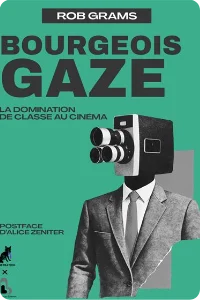
Bourgeois Gaze
Class as a blind spot
Score: 9/10
 By Farrel Grimwood · published · 4 min read
With Bourgeois Gaze, published by Les Liens qui libèrent, Rob Grams puts forward a clear and disturbing proposition: contemporary cinema remains structured by a dominant social gaze which is ignored as such. The bourgeoisie occupies the center of the frame, shapes the stories, presents its own life paths as self-evident and transforms its own codes into a common horizon.
The essay is based on a specific observation. The male gaze made it possible to identify a gender hierarchy in the construction of images. It remained to question the social hierarchy which organizes these same images. Grams then introduces bourgeois gaze as a critical tool: an interpretative framework capable of revealing how certain works naturalize a class point of view, presenting it as universal while it remains deeply situated.
The strength of the book lies in this gesture of unveiling. It is less about denouncing works than exposing the invisible mechanisms that run through them. Popular cinema, auteur cinema, social dramas and comedies all share the same imagination where respectability, success and legitimacy meet precise criteria. What seems neutral is actually an internalized social norm.
The writing accompanies this enterprise with assumed clarity. The argument progresses through concrete examples, through bold comparisons, through analyses that favour efficiency over theoretical overbidding. This clarity gives the text a particular tension. The statement asserts itself, advances, strikes, without sheltering behind a scholarly apparatus that would dilute its impact.
Behind this frontality a broader ambition emerges: to reorient the viewer’s gaze. Move the center. Give visibility to what is relegated to the periphery. By revealing the social dimension of the stories, Bourgeois Gaze engages in a profound rereading of contemporary images.
A working concept
The heart of Bourgeois Gaze lies in the solidity of its tool. By transposing the logic of the gaze to the question of class, Rob Grams is not simply adding an additional category to the critical arsenal. He redesigns the frame. Where the male gaze revealed a gender hierarchy inscribed in the staging, the bourgeois gaze highlights a social hierarchy integrated into the stories themselves.
The concept acts with immediate effectiveness. It allows us to question the way in which cinema represents success, marginality, poverty, upward social mobility. It shows how certain paths become legitimate while others remain confined to the periphery. Characters from the working classes often appear as objects of observation, figures of exception or excess, rarely as the normative center of the story.
This movement produces an effect of unveiling. The essay demonstrates that the bourgeoisie is not only manifested by external signs of wealth, but by a cultural posture: a relationship to the world, to education, to speech, to taste. This posture permeates the scenarios, influences the framing, conditions the trajectories deemed credible. It structures the collective imagination without ever designating itself as such.
The interest of the book also lies in the diversity of the examples cited. Grams crosses various works, from auteur cinema to popular success, in order to show that the phenomenon goes beyond aesthetic divisions. The question is not about the quality of the films, but about the point of view that they establish and naturalize. This transversality reinforces the scope of the concept.
What is finally striking is the ability of the bourgeois gaze to function as an immediately reusable reading key. Once named, the mechanism becomes difficult to ignore. The viewer’s gaze changes. The stories are cracking.
It is in this operativeness that the major success of the essay lies: to propose a concept sufficiently precise to enlighten, sufficiently flexible to be applied, and sufficiently incisive to lastingly change the way in which we apprehend the image.
Polemic as a method
The singularity of Bourgeois Gaze also lies in its tone. Where part of cultural criticism favors the accumulation of references and terminological caution, Rob Grams adopts a tight, direct, willingly ironic writing style.
Polemic, here, becomes a method. It helps defuse the academic solemnity which, too often, neutralizes the critical charge. By favoring clarity and frontality, the essay maintains a constant tension. The examples follow one another, the connections are made with precision, and the demonstration progresses without dissolving into technicality.
This economy of theoretical apparatus gives the text a particular effectiveness. The subject remains accessible without losing density. Criticism is deployed as closely as possible to the works, in their concrete materiality, rather than in methodological abstraction. This proximity reinforces the impact.
Irony, occasionally mobilized, acts as a revealer. It lays bare cultural reflexes, highlights blind spots, accentuates contradictions. Far from weakening the argument, it gives it additional sharpness. The polemical charge becomes a tool of unveiling, not a gratuitous posture.
By taking this line, Bourgeois Gaze is part of a tradition of essays which favor the critical gesture over feigned neutrality. The text advances, decides, proposes. This dynamic creates a movement which draws the reader into an active rereading of the images.
Verdict
A beneficial intervention
9/10
With Bourgeois Gaze, Rob Grams offers much more than an additional concept in the critical landscape. By revealing the social dimension of the cinematographic gaze, he lays bare a norm long mistaken for something self-evident. The bourgeoisie ceases to be a neutral background and becomes again what it is: a situated, historically and culturally determined position.
The strength of the essay lies in this clarity. The concept works, circulates, applies. The polemical method gives it its vigor and readability. The work rejects reassuring abstraction to favor critical effectiveness. It does not claim to close the debate; on the contrary, it gives it substance. Bourgeois Gaze thus stands out as a stimulating and necessary read for anyone interested in contemporary images. An incisive, effective text that transforms intuition into a tool.
More in Books
Full library 10/10
Sépia, tome 2 : Le complot de Flobourg
Pocket Jeunesse 8/10
100 Films d’animation japonais
Yniss 8/10
The Witcher: A Little Sacrifice
Bragelonne 7/10
One of Us Is Next
PKJ 9/10
The Star That Fell from the Sky
 8/10
Mégères et vamps face caméra
L’Harmattan 8/10
Strange Maps
Seuil 7.5/10
Quelque part dans la région du Kinki
Seuil 7.5/10
L’Élue du Dragon Volume 1: Le Voyage de Mia
Ynnis Éditions 8/10