PRO Acryl 1-Step Set #1
Twelve quick but precise shades
Score: 8.5/10
Images and videos
At a glance
We liked
- An original semi-transparent formula, more consistent than many others on flat surfaces.
- A soft matte finish consistent with classic acrylics.
- Dark Blue Black, Graphite Green, Royal Purple, Blue and Warm Brown are particularly successful.
- The colors mix well with each other.
We liked less
- A very variable opacity which requires knowing the behavior of each color.
- Warm Brown, Shadow Flesh and Orange can cover much of the zenithal underpainting.
- Graphite Gray lacks presence.
- Bubbles and foam capable of leaving small craters sometimes appear.
More on PRO Acryl 1-Step
 By Farrel Grimwood · published · 13 min read
Contents
Since Contrast paints established the idea of a color, a shadow and a highlight combined in the same layer; each brand of paint for figurines seeks its own ideal composition. Monument Hobbies took its time to find its own, but the result is finally here. The PRO Acryl range was first built around highly pigmented, matte acrylics designed to mix, before adding in May 2026 this first box of twelve so-called 1-Step colors.
Unlike most of their competitors, Monument Hobbies is a company whose European branch has established its head office in France, in the Côtes d’Armor to be precise. Founded by Wargames Nerd artists, the company seeks pigment, technique, composition; even if it means offering very different products.
It is precisely with this in mind that 1-Step paints arrive. Like all contrast-style paints, these cannot be applied to bare plastic or to a black undercoat left as is. They require a light, white or cream base, or even a zenithal undercoat with white sprayed on top of a dark background. Its fluid formula then tints the reliefs and leaves more material in the hollows. The single step therefore concerns the color, not the whole preparation of the figurine.
An unfortunate communication on paper, but perfectly in line with what Monument Hobbies offers: products made by artists, for artists, without unnecessary excess explanations. The company assumes that you know how to paint, that you know the techniques, and never tries to hold your hand or guide you through the stages of your projects.
And this first box has another particularity: its paints are more opaque than the majority of competing Speedpaint products. They seek less brutal contrast than regularity on armor, a shield or a vehicle. This difference gives the product a real personality, but it also makes the result very dependent on the color chosen.
It remains to be seen whether the PRO Acryl 1-Step Set #1 really keeps its promise in all of its twelve bottles, or whether you have to learn twelve different techniques in order to get the best out of it.
You can find this set directly on the Monument Hobbies website.
An unequivocal contrast
Before going into the details of the products, it is good to go back to what a Contrast paint is. Its preparation requires a few things: a light undercoat, a well-loaded brush and a coat applied without constantly going over the same place.
This is the basis of contrast paint, which offers a texture fluid enough to go down into the hollows, while the pigments give a lighter color on the edges. On a detailed sculpture, this operation quickly establishes a base, a readable light and shadow, without having to play with different shades yourself. An ideal composition for play, and perfect as a basis for more detailed paintings.
The underlay plays a big role, of course. White gives more bold colors. A cream base warms up yellows, flesh and browns, but it obviously modifies their tone. On a black base, Contrast loses most of its interest: even the most heavily pigmented shades are not designed to cover a dark background in a single coat.
Preparation is therefore essential, and this is precisely where the PRO Acryl 1-Step range really misrepresents its name, especially among a public who are new to the hobby or who are unfamiliar with this type of technique. The latter in fact offers everything except painting "in a single step. For Speedpaint, the base is essential and more important than with classic paint.
But the good news is that the Monument Hobbies formula does not reactivate when another paint is applied over it once the coat dries. Classic acrylic touch-ups, highlights and details stay clean. We can therefore treat the box as a quick starting point without locking the miniature into a single method.
Normally, a classic acrylic seeks to form a covering and regular layer. A Contrast focuses more on transparency: it colors the surface, moves away from the edges and concentrates in the hollows. The PRO Acryl 1-Step fall somewhere in between. Their medium maintains the fluidity of a quick paint, but Monument Hobbies uses pigments close to those of the classic PRO Acryl range. The layer remains semi-transparent, never simply tinted, for a particularly subtle effect and perfectly usable without retouching.
This hybrid formula corrects a well-known flaw with quick paints: on a large plate of armor, they often tend to form pools and dark halos. Here, opaque pigments further unify the surface. Even after two coats, the color becomes mostly denser and more even, where a very transparent paint can end up darker and more stained.
The difference between the Warm Yellow of PRO Acryl 1-Step and a Bad Moon from GW on a white armor clearly illustrates this advantage for Monument Hobbies: two coats give a full, clean, uniform yellow; without requiring a long construction and numerous alterations.
The problem is that the twelve bottles in this box do not have the same opacity. Royal Purple and Graphite Green maintain a fairly similar behavior, while Warm Brown, Shadow Flesh or Orange cover much more of the underpainting. The box offers twelve shades, but not twelve variants of the same composition which, for an uninformed painter, can quickly surprise. The consistency is found in the medium and the matte finish, not in an identical level of transparency.
The brush has time to work
The consistency is more reminiscent of a Contrast than a very liquid classic Speedpaint. The paint leaves the brush easily, spreads effortlessly and gives enough time to pick up a small blunder without drying too quickly. By emptying the brush and then returning with the bristles just damp, you can remove material from an edge or push it into a hollow. Ideal for correcting small errors, and above all much more permissive than other quick paints that dry too abruptly.
Of course, you shouldn’t rest on your laurels. Like washes and other Contrasts, the medium begins to form an almost invisible skin quite quickly. Coming back too late with the brush can tear this layer, create a trace or suddenly displace the pigment. The margin is comfortable, but not infinite. For a very gradual glaze or a long-worked transition, a classic acrylic maintains more predictable control.
A wet palette can further thin the paint, sometimes very quickly. This is useful for obtaining a filter, less so if you want to keep the strength of the color coming out of the bottle. Despite the in-between offered by Monument Hobbies with this range, it is better to work on a dry palette (or even a Speedpaint palette with wells) when you are looking for the 1-Step effect; even if it means coming back with water or medium for thin layers or the finest details.
Zenithal underpainting can lose its contrast
Any Contrast lover knows that the zenithal underpainting and the Slapchop are the best techniques for exploiting this kind of composition. And they work particularly when the paint embraces these color differences in order to exploit the shadows and lights.
This is precisely where the PRO Acryl 1-Step are the least consistent. Shades like Shadow Flesh cover up a lot of the dark areas. Warm Brown can make almost any work underneath disappear. Orange also masks part of the black, even if it keeps a variation on the light areas. These shades give a clean surface, but they reduce a little too much the contrast that the preparation had created.
Colors like Royal Purple and Graphite Green respect it much better, and Crimson lets the white stand out more than Orange. The formula is therefore not bad on a zenithal basis, but you have to choose the color carefully. For an army whose entire method is based on a black very present under the color, more transparent paints remain more effective. For light, broad and smooth flat surfaces, the 1-Step clearly takes the advantage thanks to their regularity.
Twelve particularly well-chosen shades
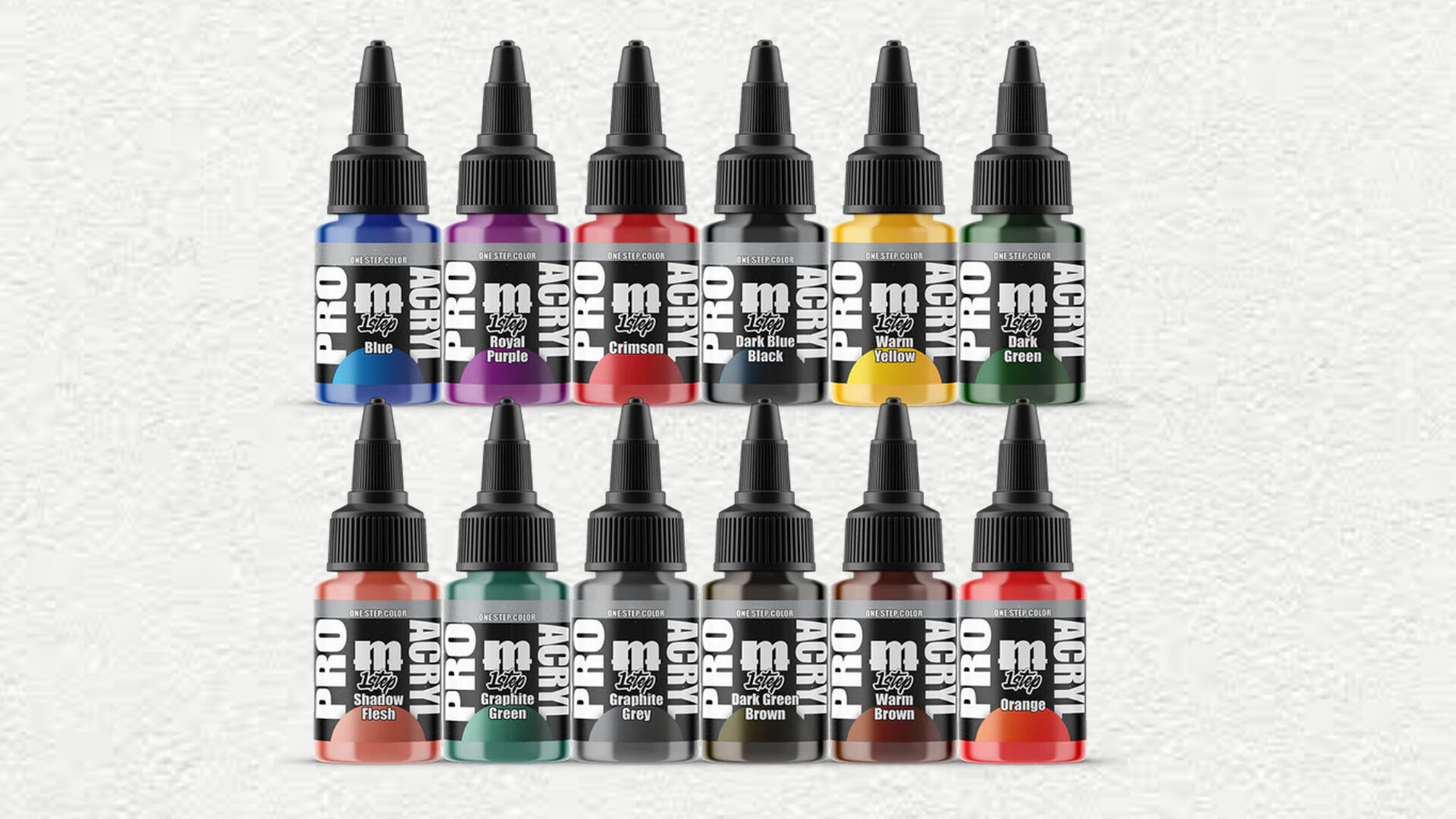
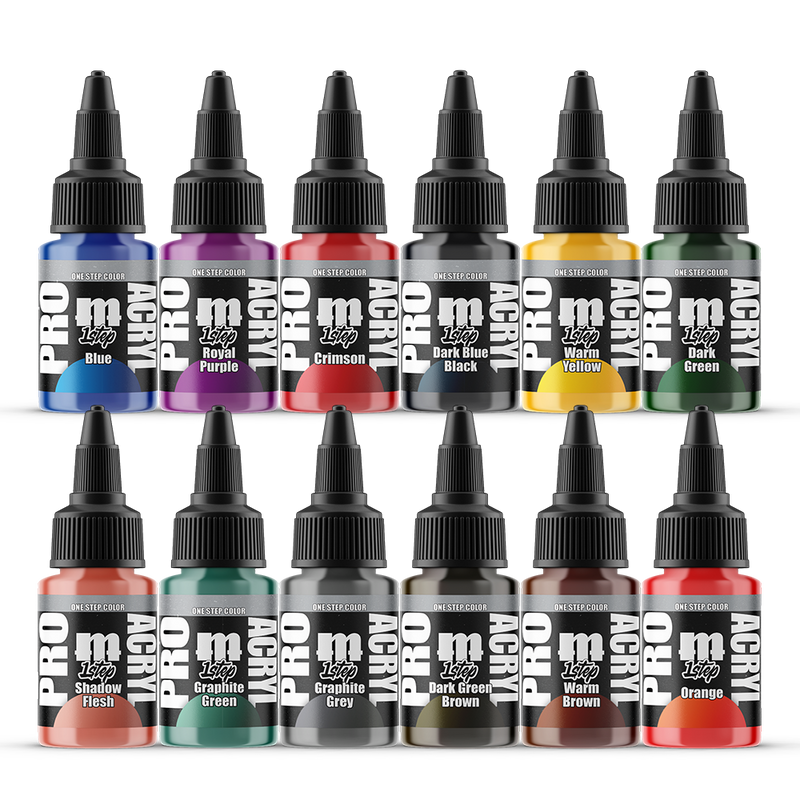
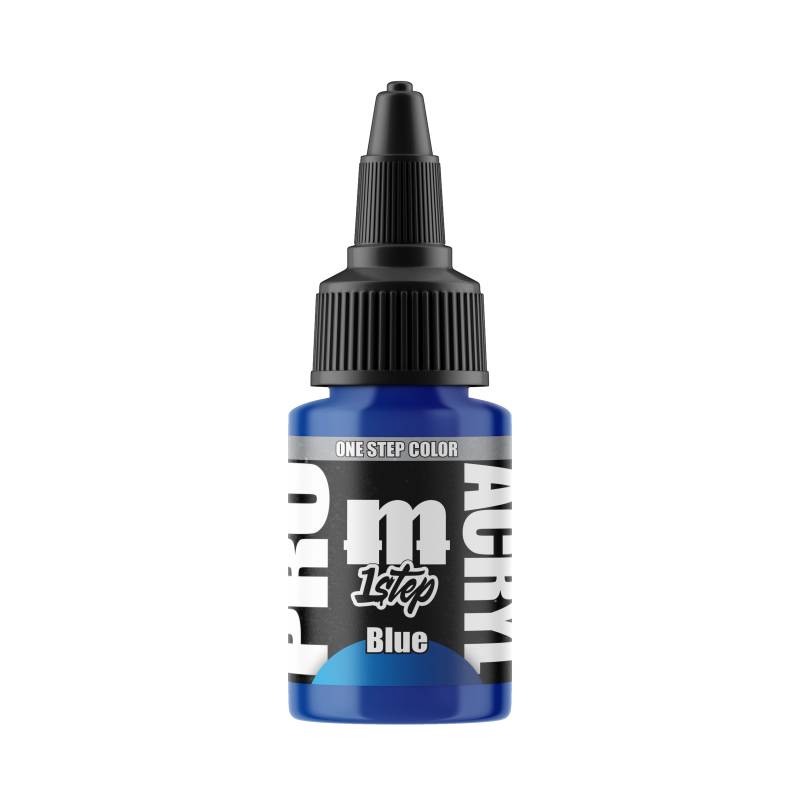
Blue is a very bright medium blue that leans slightly towards cyan. In one coat on white, it gives a bold color, clearly darker hollows and bright reliefs, with fewer spots on the flat plates. Its saturation leaves little room for discretion, but it works perfectly for a main color such as Ultramarine.
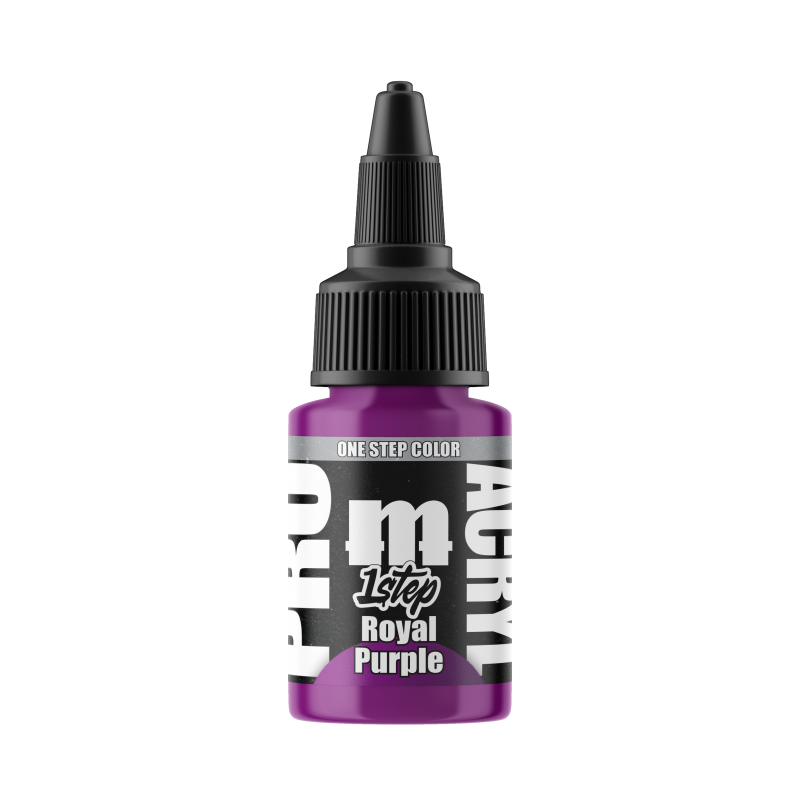
Royal Purple is a deep, rich purple. It contains less opaque pigments than the majority of the box. The undercoat remains visible, the hollows quickly gain depth and the additional layers darken the color without immediately transforming it into a solid color. It is one of the shades closest to a traditional Speedpaint, but also one of the easiest to use for colored shadows, particularly with predominantly yellow miniatures.
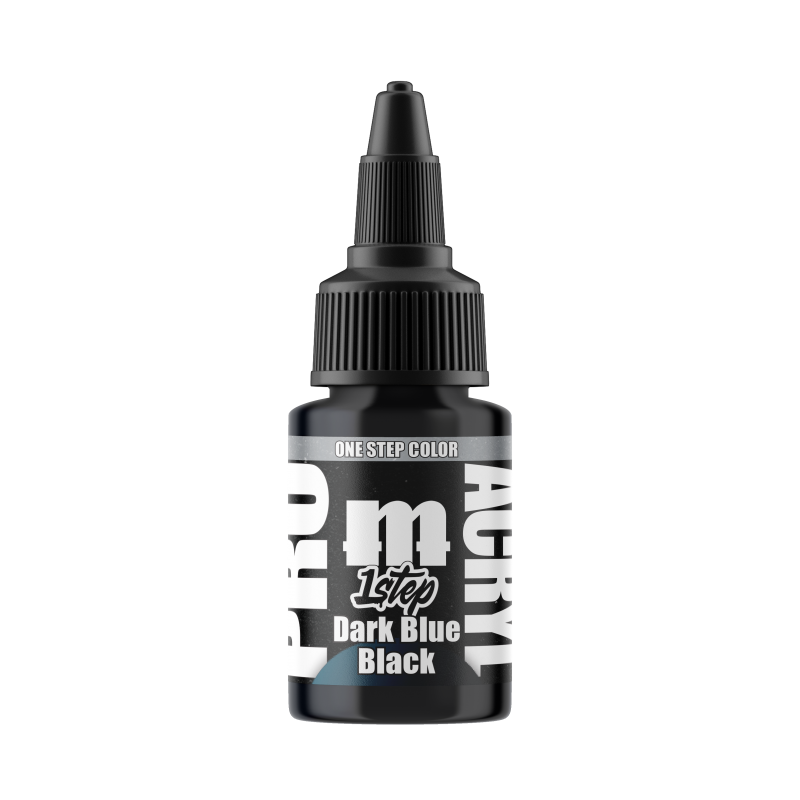
Dark Blue Black is probably the most immediately useful color in the set. At full strength, this extremely dark blue reads almost like black. A slight dilution reveals a much more saturated blue hue. On armor, fabric or metal, it therefore creates a cold black which still accepts a blacker shadow and blue highlights. It partially compensates for the absence of pure black, without ever becoming a true neutral: on an area which must remain gray or brown, its dominant blue inevitably ends up appearing, giving a particularly pleasant "crow’s wing" look.
Crimson has a name that can be misleading. It is not a bright primary red, but a red marked by violet, close to a light burgundy when the layer becomes denser. It is less loaded than Orange and allows more of the white of the preparation to pass through. For a wax seal, dark fabric, red shadow or filter on orange it is excellent. For bright red armor like that of a Blood Angel, you have to go back to Orange or add another paint: the box set simply doesn’t have any bright red.
Orange is clearly the most aggressive color in the box. It is bright, intense and significantly redder than its name suggests. Sanguine Orange would have been a more honest name. Its strong pigment load covers part of the black shadows of a zenithal base and produces a very full color from the first coat. On a flame, a fabric or an armor intended to attract the eye, it is formidable. For a yellow and transparent orange, it falls short of the demand, especially compared to a Casandora Yellow.
Warm Yellow is a warm, bright yellow, without turning pale yellow or ocher. The 1-Step version maintains the color of Warm Yellow acrylic while giving a much more efficient application. On white, one coat is enough for a strong base; a second turns armor into a uniform yellow, almost effortlessly. This coverage, however, reduces the natural contrast between the reliefs and the hollows. On a pink base, the 1-Step result is even more impressive. The bottle is great for an Imperial Fist army, lamps or fire; less to preserve a very marked black zenith.
Dark Green is the most saturated green in the set. Deep without falling into the dark, it gives a lively and very distinctive orc skin, a military fabric that remains colorful or a forest armor designed for the Dark Angels. Applied to a warm base created with Shadow Flesh, it gains even more richness.
Graphite Green is the real chromatic favorite of the set. This desaturated blue-green takes on a cold, almost spectral appearance, without becoming gray. Its higher transparency preserves the lights and shadows of the undercoat well. Where Dark Green immediately imposes its saturation, Graphite Green works in restraint and lets the volume breathe. It’s a rare color, ideal whenever a classic turquoise green seems too bright.
Dark Green Brown is the opposite. Its mix of brown, olive and green results in an organic dirtiness rather than a clean color. It works particularly well on a more natural Ork or Orruk hide, a dull uniform, a streak-covered tank, or an earth base. Mixed with Warm Brown, it quickly makes a credible slime; combined with Shadow Flesh, it also helps achieve a dirty bone shade.
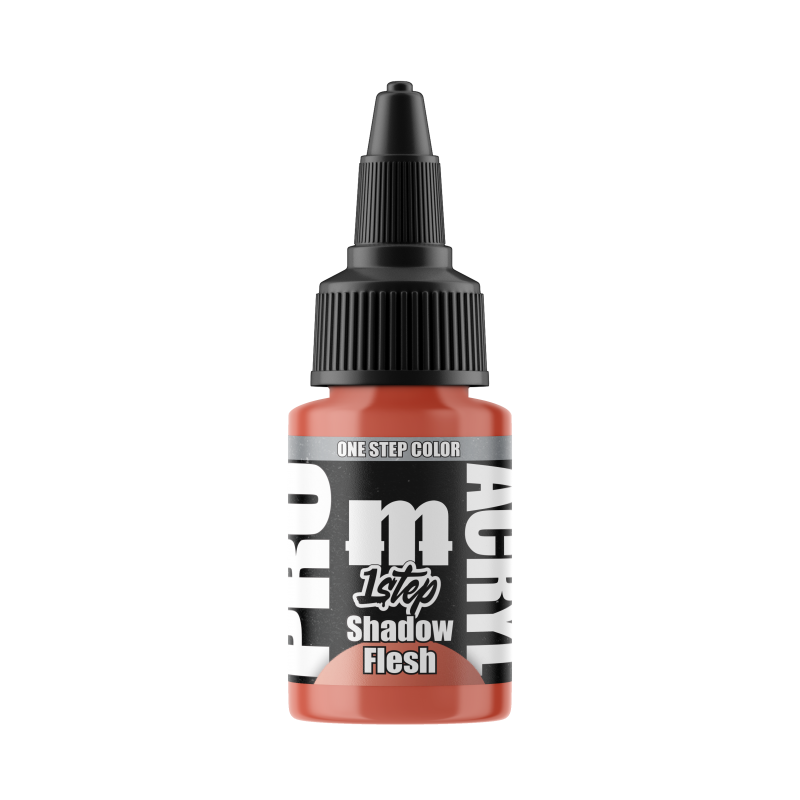
Shadow Flesh falls between pink, salmon and earthy orange. On a cream base, it gives usable warmth for many skin tones, but its interest goes well beyond human skin. It serves as a warm tone under a green, as a base for monstrous flesh, or as a component in a bone mixture. Its high opacity smoothes the result, but it also covers the shadows of a zenithal undercoat too easily.
Warm Brown is a rich, deep, very saturated orange-brown. On a light or beige base, it makes a convincing leather in one layer, with a natural gradient towards the hollows. It does, however, have one of the strongest coverages in the box. Used pure on a zenith, it can swallow almost the entire preparation. A drop of medium makes it more docile without taking away its character. With Orange, it gives a muted orange; with Dark Green Brown, it shifts towards earth and mud.
Graphite Gray is the most questionable shade. In a dense layer, it approaches a dark neutral gray; stretched on a light or metallic surface, it appears noticeably more mid-toned and less intense. It works well as a heavy wash over chainmail, as a filter over a metal, or for a quick approach to non-metallic. But it doesn’t replace a black and lacks strength for the deepest shadows. In a box without pure black, this choice leaves an obvious hole.
Mix to complete the box
Monument Hobbies did not build this range as twelve isolated recipes. The colors mix well with each other and easily accept classic acrylics. Orange with a little Warm Brown becomes darker and less garish. Warm Brown and Dark Green Brown produce credible soil. Shadow Flesh, Warm Yellow and a touch of Warm Brown create a light bone. Dark Blue Black and Warm Brown give an almost black brown without losing all its richness.
This flexibility is a real asset for those who already paint and know how to correct a color. For others, they force you to think about a more precise color scheme, prepare and experiment to achieve the perfect color. We feel that Monument Hobbies clearly offers a first set more than a complete and autonomous box set, capable of being sufficient in itself.
The box nevertheless honestly bears its number. With twelve colors, it covers the main families, but it forgets essential tools: no neutral black, no strong red, no bone, no white to correct the undercoat and no light flesh tone. The presence of three greens and several browns gives a beautiful depth to natural, military or fantastic schemes.
Water is enough to turn a 1-Step into a glaze or filter. Diluted Crimson can thus gradually blush Orange. Stretched Graphite Gray darkens a metal without covering it. Several thin layers give a correct transition, provided you let each one dry and do not come back to scrape off the half-set medium. We gain in possibilities, but we then clearly leave the territory of the single layer.
Twelve bottles… and drops
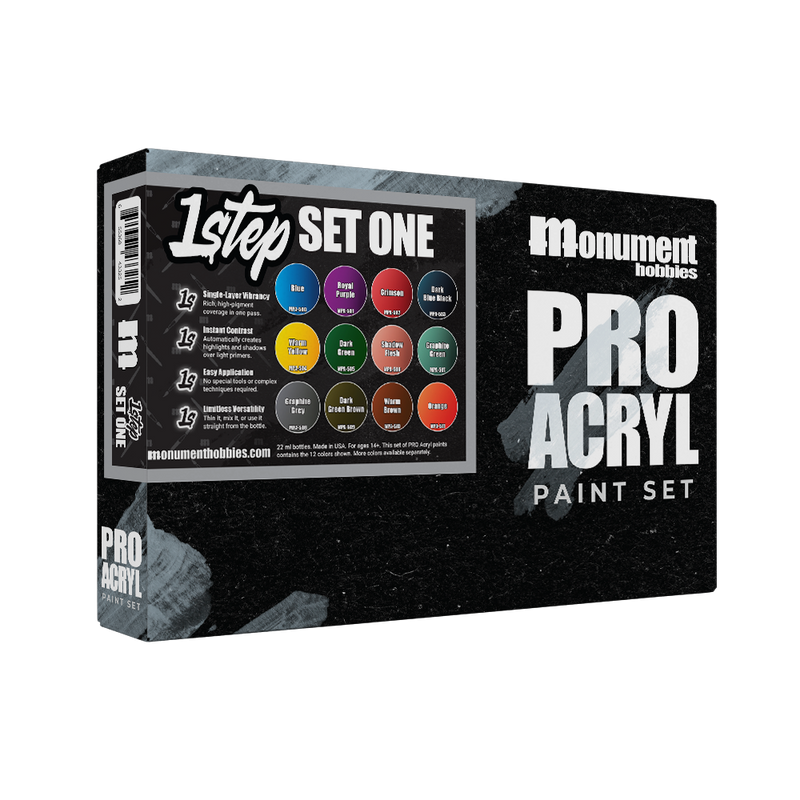
The box contains 264 ml of paint in total, distributed in 22 ml bottles. Each bottle has a mixing ball and screw-on nozzle to prevent overflow and accidents. The quantity is generous for figurine painting, the nozzle allows you to place a clean drop on the palette and the ball helps to resuspend the pigments. The system remains more bulky than a small classic dropper, but it avoids dipping the brush in a pot as well as overturning it.
The real material defect comes from the foam. 1-Steps have a marked tendency to produce bubbles when agitated or over-stirred. If one of them remains trapped in the layer while the surface closes, it can leave a small crater. You must tap the figurine, blow gently or pierce the bubble with the brush before it dries.
Most colors dry to a soft, consistent matte and much less glossy than some competitive fast paints. Touch-ups and highlights do not immediately clash with the base. Warm Brown, Blue or Graphite Green thus keep a clean surface without requiring a coat of matte varnish just to calm the shine.
The box set is ultimately better suited to the intermediate or experienced painter than to the absolute beginner. The novice benefits from the fluidity, the matte finish and the cleanliness on flat surfaces, but he must understand why certain colors cover the zenith and others do not. The more experienced painter immediately sees filters, blends, colored shadows and airbrush applications. This is where the range becomes really interesting, well beyond its deliberately simplistic name.
Verdict
A Contrast which first requires knowing how to paint
8.5/10
The PRO Acryl 1-Step Set #1 deserves its place among the Contrasts as much as the Speedpaints, because it doesn't just imitate what already exists. Its semi-transparent formula gives cleaner base coats on flat surfaces, dries with a beautiful matte finish, blends easily and remains stable enough to accommodate all the classic work that follows.
Monument Hobbies delivers here a quality set which will find its place in most workshops and clearly justifies its purchase as much as its existence in the face of the competition. The fact remains that the opacity varies greatly from one bottle to another, that several colors smother the zenithal undercoat, and, above all, that the twelve shades are not enough. The set is very good as a complementary toolkit, not a complete solution.
Pros
- An original semi-transparent formula, more consistent than many others on flat surfaces.
- A soft matte finish consistent with classic acrylics.
- Dark Blue Black, Graphite Green, Royal Purple, Blue and Warm Brown are particularly successful.
- The colors mix well with each other.
- Dry layers do not reactivate under the next layer.
- Real versatility with brush, glaze and filter.
- Twelve 22 ml bottles, a very generous format.
Cons
- A very variable opacity which requires knowing the behavior of each color.
- Warm Brown, Shadow Flesh and Orange can cover much of the zenithal underpainting.
- Graphite Gray lacks presence.
- Bubbles and foam capable of leaving small craters sometimes appear.