PXN VD6 Bundle
Direct drive without the four-figure bill
Score: 9.5/10
Images and videos




At a glance
We liked
- Smooth, detailed force feedback with a stated 6 Nm of continuous torque.
- A well-equipped detachable wheel with two magnetic and two analogue paddles.
- Adjustable metal pedals and an included brake reinforcement kit.
- Comprehensive profiles and settings to adapt the equipment to simulations.
We liked less
- Pedals that need securing and clamps that inspire less confidence on lightweight or smooth desks.
- Buttons that could be better and stitching that can feel uncomfortable.
- Software and telemetry configuration still require attention.
- No native Xbox or PlayStation compatibility.
 By Farrel Grimwood · published · 12 min read
Contents
- A complete package to get started
- A sturdy desk will be welcome
- Putting 6 Nm to good use
- Information before jolts
- Turning everything up achieves nothing
- The W AS goes well beyond the minimum
- Four genuinely useful paddles
- A firmer brake without a load cell
- Plenty of settings without starting again for every game
- PC use and a few extra adjustments
- A package with room to grow
- An appealing price amid strong competition
- Verdict
Moving from a gear-driven wheel to direct drive changes the driving experience more than adding a row of buttons or a pedal set that looks like it belongs in a racing car. The motor drives the steering shaft directly. There is no belt or gear transmission between it and the driver’s hands, making the forces in the steering easier to distinguish. The rest of the setup still has to keep up. A good motor cannot compensate for a brake that is hard to modulate or equipment that slides backwards at every corner.
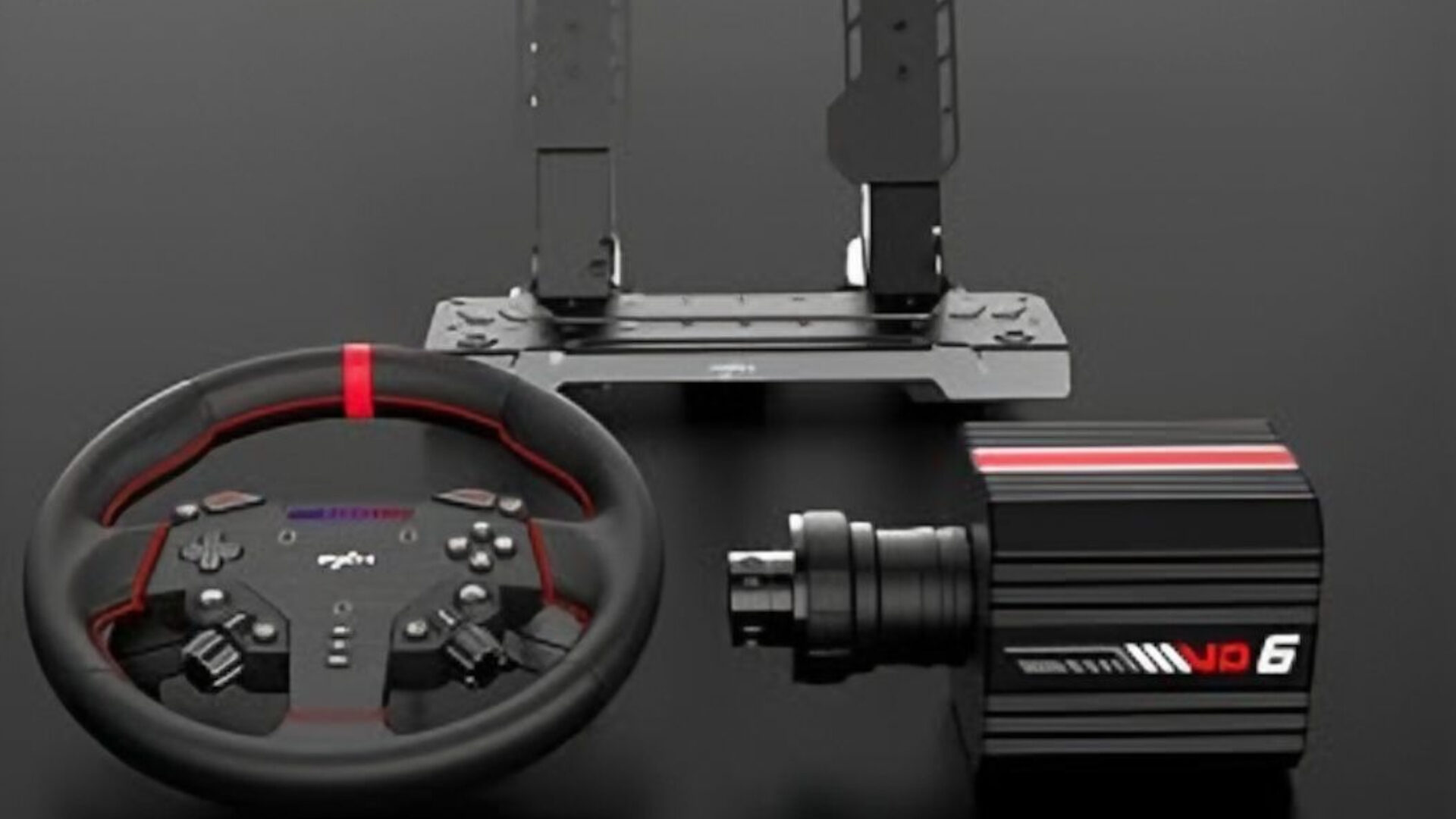
The PXN VD6 Bundle aims to provide everything needed to move to more serious equipment. At a promotional price of €379, the package combines a base rated for 6 Nm of continuous torque, a round wheel with four paddles and metal pedals. A desk mount is included too. It is a considerably more appealing package than a wheel sold on its own for the same price, but it remains PC-only and makes several compromises in its controls, brake and configuration. Can it permanently replace a first wheel, or will it simply encourage an upgrade to more expensive hardware?
A complete package to get started
The bundle includes the VD6 base, the 280 mm W AS wheel and the PD HM accelerator and brake pedal set. The Z8 desk clamps, power supply and cables are included. The mount needs assembling and the components need positioning, but no additional proprietary stand is required to get started on a suitable desk. The brake reinforcement kit is also in the box, avoiding the discovery after purchase that a firmer pedal costs extra.
There is, however, no gear lever or clutch pedal. That is perfectly suitable for cars driven with paddles, but not for a setup intended from the outset for heel-and-toe shifting and manual gearboxes. A third pedal is sold separately. The wheel’s two analogue paddles can also operate a clutch, without reproducing the movement made with a foot. The contents are therefore complete enough to race, but not to cover every form of driving.
A sturdy desk will be welcome
At 5.9 kg, the base is no small box to place between the keyboard and monitor. Its aluminium body measures roughly 23.8 cm long and 12.5 cm wide and high. The depth of the wheel and space for the rear connectors must also be allowed for. Its size remains reasonable for direct drive, but taking the whole package out and putting it away between sessions is a real undertaking.
The supplied mount allows the base to tilt and the wheel’s position to be adjusted. The metal clamps avoid the excessive flex of plastic systems, but cannot prevent a lightweight desktop from vibrating. Thin or smooth surfaces also require care with clamping and desk protection. Turning up force feedback on a table that moves mostly ends up shaking the entire installation. Bolting the base to a rigid stand remains far preferable for getting the most from the motor.
Four mounting points are provided underneath the base. The stand’s hole pattern needs checking before assuming it will fit, using an intermediate mounting plate if necessary. The pedals deserve the same attention: their grip pads are not always enough under heavy braking, especially with the reinforcement fitted. Bracing them against something can help temporarily, but bolting them down avoids having to pull them back in the middle of a race. With this kind of equipment, stability matters as much as the settings.
The connections are grouped at the rear: USB to the PC, pedals, a gear lever and compatible accessories. The base also has an input for an external emergency stop, which is not included. The power button is on the back too. That keeps the cables away from the wheel, but means leaving access behind the base if it sits close to a monitor or against a wall.
Putting 6 Nm to good use
PXN distinguishes between 6 Nm of continuous torque and a 7 Nm peak. The first figure describes the stated torque for sustained force, the second a brief demand. That is more useful than printing only the maximum in large type on the box, although manufacturer figures do not replace independent measurements of the motor’s endurance. The VD6 sits in the entry-level direct drive category, with enough force to give the steering weight without imposing the demands of a large competition base.
The low-inertia, 20-pole motor is paired with a 24-bit magnetic encoder. This measures the shaft’s position. Its resolution should not be confused with an amount of detail that every game automatically produces: force feedback also depends on the motor, software and information sent by the simulation. The bit count alone therefore cannot rank two wheels.
The aluminium body acts as a heatsink and removes the need for a fan. The motor is quiet in operation, which is welcome after a gear-driven wheel. The paddles’ clicks and vibrations transmitted to the furniture remain audible, so the mounting surface also affects the noise. In a shared room, that quiet motor is a practical advantage, even if the entire package is not silent.
Information before jolts
The VD6 shows its value in the way the steering firms up through a corner, then lightens as the front tyres begin to slide. Running over a kerb is clearly marked, while subtler variations remain perceptible. The track surface and changes in force are distinct enough to help explain what the car is doing. Compared with a gear-driven model, the main gain is continuity: small corrections are less disrupted by the mechanical transmission.
In simulations such as Assetto Corsa, Le Mans Ultimate or iRacing, that subtlety matters more than resistance against the arms alone. The aim is to feel when adding steering lock no longer tightens the line, or when it is possible to start straightening the wheel on corner exit. The VD6 responds well enough to do that. It obviously cannot replace learning racing lines and braking, but supplies more useful information than force feedback that simply vibrates hard.
There is still limited headroom in long, heavily loaded corners. A more powerful base can retain a greater distinction between an already substantial load and an additional impact. Here, the largest forces start to feel alike when too much is asked of the motor. That does not make the driving poor, but explains why 6 Nm is not always a substitute for 10 or 12 Nm, even without a desire to wrestle with the wheel.
The W AS wheel’s small diameter also helps the base remain lively. A larger rim increases leverage and changes the feeling of resistance. Swapping the wheel for greater realism in an old car or truck is therefore not a neutral change. The small supplied wheel is part of the package’s balance, even if its dimensions do not suit every vehicle equally well.
Turning everything up achieves nothing
Clipping is the main trap. It occurs when the game requests more torque than the system can reproduce: several different forces then hit the same ceiling. The wheel feels powerful but becomes less informative. On the VD6, reducing the in-game gain restores nuance instead of maintaining constantly heavy steering. Seeking the heaviest setting is a poor way to judge this motor.
There is no magic percentage to apply everywhere, though. The car, game and other settings all affect the result. The supplied profiles provide a starting point, after which force and damping can be adjusted. Too much damping slows the wheel’s return; too little can allow troublesome oscillation. In rallying or drifting, where the steering needs to return quickly, these choices matter particularly. The VD6 allows them to be fine-tuned, but does not erase the differences between games’ physics engines.
The W AS goes well beyond the minimum
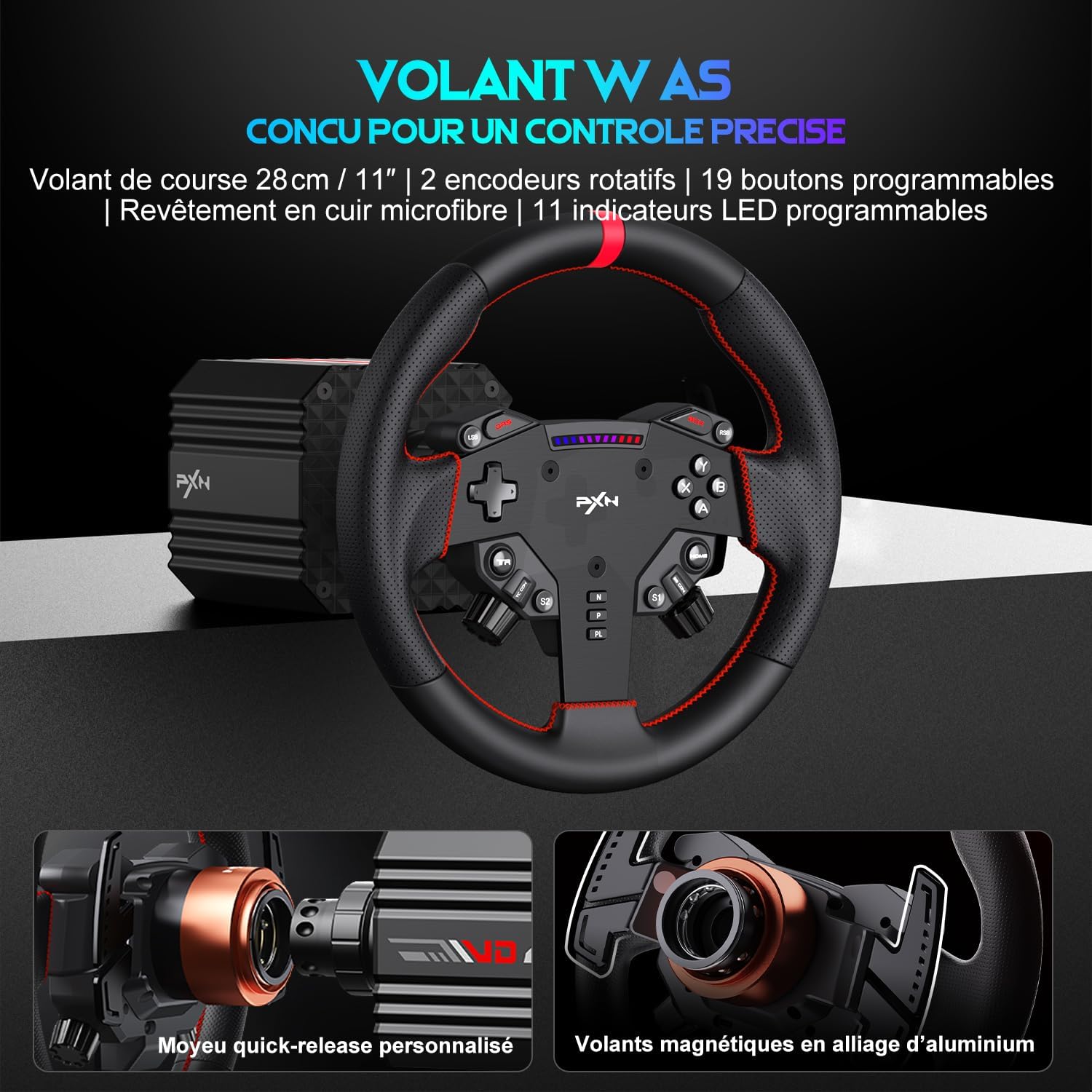
The round 280 mm wheel is easy to catch again after applying a large amount of steering lock. Its synthetic microfibre covering and metal-fronted structure feel more convincing than a simple plastic rim. At around 1,050 g, it also remains light enough to avoid unnecessarily hampering the base’s response. It is a good size for modern racing cars, less so for reproducing the range of movement of a large road-car wheel.
The assignable buttons, directional pad and two clickable rotary encoders keep common controls under the thumbs. The dials are particularly useful for adjusting traction control or ABS without taking eyes off the track, provided the car and game offer those settings. The arrangement avoids constant trips back to the keyboard. It does not turn the wheel into a dashboard, however: the 11-LED strip indicates engine speed, but no screen displays the gear or lap times.
The quality of the controls is less flattering than their number. The directional pad lacks precision, and some buttons can rattle when force feedback shakes the wheel. The stitching in the covering could also be finished better. The W AS remains well equipped for a bundle at this price, but the ergonomics and button feel are reminders that it is not a high-end model.
Four genuinely useful paddles
The main aluminium paddles use magnetic resistance. Actuation is positive and the return distinct enough to confirm a gear change without looking at the screen. They make a clack and resonate a little, but give the wheel a better quality of control than simple flexible tabs. Paddle reach is not adjustable, which limits accommodation for smaller hands.
The second pair is analogue: their travel transmits a progressive value rather than a simple button press. Among other options, the software can combine both paddles on one axis and set the clutch bite point for starts. This provides meaningful extra control in simulations that support it, even if its appeal is more limited in an arcade racer. For an entry-level direct drive package, it is a substantial inclusion.
A firmer brake without a load cell
The PD HM pedals use steel and aluminium construction. The accelerator and brake have Hall-effect magnetic sensors, with no rubbing contact to read their position. That avoids wear on a potentiometer track. Build quality is good for the price, with a structure that inspires more confidence than the small plastic units supplied with the cheapest wheels. The choice of sensors helps with maintenance, without removing the need to monitor springs, pivots and connections.
Height, pedal plate angle and spacing are adjustable. These settings make it possible to find a more natural position for left-foot braking rather than being stuck with cramped spacing. The stock brake is fairly soft. The supplied reinforcement increases resistance, adding a more pronounced constraint at the end of its travel; PXN claims the kit provides resistance equivalent to up to 20 kg of force. That figure describes the intended resistance, not a pressure-measuring capability.
The sensor still reads pedal travel. A load cell, by contrast, measures the force applied. The distinction matters when trying to repeat heavy braking and then release progressively while entering a corner: a pressure-based brake allows that modulation to be developed differently from memorising a foot position. The reinforcement improves the PD HM’s feel, but does not turn it into a load-cell pedal set.
For discovering simulations and driving regularly, the two pedals do the job. The accelerator can be modulated properly, and the brake offers more resistance once fitted with the kit. For greater consistency under difficult braking, the pedals will nevertheless be a more worthwhile upgrade than immediately replacing the base. That assumes a stand capable of taking the load: stiffening the brake without securing the set only makes it slide across the floor more.
Plenty of settings without starting again for every game
PXN SimRacing brings the devices and their settings together in one interface. Rotation angle, torque, effect strength, friction and damping can all be adjusted. The pedals offer adjustable response curves and dead zones to ignore small unintended movements at the start of their travel. The wheel adds management of the controls, analogue paddles and lighting strip. Saving profiles avoids starting from scratch when moving from a GT car to a rally car or truck.
The stated rotation range runs from 90 to 2,700°. Its maximum mainly serves applications where several full turns of the wheel are useful; there is no reason to retain it for every car. Matching the physical angle to what the game expects matters more than the maximum figure. Similarly, a very aggressive brake curve can make full braking power easier to reach, but the final percentages of release more delicate.
The software also handles updates for the various components. Version 1.6.9 has been available since 12 October 2026, and a separate tool exists for the W AS firmware. The LEDs also require telemetry configuration when a game calls for it: the transmission of data such as engine speed to the wheel software. Recognising the steering and pedals therefore does not guarantee that the strip will work immediately. The interface brings together many useful features, but there are still steps to understand before every function in the package is available.
PC use and a few extra adjustments
The VD6 is officially intended for Windows. Its A, B, X and Y buttons do not provide Xbox compatibility, and it is not sold as a PlayStation wheel either. Console use calls for a package designed for that purpose rather than relying on an improvised connection or an adapter whose operation could change.
On PC, the game list includes the Assetto Corsa titles, Le Mans Ultimate, the F1 games, Forza Motorsport and Horizon 5, along with truck simulators. That compatibility does not mean every menu will offer a PXN profile. Manual assignment of steering, pedals and buttons may be necessary. Some rally titles even have force feedback correction files distributed by PXN. This is firmly a PC simulation environment, with the flexibility and small adjustments that entails.
A package with room to grow
The quick release makes it possible to detach the wheel from the base rapidly. The mechanical lock is convincing and simplifies both storage and rim changes. Its similarity to D1/NRG couplings does not make the electronics universal, however: another wheel may fit mechanically without its buttons or paddles communicating with the VD6. Both forms of compatibility need checking, not just the shape of the coupling.
PXN’s range includes other wheels, a clutch, shifters and handbrakes. The rear sockets accept compatible accessories, but their USB-C shape does not mean every USB peripheral on the market will work directly through the base. On PC, another brand’s pedals can also be used through a separate connection if the game accepts multiple devices. PXN now offers the load-cell Vector X, so the PD HM is no longer its only pedal option. There is still no point replacing everything before identifying what the driving actually lacks.
An appealing price amid strong competition
At €379 in the European store at the time of writing, against a displayed reference price of €419, the PXN VD6 Bundle offers a great deal for the money. The base alone costs €339 there, making the bundle particularly logical for a first setup. The detachable wheel, four paddles and included brake reinforcement matter more to that assessment than a collection of minor accessories.
The comparison should no longer be limited to the old 5.5 Nm Moza R5, however. The R5 Pro is now listed at €419, with a base rated at 6 Nm, the ES Lite wheel and two SRP Lite2 pedals. The VD6 retains a useful advantage at its promotional price, but a €40 difference is not enough to dismiss questions about software, future accessories and the retailer.
Verdict
A well-equipped first direct drive setup
9.5/10
The PXN VD6 Bundle is a real step up from a gear-driven wheel. Its base delivers smooth steering with enough weight and detail to make the most of demanding simulations. The W AS adds plenty of controls and four paddles that do more than look good on a specification sheet. The adjustable metal pedals and brake reinforcement complete a well-considered package for getting started without immediately multiplying purchases. At €379, the balance between equipment, feel and price is thoroughly convincing.
Pros
- Smooth, detailed force feedback with a stated 6 Nm of continuous torque.
- A well-equipped detachable wheel with two magnetic and two analogue paddles.
- Adjustable metal pedals and an included brake reinforcement kit.
- Comprehensive profiles and settings to adapt the equipment to simulations.
- A quiet motor thanks to passive cooling.
- A particularly competitive package at the promotional price of €379.
Cons
- Pedals that need securing and clamps that inspire less confidence on lightweight or smooth desks.
- Buttons that could be better and stitching that can feel uncomfortable.
- Software and telemetry configuration still require attention.
- No native Xbox or PlayStation compatibility.