
Shango: Black Pirate of the Caribbean – Volume 1
Under the African sun, the birth of a legend
Score: 8.5/10
 By Farrel Grimwood · published · 4 min read
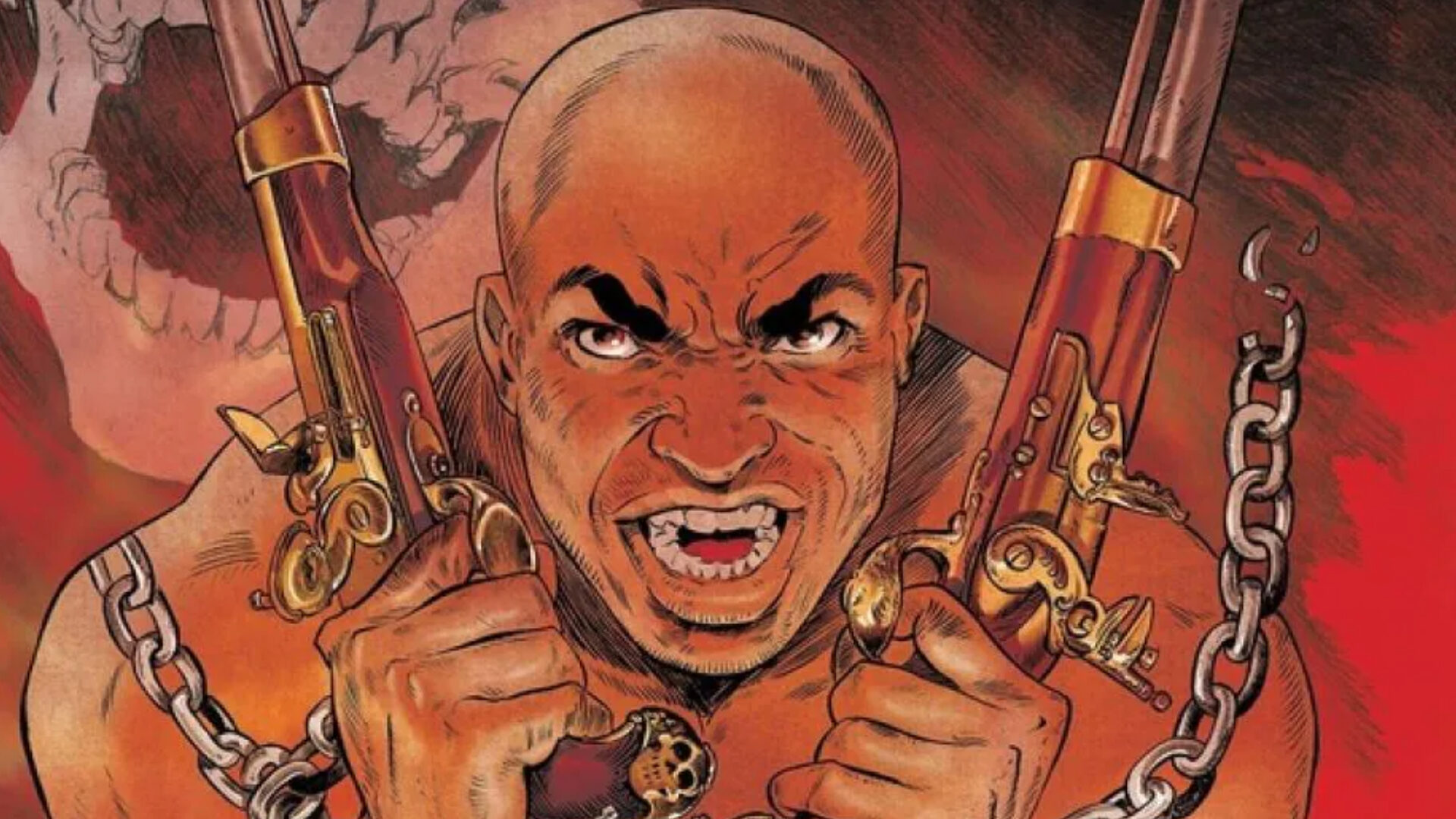
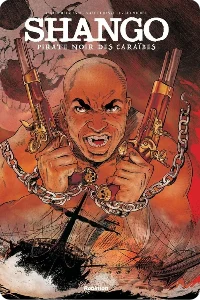
Published on February 18, 2026 by Robinson Editions, the first volume of Shango: Black Pirate of the Caribbean marks the launch of a new maritime adventure series in 56-page hardcover format. The project brings together Arnaud Delalande and Marc de Banville for the screenplay, accompanied by Guy Michel for the drawings.
By choosing to place its piracy under the sign of a black pirate, the album immediately positions itself on an imagination rarely explored in comics, directly linked to the early hours of the Atlantic slave trade and the maritime routes that shaped the Caribbean.
The work establishes an epic where African traditions, beliefs, the violence of empires and the legend of Caribbean treasures intersect to the rhythm of sails and cannons, with Haiti and Tortuga as emblematic horizons.
It remains to be seen whether Shango: Black Pirate of the Caribbean manages to transform this historical material and this breath of buccaneering into a true embodied adventure, capable of lastingly marking the imagination.
An epic born in violence
The first volume of Shango: Black Pirate of the Caribbean does not seek to introduce its hero through the spectacular. Instead, it chooses the brutality of a specific context: that of West Africa in the 17th century, at the dawn of the Atlantic slave trade. Shango is not yet a pirate. Simply the son of a chief, part of a lineage, integrated into a local political order. This initial position structures the entire shift that will follow.
The capture constitutes the founding event of the volume. Far from being treated as a simple incident, it becomes a point of fracture. The story emphasizes progressive dispossession: loss of territory, status, humanity. This descent is not artificially accelerated. It occupies a significant part of the album and imposes a more serious rhythm than that of a classic maritime adventure.
This narrative choice gives the volume a particular identity. Where one might expect a rapid rise towards piracy and naval action, the album favors establishing the historical setting. The slave trade, the commercial circuits, the mechanics of enslavement constitute the raw material of the story. The announced epic is therefore built backwards, from the fall, to justify its title only in the final pages.
Shango then appears as a figure in the making. His depth comes less from exploits than from his resistance. The character is massive, physically imposing, but still contained in his evolution. The volume does not deliver an accomplished pirate. It offers the genesis of a transformation, that of a man torn from his life, from its structure, for whom only the word "freedom" resonates.
The secondary figures participate fully in this dynamic. Dutch merchants, captains and African intermediaries make up a network of converging interests where responsibility is diluted without ever disappearing. The album avoids simplistic Manichaeism to better show the horror of an era. Relations of domination appear as the product of an expanding economic system, rather than as the expression of pure individual cruelty. Thus Shango and the others are sold for guns, tools allowing a local lieutenant to organize his revolution and his thirst for power.
The stopover in Cape Verde, marked by an attempted revolt followed by exemplary punishment, condenses this logic. Resistance exists, but it comes up against an implacable organization. This passage reinforces the tragic dimension of the volume: the impulse towards freedom does not yet flourish, it clashes; and fails.
Shango, in this first volume, remains a figure in the making. His physical stature and his ability to endure trials nourish the idea of a future transformation, without precipitating this metamorphosis. The story favors the genesis rather than the exploit. It installs a contained tension, which is based more on the accumulation of constraints than on flamboyant action.
A sea of flesh and light
If the scenario patiently establishes the genesis of its hero, it is the drawing of Guy Michel which gives the first volume its true sensory amplitude. The line does not seek academic elegance. It favours texture, movement, the tension of bodies. The silhouettes are dense, powerful, shot through with an almost raw energy which corresponds to the violence of the historical context.
The first African sequences benefit from particular attention to natural settings. The landscapes contribute to the identity of the characters, to their initial roots. When the story shifts towards the maritime universe, the graphic treatment evolves: the sea occupies the space, the pages are filled with ropes, sails, dark wood and faces marked by the ordeal. The environment paradoxically becomes more oppressive, more closed, almost claustrophobic; notably in the scenes located under the deck of the slave ship, where the tight composition accentuates the feeling of confinement.
The staging of bodies constitutes one of the most striking axes of the album. Shango is depicted as an imposing mass, a physical presence that often dominates the panel. This visual stature symbolically prepares his future transformation. Conversely, the figures of power are sometimes framed in a colder, more distant manner, which creates a contrast between the organic strength of the protagonist and the rigidity of the structures that surround him.
Light management also plays a central role. The contrasts support the brutality of the situations: dense darkness in the holds, violent flashes on the wind-swept decks, heavy skies that herald storms. This visual dramaturgy reinforces the tension without multiplying the demonstrative effects. The spectacular exists, but it remains anchored in a desire for historical credibility.
The whole composes a coherent, solid universe, which supports the ambition of the story. The drawing does not seek to embellish the violence. It makes it palpable, sometimes frontal, always embodied. This visual power undoubtedly constitutes one of the major assets of the volume, giving Shango’s odyssey a concrete and immediately identifiable presence.
It remains to be determined whether this graphic strength will be able to support, over time, the rise in narrative power announced by the series.
Verdict
A great epic under construction
8.5/10
This first volume of Shango: Black Pirate of the Caribbean lays a solid foundation. By choosing to devote most of its story to the capture, the crossing and the mechanics of the Atlantic slave trade, the album favors establishing the historical setting over immediate exaltation. This bias gives the volume an assumed gravity and a real thematic coherence, which knows how to take its time and establish its protagonists. The promise of piracy takes shape implicitly, like a transformation to come rather than a spectacle already accomplished.
Graphically, the power of Guy Michel's line gives the story an undeniable physical presence. Bodies, materials and lights participate in this immersion in a hard, tense, organic 17th century. The visual universe supports the ambition of the project and gives it a strong identity.
More in Manga & comics
Full library 8/10
Mop & Pudding: Tea Beneath the Milky Way
Rue de Sèvres (Le Renard Doré) 8/10
My Beautiful Doll Is a Super Darling
Kurokawa 2/10
Pluie Alcide
Éditions Lapin 8/10
Bug Ego
Kazé Manga 8.5/10
Ashes Volume 3
Ankama 8.5/10
La Vérité de Pinocchio
Grand Angle 7.5/10
Les 7 Chevaliers du Royaume des Marronniers
Akata 8/10
Arsène Lupin: Le Bouchon de cristal
Grand Angle 8/10
Le Bamboo de l’Avent
Bamboo 7/10