

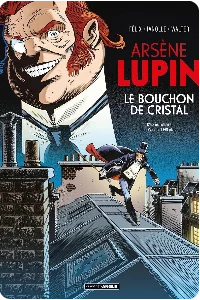
Arsène Lupin: Le Bouchon de cristal
The gentleman loses some of his composure
Score: 8/10
Images and videos
At a glance
We liked
- Lupin faces difficulty without losing his confidence or loyalty to those close to him.
- Daubrecq is a cruel opponent whose downfall is a pleasure to anticipate.
- A complete adventure that is easy to follow without knowing earlier books.
- Janolle’s expressive characters and Walter’s bold colours.
We liked less
- Information revealed early reduces the pleasure of solving the mystery.
- Some suspense developments are too convenient and arrive too close together.
- Daubrecq’s caricature sometimes overstates his villainy.
 By Farrel Grimwood · published · 4 min read
Contents
Arsène Lupin has promised to save a young man from the guillotine, and is beginning to realise that brilliance alone will not be enough. In Le Bouchon de cristal, the burglar retains his confidence but meets an opponent with the means to resist him. Jérôme Félix and Alain Janolle adapt Maurice Leblanc’s novel by allowing their hero to fail, grow irritated and search for a way out.
This self-contained story, published by Grand Angle, returns to early twentieth-century Paris, grand homes and secrets embarrassing enough to make their owners tremble. The characters often enjoy enviable social positions, which does not stop them behaving very badly. With Walter’s colours, the graphic novel embraces an atmosphere far less genteel than its elegant settings suggest. But does the mystery live up to the confrontation?
One burglary too many
Gilbert, a young protégé of Lupin’s, undertakes a burglary his boss has explicitly forbidden. He breaks into MP Alexis Daubrecq’s home with another criminal, and the operation ends in carnage. Lupin arrives too late to prevent the tragedy. Wounded, Gilbert hands him a crystal stopper before being arrested and accused of a murder he did not commit. The thief is left with an object whose importance he does not understand and an execution to prevent.
The young man has behaved recklessly, but Lupin refuses to let him pay with his life. That loyalty immediately makes the burglar worth following, even when he boasts a little too much. The case soon extends beyond the fate of one gang member: the stopper is connected to compromising information about politicians. Several people therefore have good reasons to recover it, and saving Gilbert requires far more than planning a spectacular escape.
Daubrecq is the kind of opponent whose downfall cannot come soon enough. He uses blackmail to protect his position and bend potential obstacles to his will. His respectability as an MP prevents neither cruelty nor personal score-settling. A twenty-year-old grudge drives the affair, making his violence much less abstract than a simple desire to retain power.
Against him, Lupin’s provocations have less effect than usual. The burglar can still be brilliant, but his opponent has the means to ruin lives without taking to the streets himself. Their opposition gives the book energy: Lupin has to work out how to reach a man who controls others through their secrets. Watching Daubrecq lose his confidence becomes as appealing as discovering what the famous stopper conceals.
“Genius cannot be explained, only admired!” Lupin retains enough nerve to come out with lines like that while Gilbert still needs saving. The contrast suits him very well. His pretension can raise a smile while the cost of the affair becomes visible. He forbade the burglary, yet finds himself repairing its consequences. His loyalty to the young man ultimately makes him more engaging than his exploits as a thief alone.
A mystery that reveals a little too much
The affair quickly grows, with enough blackmail, grudges and political interests to occupy Lupin. Jérôme Félix retains a taste for dramatic twists and moves his hero from one problem to another without much breathing space. The relationships between characters require attention, but the story remains fluid and needs no knowledge of earlier books.
The problem is that the book provides information quite early that strongly directs the reading, particularly around revenge. It is possible to get ahead of Lupin and wait for him to understand what has already begun to look likely. That gap sustains concern for Gilbert but reduces the pleasure of investigation. For an adventure built around a secret and a mysterious object, that is a little unfortunate.
The plot remains gripping, largely thanks to the duel with Daubrecq. It is simply more convincing when putting Lupin in difficulty than when promising a great surprise. As the case keeps finding new complications, some twists also feel very convenient ways of prolonging the trouble. The pace prevents boredom, but leaves less time to appreciate one discovery before moving to the next. The pleasure of a lively adventure remains, with a less devious mystery than hoped.
Janolle embraces caricature
Alain Janolle does not trap the characters in rigid elegance. Lupin smiles readily and adopts theatrical poses; Daubrecq looks distinctly disturbing, with grimaces, a nose and a gaze emphasised by the drawing. The caricature is deliberate. It makes power relationships very clear, even if it sometimes labours the difference between the charming hero and his repellent opponent.
The streets, bourgeois interiors and costumes establish the period without overshadowing the characters. Janolle moves from wider views to close-ups to follow reactions during conversations. The panel layout remains fairly traditional, with clearly separated frames and an obvious reading order. In a story where information and speakers change so quickly, that simplicity is welcome.
Above all, Walter contributes colours with personality. Blues, yellows and greens can be very strong, with contrasts making some confrontations almost aggressive. This is far from a Belle Époque uniformly aged in sepia. Scenes involving Daubrecq particularly benefit from those unsettling hues. It is hardly subtle, but the exaggeration suits the character and prevents the book from becoming merely a prettily dressed historical reconstruction.
The book ends with a feature by Jérôme Félix about Marius Jacob, an anarchist and burglar regularly compared with Arsène Lupin. Jacob’s direct influence on Maurice Leblanc remains disputed: the supplement is better read as an opportunity to discover a historical figure than as a certified biography of a “real Lupin”. It is a welcome detour after a story in which a thief’s honour counts for more than that of certain dignitaries.
Verdict
A worthy opponent
8/10
Le Bouchon de cristal is worth reading for its duel and for a Lupin forced to rely on cunning without knowing in advance whether he will escape. Daubrecq is hateful enough to make his downfall eagerly anticipated, and the promise made to Gilbert supplies a reason for concern behind the burglar’s provocations. The script maintains a good pace, with expressive art and colours that refuse to fade into the background.
The book would be even better if it protected its secret more carefully. Clues arrive a little quickly, twists crowd together, and Daubrecq is sometimes so exaggerated that a more insidious approach would be welcome. That does not spoil the confrontation, but it is recommended for the pleasure of watching Lupin struggle rather than for an impossible-to-anticipate puzzle. A good adaptation that makes its hero less untouchable, even as he continues to consider himself a genius.
Pros
- Lupin faces difficulty without losing his confidence or loyalty to those close to him.
- Daubrecq is a cruel opponent whose downfall is a pleasure to anticipate.
- A complete adventure that is easy to follow without knowing earlier books.
- Janolle’s expressive characters and Walter’s bold colours.
- A feature on Marius Jacob to complement the adventure.
Cons
- Information revealed early reduces the pleasure of solving the mystery.
- Some suspense developments are too convenient and arrive too close together.
- Daubrecq’s caricature sometimes overstates his villainy.
More in Manga & comics
Full library 8.5/10
La Vérité de Pinocchio
Grand Angle 8/10
Mop & Pudding: Tea Beneath the Milky Way
Rue de Sèvres (Le Renard Doré) 8/10
My Beautiful Doll Is a Super Darling
Kurokawa 2/10
Pluie Alcide
Éditions Lapin 8/10
Bug Ego
Kazé Manga 8.5/10
Ashes Volume 3
Ankama 7.5/10
Les 7 Chevaliers du Royaume des Marronniers
Akata 8/10
Le Bamboo de l’Avent
Bamboo 7/10
Magical Girl Dandelion
Akata 8/10