
Le Panthéon – Volume 1
Jacob’s abduction
Score: 6/10
Images and videos


At a glance
We liked
- A detailed and instantly recognizable steampunk Paris.
- Carefully designed machines and vehicles.
- A legible action, carried by large, spectacular panels.
- The bright colors of Max Bayo.
We liked less
- A plot that is too poorly developed behind the sequence of chases.
- The insistent hypersexualization of the heroines, even in the preparation of the investigation.
- Female characters more elaborate in their appearance than in their personality.
- Unnatural dialogue and sometimes rushed transitions to action.
 By Farrel Grimwood · published · 7 min read
Contents
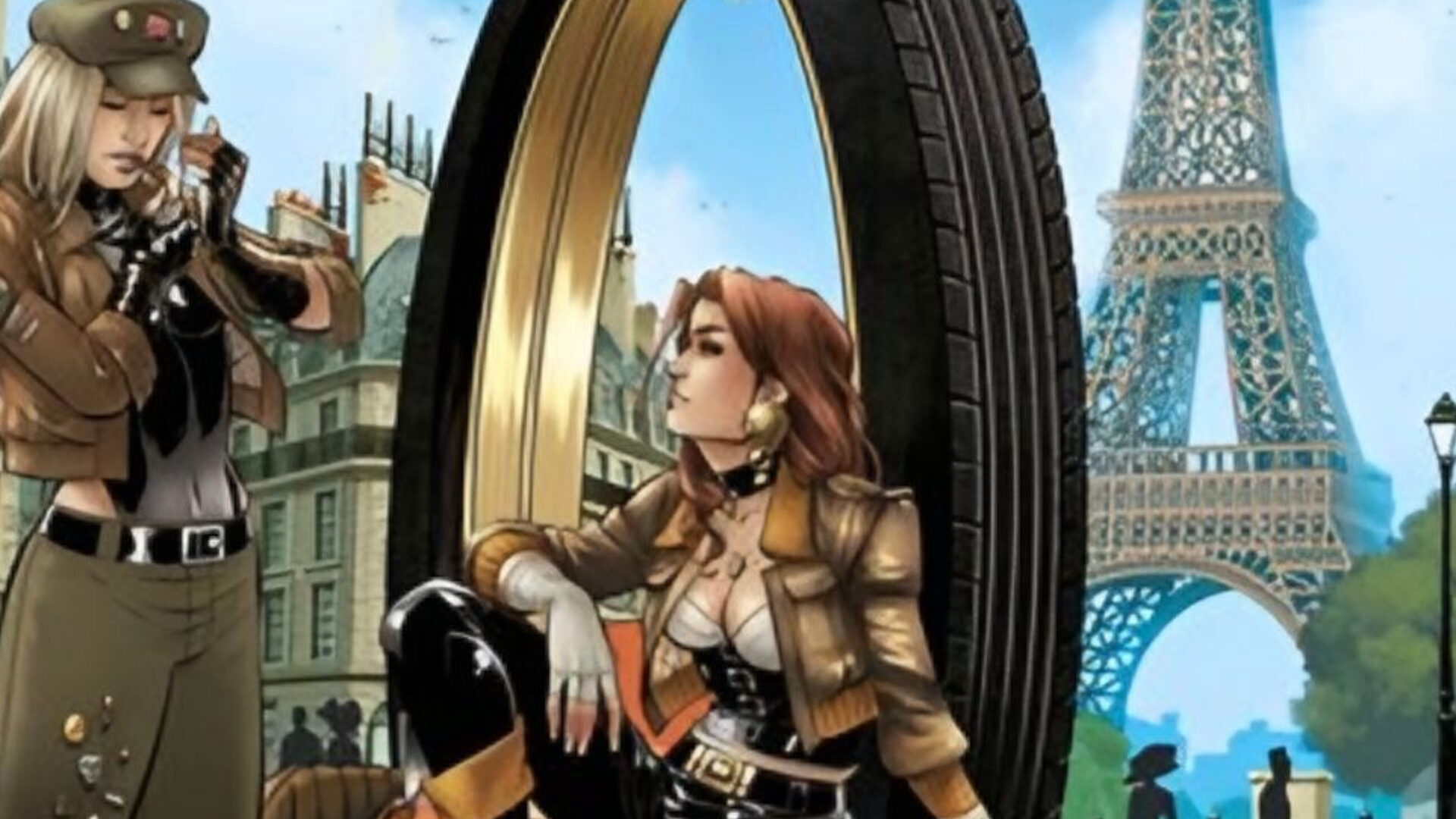
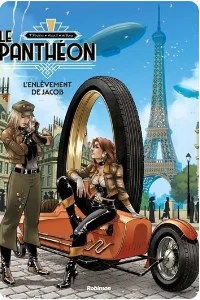
Paris in 1900, a man kidnapped and adventurers set out to find him: Le Panthéon chooses a simple premise to launch its series. Thomas Rivière on the screenplay and Mika S. on the drawing add extravagant machines and a good dose of fighting. This first volume, L’Enlèvement de Jacob, is published by Robinson after crowdfunding. The opening pages announce an adventure that has a lot to do with the spectacle.
The claimed influences give a good idea of the project. Thomas Rivière notably participated in the arrival of Lady Mechanika in France at Glénat. Here we find this taste for elaborately dressed heroines and mechanical inventions in an ancient setting, to which is added the action of Danger Girl. Mika S., already author of Layla, gives this mixture carefully crafted art. The city catches the eye, the machines have style and the eventful scenes generously occupy the pages.
It remains to give as much interest to the investigation and to the women who lead it. Because between the chases and the suggestive poses, Le Panthéon leaves little time for the development of its story. Is the drawing enough to make this first volume convincing?
Louise takes matters into her own hands
Jacob Montsouris, a wealthy businessman, has been kidnapped by a secret organization called the Pantheon. His wife, Louise, decides to find him. She seeks out Jeanne Batignolles, an adventurer who works in the agency founded by Jacob. Journalist Constance then completes the team. The objective is therefore easy to understand, even if the identity of the kidnappers and their reasons must fuel the mystery.
Louise deserves to take the initiative. She goes to Jeanne’s house, reminds her that her husband’s property is also hers and makes her understand that she intends to use her services. The scene gives the character a fairly immediate authority. This woman has money, knows her rights and does not shyly ask for a favor. Facing her, Jeanne’s relaxed attitude which creates a rather effective contrast.
This relationship could have made their association interesting beyond the mission. Louise orders because she believes she has the means, but Jeanne has experience of adventure. There is enough to provoke disagreements and test the confidence of the former. The volume mainly exploits this gap to launch the duo and give them a few lines. The characters are sketched, then the action quickly takes over.
A Paris worth seeing
Mika S.’s drawing gives good reasons to stop on the pages. His Paris remains recognizable with its buildings, its cobbled streets and the Eiffel Tower, but the airships and imaginary vehicles transform it into an adventure setting. This is the principle of steampunk: starting from a historical aesthetic to invent a technology that never existed in this form. The album uses it in enough detail to make the city look more than just a historical background.
The facades are detailed and the workshops full of tools give the machines a credible environment. Max Bayo’s colors bring light to large views and emphasise depth. The discovery of the vehicle in the hangar is particularly successful, particularly because the drawing takes the time to show the space around it. The invention appears to belong to this place, with its plans and its equipment, which makes its presentation more convincing.
The opening, with its airship, also announces a generous staging which is not lacking throughout this first volume. The large panels give scale to the danger and the movement is easy to read. The flashback that follows allows us to start again from the meeting between Louise and Jeanne without losing the reader. The album therefore knows how to introduce its adventure through images. This know-how makes the thinness of what it then develops all the more regrettable.
The problem is that Le Panthéon devotes a lot of energy to making its heroines run and very little to making their investigation interesting. The confrontations and chases follow one another, the mysteries are added, but the characters rarely have the opportunity to delve deeper into what they discover or even take the time to think about it logically. The pace maintains a quick read, but above all gives the impression that the scenario wants to move on to the next action scene before having sufficiently exploited the previous one, as if it were aimed above all at relatively young readers or readers who are quick to get bored easily more than, for example, at fans of Lady Mechanika.
However, a kidnapping is a good starting point. It engages a personal relationship, poses a threat and forces the investigators to understand what is being hidden from them. Here, Jacob’s fate serves above all to justify the mission. The story develops too little what this disappearance upsets in Louise for the emergency to take on a real emotional dimension. The latter is never developed, to the point that the reader even ends up wondering if they are really a couple. Her determination is clear, but she is more convincing when giving orders than when sharing her concern.
The dialogue does not help either. It presents situations with little nuance and seek effective responses without making the exchanges very natural. Some transitions to action lack preparation, while contrivances allow the adventure to be restarted a little too conveniently. In fact, the obstacles seem organized more to produce movement than to force the heroines to make difficult choices.
We can appreciate a light and very classic story. It is still necessary that its progress gives satisfaction. This first volume establishes its team and its adversaries, but remains poor in the development of its plot. Reserving answers afterwards is normal for a series; leaving so little room for the construction of the investigation is much less so. The 56 pages allow us to discover an attractive universe without giving so much substance to the story that should keep us there.
Heroines primarily expected to seduce
The treatment of female characters accentuates this imbalance. From the moment we meet in the agency, the necklines, very tight waists, naked bodies and seductive postures emphasize female bodies with insistence. Preparing for the mission then focuses on going out in a towel and getting dressed. Even discussions of the investigation include close-up framing of breasts. The choice of what is shown matters: the concern linked to the disappearance comes second to the suggestive presentation of the heroines.
An adventure can perfectly well be sexy and well written. Here, the hypersexualization becomes annoying by its insistence and by the lack of parallel development granted to the characters. Their clothes and poses receive attention that their emotions do not receive with the same precision. We identify them easily, but we ultimately learn very little about them. The distinction between a successful silhouette and an interesting character is felt very quickly, to the point of becoming a caricature here.
This priority also concerns the screenplay by Thomas Rivière. The order to “change your panties” given to Jeanne, accompanied by an invitation to get a makeover before departure, continues this way of presenting women. The effect is intended to be light and authoritarian. It mainly emphasises their appearance at a time when the search for Jacob should have more importance. The dressing scene that follows gives it even more space.
The drawing, however, knows how to express Louise’s confidence and Jeanne’s nonchalance. There is therefore something other than the poses in their presentation. But these differences deserved to be nourished by their decisions and their relationships, instead of remaining so dependent on immediately recognizable attitudes. The wealthy woman, the adventurer and the journalist offer three ways of approaching an investigation. The album is too little interested in what this association could produce beyond a visually attractive trio.
Le Panthéon, however, keeps part of its promise. Fans of beautiful settings and action without lengthy exposition will find a comic enjoyable to read through. The reading progresses easily and the care given to the machines as well as to the city justifies us returning to look at certain drawings. The contrast is quite clear: the images invite us to linger on their details, while the story can be read without offering as much material.
But the story benefits poorly from this achievement. The repetition of the effects of seduction occupies a disproportionate place compared to the poverty of the development of the plot. The two criticisms reinforce each other: the more the story remains underdeveloped, the more this emphasis on the heroines is obvious. A few scenes devoted to their differences, their hesitations or the consequences of their discoveries would have given more weight to the whole. As it stands, the show entertains without making the adventure particularly endearing.
Verdict
A beautiful drawing does not make the whole adventure
6/10
The Pantheon offers a successful steampunk Paris, pleasant machines to discover and action staged with energy. Mika S. gives the first volume a solid visual presence, supported by bright colors. The starting point is accessible and Louise has enough character to launch the search for her husband without waiting for others to decide for her.
The writing, however, remains too summary to accompany these qualities. The investigation lacks development, the dialogues are unevenly convincing and the female characters are too often highlighted by their physique before being highlighted by their personality. This insistent hypersexualization ends up emphasizing everything that the scenario leaves aside. Graphically successful entertainment, but too superficial to become a real pleasant surprise.
Pros
- A detailed and instantly recognizable steampunk Paris.
- Carefully designed machines and vehicles.
- A legible action, carried by large, spectacular panels.
- The bright colors of Max Bayo.
- Louise's authority, a good basis for the character
Cons
- A plot that is too poorly developed behind the sequence of chases.
- The insistent hypersexualization of the heroines, even in the preparation of the investigation.
- Female characters more elaborate in their appearance than in their personality.
- Unnatural dialogue and sometimes rushed transitions to action.
- Plot contrivances that weaken the progress of the investigation.
More in Manga & comics
Full library 8/10
Mop & Pudding: Tea Beneath the Milky Way
Rue de Sèvres (Le Renard Doré) 8/10
My Beautiful Doll Is a Super Darling
Kurokawa 2/10
Pluie Alcide
Éditions Lapin 8/10
Bug Ego
Kazé Manga 8.5/10
Ashes Volume 3
Ankama 8.5/10
La Vérité de Pinocchio
Grand Angle 7.5/10
Les 7 Chevaliers du Royaume des Marronniers
Akata 8/10
Arsène Lupin: Le Bouchon de cristal
Grand Angle 8/10
Le Bamboo de l’Avent
Bamboo 7/10