

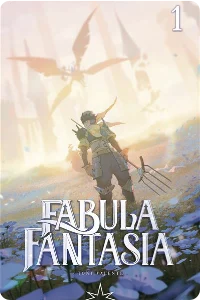
Fabula Fantasia
The promise of a countdown tale
Score: 7/10
 By Farrel Grimwood · published · 3 min read
Published by Ankama Éditions, Radiant Fabula Fantasia Volume 01 is an official spin off of the Radiant universe, written and drawn by Tony Valente. This first volume inaugurates a new independent mini-series, designed to explore a still largely theoretical part of the lore: the ideological origins of the Inquisition and the birth of the radical rejection of magic.
Unlike the main series, which focused on learning, adventure, and the gradual questioning of dogma, Fabula Fantasia takes the opposite approach. The manga follows Bard, a young farmer from a modest background, convinced that magic is at the origin of society’s decadence. Her objective is clear, brutal and assumed from the first pages: destroy the relics. Through this postulate, Tony Valente does not seek to propose a new epic, but to question the very legitimacy of the heroic story.
This first volume thus lays the foundations of an ideological and spectacular story, announcing a work oriented towards deconstruction rather than classic adventure.
The birth of a radical refusal
The heart of Radiant Fabula Fantasia Volume 01 rests above all on its inverted narrative device. Tony Valente does not tell the story of the emergence of a heroine, but the methodical construction of a counter-narrative, based on rejection, anger and fear of magic. The story opens in a world where relics occupy a prominent place. They are shown as a deceptive comfort, a permanent delegation of human responsibility.
It is in this context that Bard, the central character of the story, fits. Far from being presented as a caricatured antagonist, Bard comes from a modest background, confronted with powerlessness and injustice, she develops a radical but coherent vision in her eyes: magic is not a solution, it is the source of the problem. Her rejection is neither impulsive nor gratuitous. It is nourished by concrete observations, traumas and deep social resentment.
The scenario takes the time to show how this ideology is formed. Bard is not yet a mythologized figure, but a teenage girl at odds, obsessed with the idea that heroes are impostors glorified by a sick system. The story emphasizes this obsession, on the way in which it structures her thoughts and gradually isolates the character. The violence to come is never presented as an accident, but as the logical outcome of reasoning which hardens over the pages.
The secondary characters play an essentially functional, but relevant, role. They embody different facets of this society dependent on magic: complacent and perverted authority figures, adored heroes in search of the Scabbard of Fealty. Everyone participates, voluntarily or not, in the collective blindness that Bard denounces. This gallery of characters serves less to enrich the emotion than to reinforce the ideological purpose of the story.
Through this approach, Fabula Fantasia is clearly part of a logic of deconstruction of the heroic myth. Tony Valente centralizes the morality of Bard, who seeks a favorable outcome for the lady with rabbits. The damsel in distress doesn’t need a hero with dubious intentions to free herself from her prison.
This first volume assumes its foundational role. It lays the ideological foundations and prepares the transformation of Bard into a historical figure. The story advances slowly, but with a clear direction, favoring the coherence of the subject while maintaining spectacular effectiveness.
A staging at the service of the discourse
Graphically, Radiant Fabula Fantasia Volume 01 is part of the stylistic continuity of Tony Valente’s work, while adopting less exuberance than the main series. The line remains immediately identifiable, with its expressive characters and its readable compositions, the whole gains in depth.
The settings fully contribute to this intention. The environments presented mix wonder and fragility. Titanic towers can break under the impact of representations from the collective unconscious.
The page layouts is distinguished by a clear, dynamic and efficient division. Tony Valente takes the time to set up his scenes, multiplying the dialogue sequences to let the ideas breathe. The action scenes explode and grab the reader into a ballet that superimposes the protagonists, each more powerful than the other.
The work on expressions deserves particular attention. Bard is an undemonstrative character, often closed, even rigid. This emotional restraint is visually translated into French by intense looks, prolonged silences and undemonstrative faces. Conversely, the heroic figures or representatives of the established order are sometimes drawn with a more pronounced, almost theatrical expressiveness, accentuating the gap between the public image of the hero and the critical view that the story has on him.
Verdict
The heroic pitchfork that destroys relics
7/10
Radiant Fabula Fantasia Volume 01 stands out as an extension work. Tony Valente takes up the adventurous momentum of the main series to construct an ideological story centered on the rejection of magic and the questioning of the heroic myth. This first volume assumes a dynamic pace, filled with action scenes while providing clarification on the universe.
More in Manga & comics
Full library 8.5/10
Ashes Volume 3
Ankama 8/10
Yasuko – Volume 1 : Un nouveau départ
Ankama 7/10
Beneath the Trees Where Nobody Sees: Rite of Spring
Ankama 7/10
Block Out – Volume 1
Ankama 9/10
Loin de la mer
Ankama 7.5/10
Sauvage
Ankama 10/10
Ashes – volume 2
Ankama 9.5/10
Tisseuse
Ankama 9/10
L’île des Cochons Volants
Ankama 8/10