


Tisseuse
The invisible threads of another destiny
Score: 9.5/10
 By Farrel Grimwood · published · 5 min read
Contents
To be published by Ankama on September 12, 2025, Tisseuse is signed by Léna Canaud, an emerging author who immediately stands out with a unique story. We discover a world split into two realities offset by seven years, connected by a simple wishing well. At the heart of this narrative device, a young woman, Ethel, responsible for collecting the letters left and watching over the fragile border between these universes. But when she decides to intervene to save the one she loves, she upsets the balance and faces the weight of her transgression.
This work questions memory, connection, and the responsibility to influence the destiny of others. The question then arises forcefully: is this embroidery full of promise a simple initiatory tale, or one of the most mastered stories in recent comics?
Wishes on the edge of emptiness
Tisseuse follows Ethel, a teenager whose existence is punctuated by a role as discreet as it is overwhelming: apprentice guardian of an old well, located in an isolated garden, into which she slips letters with Laure, her grandmother. These messages, written with the hope of changing a destiny, do not remain dead letters: they are transmitted to the other side, a parallel reality shifted by seven years, in which the Weavers rewrite the threads of life according to the requests submitted. This fragile system is based on a simple rule: the guardian observes, verifies the morality of the wish and transmits it.
Ethel grew up with this weight. She knows the faces of those who come to leave trembling words, she senses the expectation and the anguish of these existences which stake everything on a fold of paper. She is the invisible witness to the hopes of others, but also the guardian of a prohibition: never write anything for yourself, never try to alter your own destiny.
Everything changes the day Saule, her partner, suddenly dies. The album does not make this disappearance a simple narrative trigger: it makes it a structuring obsession. Ethel expresses the wish to save Saule on the other side and sends him numerous letters. Each missive swallowed by the well turns into a one-way link, Ethel transmits without ever receiving in return. The reader feels the mechanics of waiting, the silence on the other side.
This impossible mourning leads to transgression, Ethel crosses the absolute prohibition: she dives into the well which is only supposed to let letters pass, breaking the border between the two realities. This gesture marks a decisive turning point: she ceases to be a guardian and becomes an apprentice Weaver, ready to directly influence the fabric of time. The narration gains intensity here: we leave a blue world to shift into sepia; Ethel no longer collects the letters but embroiders the movements that threaten the balance of the worlds.
Around Ethel, the characters shift between her own world and the one she discovers. Some protagonists exist and others do not on the other plane. Everyone hopes to correct regrets by sending wishes to this other version of themselves. They cannot change their own destiny, only alter that of the other side.
The strength of the album lies in the way it makes mourning a dramatic driving force and transgression a moral question. The story not only tells of Ethel’s love for Saule, it tells of disobedience to a system, of the choice of singularity against the mechanics of rules. Each gesture of the heroine reflects this fight: to act despite the danger. The plot tightens around this tension, building a nuanced portrait of a young woman who matures by deciding to betray the role assigned to her.
By choosing this intimate setting, Tisseuse is not looking for the epic. Instead, it chooses to delve into the fractured zones of existence: waiting, mourning, revolt, love which transforms into challenge. Each carries a symbolic weight that goes beyond their function: Ethel the rebellious, Saule the absent to be saved, Iris who only exists on the other side, Laure who has made other life choices, condemning her lineage.
The thread stretched between two worlds
Tisseuse does not borrow the logic of a classic story where the action imposes itself and unfolds in a crescendo. It is rather a circular structure, centralized on wishes and their consequences. The album plays on this mechanics of obsession: writing, waiting, hoping, starting again. Until Ethel refuses to remain a spectator and launches into the forbidden space on the other side.
The staging exploits this hope, the rhythm alternates between the immobility of everyday life and the flash where destiny changes. We move from a contemplative slowness to the urgency of a heart that beats too quickly, and it is in these contrasts that the story forges its dramatic power.
The fantastic is never treated as a spectacular break. It is woven into the very texture of the narrative. The well, the wishes, the temporal gap: these elements are not artifices, but invisible rules, which define the dramatic tension like the squares of a chessboard. Each step of Ethel on this stage is a challenge to the very laws of narrative. By choosing to act, she disrupts the entire narrative architecture: the reader loses the assurance of a settled ending.
The fragile light of thwarted destinies
Léna Canaud’s drawing does not seek flashy virtuosity: it unfolds in elegant sobriety, a clear line where every detail is weighed. No saturated decorations, instead, a refined work which focuses the eye on the essential: the faces, the gestures, the silences. It is through expressions that dramatic density emerges.
The color palette adorns the narrative. The blue hues create a climate of diffuse melancholy, where sweetness mixes with persistent seriousness. While the other side opts for sepia colors, a world where hope exists, Saule can be saved.
The general atmosphere of the album is born from this duality. It’s a hushed reading, almost whispered, but shot through with sudden emotional discharges. Where many works choose exuberance, Tisseuse favors restraint: each silence, each void, each transition becomes a space to inhabit. This bias imposes active reading, which makes the reader a participant in the story as much as a spectator.
By assuming this minimalism, Léna Canaud manages to extract a rare intensity: absence becomes visible, time becomes palpable, and each page acts as a resonance. You don’t just contemplate a story: you feel it in the very texture of its images.
Verdict
A thread stretched towards excellence
9.5/10
Tisseuse is not a graphic novel that can be consumed quickly, nor a story that seeks to seduce through overkill. By the rigor of its construction, by the accuracy of its heroine and by the purity of its drawing, Léna Canaud delivers a first album of impressive mastery.
Ethel embodies the fragile strength of a character who refuses resignation, who dares to break the established balance to save her loved one. Each page translates this inner struggle with restrained intensity, but never attenuated. The philosophical questions about wishes are very relevant. Tisseuse is one of those rare works capable of embroidering a story with unforgettable depth.
More in Manga & comics
Full library 8.5/10
Ashes Volume 3
Ankama 8/10
Yasuko – Volume 1 : Un nouveau départ
Ankama 7/10
Beneath the Trees Where Nobody Sees: Rite of Spring
Ankama 7/10
Block Out – Volume 1
Ankama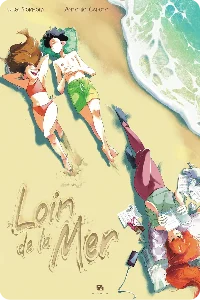 9/10
Loin de la mer
Ankama 7.5/10
Sauvage
Ankama 10/10
Ashes – volume 2
Ankama 7/10
Fabula Fantasia
Ankama 9/10
L’île des Cochons Volants
Ankama 8/10