
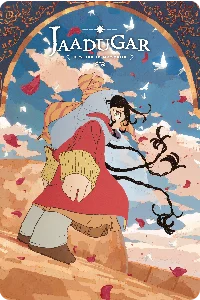
Jaadugar : A Witch in Mongolia
Knowledge as a weapon, gentleness as a trap
Score: 6.5/10
Images and videos
At a glance
We liked
- Sitara is a solid heroine, touching without being reduced to her pain.
- The second episode finally gives real violence to the story.
- The link with Fatima Khatun brings a strong historical and political dimension.
- The music and artistic direction establish a clear identity.
We liked less
- Episode 1 remains too gentle in relation to the context.
- Some scenes explain the lesson about knowledge too clearly.
- Hands that are too big sometimes attract attention.
- The shortcut around Euclid greatly simplifies scientific knowledge.
 By Farrel Grimwood · published · 6 min read
Contents
The title promises a witch, but the first two episodes start from a much more concrete place: a child sold into slavery, a house of scholars, books, calculations, a repeated prayer, then the arrival of an army which wipes it all out with a single movement. Jaadugar – A Witch in Mongolia does not place its magic in the supernatural. It places it in knowledge, and especially in what knowledge can still give to someone from whom almost everything has already been taken.
Adapted from Tomato Soup’s manga and produced by Science SARU, the anime follows Sitara, taken in by Fatima in Tus after the loss of her mother. The young girl initially resists the education offered to her. Then Mohammed, Fatima’s son, makes her understand that reading, counting and thinking can become something other than a luxury reserved for others. For a time, the series lets Sitara live a fragile routine: work, learn, hope for a letter, wait for the world to stay in its place.
It obviously doesn’t stay in place. The Mongol Empire advances, Tolui reaches the city, Fatima falls, and Sitara ends up prisoner with only what she learned in the house she has just lost as her weapon. The whole premise is there: can Jaadugar: A Witch in Mongolia hold together the beauty of a fable, the brutality of history and the trajectory of a woman who will have to use intelligence like a blade?
Sitara before revenge
The first good idea of the anime is not to open directly on the great historical figure or on the Mongol court. It starts lower, closer to the ground, with Sitara. She is not yet Fatima Khatun, she is not yet a political threat, she is not even yet convinced by what she is being taught. She is a lost, stubborn, distrustful child who discovers a new home without knowing whether she should refuse it or cling to it.
This domestic part provides material for episode 1. The dishes, the prayer, the lessons, the exchanges with Mohammed, all this establishes a fairly simple peace, almost fragile by nature. We understand why Sitara ends up holding on to this place. Fatima not only gives her a roof over her head, but a form of dignity, even in a situation that remains deeply unjust since Sitara remains a slave.
The problem is that the episode presses too hard on its thesis. Knowledge is important, knowledge liberates, knowledge opens a path: the idea is beautiful, but it comes back with a clarity that sometimes borders on a lesson. Jaadugar : A Witch in Mongolia is more touching when it lets Sitara learn through an ordinary gesture or scene than when it spells out too clearly what the viewer should remember.
Beauty that offers too much protection
Visually, Science SARU makes a very readable choice. The settings have a storybook softness, the colors envelop the scenes, the bodies remain supple, the music creates a discreet melancholy. There is something very pleasant in this way of making Tus exist as a world already lost, a place that we look at with the tenderness of what is going to disappear.
But this beauty sometimes protects the anime too much. Jaadugar: A Witch in Mongolia‘s 13th Century is about slavery, conquest, mourning, educated women in a world that can distrust them, and then an empire capable of absorbing entire lives. However, episode 1 often maintains an almost reassuring roundness. The characters have very soft shapes, the expressions remain contained, the harshest scenes are prepared in a setting which cushions the shock.
Even hands that are too big end up attracting the eye. The series relies heavily on gestures: holding a book, washing, writing, receiving an object, holding someone. When these hands become too present, they slightly pull attention away from the scene. It’s not a catastrophic flaw, but it’s the kind of graphic choice that reminds us that Jaadugar is still searching for its balance between fable and violence.
When history ceases to be a backdrop
The second episode is clearly stronger because it stops just announcing the catastrophe. Tolui’s army enters Sitara’s life, and the series finally finds the cruelty that was missing in its opening. The house of Fatima is no longer a refuge. Knowledge is no longer a beautiful promise. Everything becomes loss, flight, capture, and Sitara understands that the world will not give her any time to grow up properly.
Fatima’s death changes the weight of the anime. Until then, she could still represent learned goodness, transmission, the substitute mother. Her disappearance tears away this protection and transforms Sitara into a survivor. The scene works because it connects Mongol violence to something very intimate: Sitara does not only lose a city or a house, but also and above all a second mother.
This is where Jaadugar: A Witch in Mongolia gets really interesting. Cruelty is no longer decorative. It gives Sitara direction. It explains why knowledge can become a weapon, not in an abstract sense, but because it remains the one tool that the Mongols cannot immediately take away. The anime then finds a much stronger tension: watching a child decide to live long enough to strike back in another way.
Fatima Khatun in the shadows
Behind Sitara stands Fatima Khatun, a Persian historical figure captured during the Mongol conquests, then linked to Töregene Khatun at the heart of the Empire. The anime does not do a cold reconstruction. It takes liberties, it condenses, it displaces, but it touches on something powerful: the idea that a woman torn from her world can rise to the circles of power through knowledge, strategy and an understanding of the balance of power.
It is this link that gives the title its real strength. Witchcraft doesn’t have to be magical. In this context, calling a woman a witch can become a political weapon, a way of making an intelligence too close to power suspect. Fatima Khatun then becomes less of a historical curiosity than a revealing example: when a dominated woman understands the rules of the game too well, the world around her quickly seeks to call her something else.
For now, the anime has only opened this avenue. Töregene still appears as a promise more than a real counterpoint to Sitara. But this direction is enough to make you want to see what happens next. If Jaadugar: A Witch in Mongolia fully assumes this political dimension, it can become much more than a pretty historical drama about a wounded child.
A strong start, but not yet sharp
These two episodes therefore give a double impression. On the one hand, the subject is rare, the heroine is immediately endearing, the historical context gives real density, and the second episode proves that the series can become harsh when it agrees to leave the comfort of the fable. On the other hand, the opening remains too dutiful, too gentle, sometimes too conscious of what it wants to convey.
The rhythm illustrates this tension well. Episode 1 takes its time building attachment, but it feels almost too neat. Episode 2 gains strength as soon as everything falls apart, but it also gives the feeling that the series really begins when Sitara loses Fatima. This isn’t necessarily a bad choice, but it makes for an uneven launch.
A solid foundation nevertheless remains. Not because everything would already be perfectly mastered, but because Jaadugar: A Witch in Mongolia has real material: a heroine who changes her name, knowledge which becomes strategy, a story of conquest seen from those it crushes, and a Mongol court which already promises other forms of violence. Now the anime needs to stop protecting its subject.
Verdict
A witch still too well behaved
6.5/10
Jaadugar: A Witch in Mongolia starts with exciting material. Sitara works, Fatima quickly leaves a mark, the relationship with knowledge gives a strong identity to the series, and the second episode finally brings the cruelty necessary for the story to gain weight. When the anime lets history crush its initial cocoon, it finds something truly gripping.
But this launch remains too gentle for the violence it handles. The artistic direction is beautiful, sometimes very beautiful, but it cushions the blows too much. The writing sometimes explains its theme instead of letting it breathe, and certain educational shortcuts make the knowledge too clean, too immediately useful. There is enough ambition to continue, but Jaadugar will quickly have to become sharper if it is to do justice to Fatima Khatun.
Pros
- Sitara is a solid heroine, touching without being reduced to her pain.
- The second episode finally gives real violence to the story.
- The link with Fatima Khatun brings a strong historical and political dimension.
- The music and artistic direction establish a clear identity.
- The theme of knowledge as a survival tool works very well.
Cons
- Episode 1 remains too gentle in relation to the context.
- Some scenes explain the lesson about knowledge too clearly.
- Hands that are too big sometimes attract attention.
- The shortcut around Euclid greatly simplifies scientific knowledge.
- The series has yet to fully embrace the harshness of its subject.