
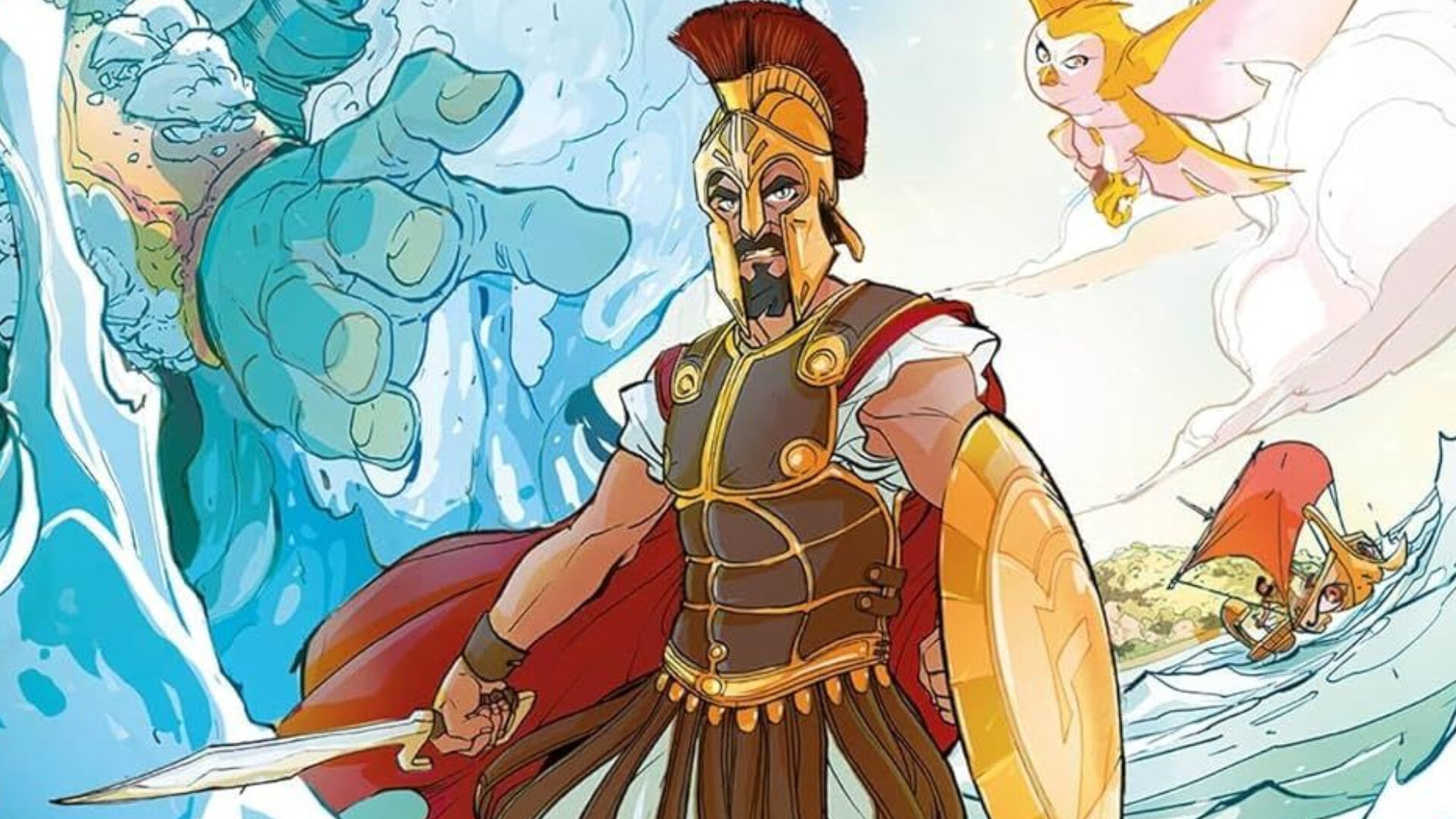

L’Odyssée – tome 01 : Ulysse
The myth finds a new direction
Score: 8/10
Images and videos


At a glance
We liked
- An intelligent and courageous Odysseus, but whose pride has real consequences.
- A rhythm that takes the time to explain Poseidon's anger.
- A clear adaptation without becoming an academic summary.
- Thomas Labourot’s expressive, dynamic art.
We liked less
- Odysseus' companions often remain less defined than their leader.
- The desire to make everything clear attenuates part of the strangeness of the myth.
- The violence and exhaustion of the journey sometimes remain too smoothed out.
- Some explanations repeat what the drawing had already established.
 By Farrel Grimwood · published · 7 min read
Contents
Bamboo launches the Nootilus label with a monument whose name is enough to fill a library. L’Odyssée belongs to common culture, but that familiarity is deceptive. Many people know the Cyclops, the Sirens or the Trojan horse without having a clear idea of the order of events, the faults of Odysseus or the role of the gods. Adapting Homer for a young readership therefore does not simply consist of shortening an ancient text. We must reconstruct a thread that everyone thinks they already know.
Maxe L’Hermenier and Thomas Labourot are no strangers to this exercise. The writer and artist have already worked together around Jack London, notably on White Fang. They know that a clear adaptation is about more than illustrating the famous scenes. It must choose what explains an act, what reveals a character and what can disappear without breaking the logic of the story. This first volume has 64 pages and opens an adaptation planned in two parts: it has neither the space nor the mission to show everything.
The issue lies there. The album must give movement to a much-told epic, present Odysseus as something other than a cunning hero, make divine interventions understandable and give the art enough room to breathe so that the sea does not become a simple blue background. Can it welcome new readers without transforming Homer into an illustrated lesson?
Nootilus brings Homer to the shelves
The choice of L’Odyssée to open Nootilus immediately defines the label’s project. Bamboo is not looking for an obscure property, but a classic whose name reassures families, booksellers and teachers. The release, set one week before Christopher Nolan’s film, reinforces this desire to put Odysseus back at the center of cultural news. This timing gives visibility to the book, but it also creates a risk: that of an album seen as an accompanying product more than as a work in its own right.
Maxe L’Hermenier sets the context, recalls the end of the Trojan War and builds the anger that will pursue the king of Ithaca. The story does not immediately jump from one known creature to the next. It first seeks to explain why this homeward journey becomes a long wandering and why the gods are not a decoration placed above humans.
This method corresponds well to Nootilus’ promise: to offer readable classics without requiring the original text as instructions. The book remains a gateway, not an annotated edition of Homer. It therefore assumes selection, simplification and a tone of adventure. The success lies in the fact that these choices serve a dramatic progression instead of producing a series of academic summaries.
Odysseus, cunning but never innocent
Odysseus wants to find Penelope, Telemachus and Ithaca, an objective simple enough so that the reader never loses direction. However, the king is not presented as a pure victim that capricious gods would have chosen at random. His intelligence saves him, but his pride also fuels his difficulties. This tension gives the story a much more interesting basis than an opposition between an admirable man and unjust forces.
The conflict with Poseidon is thus based on a chain of decisions. The confrontation with Polyphemus shows Odysseus’ cunning, his ability to observe and then turn around a situation that seemed lost. But triumph is not enough for the hero: he also wants his opponent to know who defeated him. Bravado turns a victory into a lasting fault. The album makes this causality very clear without interrupting the action to deliver a moral.
This ambivalence is essential for the myth to maintain its strength. Odysseus deserves admiration for his wit, his courage and his desire to return, but he remains capable of putting his people in danger to defend his name. The volume does not push this contradiction into a complex psychological study. However, it poses enough nuances to avoid the flawless champion, which gives weight to the events to come.
Take time before the monsters
An adaptation of L’Odyssée can easily become an encyclopedia: an island, a creature, an escape, then the next known scene. This first volume chooses a more relaxed pace. It returns to the departure from Troy, establishes the situation of Odysseus and gives a precise cause for Poseidon’s hostility. The episodes therefore offer more than spectacle, they modify the conditions of the return and gradually tighten the grip around the crew.
This relative calm benefits readers who discover the story. The names, relationships and stakes have time to register before the action resumes. Maxe L’Hermenier uses narration to bridge the gaps, then lets the dialogue and images carry the decisive scenes. The book moves forward methodically, but it does not give the feeling of rushing through a syllabus to be completed at the end of the chapter.
The trade-off shows in some transitions. Some information is formulated with an almost educational clarity, as if the text wants to ensure that no reader is left behind. This caution sometimes slows down a sequence or repeats what the image had already made understandable. It remains limited, but it reminds us that the album aims first of all to provide access to the myth before surprising those who already know it.
An epic designed to be understood
Clarity doesn’t just depend on vocabulary. Homer’s universe includes kings, warriors, rival deities and rules of honor that are no longer self-evident. The script introduces them through their concrete effects.
This writing allows the adventure to remain primary. The explanations arrive at the moment when they become useful, without a long historical parenthesis. The reader understands who is acting, why a choice matters, and what the crew is risking. The balance between captions, dialogue and action gives the volume a fluid continuity, while the original material often advances through embedded stories, flashbacks and reported stories.
Everything also becomes more direct. The companions exist above all as a group subject to the decisions of the king, and several divine relationships are reduced to immediately identifiable functions. This choice makes reading easier, but reduces the sensation of an ancient world governed by shifting alliances, rites and contradictory duties. The album gains a clear direction while abandoning some of Homer’s strangeness.
Thomas Labourot gives movement to the myth
Thomas Labourot’s drawing refuses frozen solemnity. The bodies run, fall, tense and occupy the space with immediate energy. The very expressive lines, close to animation in the construction of the figures, make the emotions easy to read without reducing each reaction to a grimace. Odysseus maintains a leadership presence, but he can also appear worried, exhausted or carried away by his own victory.
The staging remains fully designed for the comic strip. Wide shots establish the sea, ships and the size of threats, while tighter panels follow a decision or movement. The reading flows effortlessly, even when the action requires several positions in the same place. Polyphemus can then dominate space without the crew disappearing in a mass of silhouettes.
Color accompanies this dynamism with bold tones. The light adds depth to the adventure, the darker areas tighten the tension and the creatures maintain a sense of wonder. The whole thing catches the eye without becoming garish. This visual cleanliness can sometimes attenuate the violence and harshness of the ancient world, but it offers the volume a welcoming and coherent identity with its audience.
Clarity versus brutality
Making Homer accessible requires choosing how far to show the leader’s fear, death, and responsibility. The album does not remove the danger: men can be crushed by a creature, lost at sea or struck by a divine decision. However, it prefers the tension of adventure to a harsh depiction of each consequence. The reader understands the threat without the book trying to shock them.
This approach works with Labourot’s drawing and the general rhythm. It allows you to maintain a family reading, to give momentum to the confrontations and keep the story from becoming relentlessly solemn. Fear comes from the size of an enemy, from confinement or from a sea that has become hostile. It is clear, concrete, then integrated into the action.
On the other hand, it loses some of the sense of vertigo. L’Odyssée is also based on exhaustion, loss and the idea that each victory sometimes pushes the return further away. The volume touches on this dimension without always giving it time to settle in. Its world is dangerous, but still very ordered by the readability of the adaptation. The next chapters will have to deepen this wear and tear so that the long return does not seem like a series of tidy obstacles.
A first act which already depends on the second
The choice of an adaptation in two volumes gives space to the story, but it changes the nature of this volume. The album cannot offer the satisfaction of returning to Ithaca or close the evolution of Odysseus. It must be judged as an opening: introducing the king, explaining Poseidon’s hatred, forming the crew in the reader’s mind and making people want to pursue a route of which everyone knows the general outcome.
On these terms, it delivers. The book builds a real departure and does not simply cut off the epic after an arbitrary number of pages. The ending leaves a direction, a threat and several tensions still active. It gives the second volume solid dramatic material rather than a simple list of famous encounters to be placed before Ithaca.
Odysseus is defined, the divine conflict is initiated, and certain scenes have their own resolution, but the main arc remains open. The final value of this adaptation will therefore depend on how the sequel will deal with the fatigue of the leader, the fate of his men and the reclaiming of home. This first act inspires confidence without being able to carry the full weight of L’Odyssée alone.
Verdict
Odysseus finds the right course
8/10
L'Odyssée - tome 01 : Ulysse succeeds in its main objective: to make an ancient story clear, moving and attractive without reducing it to a collection of mythological creatures. Maxe L'Hermenier takes the time to connect the actions to their consequences, establishes an admirable Odysseus who is nevertheless responsible for some of his misfortunes and constructs a progression that is easy to follow. Thomas Labourot brings the necessary energy with expressive figures, legible action and settings that give scale to the maritime route.
The album sometimes smoothes out the harshness of the myth, keeps the companions in the background and favors immediate understanding to the detriment of religious or political ambiguity. It also remains dependent on a second volume which will have to bring the return to its conclusion. These reservations do not detract from the solidity of this opening. Nootilus starts with a sincere adaptation, well constructed and capable of making you want to return to Homer after the last panel.
Pros
- An intelligent and courageous Odysseus, but whose pride has real consequences.
- A rhythm that takes the time to explain Poseidon's anger.
- A clear adaptation without becoming an academic summary.
- Thomas Labourot’s expressive, dynamic art.
- A readable staging which gives scale to the creatures and ships.
- Strong colors that support both adventure and tension.
Cons
- Odysseus' companions often remain less defined than their leader.
- The desire to make everything clear attenuates part of the strangeness of the myth.
- The violence and exhaustion of the journey sometimes remain too smoothed out.
- Some explanations repeat what the drawing had already established.
- A first volume which cannot be fully judged without the conclusion of the diptych.
More in Manga & comics
Full library 8/10
Le Bamboo de l’Avent
Bamboo 7.5/10
Le jour où…
Bamboo 8/10
Les Adieux ne durent jamais
Bamboo 8/10
Mop & Pudding: Tea Beneath the Milky Way
Rue de Sèvres (Le Renard Doré) 8/10
My Beautiful Doll Is a Super Darling
Kurokawa 2/10
Pluie Alcide
Éditions Lapin 8/10
Bug Ego
Kazé Manga 8.5/10
Ashes Volume 3
Ankama 8.5/10
La Vérité de Pinocchio
Grand Angle 7.5/10