
Le Garçon et le Dragon
An improbable encounter in the heart of solitude
Score: 4/10
 By Farrel Grimwood · published · 3 min read
Le Garçon et le Dragon tells the story of a schoolboy, Shitarô, who wakes up with amnesia near a shrine after leaving home. Very quickly, the manga lays its foundations: a runaway teenager, a diffuse uneasiness, the authorities who are looking for him, and a day which serves as a parenthesis before his memories resurface.
The narrative progresses in a linear manner. Shitarô wanders, observes, listens. He does not lead the action, he suffers it. This passivity is voluntary and consistent with his psychological state. The encounter with the dragon constitutes the heart of the story. Isolated for years, he is convinced that Shitarô is the person he was waiting for, even if it is a boy and not a girl. From there, the dragon tells him about his dreams, those he would like to fulfill with him such as flying together in the sky for a long time. Shitarô listens and accepts this situation without ever really questioning it.
This is where the storyline starts to seriously go off the rails. The relationship between a conscious adult and a vulnerable adolescent is written on an ambiguous emotional register that the manga refuses to assume or deconstruct. The text evokes waiting, love, promise, without ever clarifying the exact nature of this link. This vagueness is neither denounced nor questioned. It is simply posed, then normalized by the staging.
The problem is not the discomfort in itself, but the story’s total lack of critical perspective on this discomfort. No character serves as counterpoint. No scene really challenges this dynamic. The dragon maintains its expectations towards Shitarô who does not oppose it.
Le Garçon et le Dragon tells a story of running away and mistreatment, but it is heavily parasitized by a central relationship that is poorly defined and poorly controlled. The story had the elements to offer a sober and touching initiation. On the contrary, it chooses to trap itself in an ambiguity it never confronts, lastingly weakening its characters and subject.
A visual softness which cushions the shock of the story too much
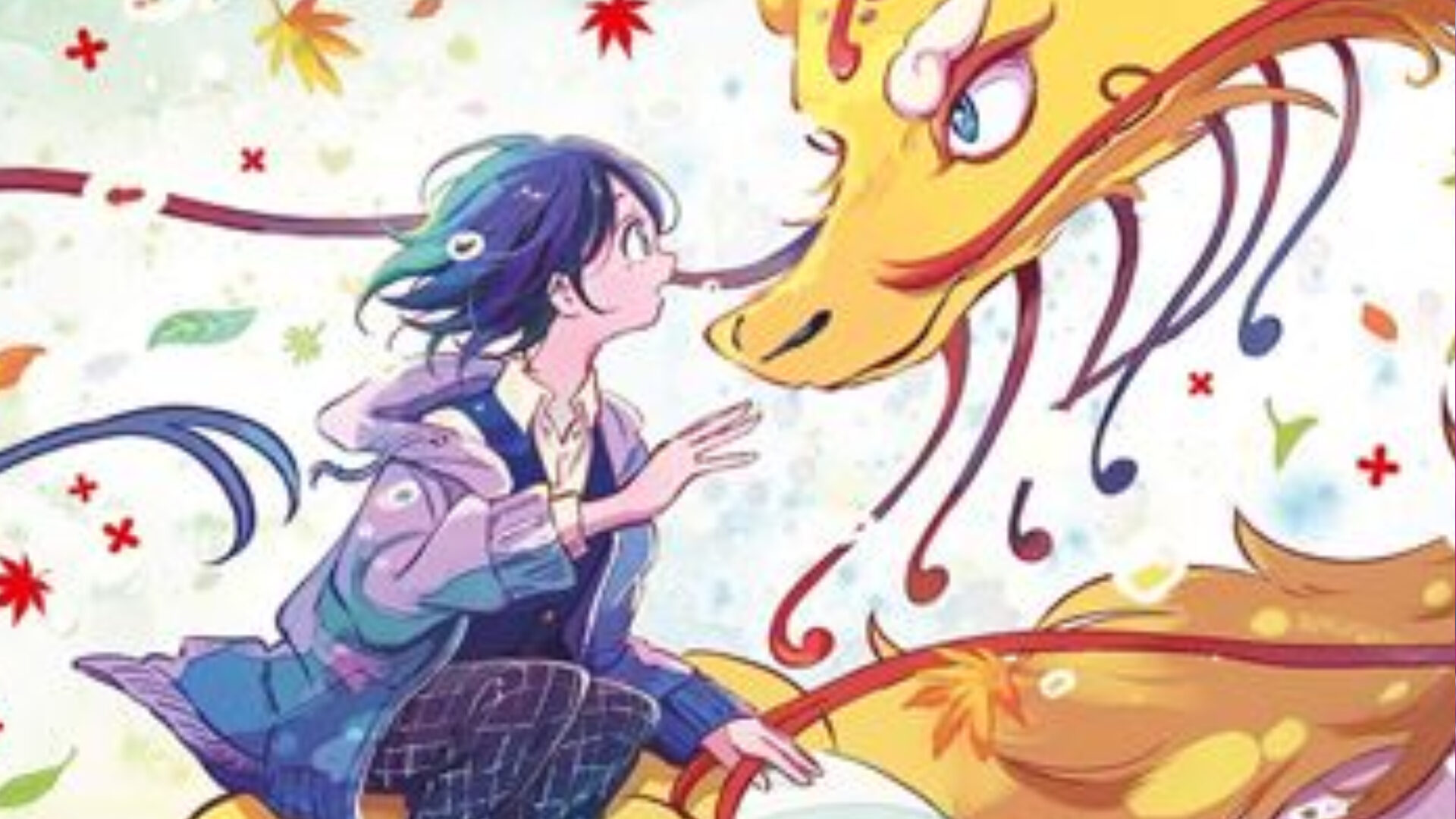
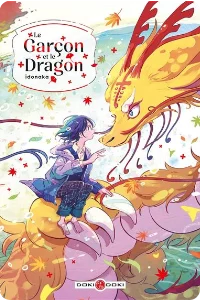
Visually, Le Garçon et le Dragon is part of an immediately readable and deliberately soothing aesthetic. Idonaka’s linework is round, supple, lightly loaded, with marked expressiveness of the faces and great attention paid to the looks. Nothing overflows. The drawing constantly seeks to establish a climate of calm and security, in contrast to the violent nature of the story.
The backgrounds are restrained and not intrusive. The sanctuary, the paths, the school are drawn as places outside of time, almost frozen, reinforcing the idea of a parenthesis cut off from the real world. This economy of details works well to accompany Shitarô’s wandering and give the manga a coherent visual identity, without unnecessary overload.
The representation of the dragon is indicative of this bias. Far from a disturbing or fundamentally other creature, it is drawn in a warm, expressive, almost familiar way. This constant humanization facilitates reader attachment, but it also erases any form of symbolic tension. Where the drawing could have established distance or visual discomfort, it instead invites attachment.
The layout favors downtime. The silences occupy an important place, the panels breathe, some pages linger to allow an emotion or an exchange to exist without dialogue. This formal choice effectively serves the slow pace of the narration and allows the reader to settle into this suspended day. However, the revelations concerning Shitarô break this dynamic by establishing a dark side, of extreme violence.
Le Garçon et le Dragon is graphically controlled and coherent, but shocking in the evocation of the violence it depicts. The artistic direction supports an emotion that diverges, confronting the reader with the unbearable.
Verdict
A fable that confuses delicacy and blindness
4/10
Le Garçon et le Dragon tells the story of a teenager's escape as a suspension of reality. The manga knows how to capture this wandering and this emotional fatigue. On this point, the sincerity is real, and the sobriety of the story works.
But this parenthesis is heavily parasitized by the central relationship, written in a constant vagueness that the screenplay refuses to question. By making the dragon the emotional heart of the story without ever clarifying or questioning the nature of its attachment, the manga creates a discomfort that it treats as a simple narrative setting. Finally, the profound violence shocks the reader who, comforted by a soft and soothing graphic style, does not expect to discover such horror in Shitarô.
More in Manga & comics
Full library 7/10
Shiba Inu Rooms – Volume 1
Doki Doki 9/10
Raja – volume 3
Doki Doki 8.5/10
Völundio: Divergent Sword Saga
Doki Doki 9.5/10
Raja – volume 2
Doki Doki 8/10
Mop & Pudding: Tea Beneath the Milky Way
Rue de Sèvres (Le Renard Doré) 8/10
My Beautiful Doll Is a Super Darling
Kurokawa 2/10
Pluie Alcide
Éditions Lapin 8/10
Bug Ego
Kazé Manga 8.5/10
Ashes Volume 3
Ankama 8.5/10