

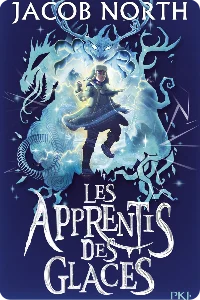
Ice Apprentices
A world of ice with assertive ambitions
Score: 6/10
 By Farrel Grimwood · published · 4 min read
Published by Pocket Jeunesse, Ice Apprentices inaugurates a new youth fantasy series by Jacob North. The novel sets its plot in the Tundra, a frozen world where magic is a vital necessity. Surviving requires learning to control it. The work thus displays a clear ambition: to combine a coming-of-age story and a hostile universe, in an atmosphere dominated by cold.
At the center of this system, Oswin, a young protagonist called to join Corridor, an institution responsible for training those capable of handling the forces that maintain the balance of the world. The novel adopts a familiar structure of formation and progressive revelation, placing its hero in a classic learning trajectory, between self-discovery and confrontation with danger.
The whole is part of a well-identified tradition of fantasy for young readers, where ordeal forges identity and where the outside world reflects inner fragilities. But behind this classic framework, does the novel manage to impose a true singularity, or does it remain a prisoner of its models?
An initiation under permanent tension
The heart of the novel is based on a dynamic of learning. Oswin’s entry into Corridor structures the narrative progression and offers a clear framework: acquisition of skills, discovery of the implicit rules of the world, confrontation with forces beyond the individual. This architecture works effectively, although it has been done many times before. It gives the story a readable framework and allows the reader to gradually understand the issues linked to magic and survival in the Tundra.
The universe, dominated by cold and constant threat, constitutes one of the major assets of the novel. Magic is never merely decorative. It responds to a concrete need. It protects, it warms, it maintains the fragile balance of a hostile world. This dimension reinforces the coherence of worldbuilding and gives the framework significant internal credibility.
Oswin, for his part, fits into the all-too-classic trajectory of a hero under construction. His feeling of disconnect, his need to belong and the question of his heritage feed a hackneyed and pre-cut dramatic thread, without the slightest ounce of originality. The character remains endearing and sufficiently nuanced to carry the intrigue, even if all the mechanisms of his evolution remain predictable. The secondary gallery participates in this dynamic without ever imposing itself with the same force. Certain figures gain relief, others remain more functional, serving the progression of the protagonist.
The novel chooses to integrate contemporary societal markers in the representation of its characters. Their presence gives a modern, almost anachronistic color to the work. The question that then arises is less about the representation itself than about its integration into the fictional world, and above all about its usefulness. In a fantasy universe marked by a strong climatic and magical identity, these elements would have benefited from being more articulated to the internal system of the story, in order to avoid an impression of juxtaposition rather than fusion. Here, the feeling is given that gender identity is an artifice made to promote a narrative too weak to make an impression otherwise. And the low quality of the story clearly does not help the reader to become overly immersed.
Narratively, the rhythm alternates effectively between learning sequences and moments of tension linked to external threats. However, the dramatic rise in power remains too measured, incapable of really gripping. The novel favors settling in over a clean break. This restraint reinforces the introductory dimension of the volume, but does not allow us to really feel the tension promised in the conflicts to come.
Ice Apprentices builds a solid universe and lays clear foundations. It establishes its hero, specifies its rules and outlines its tensions. It remains to be seen whether this first step, structured but still cautious, is enough to give the saga the distinctive momentum it aims for.
Fluid writing but too marked
Stylistically, Ice Apprentices adopts clear, direct writing, perfectly suited to its target readership. The narration prioritizes readability and efficiency. The descriptions are precise enough to establish the icy atmosphere of the Tundra without weighing down the progression. The text progresses smoothly, with dynamic chapters which maintain a regular tension.
This fluidity constitutes an undeniable asset: it makes reading accessible and supports the rhythm of the learning story. The action scenes remain understandable, the issues are carefully explained, and Oswin’s trajectory always remains intelligible. The novel never loses its reader.
However, this desire for clarity is accompanied by a didacticism which clearly does not serve the plot. Emotions, intentions and conflicts are stated explicitly, leaving little room for implicitness or reflection. Thus, the young reader is never guided into interpretation or assumptions. Everything is pre-prepared, made easily understandable, Manichean, without the slightest stylistic nuance. This tendency to verbalize tensions limits dramatic depth to a simple play of exasperating platitude. Where the context might have suggested, the text explains. Where the dialogues could have encouraged reflection and deception; they are content to be explicit. This approach makes reading safer, but reduces the emotional intensity and intellectual participation of the reader.
The dialogues follow this same logic. They fulfill their narrative function effectively, but lack naturalness or singularity. Certain exchanges give the impression of carrying more information than the characters’ own voices.
The whole remains coherent and controlled. The novel does not stumble stylistically. It opts for a safe, readable, structured line. This caution ensures the effectiveness of the story, but also limits the formal audacity and literary depth that the universe could have supported.
Verdict
A solid foundation that lacks momentum
6/10
Ice Apprentices lays the foundations of a structured and coherent saga. The frozen universe works, magic gives meaning to the world and the hero's trajectory offers a clear guideline. The novel provides accessible fantasy for young readers.
However, despite these qualities, the whole remains too cautious. The narrative construction remains too defined, the conflicts lack scope and the writing favors explanation over suggestion. Certain contemporary choices, integrated without being fully anchored in the world system, create a dissonance that weakens immersion. The work never justifies its point, does not seek to encourage reflection and is content to tell a story that lacks nuance.
More in Books
Full library 10/10
Sépia, tome 2 : Le complot de Flobourg
Pocket Jeunesse 7/10
Arsène Lagriffe Chat Détective Volume 3: Donne la patte
Pocket Jeunesse 8.5/10
La Cage
Pocket Jeunesse 9/10
Nobody in Particular
Pocket Jeunesse 9.5/10
Sépia : Le réveil de la magie de l’encre
Pocket Jeunesse 7/10
Born Wicked (The Cahill Witch Chronicles, Book 1)
Pocket Jeunesse 8/10
Poules Party : Le livre d’activités des P’tites Poules
Pocket Jeunesse 7.5/10
Scarlet
Pocket Jeunesse 9/10
Cinder
Pocket Jeunesse 8/10